
A dad bod is the build a lot of men notice in the mirror somewhere in their 30s or 40s. The shoulders and arms are still there, but there's a belly that wasn't there at 25, and the jeans that fit before the first kid now sit a notch tighter. Merriam-Webster added the term in 2021 and defines it as "a physique regarded as typical of an average father," especially one that is slightly overweight and not extremely muscular.
Dad bods get talked about as a joke, a trend or a badge of honor, and none of those labels says much about your health. The useful questions are simpler. Is the belly a risk? Why did it show up? What actually shrinks it when you have a job, a family and about 30 spare minutes on a good day?
This page answers those with studies on fathers and weight, the research on belly fat and how to lose a dad bod at home with dumbbells and walking. This page doesn't shame anyone. A dad bod usually means life got full, and that's a design problem with a fix.
What Is Considered a Dad Bod?
A dad bod is considered a build that sits between fit and overweight: some muscle in the chest, arms and legs, a rounded or soft midsection and no visible abs. There's no medical definition, no weight cutoff and no body-fat percentage attached to it. Two men at the same weight can look completely different, and only one of them might get called a dad bod.
Most descriptions share these traits:
- A soft belly. Extra fat sits mostly around the waist, the classic dad belly, while the arms and legs stay fairly lean.
- Some leftover muscle. A frame from years of sports, manual work or old gym habits that hasn't fully gone away.
- A slightly higher weight than in your 20s, though no study sets a number.
- Age and life stage. The term is tied to fathers and to men in their 30s and 40s, but you don't need kids to have one.
Meaning of dad bod and where the term came from
The meaning of dad bod has stayed close to that dictionary entry: an average father's build, a little heavy and not very muscular, usually said with affection. The phrase took off in 2015, when Clemson University student Mackenzie Pearson wrote an essay for the Odyssey platform titled "Why Girls Love the Dad Bod." It went viral, news outlets picked it up, and dad bods became a debate about attraction and body image. By 2021 the word had enough staying power for Merriam-Webster to add it to the dictionary.
Fit dad bod, built dad bod and dad bod muscles
A fit dad bod (sometimes called a built, buff or muscular dad bod) is the strong version: thick shoulders, real strength and still a little softness at the waist. Plenty of men who lift or play sports carry one by choice, because they'd rather be strong and eat normally than chase visible abs. For health, the label matters less than the tape measure, which the section on whether a dad bod is healthy covers below.
Why Men Get a Dad Bod: What the Studies Show
A dad bod rarely comes from one cause. The research points to a handful of small changes that stack up when a baby arrives and a career peaks at the same time.
Fathers' BMI rises after the first child
The best-known study followed 10,253 American men for 20 years, starting in their teens in 1994. Garfield and colleagues (2016), publishing in the American Journal of Men's Health, found that men who became fathers and lived with their child saw BMI rise by 0.59 units, or 2.6%, from the start of fatherhood to the end of the study. Fathers who didn't live with their child gained 0.45 units, or 2%. Over the same years, from age 23 on, men without children saw their BMI fall slightly, by about 0.1 unit. By our own conversion, 0.59 BMI units works out to roughly 4.4 pounds for a man who is 6 feet tall.
That's a real effect, but a modest one, and the evidence isn't settled. When Corder and colleagues (2020) reviewed long-term studies of young adults becoming parents for the first time, only one of the studies that tracked BMI included men, and it found no difference in BMI change between fathers and men without children. The data on movement were thin but leaned one way: both studies of men that measured physical activity found that fathers' activity dropped more than non-fathers'.
Less time to exercise
That drop in activity makes sense to anyone who has done a 6 a.m. feeding before work. The pickup basketball game, the evening gym session and the weekend long run are usually the first things a new schedule squeezes out. Calories burned through daily movement fall, while the meals and snacks around a busy household often stay the same or grow.
Shorter sleep and a bigger appetite
New fathers lose less sleep than new mothers, but they do lose it. In a German panel study of 2,118 men and 2,541 women, Richter and colleagues (2019) found that men's sleep fell by about 13 minutes a night in the first three months after a birth, against 62 minutes for women, and that neither parent's sleep had fully recovered six years after the first child.
Short sleep tends to show up on the plate. A review of 11 controlled studies by Al Khatib and colleagues (2017) found that cutting sleep short made people eat about 385 more calories a day, with no rise in the calories they burned. Repeat that on enough tired days and it adds up.
Testosterone drops after a baby
Becoming a father also lowers testosterone. Gettler and colleagues (2011) followed 624 young men in the Philippines for four and a half years. The men who became partnered fathers saw their morning testosterone fall by a median of 26% and their evening level by 34%, a larger drop than in single men without children, and fathers who did three or more hours of childcare a day had lower levels than fathers who weren't involved in care. The study measured hormones, not body fat, so it doesn't show that this drop causes a dad belly. It's one more change happening at the same time.
Age, muscle and metabolism
Many men blame a slowing metabolism, and the data doesn't back that up for the 30s and 40s. In a study of more than 6,400 people from infancy to age 95, Pontzer and colleagues (2021) found that daily energy expenditure, adjusted for body size and lean mass, held steady from about age 20 to 60. Muscle is a different story. In MRI scans of 468 adults, Janssen and colleagues (2000) found that muscle as a share of body weight started falling from the third decade of life, though the drop in total muscle didn't become noticeable until around 50. Less muscle and less movement mean fewer calories burned, without any change in the rate your cells run at.
Is the dad belly a beer belly?
Beer plays a part, but probably not the way people think. In a German study of 7,876 men, Schütze and colleagues (2009) found that men who drank a liter of beer a day had a 17% higher risk of a growing waist than very light drinkers. Most of that came from overall weight gain, though. The authors found no evidence that beer targets the belly specifically. Drinks add calories like anything else, and men tend to store extra fat around the middle.
Is a Dad Bod Healthy?
A dad bod can be healthy or not, and the waist is what decides it. Fat stored deep in the belly around the organs, called visceral fat, is more closely tied to heart disease and type 2 diabetes than fat on the arms, hips or thighs. A slightly soft man with a moderate waist and good fitness is in a very different place from a man whose waist keeps growing.
Why belly fat matters more than the scale
The largest study on this followed 359,387 adults in nine European countries for almost 10 years. Pischon and colleagues (2008) found that men in the top fifth for waist size had about twice the risk of death of men in the bottom fifth (a relative risk of 2.05), even after accounting for BMI. Waist size added warning information that weight alone missed.
It holds at a normal weight too. In US national survey data on 15,184 adults, Sahakyan and colleagues (2015) found that a man with a normal BMI and a high waist-to-hip ratio had 1.87 times the risk of death of a man at the same BMI without the extra belly fat. He also had about twice the risk of men who were overweight or obese by BMI but carried less fat at the waist. That's why an international panel of obesity researchers called waist circumference a vital sign and named shrinking it a key treatment target for men (Ross and colleagues, 2020).
Dad bod vs fat: where the line is
A waist measurement draws the line between a dad bod and carrying too much fat. Measure around your bare waist midway between your lowest rib and the top of your hip bone, standing relaxed, after a normal breath out. The World Health Organization's expert consultation lists these widely used cutoffs for men:
| Waist, men | WHO risk level | What it means for a dad bod |
|---|---|---|
| 94 cm (37 in) or less | Not increased | A soft look, but no added waist risk |
| Over 94 cm (37 in) | Increased | Worth working on now, while small changes are enough |
| Over 102 cm (40 in) | Substantially increased | A health priority, and a good reason to see your doctor |
These cutoffs come mostly from studies of European men. Risk rises at smaller waists in Asian men, so a lower line of 90 cm (35.4 inches) is often used for them (Alberti and colleagues, 2009). If your waist is over 40 inches, a check of your blood pressure, blood sugar and cholesterol is worth more than any mirror.
Knowing what to do is the easy part.
FitCraft, our mobile fitness app, pairs you with an AI coach who builds you a personalized plan around your goals, schedule, and fitness level. Every FitCraft program is designed by Domenic Angelino, MPH (Brown University) and NSCA-CSCS, with research published in the Journal of Strength and Conditioning Research and Medicine & Science in Sports & Exercise.
Take the Free Assessment Free • 2 minutes • No credit cardHow to Lose a Dad Bod in Your 30s and 40s
Losing a dad bod takes the same three things at 35 or 45: move more, lift a few times a week and eat a little less. The good news from the research is that men's belly fat responds well, and the visceral fat around the organs shrinks along with it.
In a randomized trial of 52 men with obesity, Ross and colleagues (2000) compared weight loss through diet with weight loss through daily exercise over three months. Both groups lost about 7.5 kg (16.5 pounds), and both cut their belly and visceral fat. The exercise group lost 1.3 kg more total fat and improved its fitness by about 16%. A third group exercised while eating enough to hold its weight steady, and those men still lost abdominal and visceral fat.
Lift two or three times a week
Strength training is the piece most men skip, and it's the one with the best track record for the waist. In the Health Professionals Follow-up Study of 10,500 US men, Mekary and colleagues (2015) found that each extra 20 minutes a day of weight training went with 0.67 cm less waist gain over 12 years, about twice the 0.33 cm linked to the same time spent on moderate to vigorous cardio. That's an observational study, so it shows a link rather than proof. Trials point the same way: a review of 58 trials by Wewege and colleagues (2022) found that resistance training lowered body fat percentage by about 1.5 points and reduced visceral fat compared with no exercise.
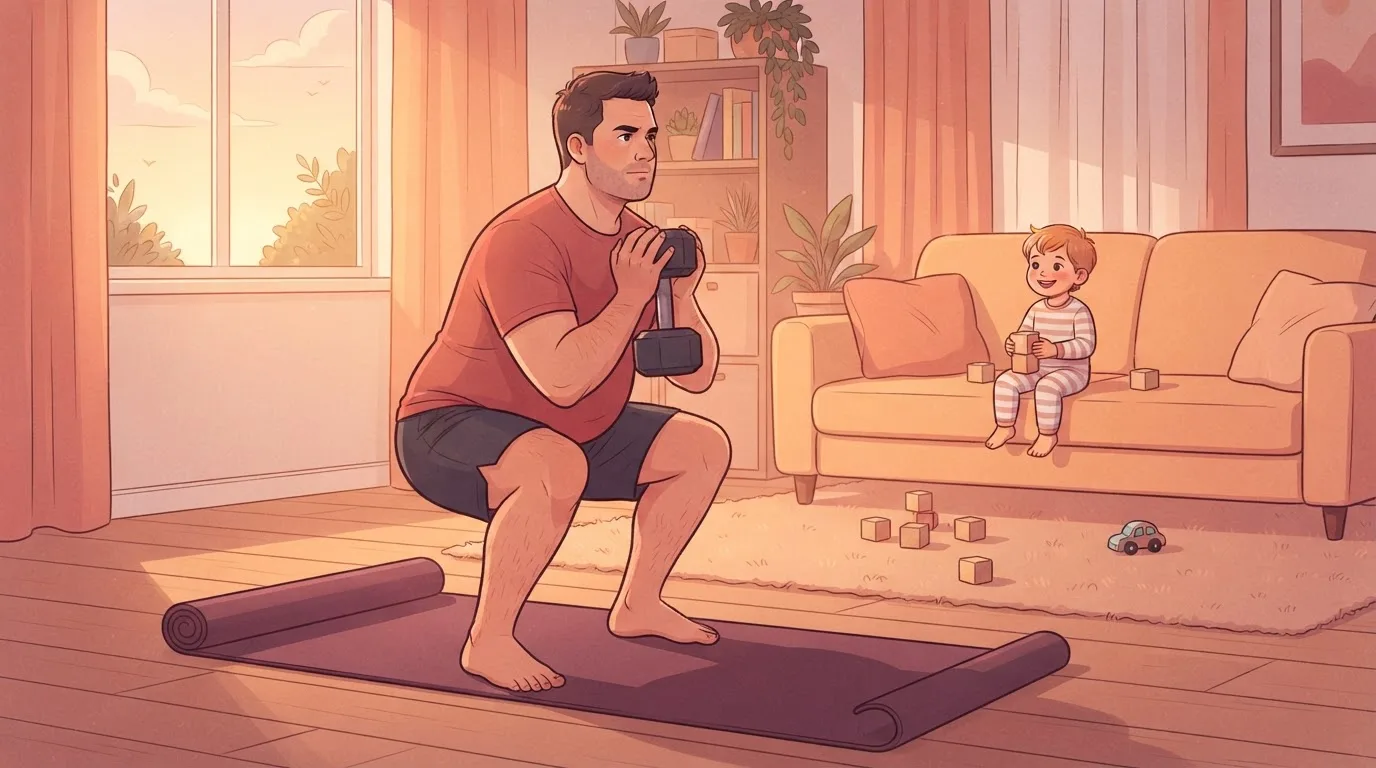
You don't need a gym. A pair of adjustable dumbbells covers the big movements: goblet squats, Romanian deadlifts, split squats, one-arm rows, floor presses and push-ups. Do 2 or 3 sets of 8 to 15 reps of each, and end each set when you could still manage 1 to 3 more good reps. Our 3-day workout plan for men over 40 lays out the exercises, sets and progression week by week.
Walk on most days
The CDC recommends at least 150 minutes a week of moderate activity such as brisk walking, plus two or more days of muscle-strengthening work (CDC). For a busy dad, that's a 20- to 30-minute walk most days. Pushing a stroller counts. So does walking the kids to school or doing laps of the field during practice.
Eat a little less and keep protein high
Exercise shrinks belly fat, but the scale moves faster with a calorie deficit. The 2013 obesity guideline from the American Heart Association, the American College of Cardiology and The Obesity Society recommends eating about 500 to 750 calories a day below your needs, or about 1,500 to 1,800 calories a day for men (Jensen and colleagues, 2014). Keep protein high so the weight you lose is fat rather than muscle. A review of 49 trials found that protein's benefit for muscle levelled off at about 1.6 g per kilogram of body weight a day (Morton and colleagues, 2018), which is about 145 grams for a 90 kg (198 lb) man. Our 12-week plan for losing weight after 40 turns those numbers into meals and a weekly routine.
Protect your sleep
You can't always control a newborn, but you can protect the sleep you have. Go to bed at the same time on most nights, keep the phone out of the bedroom and trade night feedings with your partner where you can. Given the extra 385 calories that followed short nights in the Al Khatib review, sleep belongs in the plan alongside training.
Go easy on drinks
A regular 12-ounce beer has about 150 calories, so two a night add up to more than 2,000 calories a week. You don't have to quit. Saving drinks for weekends or swapping every other one for sparkling water cuts a real chunk of the calories that build a dad belly.
A sample week for a busy dad
| Day | What to do | Time |
|---|---|---|
| Monday | Strength A: goblet squat, push-up, one-arm row, plank | 25 to 35 minutes |
| Tuesday | Brisk walk, stroller welcome | 20 to 30 minutes |
| Wednesday | Strength B: Romanian deadlift, split squat, floor press, dead bug | 25 to 35 minutes |
| Thursday | Brisk walk | 20 to 30 minutes |
| Friday | Strength A again, or rest on a rough week | 25 to 35 minutes |
| Saturday | Longer family walk, hike or bike ride | 45 to 60 minutes |
| Sunday | Rest | None |
Measure your waist every two weeks at the same spot, first thing in the morning. If it's coming down, the plan is working, whatever the scale says on a given day.
What This Means for You
A dad bod usually tells a story of a full life: less sleep, less free time, more meals eaten standing up. It isn't a character flaw, and you don't need a six-pack to be healthy. What matters is the direction of your waist. If it's under 37 inches and stable, you're in good shape on the measure that predicts the most. If it's growing, short strength sessions, daily walks and a modest calorie cut will turn it around, and the trials above show men's belly fat responding within a few months.
The hard part is doing it on the weeks when everything else is on fire. Barry, 42, lost 28 pounds in four months with FitCraft by training at breakfast while his kids ate, and said it "worked around my life." In FitCraft, a 3D AI coach demonstrates each dumbbell and bodyweight exercise on an interactive model so you can learn the form, says your name during the workout and adapts your workouts as you progress. Streaks and XP give you a reason to keep showing up after the first few weeks. If you're comparing options, our review of the best workout apps for men over 40 sets them side by side, and our guide to starting fitness after 40 covers the first month.
Frequently Asked Questions
Is a dad bod a compliment?
A dad bod is usually meant as a friendly, affectionate label for a relaxed, ordinary build, and the 2015 essay that made the term popular praised it. Whether it lands as a compliment depends on the tone and on how the man feels about his own body. If the comment bothers you, your waist measurement is a better guide to your health than anyone's opinion.
Do girls like guys with dad bods?
Some do, and plenty of people say they prefer a relaxed, ordinary build to a shredded one. There's no reliable research on it, though: most claims come from informal polls and opinion pieces, so treat any headline percentage with caution. Attraction varies a lot from person to person.
What's the female equivalent of a dad bod?
The closest term is mom bod, used for a woman's softer shape after pregnancy and the early years of raising children. Like dad bod, it's slang with no medical definition. For women, the waist measurement that signals higher health risk is lower than for men: a WHO expert report puts higher risk above 80 cm (about 31.5 inches) and substantially higher risk above 88 cm (about 35 inches).
Is 20% body fat a dad bod?
There's no body-fat percentage that defines a dad bod, because the term is slang and not a medical category. Home body-fat readings can also differ by several points depending on the method. A tape measure is a simpler health check: a WHO expert report puts men's waist risk as increased above 94 cm (37 inches) and substantially increased above 102 cm (40 inches).
What is a fit dad bod?
A fit dad bod, also called a built or muscular dad bod, is a strong, thick build with real muscle and a little softness at the waist. Plenty of strong, active men carry one. Whether the softness matters for health comes down to the waist measurement rather than the look.
How long does it take to lose a dad bod?
Plan on a few months. In a three-month randomized trial, men with obesity who lost about 7.5 kg (16.5 pounds) through daily exercise or through diet cut their belly and visceral fat (Ross and colleagues, 2000). At a steady pace of about 1 to 2 pounds a week, losing 15 to 20 pounds takes roughly two to five months, and your waist usually shows the change before photos do.