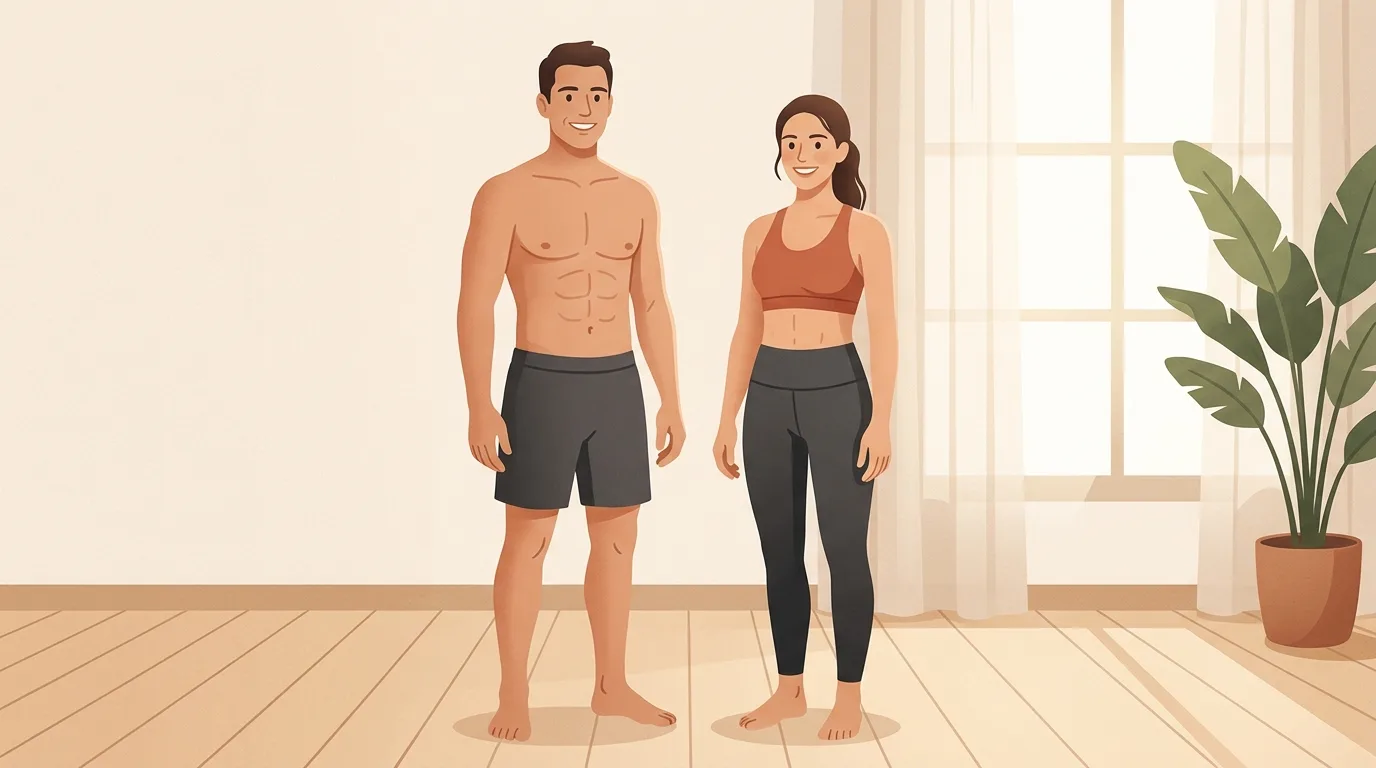
You've lost weight, your clothes fit better and you train your core every week, but your abs still aren't showing. Then you search for the number you need and find answers ranging from 6 percent to 25 percent. It's hard to know whether you're close or nowhere near.
Part of the confusion is that people mean different things by "seeing abs." A faint outline in bathroom lighting, a four-pack at rest and a sharp six-pack in daylight each show up at a different body fat level. The other part is that the number on your scale or caliper report may be several points off. Both come down to measurement and biology, and once you know how they work you can set a realistic target.
This page answers what percent body fat you need to see abs, shows what different percentages look like for men and women, explains why the number varies, covers whether very low body fat is healthy, and lays out how to get there without wrecking your energy.
What Body Fat Percentage Do You Need to See Abs?
Your abs are already there. The rectus abdominis, the six-pack muscle, sits under a layer of fat on your stomach, and it shows once that layer gets thin enough. Here's the typical progression. It's based on coaching experience rather than a single study, because no one has scanned large groups at every body fat level and recorded when their abs appeared.
| What you see | Men | Women |
|---|---|---|
| Faint outline of the upper abs, often only when flexing | 15 to 19% | 25 to 29% |
| Visible four-pack at rest | 12 to 14% | 20 to 24% |
| Full six-pack with oblique lines | 10 to 12% | 16 to 19% |
| Very sharp abs and lower-belly veins (stage lean) | Under 8% | Under 14% |
These figures assume a fairly accurate measure, such as a DXA scan. The outline and four-pack ranges match our guide on how to get abs. Women's numbers run about 6 to 10 points higher than men's for the same look, because women carry more essential fat for hormonal and reproductive health. The American Council on Exercise puts essential fat at 2 to 5 percent for men and 10 to 13 percent for women.
Lower abs usually show last, because many people store their last stubborn fat below the belly button. The V-shaped lines along the hips, often called the Adonis belt, need body fat at the low end of each range.
What Different Body Fat Percentages Look Like
These tables describe what most people look like at each level, separately for men and women. The descriptions are coaching estimates, not study results, so treat them as general guides only. Bodies at every one of these levels can be strong and healthy, and the right number for you depends on your goals and how you feel. The health ranges come from Gallagher and colleagues (2000), for adults aged 20 to 39. Our page on what a healthy body fat percentage is gives the ranges for older ages too.
Men
| Body fat | What it usually looks like | Health range (age 20 to 39) |
|---|---|---|
| 5% body fat | Stage-lean bodybuilder: every ab, deep oblique lines, veins across the stomach. Held for days or weeks at most. | Below healthy (under 8%) |
| 8% body fat | Sharp six-pack and V lines, visible veins on the arms and lower belly | Healthy, at the low edge |
| 10% body fat | Full six-pack at rest, clear muscle separation in the shoulders and arms | Healthy |
| 12% body fat | Four-pack to six-pack at rest, faint oblique lines | Healthy |
| 14% body fat | Four-pack at rest, lower abs soft, a lean look in clothes | Healthy |
| 16% body fat | Flat stomach, faint upper-ab outline in good light or when flexing | Healthy |
| 20% body fat | Average look, no ab lines at rest, a soft stomach | Start of the overweight range |
| 25% body fat | Rounder waist, some fat over the hips, chest and back | Start of the obese range |
| 30% body fat | Round stomach and waist. A man at 30 percent body fat carries close to a third of his weight as fat. | Obese range |
Women
| Body fat | What it usually looks like | Health range (age 20 to 39) |
|---|---|---|
| 12% body fat | Competition-stage lean: every ab and vein visible, inside the 10 to 13% range ACE calls essential fat | Below healthy (under 21%) |
| 14% body fat | Very defined six-pack and obliques, little fat on the hips | Below healthy |
| 16% body fat | Clear six-pack at rest, athletic arms and shoulders | Below healthy |
| 18% body fat | Six-pack lines at rest, a lean, athletic look | Below healthy |
| 20% body fat | Four-pack or upper-ab lines at rest, a fit, toned look | Just under the healthy range, which starts at 21% |
| 24% body fat | Upper-ab lines in good light, a flat stomach | Healthy, near the lower edge |
| 27% body fat | Flat stomach, a faint vertical line down the middle, some softness at the hips and thighs | Healthy |
| 30% body fat | Soft stomach with no ab lines, curves at the hips and thighs | Healthy |
| 35% body fat | Rounder stomach, more fat on the arms and back | Overweight range |
| 40% body fat | Fuller stomach, hips and upper arms | Obese range |
Notice how the healthy band shifts. For men under 40, even a six-pack at 10 to 12 percent sits inside the healthy range. For women, a four-pack at 20 to 24 percent sits at the lower edge of it, and a full six-pack at 16 to 19 percent falls below Gallagher's healthy floor of 21 percent, which is why many women find visible abs harder to keep than to reach.
Does 15% body fat show abs?
On most men, 15 percent body fat shows a faint outline of the upper abs in good light or when flexing, but not a full six-pack at rest. On most women, 15 percent is very lean, and the abs are usually clearly visible.
Is 20% body fat chubby?
No. A woman at 20 percent body fat is lean and often athletic. A man at 20 percent looks average, with no visible abs and a soft stomach. Gallagher's ranges put 20 percent at the start of the overweight band for men aged 20 to 39, so it's a fine place to begin trimming down from.
Why the Number Varies From Person to Person
Two people at the same body fat percentage can look very different through the middle. Three things explain most of the gap: where you store fat, the shape of your abs, and how your body fat was measured.
Where your body stores fat
Fat distribution is partly inherited. In a genetic study of up to 224,459 people, Shungin and colleagues (2015) found 49 gene regions linked to waist-to-hip ratio, independent of overall body size. Twenty of them acted differently in men and women, and 19 of those had stronger effects in women. If your parents carry their weight around the middle, you may need a lower overall number before your abs show.
Sex matters too. Women tend to store more fat under the skin at the hips and thighs, while men tend to store more at the waist and inside the abdomen, a pattern reviewed by Karastergiou and colleagues (2012). That's another reason one number can't fit everyone.
The shape of your abs
The "packs" are segments of the rectus abdominis, separated by bands of tendon called tendinous intersections. Most people have three. In a dissection study of 54 people, Anita and colleagues (2015) found three in 52 of them, four in one and five in one. A second study by Broyles and colleagues (2018) found three paired bands in 30 of 32 bodies and four in the other two. So an eight-pack or ten-pack comes down to anatomy, and training can't add a band.
Muscle size helps as well. In coaching practice, people with well-trained abs often see lines a little earlier, because a thicker muscle pushes against the same layer of fat. Ab training can't remove the fat on top, though. In a 6-week trial, Vispute and colleagues (2011) found no change in belly fat from ab exercises alone. Our list of lower ab exercises covers the training side.
How your body fat was measured
This is the biggest source of confusion. Every home method estimates body fat, and the estimates can disagree by several points, even in very lean people. Hulmi and colleagues (2016) measured 27 female fitness competitors three ways. The morning after their competition, the same women averaged 12.7 percent by DXA, 11.6 percent by bioimpedance and 18.3 percent by skinfolds. That's a gap of almost 7 points between methods on the same morning.
- Smart scales and handheld devices: when Siedler and colleagues (2023) tested 15 bioimpedance devices, their average errors ranged from 3.5 points too low to 11.7 points too high, though they tracked change over time more closely.
- Food and drink: in 32 athletic men, Kerr and colleagues (2017) found that eating and drinking before a test shifted fat estimates substantially for skinfolds and bioimpedance, while DXA held up if the food and drink stayed under about 500 grams.
- Tape and calculators: our body fat calculator uses the US Navy tape method, which is fine for tracking your trend but can sit several points from a lab reading.
The fix is consistency. Use one method, test at the same time of day before eating, and watch the trend. Our guide on how to measure body fat at home ranks the options.
Can you be 10% body fat with no abs?
Yes, and it happens often. The 10 percent reading may be wrong, since a scale or caliper can easily be off by several points. You may also store more of your remaining fat on your lower belly, have thinner ab muscles, or be bloated that day. If your waist is still shrinking, you're still making progress.
Knowing what to do is the easy part.
FitCraft, our mobile fitness app, pairs you with an AI coach who builds you a personalized plan around your goals, schedule, and fitness level. Every FitCraft program is designed by Domenic Angelino, MPH (Brown University) and NSCA-CSCS, with research published in the Journal of Strength and Conditioning Research and Medicine & Science in Sports & Exercise.
Take the Free Assessment Free • 2 minutes • No credit cardIs Very Low Body Fat Healthy?
A visible six-pack isn't a health marker on its own, and the leanest end of these tables comes with real costs. The risks rise faster for women.
For women: periods and energy availability
In the Hulmi study, the 27 competitors dieted for about 20 weeks and dropped from 23.1 to 12.7 percent body fat by DXA. Their leptin, thyroid hormone, testosterone and estradiol fell, and 63 percent reported irregular periods during the diet, against 30 percent of a comparison group who didn't diet. Some of that predated the diet: 37 percent of the dieters had reported irregular bleeding at the start. Most hormones recovered within 3 to 4 months of eating more, but thyroid hormone and testosterone hadn't fully returned by the end of the study.
The trigger appears to be energy availability: the calories left over for your body after exercise, per kilogram of lean mass. When Loucks and Thuma (2003) set energy availability for 29 young women over 5 days, the hormone pulses that drive the menstrual cycle stayed normal at 30 kcal per kg of lean mass a day but were disrupted below it. For a woman with 45 kg of lean mass, that line sits at about 1,350 calories a day left after her workouts. The 2023 IOC consensus on Relative Energy Deficiency in Sport links low energy availability to effects on hormones, bone, mood and performance.
For men: testosterone and mood
Men have more room, but stage-lean levels still cost something. In a case study of a natural bodybuilder, Rossow and colleagues (2013) recorded testosterone falling to about a quarter of its starting value as his body fat dropped from 14.8 to 4.5 percent, along with worse mood and lower strength. Most of it recovered after the contest. Our healthy body fat page covers that case in more detail.
Signs you've gone too low include missed or irregular periods, constant cold, poor sleep, low sex drive, falling strength, irritability and thinking about food all day. If you notice them, eat more and talk to a doctor.
How to Get to the Body Fat Where Your Abs Show
Getting there takes a modest calorie deficit held for months, strength training to keep your muscle, and enough protein. Spot reduction doesn't work, so crunches alone won't do it. Here's a plan that works for most adults.
Lose 0.5 to 0.7 percent of your body weight a week
Slow loss keeps more muscle. In elite athletes, Garthe and colleagues (2011) found that a slower target of about 0.7 percent of body weight a week added lean mass, while a faster target of 1.4 percent a week only held it steady. Contest-prep guidelines by Helms and colleagues (2014) recommend 0.5 to 1 percent a week.
Work out your timeline
Here's the math for a man who weighs 80 kg (176 lb) at 20 percent body fat. He has 16 kg of fat and 64 kg of lean mass. To reach 12 percent with the same lean mass, he needs to weigh about 72.7 kg, so he has about 7 kg of fat to lose. At 0.5 to 0.7 percent of body weight a week, that takes roughly 14 to 19 weeks, or about two weeks per percentage point.
A woman who weighs 65 kg (143 lb) at 30 percent has 45.5 kg of lean mass. Reaching 24 percent, the four-pack range, means about 59.9 kg, or about 5 kg of fat to lose. At the same pace that's roughly 12 to 16 weeks.
Lift, eat protein and train your abs
- Strength train two to four days a week. It tells your body to keep muscle while you eat less.
- Eat about 1.6 g of protein per kg of body weight a day. A meta-analysis of 49 trials by Morton and colleagues (2018) found muscle gains leveled off around that intake.
- Train your abs two or three times a week. Thicker muscle shows sooner once the fat comes off.
- Check your waist every two weeks. A shrinking waist confirms fat loss even when the scale stalls.
What This Means for You
Pick the look you actually want, which is rarely the leanest one on the chart. For most men, a four-pack at 12 to 14 percent is reachable and easy to live with. For most women, upper-ab lines at 20 to 24 percent sit at the lower edge of the healthy range, which is about as lean as most women can hold comfortably. Then measure the same way every time and judge progress by your trend, your waist and your photos.
The hardest part is keeping the plan going for four months. If you want a workout app that helps with that, our comparison of the best workout apps for weight loss sets out the options. FitCraft's strength workouts use bodyweight and dumbbells, and an AI coach demonstrates each exercise on an interactive 3D model that highlights the working muscles. Your workouts adjust as you progress, and streaks and calendar rewards make showing up a habit. Sarah, 27, lost 18 pounds in three months and said it was the first app that made exercise feel like something she chose. Start this week by taking one body fat reading you can repeat.
Frequently Asked Questions
Does 15% body fat show abs?
For most men, 15% body fat shows a faint outline of the upper abs in good light or when flexing, but not a full six-pack at rest. For most women, 15% body fat is very lean and the abs are usually clearly visible. That's below the healthy range for women under 40 in Gallagher's 2000 ranges, which start at 21%.
Is 20% body fat chubby?
No. In a woman, 20% body fat is lean and athletic, just under the lower edge of Gallagher's 2000 healthy range for women aged 20 to 39, which runs from 21% to 33%. In a man, 20% looks average, with a soft stomach and no visible abs. For men aged 20 to 39 it sits at the start of Gallagher's overweight band, so it's a reasonable place to start trimming down from.
Can you be 10% body fat with no abs?
Yes. Your reading may be wrong: the same lean women measured 12.7% by DXA and 18.3% by skinfolds in one study (Hulmi 2017), and smart scales vary even more. You may also store more of your remaining fat on your lower belly, have thin abdominal muscles, or be bloated that day. Retest with the same method and look at your waist and photos too.
How rare is it to have 10 abs?
A ten-pack is rare. It needs five tendon bands across the rectus abdominis, and in a dissection study of 54 people only one had five, one had four and 52 had three, the common six-pack pattern (Anita 2015). The number of bands is set by your anatomy, so training can't add more.
What does 12% body fat look like?
On a man, 12% body fat usually looks lean and athletic, with a visible four-pack or six-pack at rest, some shoulder and arm definition and a faint outline of the obliques. On a woman, 12% falls inside the 10 to 13% range ACE calls essential fat, a competition-stage level few women can hold safely.
What body fat percentage do women need to see abs?
Most women see a visible four-pack at rest at about 20 to 24% body fat and sharper definition at about 16 to 19%, with a faint outline showing in the mid to high 20s. These are coaching estimates rather than study results. Women carry more essential fat than men, so their numbers run about 6 to 10 points higher for the same look.