- Getting fit is not a willpower problem. The "you just need discipline" framing is a mismatch with how behavior change actually works. The replication crisis in willpower science (Hagger et al. 2016) found the original "ego depletion" effect did not hold up across labs.
- Habits take time. A 2010 study by Lally and colleagues in the European Journal of Social Psychology tracked 96 adults trying to build new health behaviors and found the average time to automaticity was 66 days, with a range from 18 to 254. Two to three months of consistent practice is what the data actually shows.
- Hard exercise feels worse before it feels better. Ekkekakis, Parfitt, and Petruzzello (2011), in Sports Medicine, found that exercise above the ventilatory threshold reliably produces a negative affect in most people, especially newcomers. Fitness apps that prescribe hard intervals to beginners are working against the data.
- Response to training varies a lot between people. The HERITAGE Family Study, by Bouchard and colleagues (1999) in the Journal of Applied Physiology, found that gains in VO2 max after 20 weeks of standardized training ranged from zero to over 40 percent. The family component explained about half of that variance. Some people are high responders. Others have to work harder for the same return.
- Detraining is fast. Mujika and Padilla (2000) reviewed the short-term detraining literature in Sports Medicine and reported that VO2 max declines rapidly in highly trained athletes within the first few weeks of stopping, with smaller declines in recently trained individuals. Maintenance dose is much smaller than building dose, but it is not zero.

Someone on r/xxfitness recently asked the question every honest exerciser has thought at least once. "Anyone feel that getting real fit is super challenging?" The replies were the usual mix. A lot of "just push through it." A few "you have to want it more." Some helpful tactical advice. And a few people quietly admitting they had been at it for years and still found it hard.
The answer is more interesting than the gym-culture script. Getting in shape is not primarily a willpower failure. The behavior and exercise science has been pretty clear for two decades. The task is structurally hard for three reasons that have almost nothing to do with discipline. Once you can see them, the path becomes a lot more workable.
Here is the plan. We will walk through the three structural barriers in order. Then we will look at why "just want it more" is a worse strategy than people think. Then we will close with a small set of changes that the behavior research actually backs.
Barrier 1: Habits Take Months, Not Weeks
The dominant cultural script around fitness is the 30-day transformation. A month of clean eating and consistent workouts and you will be a new person. The research disagrees.
The cleanest piece of evidence on habit formation is a 2010 study by Lally, van Jaarsveld, Potts, and Wardle in the European Journal of Social Psychology. They tracked 96 adults in London for 12 weeks while each tried to build a new daily health behavior of their choice. Some chose eating a piece of fruit at lunch. Some chose drinking a glass of water with each meal. Some chose a daily walk. The participants reported each day whether they had done the behavior, and how automatic it felt.
The headline result was that the median time to reach what they called automaticity (the behavior feeling automatic rather than effortful) was 66 days. But the range was wide. Some participants got there in 18 days. Others were still not at automaticity after 254 days. The behaviors that required more effort, like a daily walk, took longer than the easier ones, like drinking a glass of water. The physical side runs on its own schedule too, and our timeline for when fitness actually shows up lays out when strength, cardio and visible change each arrive.
Two months is the median. Many people take longer. And a near-daily walk is exactly the kind of behavior that takes longer than the easy ones. So if you have been at a new fitness habit for three weeks and it still does not feel automatic, that is not a sign you are failing. That is exactly what the average curve looks like.
This matters because the most dangerous moment in any fitness attempt is around weeks three to four. Lots of people quit at the point where the data says the behavior is still very much in its effortful phase. Our piece on the week 20 problem covers the slightly later quitting point too.
Barrier 2: Hard Exercise Feels Bad in the Moment
This is the one nobody wants to say out loud. Hard exercise feels unpleasant while you are doing it. Not just to you. To almost everyone. And that unpleasantness is not a discipline failure. It is a measured psychological response with a clear physiological trigger.
Ekkekakis, Parfitt, and Petruzzello (2011), in a long review in Sports Medicine, pulled together a decade of data on what they call "affective response" to exercise. The finding is consistent. Below the ventilatory threshold (a moderate intensity, roughly conversational pace), most people report feeling neutral to mildly pleasant during exercise. At or above the ventilatory threshold (hard breathing, sentences breaking up), most people report feeling reliably unpleasant. The shift is sharp, and it shows up across age, fitness level, and exercise mode.
The interesting twist is the rebound. People feel reliably better immediately after exercise, even if they felt bad during it. That is what gym culture is talking about when it says "you never regret a workout." The good feeling is real. It is just not happening while you are doing the hard part.
This has consequences. If your fitness app sends you straight into intervals on day one, the affective experience will be reliably negative, and the research predicts you are less likely to come back. Behavioral economics calls this the "remembered self" problem. Your remembered self will recall how the workout felt, not the abstract long-term benefit. If the felt experience is bad, the remembered judgment is bad, and the next workout gets harder to start.
The practical implication: start at intensities that feel okay. Build from there. Our writeup on Zone 2 cardio covers the easy-pace foundation that the research keeps validating.
Barrier 3: Trainability Varies a Lot Between People
If you have ever followed the same training program as a friend and ended up with very different results, the science says you are not imagining it.
The cleanest evidence is the HERITAGE Family Study, run across four research centers in the United States and Canada. Bouchard, An, Rice, and colleagues (1999), in the Journal of Applied Physiology, took 481 sedentary adults from 98 nuclear families and put them all through an identical, supervised, 20-week endurance training program. Three sessions a week, same intensity progression, same volume, same testing.
The result that made the study famous was the range. Average VO2 max improvement was about 17 percent, which sounds clean enough. But the individual responses ranged from no measurable improvement at all (a small group of clear non-responders) to over 40 percent (the high responders). About half of that variation tracked family lines, suggesting a meaningful genetic component to trainability. The exact heritability number has been debated, but the basic finding has held up in dozens of follow-up studies.
Practically, this means two things. First, if your fitness gains feel slower than someone else doing similar work, you may be on a different point of the response curve. That is biology, not effort. Second, the response curve is not a hard ceiling. Even low responders showed meaningful health improvements (reduced cardiovascular risk markers, better insulin sensitivity, lower blood pressure) even when the VO2 max scorecard moved less than the high responders. Fitness gains are not the only thing fitness does.
The cultural version of this is "some people are just built for it." The research version is "the response curve is wide, and we know it is at least partly genetic, but everyone moves on at least some axis."
Knowing what to do is the easy part.
FitCraft, our mobile fitness app, pairs you with an AI coach who builds you a personalized plan around your goals, schedule, and fitness level. Every FitCraft program is designed by Domenic Angelino, MPH (Brown University) and NSCA-CSCS, with research published in the Journal of Strength and Conditioning Research and Medicine & Science in Sports & Exercise.
Take the Free Assessment Free • 2 minutes • No credit cardWhy "Just Want It More" Is a Bad Strategy
The default cultural advice to anyone struggling with fitness is some version of "you have to want it more" or "you just need more discipline." The behavior research has spent the last decade quietly dismantling that frame.
The classical "ego depletion" model of willpower (the idea that self-control is a finite resource that runs out as you use it) was tested in a 23-lab preregistered replication by Hagger and colleagues (2016) in Perspectives on Psychological Science. The original effect did not replicate. The effect size in the combined analysis was statistically indistinguishable from zero. Willpower as a depleting battery is not how it actually works.
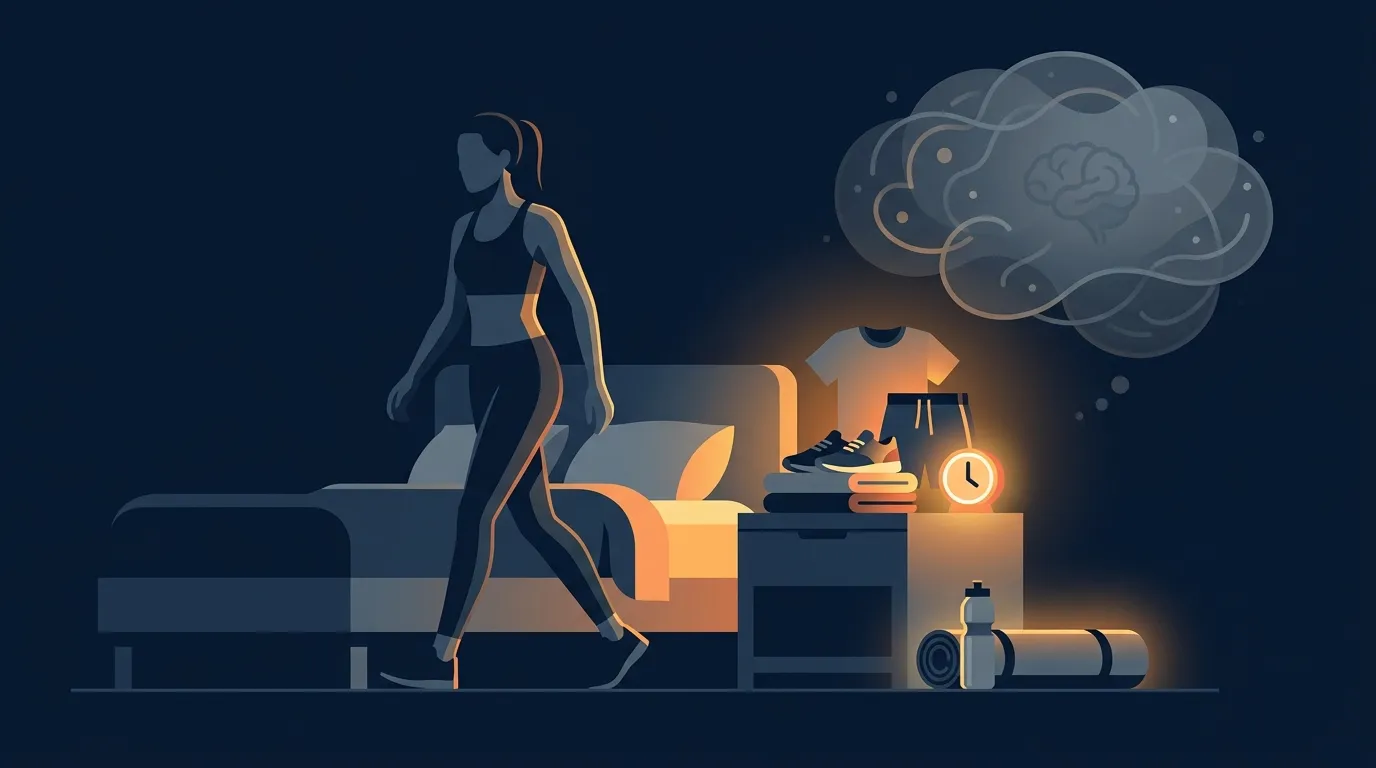
What actually predicts behavior change is something less satisfying. Habit strength. Context. Environment. Whether your fitness behavior is hooked to an existing cue, like coffee or a morning shower. Whether your workout clothes are visible when you wake up. Whether the friction to start is low or high. These details sound trivial. They turn out to be much more powerful predictors of consistency than any introspective sense of "wanting it."
The implication for anyone trying to get fit. If you have been telling yourself the answer is more willpower, the evidence says you are aiming at the wrong lever. The right levers are environmental design (where the equipment lives, what time the session is scheduled for, what gets in the way), habit anchoring (tying the workout to something you already do reliably), and starting small enough that the felt experience stays in the okay-to-pleasant range. None of that requires more discipline. It requires fewer obstacles.
Our piece on building an exercise habit without willpower goes deeper on the environmental design side.
How Long Does It Take to Get Fit?
This is the question everyone wants a clean answer to. The honest one depends on what fit means.
Cardiovascular fitness. Measurable VO2 max gains show up in most people within 6 to 12 weeks of consistent training (the HERITAGE protocol was 20 weeks). The size of the gain varies widely, as discussed above. Resting heart rate typically drops within a few weeks. Hardness of perceived effort at the same pace drops noticeably by week 6 to 8.
Strength. The first 4 to 6 weeks of resistance training produce mostly neural adaptations: better motor recruitment, better synchronization, better lift-specific skill. Visible muscle changes take longer, usually 8 to 12 weeks at the earliest for noticeable differences, and several months to a year for large changes.
Body composition. Visible body composition change from training plus modest diet adjustment usually takes 8 to 12 weeks to register in a mirror, longer if the goal is significant. The mirror is a noisy short-term signal because lighting, water retention, and sleep all swing how you look on a given day.
Behavioral automaticity. This is the deepest one. From Lally 2010, the median time to feel automatic was 66 days. Many people take longer. Treat the first two to three months as the building phase. Plan in months, not weeks.
Why Staying Fit Is Almost as Hard as Getting Fit
One of the cruelties of fitness is that it does not stick around without ongoing input. Mujika and Padilla (2000) reviewed the short-term detraining literature in Sports Medicine. Endurance adaptations begin to detrain within days of stopping, and VO2 max declines rapidly in highly trained athletes within the first few weeks of complete rest, with smaller declines in recently trained individuals. Stroke volume, capillary density, and mitochondrial enzyme activity all decline measurably over weeks to months. Muscle adaptations hold longer, but resistance training strength also drifts down without periodic loading.
The encouraging part of the same review is that the maintenance dose is meaningfully smaller than the building dose. Two to three sessions a week at the same intensity that built the adaptation will hold most of it. You do not have to keep pushing for new PRs to keep what you have. You just have to keep moving.
The behavioral takeaway is what fitness coaches have known forever. Getting fit is a project. Staying fit is a practice. The mental model that works long-term is the practice one. People who think of fitness as something they finish tend to lose it. People who think of it as something they do tend to keep it.
What Actually Works (Per the Research)
If the three structural barriers above explain why getting fit feels hard, what does the evidence say about what makes it less hard?
Plan for 8 to 12 weeks of effortful practice, not 4. Match your timeline to the data on habit formation. The first month is the hardest. Most people who quit do so before the behavior is anywhere near automatic.
Start at intensities that feel okay. The affective research is clear. Easy and moderate efforts feel neutral to mildly pleasant during exercise. Hard efforts feel unpleasant. Beginners do not need to suffer to get fit. Most of the early-phase aerobic gains come from intensities that do not require the unpleasant zone.
Build the environment, not the discipline. Lay out workout clothes the night before. Schedule the session at a fixed cue (right after coffee, right before lunch). Reduce the number of decisions between waking up and starting. Each removed friction is worth more than an extra ounce of motivation.
Anchor to an existing habit. Pair the new behavior with one you already do reliably. "Right after I brush my teeth in the morning, I do five minutes of mobility." The existing habit is the trigger. The new behavior gets a ride on it.
Pick a goal that survives a bad day. Goals tied to identity ("I am a person who exercises") survive better than goals tied to a single outcome ("I want to lose 20 pounds"). The identity goal gives you a way to recover from a missed day. The outcome goal makes a missed day feel like a verdict.
Track the trend, not the day. Body composition, fitness, and habit strength are all noisy short-term signals. Look at the 4-week trend, not the daily reading. The brain is bad at this. The data needs a long lens.
If you are returning from a break, our piece on getting back into working out walks through the easier-than-it-feels return curve.
If the whole thing has always felt like a slog, this side of FitCraft was written for you.
Frequently Asked Questions
Why is getting in shape so hard?
Getting in shape is hard for three structural reasons, not because you lack discipline. First, exercise habits take about 66 days on average to automate, with a range from 18 to 254 days depending on the behavior and the person (Lally et al. 2010, European Journal of Social Psychology). Second, hard exercise feels worse before it feels better. Ekkekakis et al. (2011) found that at intensities above the ventilatory threshold, exercise produces a reliably negative affect in most people, especially newcomers. Third, the response to identical training varies a lot. The HERITAGE Family Study found that VO2 max gains after 20 weeks of standardized training ranged from zero to over 40 percent depending on the individual (Bouchard et al. 1999). You are not weak. The task is genuinely structurally hard.
How long does it take to get in shape?
The honest answer depends on what shape means. Cardiovascular fitness measured by VO2 max climbs noticeably within 6 to 12 weeks of consistent training in most people, though the size of the gain varies widely between individuals (HERITAGE Family Study). Visible body composition changes from training plus modest diet adjustment usually take 8 to 12 weeks to register in a mirror, longer if the goal is significant. The hardest part is not the physical adaptation but the behavioral one. Lally et al. (2010) tracked 96 adults trying to build new health behaviors and found the average time to automation was 66 days, with a wide range. Plan in months, not weeks, and protect the first two to three months from any all-or-nothing thinking.
Why is staying fit so hard?
Detraining is fast. Mujika and Padilla (2000), in a Sports Medicine review of the short-term detraining literature, reported that VO2 max declines rapidly in highly trained athletes within the first few weeks of stopping training, with smaller declines in recently trained individuals. Muscular gains hold longer, but cardiovascular fitness atrophies quickly. The maintenance dose is meaningfully smaller than the building dose. Two to three sessions per week of the same intensity that built the adaptation will hold most of it. The real challenge is not the workouts. It is that life keeps pulling at the schedule, and the slip from three sessions a week to one happens quietly.
Is it harder to get back in shape than to get fit the first time?
It is faster, not harder. Muscle memory research shows that previously trained muscle retains structural and epigenetic adaptations long after detraining. Returning to former strength and conditioning levels is meaningfully faster than building them from scratch. The psychological gap is what makes it feel harder. You remember what you were capable of, and the early weeks of retraining feel like a step backward even when the trajectory is favorable. Drop the comparison to your past peak, treat the first four to six weeks as rebuilding the floor, and the trajectory will catch up. See our muscle memory science piece for the underlying biology.
Why does fitness feel so much easier for some people?
Three reasons. First, the response to training has a large heritable component. The HERITAGE Family Study (Bouchard et al. 1999) found that the family component accounted for about half of the variance in VO2 max response to a standardized training program, and individual gains ranged from no measurable improvement to over 40 percent. Some people are genuine high responders. Second, environmental context matters. Someone with a flexible schedule, a supportive household, and an active commute encounters far fewer friction points than someone with shift work and small children. Third, lift-specific skill and habit history compound. Someone who exercised in their twenties already has motor patterns and a sense of effort that makes return faster than a true beginner. None of these are reasons to give up. They are reasons to expect different timelines.