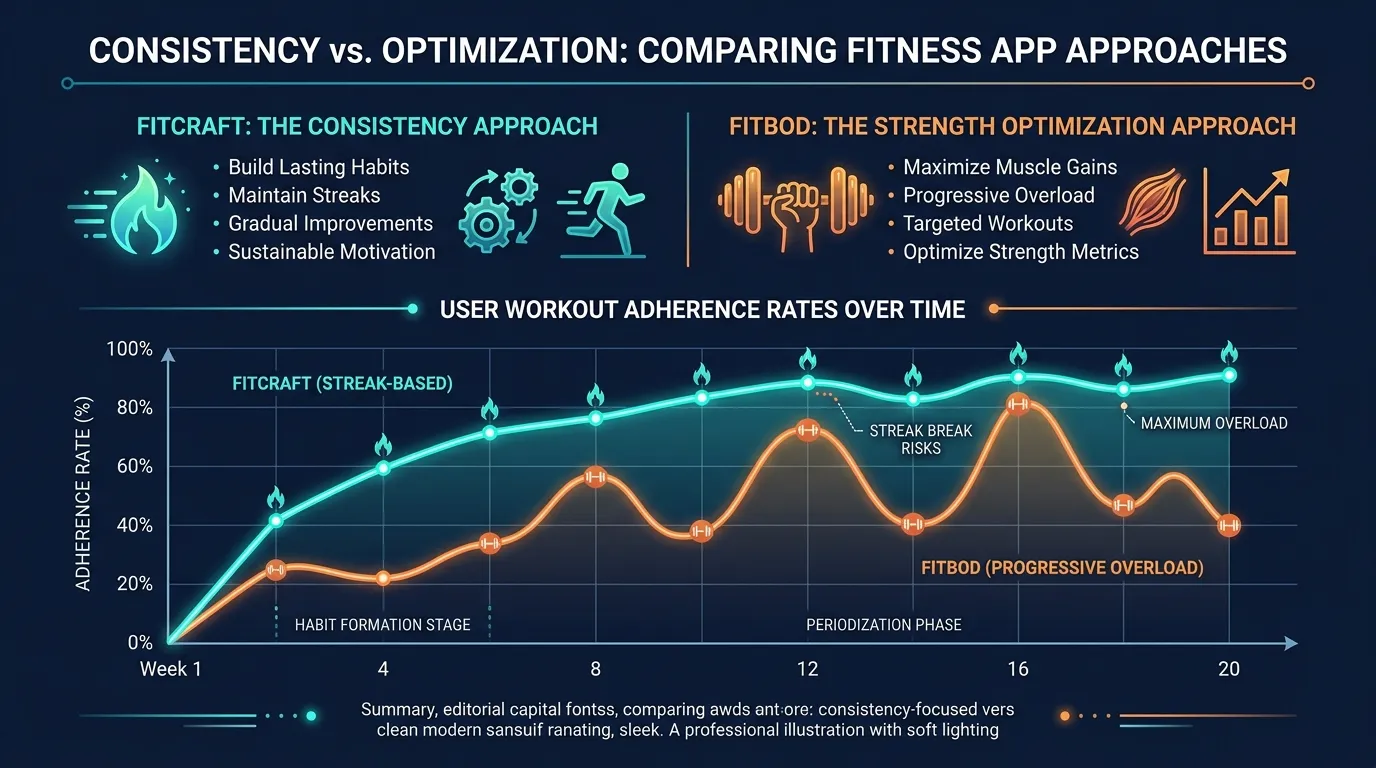
You're comparing FitCraft and Fitbod because you want an AI-powered fitness app that actually works. Smart move. Both use artificial intelligence to personalize your training, but they solve fundamentally different problems, and understanding which problem is yours is the difference between finally getting results and adding another app to the graveyard on your phone.
Fitbod uses AI to optimize your strength training. Its algorithm builds each session around progressive overload, tracks how recovered each muscle group is, and uses non-linear periodization to keep progress coming. With 15 million-plus downloads and a library of over 1,000 exercises, it has earned its place as one of the most popular strength apps on the market. If you already show up consistently, Fitbod makes sure you're not wasting a single rep.
FitCraft uses AI coaching and gamification to make showing up feel easier. Your workouts are led by an AI coach, a 3D character who talks to you, demonstrates every exercise on an interactive 3D model you can rotate and zoom, and motivates you by name. Around that sits a game layer: streaks, XP, collectible cards, and calendar rewards that make showing up feel like progress. Every program is designed by Domenic Angelino, an exercise scientist with an MPH from Brown University and NSCA-CSCS certification, and your plan adapts as your progress advances.
Here's the core tension: Fitbod assumes you'll show up and optimizes what happens when you do. FitCraft is built for the harder problem, making sure you show up in the first place.
Quick Comparison
| Feature | FitCraft | Fitbod |
|---|---|---|
| Core Approach | Gamification + 3D AI coaching | AI-driven strength optimization |
| Primary Focus | Workout consistency & habit building | Strength progression & tracking |
| Personalization | Free diagnostic assessment | AI adapts from training history |
| Designed By | NSCA-certified exercise scientist | Proprietary algorithm + training data |
| Best For | People who quit workout apps | Intermediate/advanced lifters |
| Gamification | Streaks, XP, collectible cards, calendar rewards | None |
| AI Coaching | 3D coach who talks, demonstrates, and motivates | AI workout generation |
| Progressive Overload | Built into program design | Automated per-session algorithms |
| Workout Guidance | Interactive 3D exercise demos with pinch-and-zoom camera control | Multi-angle exercise videos |
| Exercise Library | Full library, expert-curated | 1,000+ exercises |
| Muscle Recovery Tracking | Built into programming | Dedicated recovery percentages |
| Wearable Support | No watch app | Apple Watch |
| Free Option | Free version available | Paid app |
| Platforms | iOS & Android | iOS & Android |
The Core Difference
Fitbod and FitCraft both use AI to personalize your workouts, but they're solving completely different bottlenecks in your fitness journey.
Fitbod is a strength training optimization engine. Its AI tracks which muscle groups you've worked, assigns recovery percentages so fatigued muscles get rest, and applies non-linear periodization so every session builds on the last. It logs your personal records and total volume, and its equipment settings adapt workouts to whatever you have, from a full gym to nothing at all. If you're an intermediate or advanced lifter with the gym habit locked in, Fitbod's algorithmic precision is genuinely impressive.
FitCraft is a workout consistency engine. It uses behavioral science and game mechanics to solve the problem that comes before workout optimization: actually showing up. Streaks create accountability. Programs give you a multi-week structure. Collectible cards and XP tap the same reward loops that keep people playing games for years. The evidence is real: a 2022 meta-analysis of 16 randomized controlled trials by Mazeas et al. in the Journal of Medical Internet Research found gamified interventions significantly increased daily physical activity, with effects that persisted after the programs ended.
Think of it this way: Fitbod optimizes the workout. FitCraft solves whether you do the workout at all.
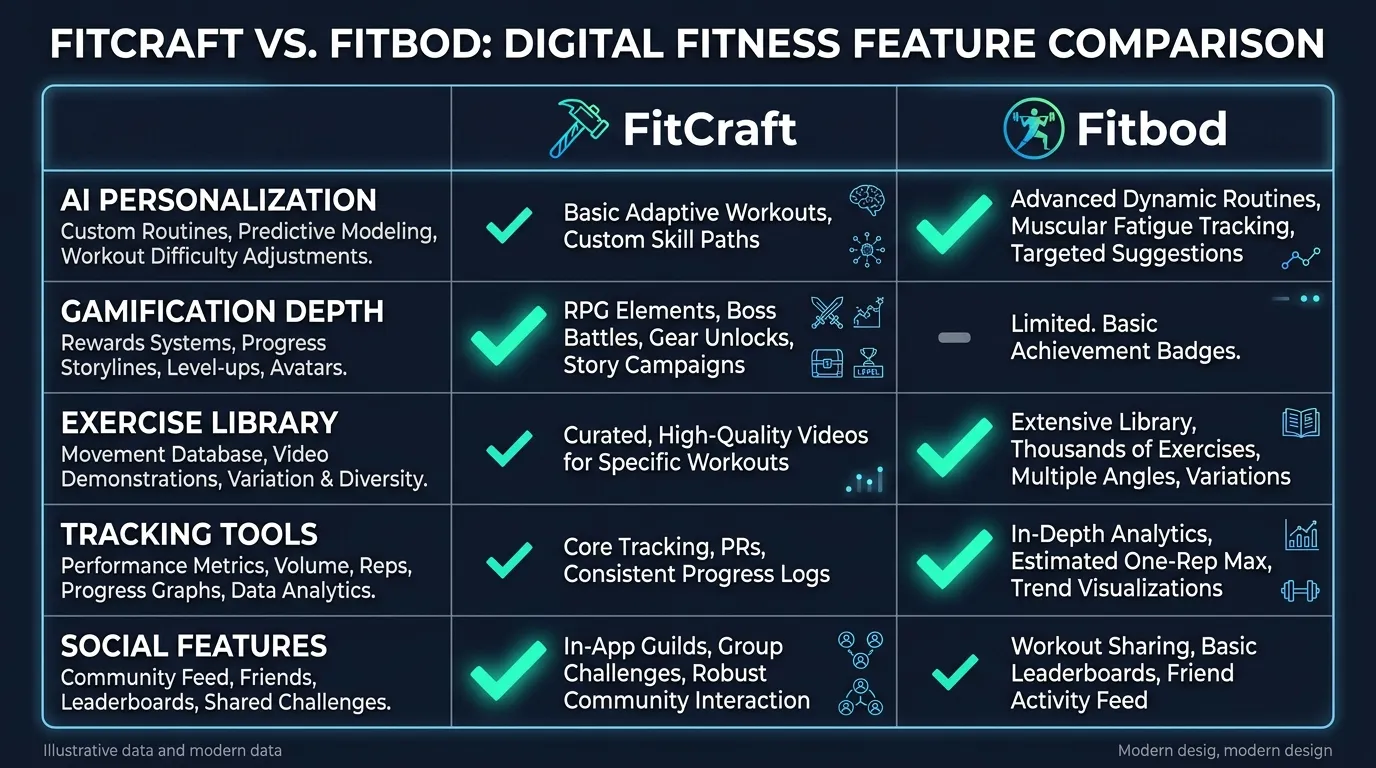
Where Fitbod Wins
We'll be straight with you. Fitbod is excellent at what it does, and it does several things better than FitCraft:
- Sophisticated progressive overload automation. Fitbod's algorithm is built from the ground up for strength progression. It tracks sets, reps, and weight across every exercise and adjusts the next session to keep pushing you forward. If automated overload programming is your top priority, Fitbod is among the best in the market.
- Deep exercise library. Over 1,000 exercises with high-resolution, multi-angle demonstration videos. Whether you train with barbells, dumbbells, cables, or machines, the library is deep and well organized.
- Detailed performance tracking. Personal records, volume, and training history in one clean dashboard. If you love your numbers, Fitbod delivers them.
- Dedicated muscle recovery tracking. Fitbod estimates per-muscle recovery so your programming automatically avoids hammering fatigued muscle groups. Genuinely useful if you train four or more days per week.
- Apple Watch app. You can run sessions from your wrist, which serious gym-goers appreciate. FitCraft has no watch app.
Where FitCraft Wins
FitCraft was built for the problem Fitbod doesn't address, the reason most people never see results from any fitness app:
- Gamification that creates real consistency. Fitbod has zero gamification. That's fine if you're already self-motivated. But if you've quit fitness apps within a month before, the problem isn't your programming, it's that nothing made you want to come back. FitCraft's streaks, XP, collectible cards, and calendar rewards are the same mechanics the BE FIT randomized controlled trial (2017) tested, where gamified families hit their activity goals on 53% of days versus 32% for controls.
- Behavioral science built into every touchpoint. Fitbod takes a pure engineering approach: better algorithms, better workouts. FitCraft takes a behavioral approach: understanding why people quit and designing systems that make continuing easier than stopping. The STEP UP trial (2019) in JAMA Internal Medicine showed competition-based gamification added roughly 920 steps per day for overweight and obese adults.
- A coach, not just a generator. Fitbod's AI produces a workout list. FitCraft's AI coach leads the session: a 3D character who demonstrates every movement on an interactive model, talks you through sets, and celebrates your progress by name. For anyone who finds solo training lonely or uncertain, that difference is the whole product.
- Expert-designed holistic programming. Every FitCraft program is designed by Domenic Angelino, NSCA-CSCS, combining strength, cardio, yoga, and mobility rather than strength alone.
- Built for people who have quit before. Most people who download a fitness app stop using it within weeks, the pattern documented in our engagement decay explainer. Fitbod assumes you're already committed. FitCraft is engineered for the much larger group who want to be.
See what FitCraft would build for you
FitCraft, our mobile fitness app, pairs you with an AI coach who builds you a personalized plan around your goals, schedule, and fitness level. Every FitCraft program is designed by Domenic Angelino, MPH (Brown University) and NSCA-CSCS, with research published in the Journal of Strength and Conditioning Research and Medicine & Science in Sports & Exercise.
Take the Free Assessment Free • 2 minutes • No credit card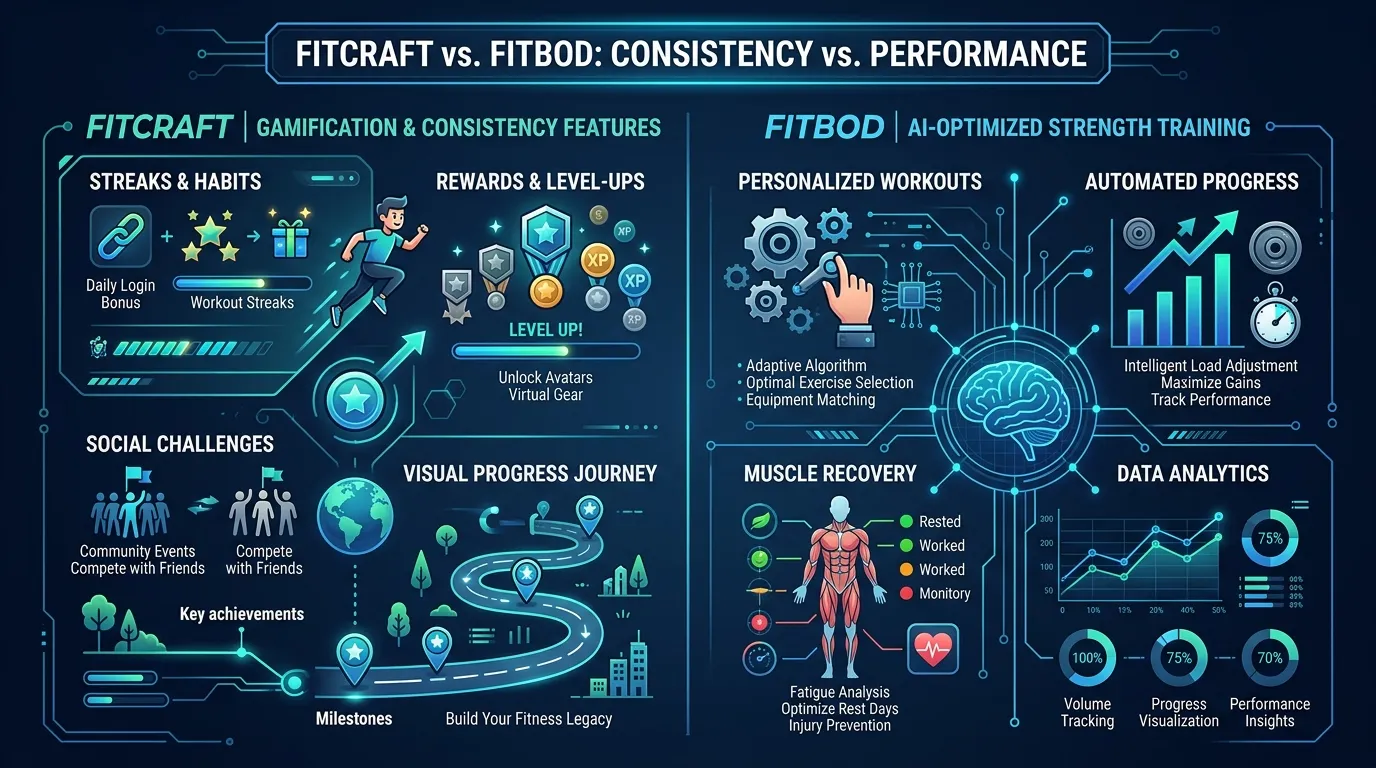
Who Should Choose FitCraft
FitCraft is right for you if:
- You've tried fitness apps before and quit within a few weeks. This is the single most important differentiator. If your problem is consistency rather than programming quality, FitCraft is designed specifically for you. Fitbod will give you a great workout on the days you show up. It won't solve the showing-up problem.
- You're motivated by rewards, progression, and streaks. If a game's progression system has ever hooked you, FitCraft channels that same psychology into your fitness routine instead of relying on willpower.
- You want a holistic approach, not just strength. FitCraft combines strength, cardio, yoga, and mobility in one system. Fitbod is laser-focused on resistance training.
- You're a beginner or returning after a break. The free assessment adapts to any level, and the 3D coach removes the "am I doing this right?" anxiety that stops new lifters.
Who Should Choose Fitbod
Fitbod is right for you if:
- You already train consistently and want better programming. If showing up isn't your problem but random workouts are, Fitbod's algorithms give your training real structure and measurable progression.
- You're an intermediate or advanced lifter focused on strength. Recovery tracking, volume analytics, and PR logging are built for people who care about their numbers. If you track estimated one-rep maxes, Fitbod speaks your language.
- You want wearable integration. Running workouts from an Apple Watch is a real quality-of-life upgrade that FitCraft doesn't offer.
- You want maximum control with minimum coaching. Fitbod hands you an optimized plan and gets out of the way. If a talking 3D coach sounds like friction rather than fun, Fitbod's quieter experience will suit you.
The Bottom Line
The Verdict
Fitbod and FitCraft are both excellent AI fitness apps, built for different people with different problems. Fitbod is the better choice for experienced lifters who already have the gym habit and want algorithmic precision in their strength programming. FitCraft is the better choice for anyone who has struggled to stay consistent, because the best workout program in the world is worthless if you stop doing it in week 3.
Here's the question that tells you which one you need: is your problem that your workouts aren't optimized, or that you stop doing them?
If it's the second one, that's not a programming problem. It's a behavioral design problem, and behavioral design is exactly what FitCraft was built to solve. Randomized trials of gamified exercise, from BE FIT to STEP UP to the 2022 Mazeas meta-analysis, keep landing on the same finding: game mechanics get people moving more, and keep them moving after the novelty fades.
Frequently Asked Questions
Is FitCraft better than Fitbod?
It depends on what's holding you back. Fitbod is better for experienced lifters who want optimized strength programming with progressive overload and recovery tracking. FitCraft is better if your main problem is consistency, meaning you quit apps after a few weeks. FitCraft uses a 3D AI coach and gamification to make showing up automatic, while Fitbod focuses on making each workout as effective as possible.
Does Fitbod have gamification features?
No. Fitbod focuses on workout optimization, progressive overload, and recovery tracking rather than gamification. It logs your PRs, volume, and training history, which is excellent for data-driven lifters, but it doesn't include streaks, XP, collectible rewards, or a character-based coach. FitCraft uses those game mechanics specifically to solve the consistency problem.
Can I use FitCraft for strength training like Fitbod?
Yes. FitCraft includes strength training with dumbbells, barbells, resistance bands, and bodyweight, in programs designed by Domenic Angelino, an NSCA-certified exercise scientist. That said, Fitbod's per-session optimization is more granular for pure strength work. FitCraft takes a more holistic approach that combines strength, conditioning, and consistency mechanics in one system.
Which app is better for beginners, FitCraft or Fitbod?
FitCraft is generally better for beginners. Its free assessment adapts to any fitness level, the 3D coach demonstrates every exercise on an interactive model, and the gamification system helps new exercisers build the habit before they quit. Fitbod's data-heavy approach suits intermediate and advanced lifters who already train consistently and want to optimize their programming.
Does Fitbod work without a gym?
Yes. Fitbod lets you set your available equipment and generates workouts around it, including bodyweight-only sessions. FitCraft also adapts to your equipment, from a full gym down to nothing at all. The difference is the experience around the workout: Fitbod gives you an optimized list to execute, FitCraft gives you a coached, gamified session.