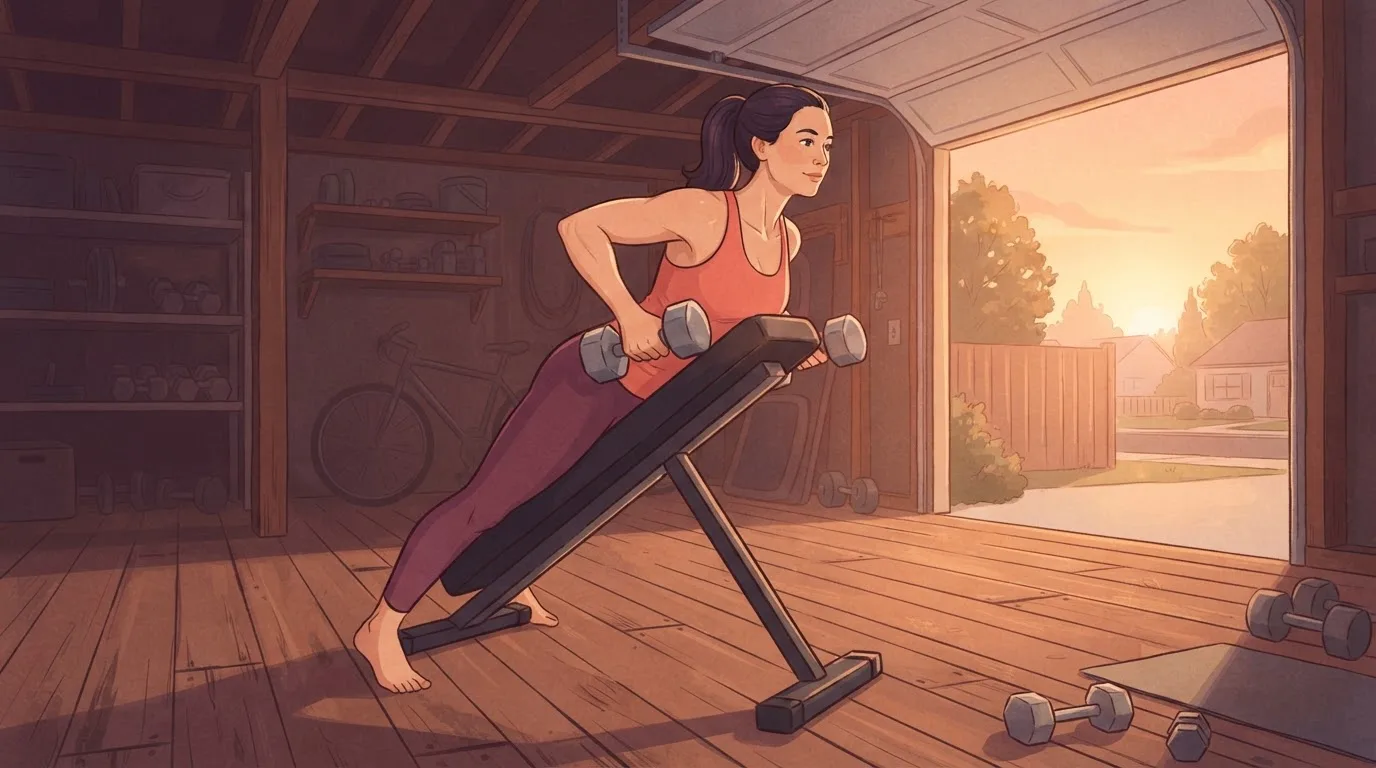
You spend most of the day with your arms in front of you: typing, driving, scrolling, carrying kids or groceries. By evening there's a dull ache between your shoulder blades, and every stretch you try feels good for about a minute.
It's easy to assume that ache means your upper back is tight and needs more stretching. It may also mean the muscles there are tired from holding your shoulder blades in place all day with little training to back them up. The rhomboids are a big part of that group, and they respond to the same thing every other muscle does: regular work against resistance.
Below you'll find eight rhomboid exercises using dumbbells, bands or your body weight, what the rhomboid muscles do, what EMG studies show about which moves work them hardest, when to strengthen and when to stretch, and a 10-minute routine for desk workers.
8 Rhomboid Exercises With Dumbbells, Bands or Your Body Weight
Every exercise here ends the same way: your elbows or hands travel back and your shoulder blades draw together and slightly down. Do each rep slowly, hold the squeeze for a second or two, and stop the set when your shoulders start to shrug up toward your ears.
| # | Exercise | Equipment | Sets and reps |
|---|---|---|---|
| 1 | Robbery | Body weight | 2 to 3 x 8, 3-second squeeze |
| 2 | Lawnmower pull | Body weight or a light dumbbell | 2 to 3 x 10 per side |
| 3 | Chest-supported dumbbell row | Two dumbbells and a bench or sturdy chair | 3 x 8 to 12 |
| 4 | Prone W raise | Body weight | 2 to 3 x 10 to 12 |
| 5 | Prone T raise, thumbs up | Body weight or very light dumbbells | 2 to 3 x 10 to 12 |
| 6 | Bent-over reverse fly | Light dumbbells | 2 to 3 x 12 to 15 |
| 7 | Seated band row | Resistance band | 3 x 12 to 15 |
| 8 | Bodyweight row with a shoulder-blade squeeze | Suspension trainer or sturdy table | 3 x 6 to 10 |
1. Robbery
Stand with your feet hip-width apart and hinge forward about 45 degrees at the hips, arms hanging in front of your thighs, palms facing your legs. Stand up tall as you bend your elbows and pull them back and down, keeping them close to your sides, and turn your palms up and out as if someone just said "hands up". Finish by squeezing both shoulder blades toward your back pockets and hold for 3 seconds. This is the move that drew the most rhomboid activity in the fine-wire study below, and it needs no equipment.
2. Lawnmower pull
Stand with your feet a little wider than your hips. Bend forward and turn your trunk so your right hand reaches toward your left knee. In one smooth motion, stand up and turn your trunk back to the right while you pull your right elbow back to your waist, as if starting a lawnmower, and finish with your elbow in your back pocket and your shoulder blade squeezed in. Start with no weight; add a light dumbbell once 10 smooth reps per side feel easy.
3. Chest-supported dumbbell row
Set a bench to a low incline, or kneel behind a sturdy chair, and rest your chest on it with a dumbbell in each hand hanging straight down. Pull your elbows back at about 45 degrees from your body until they pass your ribs, pause, and lower slowly. With your chest supported you can't cheat by rocking, which makes this a good loaded rhomboid exercise for home lifters. Choose a weight that leaves you 1 to 3 reps short of failure. Our dumbbell back exercises guide covers the other row variations and how to load them.
4. Prone W raise
Lie face down with your forehead resting on a folded towel. Bend your elbows to about 90 degrees and set your arms in a W beside your head, thumbs toward the ceiling. Lift your arms and hands an inch or two off the floor by pulling your elbows down toward your hips and squeezing your shoulder blades. Hold for 2 seconds and lower. The bent elbows put your arm close to the rowing position that shifted work toward the rhomboids in the study by Fennell and colleagues below, though that study didn't test the W raise itself.
5. Prone T raise, thumbs up
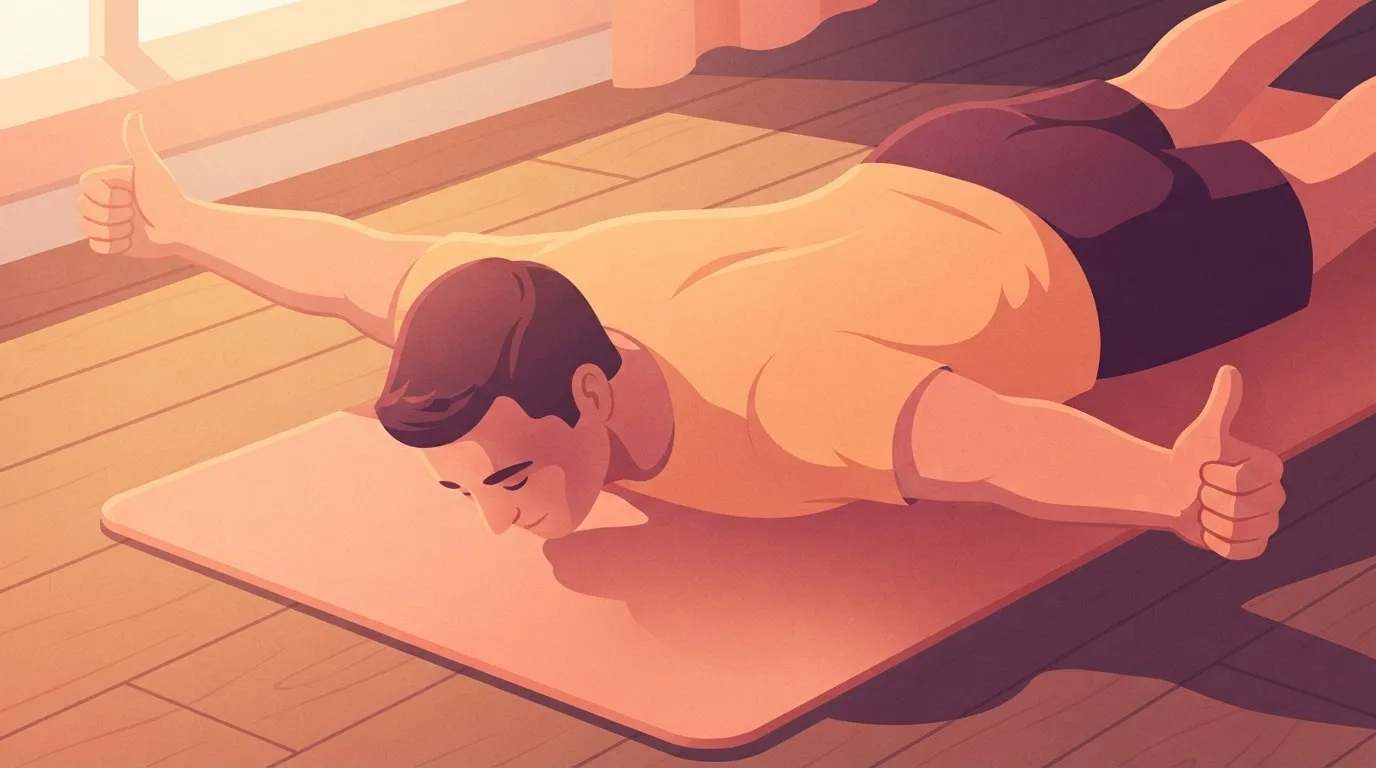
Lie face down and stretch your arms straight out to the sides in a T, thumbs pointing to the ceiling. Squeeze your shoulder blades together first, then lift your arms just above the floor without shrugging. Hold for 2 seconds and lower. Use no weight until 12 controlled reps feel easy, then hold a 1 to 2 pound dumbbell or a water bottle. Both the rhomboids and the middle trapezius work in this raise, so pair it with the W raise to train the squeeze from two arm positions.
6. Bent-over reverse fly
Hinge forward until your chest is close to parallel with the floor, with a light dumbbell in each hand under your shoulders and a soft bend in your elbows. Sweep your arms out to the sides until they're in line with your body, squeezing your shoulder blades at the top, and lower slowly. This one also trains the rear delts heavily, so keep the weight light enough that your shoulder blades, not just your arms, do the moving. Our guide to rear delt exercises covers the fly variations in more detail.
7. Seated band row
Sit on the floor with your legs straight and loop a resistance band around the soles of your feet. Hold an end in each hand, sit tall, and pull your hands toward your lower ribs, elbows close to your body. Squeeze your shoulder blades together for a full second before you let the band pull your arms forward again. Choose a band that makes the last 2 or 3 reps hard.
8. Bodyweight row with a shoulder-blade squeeze
Hold the handles of a suspension trainer anchored above head height, or the edge of a sturdy table you can lie under, and walk your feet forward until your body leans back at an angle with your arms straight. First, without bending your elbows, squeeze your shoulder blades together so your chest rises an inch. Then pull your chest to your hands, pause, and lower all the way. The more upright you stand, the easier it gets. Only use a table that can't tip.
Rhomboid Muscles: Where They Sit and What They Do
The rhomboid muscles are two flat, diamond-shaped muscles in your upper back. The rhomboid minor runs from the bottom of your neck and the top of your upper spine, around the C7 and T1 vertebrae, to the inner edge of your shoulder blade. The rhomboid major sits just below it, running from the T2 to T5 vertebrae to the lower part of that same inner edge. Both lie underneath the trapezius, the large diamond of muscle you can see on a lean back, and both are supplied by the dorsal scapular nerve.
What scapular retraction means
Scapular retraction is the movement of your shoulder blades toward your spine, the "squeeze" at the end of a row. The rhomboids share it with the middle trapezius. They also do a second job: they rotate the shoulder blade downward, tipping the outer tip of your shoulder down. Fennell and colleagues (2016) point out that this downward rotation can worsen shoulder impingement, a pinching at the top of the shoulder that needs the opposite, upward rotation, when the arm goes overhead.
Why they're hard to measure
Because the rhomboids sit under the trapezius, electrodes stuck on the skin over that spot mostly pick up trapezius activity. To measure the rhomboid itself, researchers thread a fine wire into the muscle under ultrasound or anatomical guidance. That's why the rhomboid numbers in the next section come only from fine-wire studies, and the middle trapezius numbers come mostly from surface electrodes.
What EMG Studies Show About Rhomboid and Middle Trapezius Work
EMG (electromyography) records the electrical activity of a muscle, usually as a percentage of the most it can produce in a maximal test. Higher numbers mean the muscle is working harder, though numbers from different studies aren't directly comparable because each lab tests people a little differently.
Rhomboid major: fine-wire studies
| Study | Who | What it found for the rhomboid |
|---|---|---|
| Berckmans 2020 | 23 healthy men | Robbery 66% and lawnmower 59% of maximum, both higher than two smaller rehab moves |
| Berckmans 2021 | 26 healthy adults | Moderate activity, 25% to 45%, in prone T raise with the thumbs up, prone arm extension and two side-lying moves |
| Fennell 2016 | 12 healthy adults | Compared with a straight arm turned thumbs up, a bent-elbow rowing position shifted the balance toward the rhomboid; both muscles worked in all four positions |
| Castelein 2016 | 21 healthy adults | The towel wall slide worked the rhomboid and other retractors less than arm raises |
| Moseley 1992 | 9 healthy adults | Rowing was one of four core exercises across 8 shoulder blade muscles, including the rhomboids |
The biggest numbers came from whole-body pulls. Berckmans and colleagues (2020) placed fine-wire electrodes in the rhomboid major of 23 healthy men during four common shoulder exercises. The robbery reached 66 percent of a maximal contraction and the lawnmower 59 percent, significantly more than two smaller rehab moves, the inferior glide and the low row. Both exercises come from Kibler and colleagues (2008), who described them as moves that use the hips and trunk to help pull the shoulder blades back. Berckmans' team also measured the middle trapezius in the same session, with skin electrodes, at 36 percent in the lawnmower and 39 percent in the robbery.
Arm position decides which retractor does more. Fennell and colleagues (2016) used fine wire in both the middle trapezius and the rhomboid major of 12 healthy adults, with the arm held out at shoulder height in four positions. With the elbow bent in a rowing position, the middle trapezius-to-rhomboid ratio was 22 percent lower than with the arm straight and the thumb turned up, meaning the rhomboid was doing relatively more of the work. All four positions worked both muscles together. So bent-elbow pulls tilt the squeeze a little toward the rhomboids, straight-arm raises with the thumb turned up tilt it a little toward the middle trapezius, and both muscles work in both.
Moderate work counts too. Berckmans and colleagues (2021) recorded 26 healthy adults with fine wire during side-lying external rotation, side-lying forward raises, the prone T raise with the thumbs up and prone arm extension. The rhomboid worked at 25 to 45 percent of its maximum in all four, a moderate level that makes these raises a sensible starting point if your upper back hasn't done much in years.
One popular posture drill does less here. Castelein and colleagues (2016) measured 21 healthy adults during three arm-raising exercises and found that the towel wall slide worked the retractors, including the rhomboid major, less than the other two. The wall slide has other uses, but it isn't a rhomboid exercise. And in the oldest fine-wire study, Moseley and colleagues (1992) recorded 8 shoulder blade muscles, including the rhomboids, across 16 exercises in 9 adults and named rowing as one of the four core exercises for a scapular strengthening program.
Middle trapezius: surface EMG studies
The middle trapezius sits right over the rhomboids and shares the squeeze, so most retraction work trains both. Ekstrom and colleagues (2003) recorded 30 healthy adults across 10 exercises with surface electrodes. The middle trapezius worked hardest in two prone moves: the T raise with the arm turned so the thumb points up, and the overhead Y raise. Castelein's group found a similar pattern: raising the arms with a band and an added outward turn worked the middle and lower trapezius more than a plain arm raise or the wall slide.
Our guide on how to fix rounded shoulders builds its exercise table on a related surface EMG ranking of 45 adults by Cools and colleagues (2007), which favored side-lying and prone moves that work the middle and lower trapezius without much upper trapezius. That guide covers posture, the shoulder pain evidence and a four-week plan, so this page doesn't repeat it.
Find out what's really holding you back
FitCraft, our mobile fitness app, pairs you with an AI coach who builds you a personalized plan around your goals, schedule, and fitness level. Every FitCraft program is designed by Domenic Angelino, MPH (Brown University) and NSCA-CSCS, with research published in the Journal of Strength and Conditioning Research and Medicine & Science in Sports & Exercise.
Take the Free Assessment Free • 2 minutes • No credit cardHow to Strengthen Your Rhomboid Muscle
The rhomboids are small, and bigger muscles are happy to take over. These cues keep the work where you want it:
- Move the shoulder blades first. Start each rep by drawing your shoulder blades back an inch, then bend your elbows. If your elbows move first, your arms and lats take the load.
- Pull to the back pocket, not the ear. Think "shoulder blades down and back". If your shoulders creep up, the upper trapezius has taken over, so lighten the weight.
- Hold the squeeze. A 1 to 3 second pause at the end of each rep makes the retractors work through the part of the movement momentum usually skips.
- Bend your elbows for a little more rhomboid. A bent-elbow rowing position shifts the balance toward the rhomboids compared with a straight arm turned thumbs up, though straight-arm raises still train both muscles. Do one of each.
- Train close to failure. Stop each set 1 to 3 reps short of failure on rows, and when the squeeze gets shaky on raises.
- Progress slowly. Add reps first, then a second of pause, then weight or a stronger band.
Most people do well with 6 to 10 hard sets a week split over two or three sessions: for example, one row, one raise and one whole-body pull such as the robbery each time.
Strengthen or Stretch? What to Do About a Sore Upper Back
The ache between your shoulder blades makes stretching feel like the obvious answer, and a gentle stretch can feel great. The trials point to strength work as the part that changes the pain over weeks. These trials looked at neck and shoulder pain in working adults, not at the rhomboids, and they used neck and shoulder strength exercises rather than rhomboid moves alone.
- Andersen and colleagues (2008) randomized 48 women in computer-heavy jobs with chronic neck muscle pain. Ten weeks of strength training for the painful muscles cut their worst pain by 35 points on a 100-point scale, about 79 percent, while general fitness training on a bike brought only a small, short-lived drop.
- Ylinen and colleagues (2003) followed 180 female office workers with chronic neck pain for a year. Every group was advised to do aerobic exercise and stretching three times a week, and the two groups that added neck training and dumbbell exercises for the shoulders and arms had significantly less pain and disability at 12 months than the group that only got the advice.
- Andersen and colleagues (2011) gave 198 adults with frequent neck and shoulder pain resistance training with elastic tubing for 2 or 12 minutes a day, five days a week. After 10 weeks, pain fell by 1.4 points on a 10-point scale in the 2-minute group and 1.9 points in the 12-minute group compared with a group that got health information.
So stretch for comfort if it helps, and make strength work the main event. Our rounded shoulders guide explains a similar finding for the chest stretch: it eased pain without changing muscle length.
What is the primary cause of rhomboid pain?
There isn't one. Often the ache comes from tired muscles after long hours in one position or a new workout, and that kind tends to ease when you move. Pain between the shoulder blades can also start somewhere else:
- The neck. In a study of 50 people with a pinched nerve in the neck by Tanaka and colleagues (2006), pain between the shoulder blades pointed to the C7 or C8 nerve root, and the neck or shoulder blade pain came before any arm symptoms in 70 percent of them.
- The nerve to the rhomboids. Sultan and El-Tantawi (2013) tested 55 people with pain between the shoulder blades on one side and found nerve test results consistent with a dorsal scapular nerve problem in 29 of them, about 53 percent.
- The heart. The American Heart Association lists upper back pressure among heart attack symptoms, especially in women. Sudden upper-back pain with chest pressure, shortness of breath, sweating or nausea is an emergency.
See a doctor or physical therapist if your upper-back pain spreads into your arm or hand, comes with numbness or weakness, is on one side and won't settle, wakes you at night, or followed a fall or accident. Exercise is for the common, muscular kind.
Stretches that feel good
If a stretch helps you relax, keep it short and gentle. Hug yourself, round your upper back and breathe into the space between your shoulder blades for 20 to 30 seconds. Or sit back into a child's pose and walk your hands to one side to open the opposite upper back. Then follow it with a set of robberies or rows.
A 10-Minute Rhomboid Routine for Desk Workers
This routine fits around a workday. The daily set takes two minutes at your desk and borrows its dose from the Andersen trial above, which used an elastic-tubing shoulder raise rather than a row and measured neck and shoulder pain. The longer session takes about ten minutes and works best two or three times a week, on days you aren't doing a full back workout.
| When | Exercise | Dose |
|---|---|---|
| Every workday (2 minutes) | Seated band row or robbery | 1 set to near failure, then shake out your arms |
| 2 to 3 days a week (10 minutes) | Robbery | 2 x 8, 3-second squeeze |
| Lawnmower pull | 2 x 10 per side | |
| Chest-supported dumbbell row or band row | 3 x 10 to 12 | |
| Prone W raise | 2 x 12 | |
| Prone T raise, thumbs up | 2 x 12 |
Rest about 30 to 45 seconds between sets. When the last reps of every set stop feeling hard, add a pause, a rep or a little weight. Keep a band at your desk so the daily set happens without a trip to another room.
Keeping the Routine Going When Work Gets Busy
The exercises are simple. The hard part is still doing them in week six, when a deadline lands and the band sits untouched in a drawer. If your workouts are usually the first thing to go when work gets busy, our roundup of the best workout apps for busy professionals compares apps built around short sessions.
FitCraft has the prone T, W and Y raises, the rear delt raise, the band pull-apart and the supported dumbbell row as exercises with interactive 3D demos you can zoom in on, and its exercise tips name the muscles to focus on. Your AI coach says your name while you train, your workouts adjust as you progress, and streaks and calendar tracking make a missed day easy to see.
The Bottom Line
Rhomboid exercises are any moves that pull your shoulder blades together against resistance. The robbery and the lawnmower drew the most rhomboid activity of the four moves in one fine-wire study, and a bent-elbow rowing position shifted more of the work to the rhomboids than a straight arm turned thumbs up, so a good plan uses both. For neck and shoulder pain after long days at a desk, strength work did better than stretching advice or bike training in two trials, and two minutes a day of resistance training helped.
Working out consistently is hard, but it doesn't have to be. As Matt put it, "The real win is I actually want to work out now. That's never happened before." Start with one set of robberies before you sit down tomorrow.
Frequently Asked Questions
Does T bar row work rhomboids?
Yes. Any row that pulls your elbows back past your body and squeezes your shoulder blades together works the rhomboids, along with the middle trapezius and the lats. In a fine-wire EMG study, a bent-elbow rowing position shifted more of the work toward the rhomboids than a straight arm turned thumbs up. The T-bar row uses a barbell, so at home a chest-supported dumbbell row does the same job.
What is the king of all back exercises?
No single exercise earns that title, because the back has several jobs. For the rhomboids and the other muscles that move the shoulder blades, the row family comes closest: a 1992 study that recorded 8 shoulder blade muscles named rowing as one of four core exercises for a scapular strengthening program. Pair a row with a hinge such as a dumbbell Romanian deadlift and you cover most of the back.
What muscle gets neglected the most?
No study ranks muscles by neglect. In home routines built around push-ups and presses, the muscles that pull the shoulder blades back, the rhomboids, middle trapezius and rear delts, often get the fewest sets. Matching each set of pushing with a set of rowing is a simple way to keep them in the plan.
How to stretch the upper back?
Hug yourself, round your upper back and breathe into the space between your shoulder blades for 20 to 30 seconds, or sit back into a child's pose and walk your hands to one side. Thread the needle on your hands and knees adds rotation. Stretch for comfort, then follow it with a strengthening move, because strength training reduced neck pain in office workers more than stretching advice alone did.
How often should you train your rhomboids?
Two or three sessions a week of 6 to 10 hard sets of rows and raises is enough for most people. If you sit all day, a single short set on workdays is a reasonable add-on: in a trial of 198 working adults, 2 minutes a day of elastic-tubing shoulder training for 10 weeks reduced neck and shoulder pain.