"Backed by science" is the most abused phrase in fitness marketing. Every app claims it. Almost none cite a specific study.
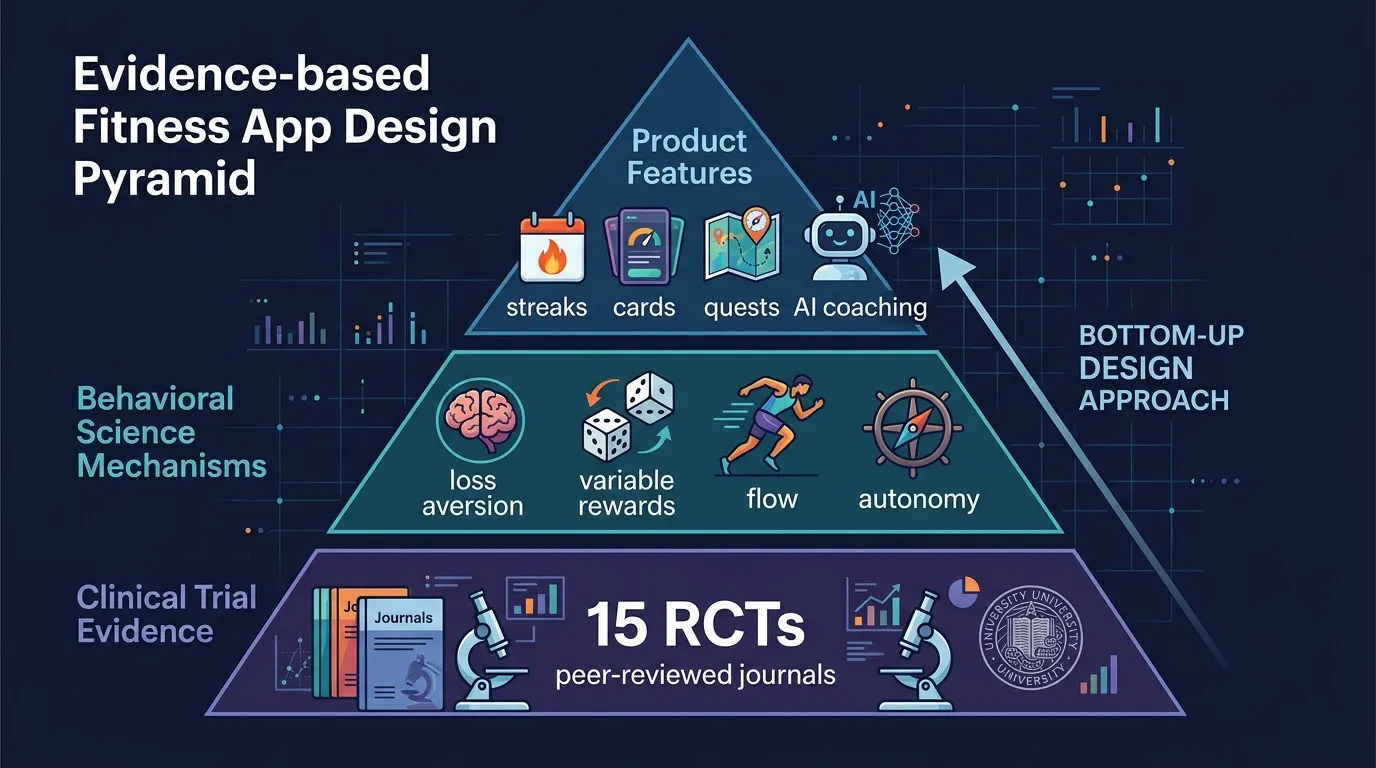
FitCraft is different. Every game mechanic in the app corresponds to a specific finding from a peer-reviewed clinical trial. Not a blog post. Not a pop-science book. A randomized controlled trial published in a medical journal with a PubMed Central ID you can look up yourself.
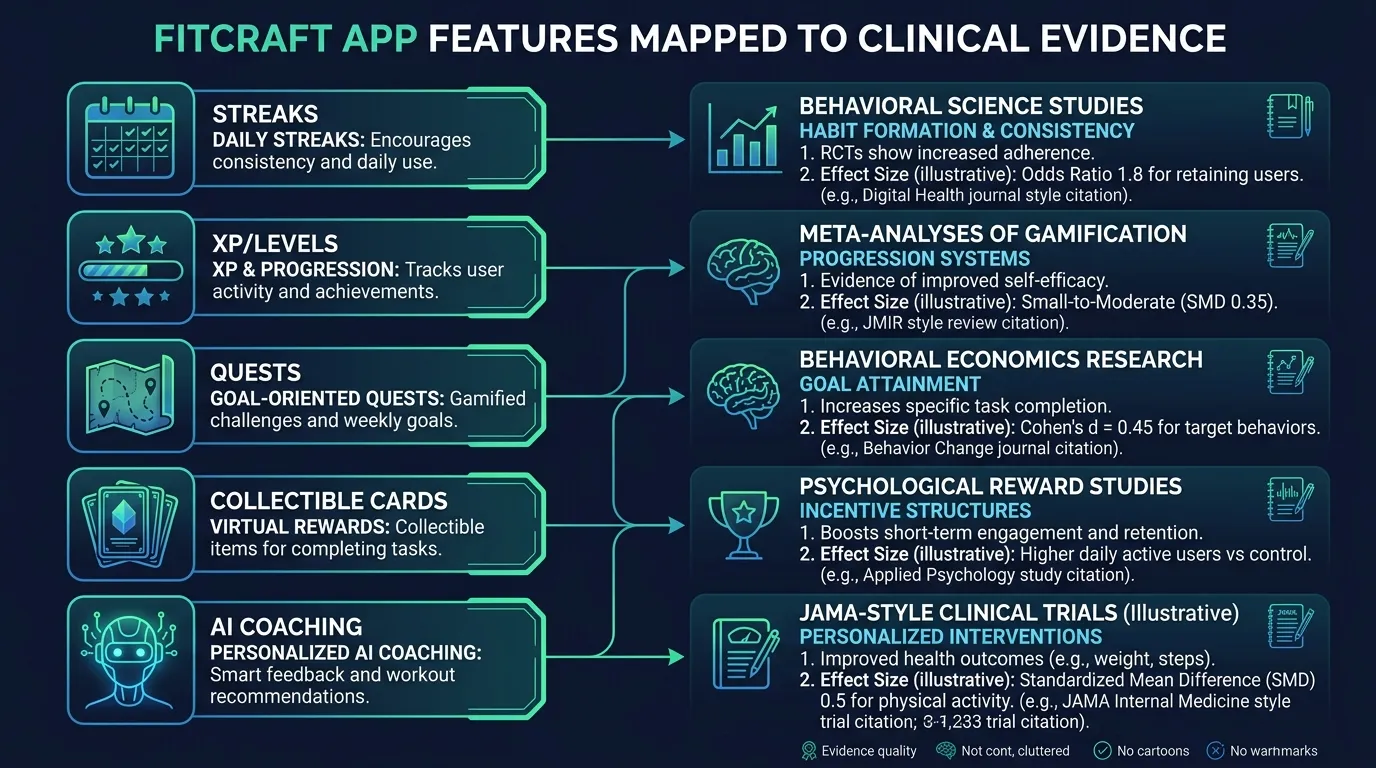
Below is the complete mapping — feature by feature, trial by trial, with exact effect sizes.
The Complete Feature-to-Evidence Map
| FitCraft Feature | Psychological Mechanism | Supporting Trial(s) | Effect Size | Publication |
|---|---|---|---|---|
| Streak System | Loss aversion + commitment consistency | ALLSTAR (n=150), Stroke RCT (n=34), Veterans (n=180) | +759 to +981 steps/day | JACC CardioOncology 2025, JAMA Neurology 2022, JAMA Netw Open 2021 |
| Calendar Tracking & Rewards | Self-monitoring + visual feedback + goal commitment | Fitbit Feature Deconstruction (n=70), BE FIT (n=200) | Significant motivation/readiness gains | PMC11282379 2024, JAMA Intern Med 2017 |
| Self-Chosen Goals | Goal autonomy + immediacy | ENGAGE (n=500) | +1,384 steps/day (sustained) | JAMA Cardiology 2021 |
| AI-Adaptive Difficulty | Flow state + automated coaching | GAMEPAD (n=103) | +1,074 steps (grew post-intervention) | JAHA 2025 |
| Collectible Cards | Variable ratio reinforcement | Skinner reinforcement schedule research + gamification meta-analysis (16 RCTs, n=2,407) | g = 0.42 (pooled effect) | J Med Internet Res 2022 |
| Quest Progression | Competence + autonomy (SDT) | BE FIT (n=200) — points + levels + progression | 53% vs 32% goal achievement | JAMA Internal Medicine 2017 |
| Avatar Progression | Competence (SDT) + identity reinforcement | BE FIT (n=200), MapTrek (n=146) | 53% vs 32% goal achievement; +2,183 steps/day | JAMA Intern Med 2017, PMC6064890 2018 |
| AI Trainer Ty | Adaptive encouragement + automated coaching | GAMEPAD (n=103), Veterans (n=180) | +1,074 steps (grew post-intervention) | JAHA 2025, JAMA Netw Open 2021 |
Feature Deep Dives
Streak System
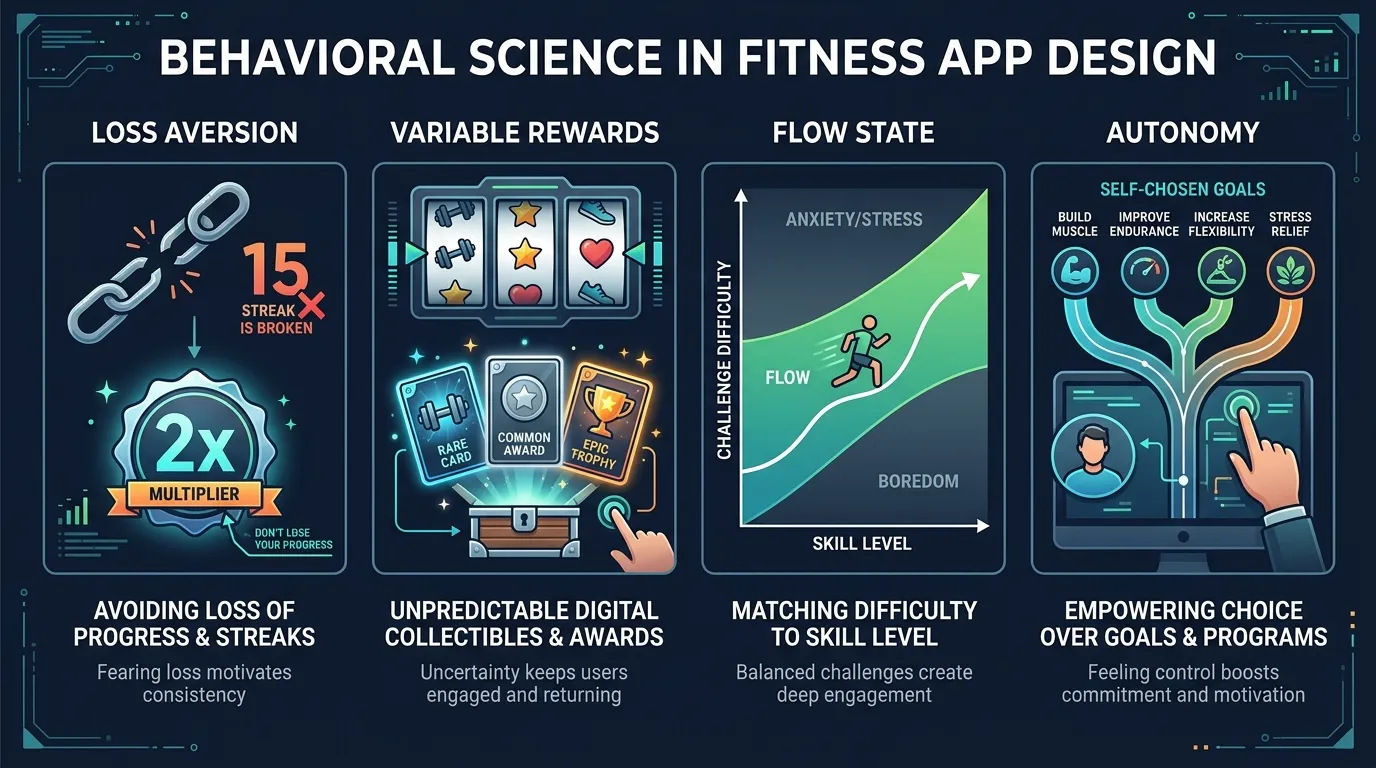
FitCraft tracks consecutive workout completions. Breaking a streak feels like losing something you already earned — that's loss aversion, one of the most robust findings in behavioral economics. Daniel Kahneman and Amos Tversky's prospect theory (1979) showed that losses are psychologically about twice as powerful as equivalent gains.
Three clinical trials used loss-framed point systems — where participants were endowed with points at the start of each week and lost them for missed goals — and all three found significant step increases.
Supporting evidenceHow FitCraft applies this: Your workout streak acts as a soft loss-framed system. You don't lose money — you lose visible progress. Our deep dive on streak psychology explains why this mechanism is powerful even without financial stakes. The streak counter makes the "cost" of skipping a workout tangible and immediate.
Calendar Tracking & Calendar Rewards
FitCraft's calendar gives you a visual record of every workout — and rewards you for consistency. Seeing your progress mapped across days and weeks taps into self-monitoring, one of the most reliable behavior change techniques in health psychology.
Supporting evidenceHow FitCraft applies this: Your calendar is more than a log — it's a visual scorecard. Each completed workout fills in the day, and calendar rewards unlock as you hit weekly and monthly consistency targets. The research shows that self-monitoring with visual feedback is one of the simplest and most effective ways to sustain a new behavior. FitCraft makes your consistency visible and rewarding.
Self-Chosen Goals
FitCraft lets you set your own workout targets — frequency, intensity, and focus areas. This isn't a UX convenience. It's the most effective goal-setting strategy tested in gamification research.
Supporting evidenceHow FitCraft applies this: When you start FitCraft, the AI trainer Ty guides you through a 32-step diagnostic — but you choose your goals, difficulty level, and schedule. The ENGAGE trial is unambiguous: letting people choose their own targets and start immediately was the only arm that reached significance. FitCraft builds the structure; you choose the destination.
AI-Adaptive Difficulty
FitCraft's AI trainer Ty adjusts workout difficulty based on your progress. The goal: keep you in the flow channel between boredom and frustration, where exercise feels challenging but achievable.
Supporting evidenceHow FitCraft applies this: Ty adapts your workouts based on your progress over time. As you level up and complete quests, workout difficulty scales with you. The GAMEPAD finding is key: when an automated system teaches people to self-regulate their own progression, the behavior sticks — and even improves — after the formal intervention ends. That's the goal: FitCraft trains you to train yourself.
Collectible Cards
After workouts, you earn collectible cards with varying rarity. You never know when a rare card will drop — that's variable ratio reinforcement, the most powerful reinforcement schedule identified by B.F. Skinner's decades of research. (For the neuroscience behind why this works, see our article on dopamine and exercise motivation.)
Supporting evidenceHow FitCraft applies this: Cards come in varying rarities — common, uncommon, rare, and ultra-rare. The unpredictability means every workout could be "the one" where something exciting drops. This keeps the reward circuitry active across sessions, long past the point where fixed-schedule rewards (a badge every 10 workouts) lose their motivational power. It's the same mechanism behind trading card games and gacha systems — redirected toward a healthy behavior.
Quest Progression System
FitCraft structures your fitness journey as a series of quests — themed challenges with clear objectives, visible progress, and escalating difficulty. This directly satisfies two of the three core needs from Self-Determination Theory: competence (you see yourself advancing) and autonomy (you choose which quests to pursue). For a full breakdown of why this framework matters, see why gamification works for fitness.
Supporting evidenceHow FitCraft applies this: Quests give structure to what would otherwise be "just another workout." Each quest has a narrative wrapper, clear milestones, and a completion reward. You're not just doing push-ups — you're progressing through a chapter. The BE FIT and MapTrek data show that visible progression systems significantly increase goal achievement and daily activity.
Avatar Progression
FitCraft gives you an avatar that evolves as you train. Your avatar's progression is a visual representation of your real-world effort — creating a sense of competence and identity reinforcement that keeps you coming back.
Supporting evidenceHow FitCraft applies this: Your avatar levels up as you earn XP from workouts, quests, and streaks. It's a persistent visual reminder of how far you've come. The BE FIT and MapTrek research shows that visible progression systems — especially ones tied to a visual identity — produce significantly higher engagement and goal achievement than static tracking alone.
AI Trainer Ty (Personalized Encouragement)
Ty is FitCraft's AI trainer — a personalized coach that provides adaptive encouragement, guides your workout progression, and keeps you motivated through every phase of your fitness journey.
Supporting evidenceHow FitCraft applies this: Ty isn't a generic chatbot — Ty adapts encouragement and guidance based on your progress. The GAMEPAD trial showed that fully automated coaching can produce durable behavior change that persists (and even grows) after the formal program ends. Ty provides that same adaptive coaching layer, personalized to your level and goals.
Why We Chose This Approach (And What We Do Differently)
Being research-driven also means choosing the approaches that produce the most durable results.
- FitCraft uses intrinsic motivation instead of financial incentives. Research shows that intrinsic approaches — game rewards, progression systems, and visible streaks — produce more durable results than cash incentives. The veterans trial (2021) found that combining loss-framed mechanics with gamification produced +1,224 steps/day, confirming that the game-mechanics layer is the key driver. FitCraft channels that same loss-aversion psychology through cards, quests, and progression — rewards that sustain engagement without external payments.
- Visible progression drives long-term engagement. The BE FIT trial showed that points, levels, and visible progression produced 53% vs 32% goal achievement (+953 steps/day). The MapTrek trial confirmed that visual advancement systems drive +2,183 steps/day. That's why FitCraft uses avatar progression, XP-based leveling, and quest milestones — the evidence shows that seeing yourself advance is one of the strongest motivators for sustained behavior change.
- FitCraft starts you at your chosen level immediately. The ENGAGE trial tested gradual vs immediate goal implementation. Immediate, self-chosen goals produced +1,384 steps/day — the largest effect in the study. FitCraft lets you start right away at the level you choose.
- FitCraft uses automated coaching that builds lasting habits. The GAMEPAD trial is the only trial where effects grew after the intervention ended (+1,074 steps at follow-up). Automated coaching teaches people to self-regulate their own progression. FitCraft's AI trainer Ty provides that same adaptive coaching layer — personalized encouragement that helps you build habits that stick.
The Bottom Line
Most fitness apps are designed by intuition. FitCraft is designed by evidence.
Every streak, every collectible card, every quest, and every adaptive workout maps to a specific finding from a randomized controlled trial. Not a blog post. Not a marketing claim. A clinical trial with a sample size, a control group, a P-value, and a PubMed Central ID.
That matters because the fitness app market is full of apps that "feel" right but don't actually change behavior long-term. The research gives us a blueprint for what actually works — and what doesn't. FitCraft follows that blueprint.
The studies are all linked on our Gamification & Fitness Statistics page if you want to check the data yourself.
See the research in action
Take the free 2-minute diagnostic and experience every evidence-based mechanic firsthand.
Take the Free Assessment Free · 2 minutes · No credit cardFrequently Asked Questions
Is FitCraft backed by scientific research?
Yes. Every core game mechanic in FitCraft maps to a specific finding from peer-reviewed clinical trials published in JAMA Internal Medicine, JAMA Cardiology, JAMA Network Open, and the Journal of the American Heart Association. These include the BE FIT trial (2017, n=200), the ENGAGE trial (2021, n=500), the GAMEPAD trial (2025, n=103), and the ALLSTAR trial (2025, n=150), among others. FitCraft's streak system, collectible cards, quest progression, self-chosen goals, and adaptive difficulty are all grounded in mechanisms that produced statistically significant increases in physical activity in randomized controlled trials.
What fitness app is backed by the most clinical evidence?
FitCraft is one of the few fitness apps that maps its features directly to specific randomized controlled trials. Most fitness apps claim to be "science-backed" without citing specific studies. FitCraft's game mechanics are based on findings from 15 RCTs involving over 2,500 participants, published in top-tier medical journals. Each feature — from streaks to collectible cards to adaptive difficulty — corresponds to a specific mechanism that produced measurable physical activity increases in clinical settings.
How does FitCraft use behavioral science?
FitCraft applies behavioral science through six evidence-based mechanisms: (1) loss-framed streaks based on loss aversion research from 3 RCTs showing +759 to +981 extra steps/day; (2) gamification with XP and leveling based on the BE FIT trial showing 53% vs 32% goal achievement; (3) self-chosen goals based on the ENGAGE trial showing +1,384 steps/day when users choose their own targets; (4) adaptive difficulty based on the GAMEPAD trial where automated coaching produced effects that grew post-intervention; (5) collectible card rewards using variable ratio reinforcement schedules from Skinner's research; (6) quest progression and avatar advancement satisfying competence and autonomy needs from Self-Determination Theory.
Why does FitCraft use collectible cards and quests instead of simple badges?
Because the evidence shows variable rewards outperform fixed rewards. A meta-analysis of 16 RCTs (2,407 participants) found that gamification interventions using variable reward mechanisms produced a pooled effect of Hedges' g = 0.42 and approximately 1,421 additional steps/day. Fixed-schedule rewards (like a badge every 10 workouts) lose their motivational power over time, while variable-ratio reinforcement — the same mechanism behind trading card games — keeps the reward circuitry active across sessions. FitCraft's collectible cards come in varying rarities, so every workout could be the one where something exciting drops. Quests add narrative structure and visible progression, satisfying the competence need from Self-Determination Theory.