You learned it in middle school PE. Touch your toes. Hold it for 30 seconds. Don't bounce. Stretching prevents injuries , everybody knows that.
Except it doesn't. Not the way you've been doing it, anyway.
Over the last two decades, exercise scientists have systematically dismantled the "stretch before you train" dogma. The research is now overwhelming: static stretching before exercise makes you weaker, slower, and less powerful , without reducing your injury risk at all. Dynamic warm-ups do the opposite on every count. And yet most people are still grabbing their ankle and counting to 30 before they work out.
Let's look at what the research actually says. Not gym folklore. Not what a personal trainer told you in 2009. The systematic reviews and meta-analyses that settle this debate.
The Behm Review: Static Stretching Hurts Performance
The most comprehensive analysis of stretching and performance was published in 2016 by David Behm and colleagues in Applied Physiology, Nutrition, and Metabolism. This wasn't a single study. It was a systematic review pulling together findings from over 200 studies on how acute muscle stretching affects performance, range of motion, and injury incidence.
The Numbers Don't Lie
Here's what Behm et al. found:
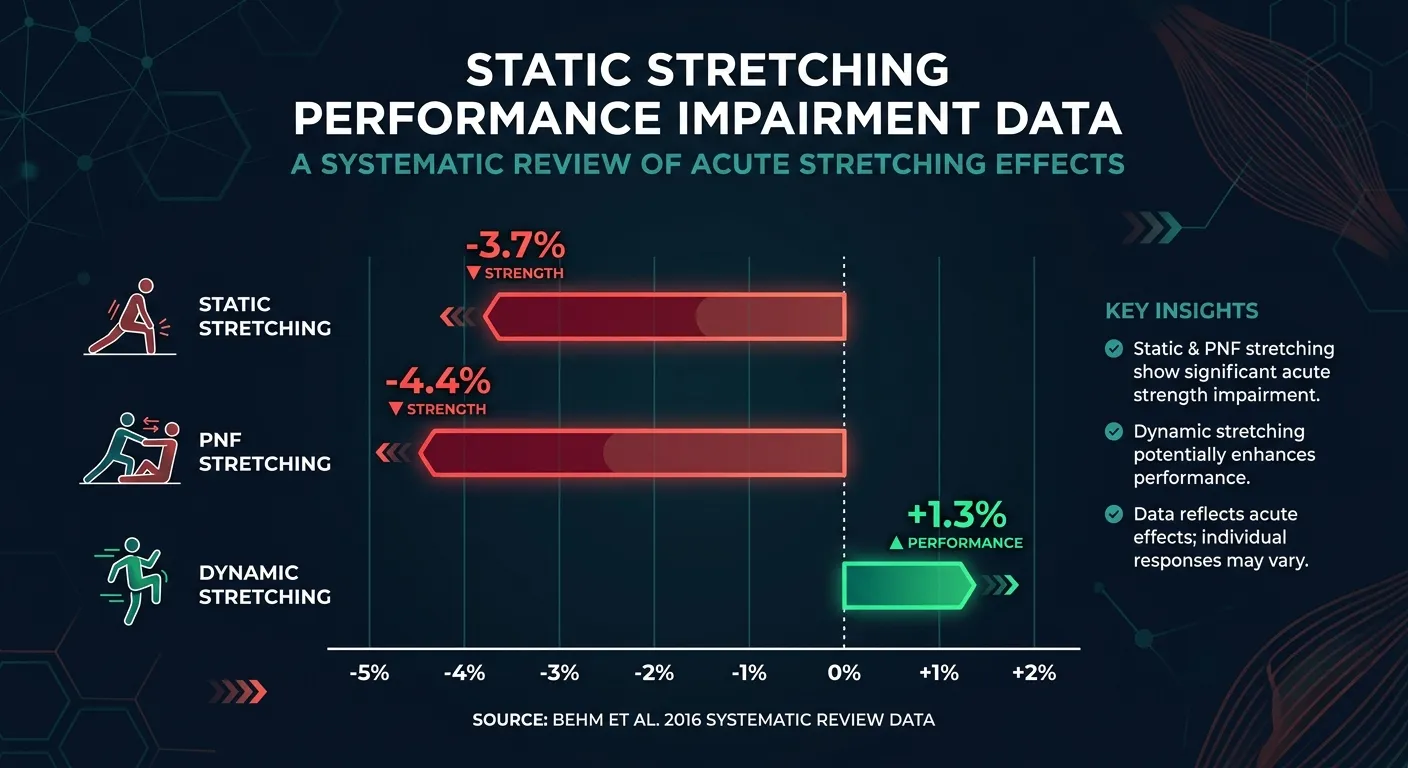
- Static stretching reduced strength performance by 3.7% on average
- PNF stretching (contract-relax) reduced strength by 4.4%
- Dynamic stretching improved performance by 1.3%
- Stretches held 60 seconds or longer caused even bigger deficits: −4.6% versus just −1.1% for shorter holds
- Static stretching increased range of motion by about 8% across 27 studies. So it does something, just not what most people think
That 3.7% might sound small. It's not. For a recreational exerciser, that's the difference between completing your last two reps or failing early. For a sprinter, it's the difference between qualifying and going home. For someone trying to build strength with progressive overload, it means your muscles are producing less force than they're capable of , every single session , because of a warm-up ritual that doesn't help you.
Citation: Behm DG, Blazevich AJ, Kay AD, McHugh M. Acute effects of muscle stretching on physical performance, range of motion, and injury incidence in healthy active individuals: a systematic review. Appl Physiol Nutr Metab. 2016;41(1):1-11.
Why Does Static Stretching Reduce Force?
The mechanisms are well understood at this point. When you hold a muscle in a lengthened position for 30-60+ seconds, you temporarily alter two things:
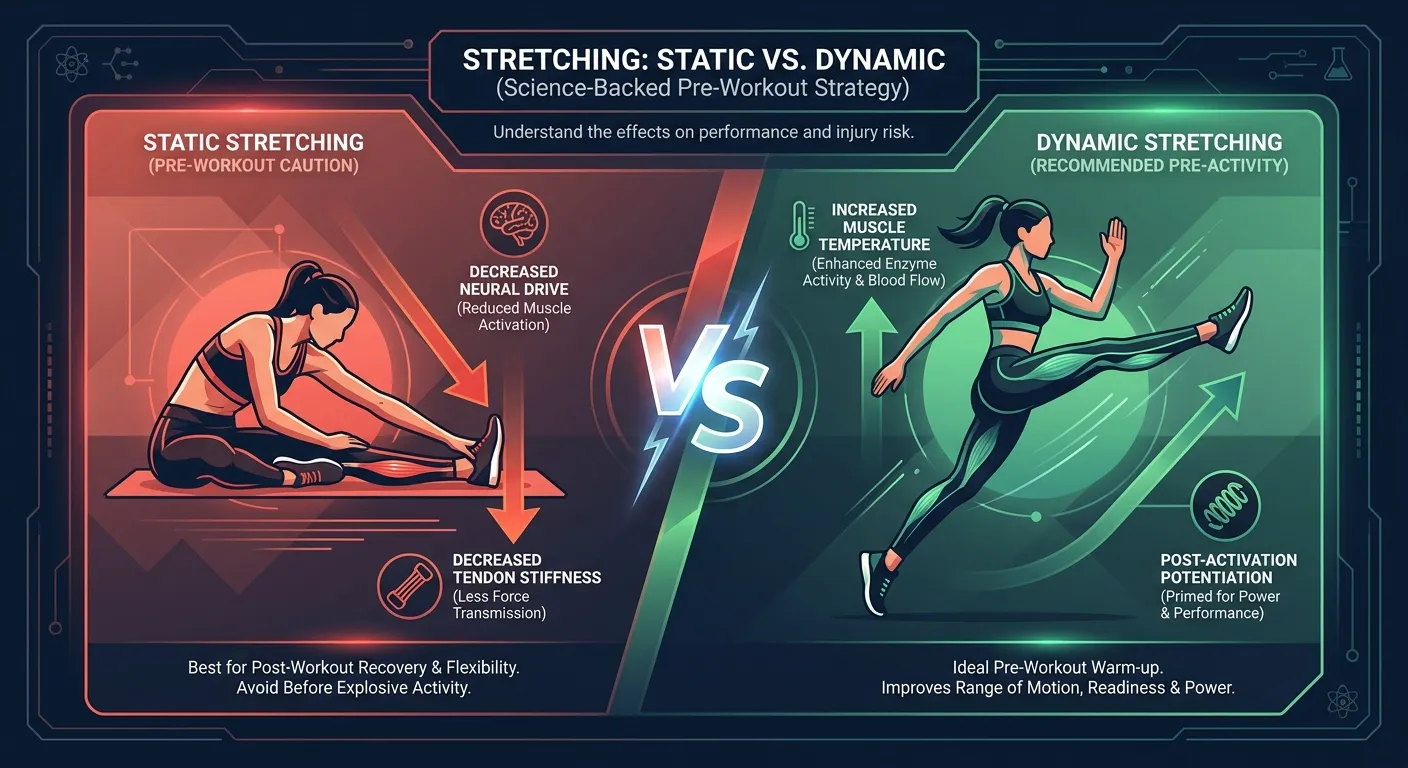
- Neural drive decreases. Your nervous system reduces the signal intensity to the stretched muscle. Think of it like turning the volume knob down on your muscle activation. The muscle can still contract, but it's getting a quieter command.
- Musculotendinous stiffness drops. Your muscle-tendon unit becomes more compliant , more "stretchy." That sounds good in theory, but stiffer tendons actually transfer force more efficiently. A compliant tendon is like a loose rubber band: it absorbs energy instead of transmitting it. For activities requiring power, speed, or maximal force, that's a net negative.
These effects are temporary. They dissipate within about 10-15 minutes. But if you're walking straight from your hamstring stretch into your squat set (which is what most people do), you're squatting with reduced neural drive and reduced tendon stiffness. You are literally less capable than if you'd skipped the stretch entirely. A flowing lunge sequence avoids that trade-off entirely, which is why the worlds greatest stretch has become the default pre-lift drill in so many programs.
Dynamic Stretching: What Actually Works Before Exercise
Dynamic stretching means moving your joints through their full range of motion in a controlled, rhythmic way. Leg swings. Walking lunges. Arm circles. High knees. Movements that look like abbreviated versions of the exercises you're about to do.
The evidence for dynamic warm-ups is the mirror image of the evidence against static stretching before training.
Performance Improves Across the Board
Opplert and Babault published a comprehensive review of dynamic stretching research in Sports Medicine in 2018. Their analysis found "substantial evidence" that dynamic stretching improves:
- Force production , muscles generate more power after dynamic warm-ups
- Sprint performance , faster acceleration and top speed
- Jump height , meaningful improvements in vertical leap
- Range of motion , yes, dynamic stretching increases flexibility too, without the performance penalty
A 2013 study published in the Journal of Strength and Conditioning Research compared dynamic and static warm-ups directly. Athletes who performed dynamic stretching had better sprint times and agility scores than those who did static stretching, and both groups outperformed those who did no warm-up at all.
Citation: Opplert J, Babault N. Acute Effects of Dynamic Stretching on Muscle Flexibility and Performance: An Analysis of the Current Literature. Sports Med. 2018;48(2):299-325.
Why Dynamic Warm-Ups Work
The mechanisms here are the opposite of what happens with static stretching:
- Increased muscle temperature. Active movement raises intramuscular temperature, which improves contractile speed and force production. Warm muscles simply work better.
- Post-activation potentiation. Dynamic movements "wake up" the neural pathways you're about to use. Doing bodyweight squats before barbell squats primes the exact motor patterns you need.
- Rehearsal effect. Moving through exercise-specific ranges of motion prepares your coordination systems for the actual workout. Your body practices the movement before loading it.
This is why a sprinter doing high knees and A-skips before a race runs faster than one who sat on the ground holding a hamstring stretch. The dynamic warm-up prepared the specific systems the sprint demands. The static stretch temporarily dampened them.
Enjoying the article?
Start a new fitness routine today, written by me and coached by the AI I designed.
Take the Free Assessment Free • 2 minutes • No credit cardThe Injury Prevention Myth
Here's where it gets really uncomfortable for stretching advocates. Because the performance argument is one thing , maybe you're willing to sacrifice a little power for protection. That's a reasonable trade-off. Except the protection doesn't exist.
Lauersen et al.: Stretching Doesn't Prevent Injuries
In 2014, Lauersen, Bertelsen, and Andersen published a meta-analysis in the British Journal of Sports Medicine that examined 25 randomized controlled trials involving 26,610 participants. They compared the injury prevention effects of different exercise interventions: stretching, strength training, proprioceptive training, and multicomponent programs.
The results weren't close:
- Stretching: no statistically significant reduction in injury risk. The confidence intervals crossed 1.0, meaning the data couldn't distinguish stretching from doing nothing.
- Strength training: 68% reduction in injury risk , consistent across four studies with zero heterogeneity (I2 = 0%)
- Proprioceptive training: 45% reduction in injury risk
Read that again. Strength training cut injuries by more than two-thirds. Stretching? Statistically no different from skipping it. And this wasn't a small study cherry-picking favorable trials. This was 26,610 people across 25 RCTs.
Lauersen's team followed up in 2018 with a deeper analysis specifically on strength training, confirming the effect was dose-dependent: more strength training volume produced greater injury protection, with no adverse effects observed. The conclusion was blunt , strength training is "superior, dose-dependent, and safe" for injury prevention.
Citations:
- Lauersen JB, Bertelsen DM, Andersen LB. The effectiveness of exercise interventions to prevent sports injuries: a systematic review and meta-analysis of randomised controlled trials. Br J Sports Med. 2014;48(11):871-877.
- Lauersen JB, Andersen TE, Andersen LB. Strength training as superior, dose-dependent and safe prevention of acute and overuse sports injuries. Br J Sports Med. 2018;52(24):1557-1563.
Why the Myth Persists
If the evidence is this clear, why do most people still believe stretching prevents injuries?
A few reasons. The "stretch to prevent injury" advice has been repeated for so long that it feels like established fact. PE teachers taught it. Coaches enforced it. Physical therapists prescribed it. By the time the research caught up, the belief was already cultural. Telling someone that static stretching doesn't prevent injuries feels like telling them that breakfast isn't the most important meal of the day , technically correct, but emotionally jarring. This is closely related to the active recovery research, which shows a similar pattern: a widely recommended practice (light movement between sessions) also has much weaker evidence than people assume.
There's also a confusion between flexibility and injury prevention. Stretching does increase range of motion. And restricted range of motion can contribute to injury in certain contexts. But the assumption that "more flexible = fewer injuries" isn't supported by the population-level data. For most recreational exercisers, adequate range of motion. Not maximal flexibility , is what matters. And adequate ROM is maintained through regular exercise itself, not pre-workout stretching rituals.
Common Misconceptions
Misconception 1: "I need to stretch before exercise to prevent pulling a muscle"
This is the most widespread belief, and the research directly contradicts it. Behm et al.'s 2016 review specifically examined injury incidence and found no meaningful protective effect from pre-exercise static stretching. Lauersen et al.'s 2014 meta-analysis confirmed this across 26,610 participants. If you want to prevent muscle strains, strength training is 68% effective. Stretching? Not statistically different from doing nothing.
Misconception 2: "Static stretching is always bad"
This is the overcorrection. Static stretching isn't harmful , it's poorly timed. The Behm review found that static stretching increases range of motion by about 8%. That's genuinely useful. If you have tight hips limiting your squat depth, or tight hamstrings affecting your deadlift setup, static stretching can help. Just do it after your workout, or on rest days, or as a separate flexibility session. Not in the five minutes before you need maximal force production. If tight hamstrings are the specific thing you're chasing, our guide on how to touch your toes lays out the weekly dose the range-of-motion research actually supports.
Misconception 3: "A few seconds of stretching won't matter"
Duration matters, but even short holds aren't free. Behm et al. found that stretches under 60 seconds still reduced strength by 1.1%. That's smaller than the 4.6% impairment from longer holds, but it's still a decrease in performance , compared to the 1.3% increase from dynamic stretching. Why choose a warm-up that makes you worse when an equally quick alternative makes you better?
What the Evidence Actually Recommends
After two decades of systematic reviews, the practical recommendations are straightforward:
Before exercise:
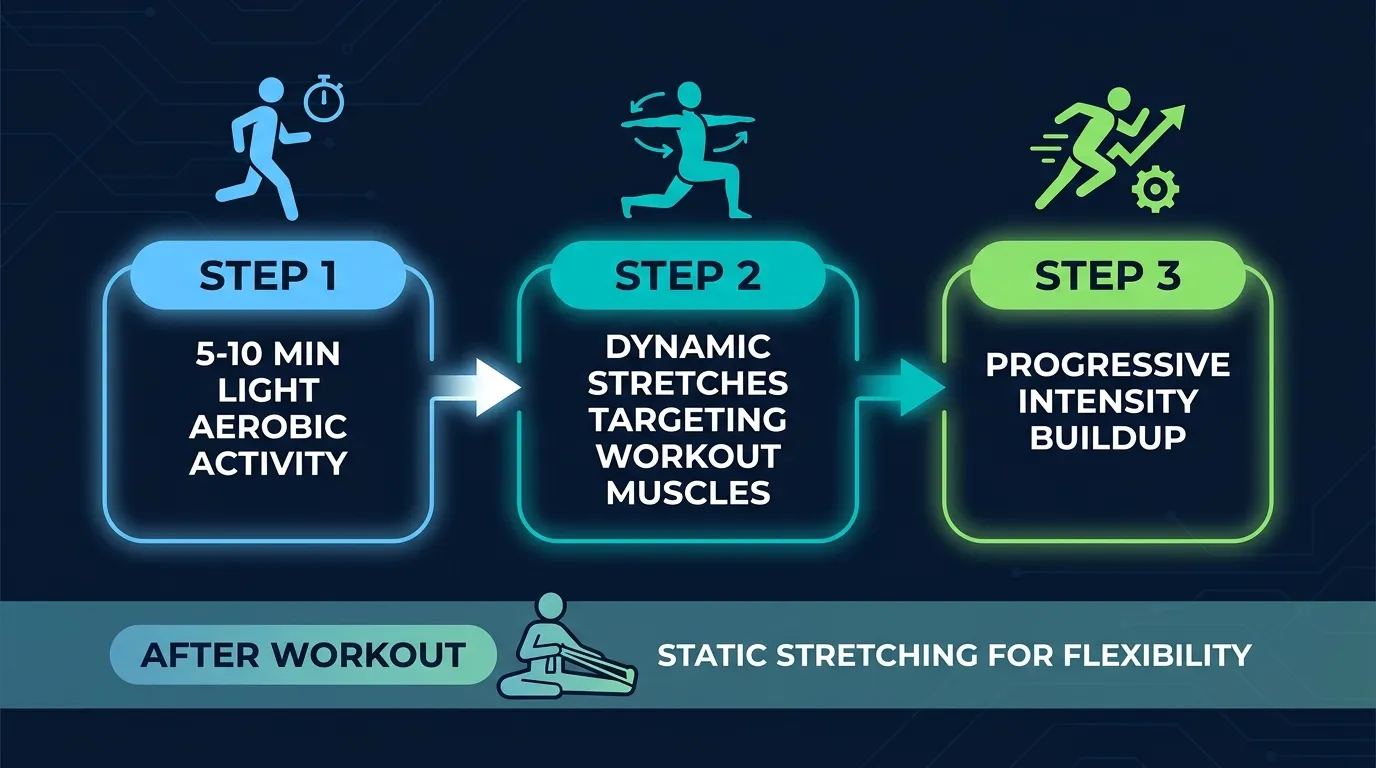
- Start with 5-10 minutes of light aerobic activity (walking, cycling, jumping jacks) to raise muscle temperature
- Follow with dynamic stretches targeting the muscle groups you're about to train
- Make the dynamic movements progressively more intense , start slow, build to near-workout speed
- Skip the static stretching entirely before strength or power activities
After exercise:
- This is when static stretching belongs. Post-workout static stretching can improve flexibility over time without any performance trade-off
- Hold stretches for 30-60 seconds per muscle group
- Focus on muscles that felt tight or restricted during the workout
For injury prevention:
- Prioritize strength training , 68% injury reduction (Lauersen et al., 2014)
- Include proprioceptive and balance work , 45% injury reduction
- Don't rely on stretching as your injury prevention strategy. The data doesn't support it. The full picture from the strength training and injury prevention research makes this clear: progressive resistance work reduces injury risk by 68%, while stretching shows no statistically significant effect.
This isn't controversial in the research community anymore. It's been the consensus position for over a decade. The gap is between what exercise scientists know and what the general public still does.
Should I Stretch Before or After a Workout?
Short answer: dynamic before, static after or in a session of its own. But the two halves of that sentence are supported by very different amounts of evidence, and it is worth knowing which is which. The case against static stretching before training is strong and quantified. The case for static stretching after training is thinner than almost anyone admits, and it rests on flexibility rather than on recovery.
Before. This part is settled. The Behm et al. (2016) review above put static stretching at a 3.7% average strength decrement, rising to 4.6% for holds of 60 seconds or longer, against a 1.3% improvement from dynamic work. Those effects fade in roughly 10 to 15 minutes, so a static stretch early in a long warm-up is not the same problem as one taken straight into a working set. If you genuinely need extra range to get into a position safely, take the stretch, then spend ten minutes doing dynamic work and warm-up sets before the first hard effort. The order and the gap are what you are managing, not the stretch itself.
After. Here is the part that usually gets stated with more confidence than it deserves. Post-workout static stretching is routinely prescribed to speed recovery and reduce soreness, and the trials do not support that. Afonso and colleagues (2021) screened 17,050 records in Frontiers in Physiology and meta-analysed 10 randomised controlled trials covering 229 participants. Compared with simply resting, post-exercise stretching had no effect on strength recovery (effect size -0.08) and no effect on delayed onset muscle soreness at 24, 48 or 72 hours. Their own conclusion was that recommendations for post-exercise stretching as a recovery tool should be avoided, because the available data does not support the claim. The older Cochrane review by Herbert, de Noronha and Kamper (2011) reached the same place from 12 studies: stretching before or after exercise produces, at most, a trivial reduction in soreness, on the order of one point on a hundred-point scale.
So stretch after your workout, but for the right reason. The reason is range of motion, not recovery, and on that outcome the evidence is good. Konrad and colleagues (2024) pooled 77 stretching studies and 186 effect sizes in the Journal of Sport and Health Science and found static and PNF stretching beat ballistic stretching for long-term range, while total volume, intensity and frequency did not significantly change the outcome. Translated: a modest, consistent dose in the cooldown, when you are already warm and no longer need maximal force, is the cheapest place in the week to put flexibility work. Just do not expect it to make tomorrow hurt less. If you want the dose applied to one stubborn joint, our guide on hip flexor exercises and stretching works through what the weekly minimum actually looks like.
How FitCraft Applies This Research
When we built FitCraft's workout programming, these findings shaped every warm-up protocol. Ty , your 3D AI coach , doesn't just tell you to "warm up." He builds a dynamic warm-up specific to the workout you're about to do.
- Movement-specific preparation. If your workout includes squats, Ty programs dynamic hip openers, bodyweight squats, and leg swings. Not static hamstring holds. The warm-up rehearses the exact movement patterns you're about to load.
- Progressive intensity. The warm-up starts light and builds toward workout-level effort. This follows the research showing that gradually increasing intensity produces better potentiation effects than jumping straight into working sets.
- Flexibility where it matters. FitCraft includes dedicated mobility and yoga sessions where static stretching is appropriate and effective , separate from strength and power workouts where it would impair performance.
- Strength-first injury prevention. Rather than relying on stretching for protection, FitCraft's programming progressively builds strength through bodyweight, dumbbell, and resistance band exercises. The intervention with the strongest injury prevention evidence (Lauersen et al., 2014; 2018).
These aren't marketing claims bolted onto a generic app. They're design decisions made by an Ivy League-trained exercise scientist who studied this literature. Every warm-up Ty builds maps to a specific finding in the research above, and the free version includes all of it.
References
- Behm DG, Blazevich AJ, Kay AD, McHugh M. "Acute effects of muscle stretching on physical performance, range of motion, and injury incidence in healthy active individuals: a systematic review." Applied Physiology, Nutrition, and Metabolism 41.1 (2016): 1-11. doi:10.1139/apnm-2015-0235
- Lauersen JB, Bertelsen DM, Andersen LB. "The effectiveness of exercise interventions to prevent sports injuries: a systematic review and meta-analysis of randomised controlled trials." British Journal of Sports Medicine 48.11 (2014): 871-877. doi:10.1136/bjsports-2013-092538
- Lauersen JB, Andersen TE, Andersen LB. "Strength training as superior, dose-dependent and safe prevention of acute and overuse sports injuries: a systematic review, qualitative analysis and meta-analysis." British Journal of Sports Medicine 52.24 (2018): 1557-1563. doi:10.1136/bjsports-2018-099078
- Opplert J, Babault N. "Acute Effects of Dynamic Stretching on Muscle Flexibility and Performance: An Analysis of the Current Literature." Sports Medicine 48.2 (2018): 299-325. doi:10.1007/s40279-017-0797-9
- Perrier ET, Pavol MJ, Hoffman MA. "The acute effects of a warm-up including static or dynamic stretching on countermovement jump height, reaction time, and flexibility." Journal of Strength and Conditioning Research 25.7 (2011): 1925-1931. doi:10.1519/JSC.0b013e3181e73959
- Afonso J, Clemente FM, Nakamura FY, et al. "The Effectiveness of Post-exercise Stretching in Short-Term and Delayed Recovery of Strength, Range of Motion and Delayed Onset Muscle Soreness: A Systematic Review and Meta-Analysis of Randomized Controlled Trials." Frontiers in Physiology 12 (2021): 677581. doi:10.3389/fphys.2021.677581
- Herbert RD, de Noronha M, Kamper SJ. "Stretching to prevent or reduce muscle soreness after exercise." Cochrane Database of Systematic Reviews 7 (2011): CD004577. doi:10.1002/14651858.CD004577.pub3
- Konrad A, Alizadeh S, Daneshjoo A, et al. "Chronic effects of stretching on range of motion with consideration of potential moderating variables: A systematic review with meta-analysis." Journal of Sport and Health Science 13.2 (2024): 186-194. doi:10.1016/j.jshs.2023.06.002
Frequently Asked Questions
Does static stretching before exercise reduce performance?
Yes. A 2016 systematic review by Behm et al. in Applied Physiology, Nutrition, and Metabolism found that static stretching before exercise reduces strength performance by an average of 3.7%. Stretches held for 60 seconds or longer produce even larger impairments of 4.6%. Dynamic stretching, by contrast, improved performance by 1.3% in the same review.
Does stretching prevent injuries?
The evidence says no. At least not in the way most people think. A landmark meta-analysis by Lauersen et al. (2014) covering 26,610 participants found that stretching programs had no statistically significant effect on injury prevention. Strength training was far more effective, reducing injury risk by 68%. If injury prevention is your goal, strength training beats stretching by a wide margin.
Should I do dynamic or static stretching before a workout?
Dynamic stretching before a workout is the evidence-based recommendation. Research consistently shows dynamic warm-ups improve power, sprint speed, and jump height, while static stretching before exercise can temporarily reduce strength and explosiveness. Save static stretching for after your workout or on rest days when you want to improve flexibility without performance concerns.
Should I stretch before or after a workout?
Both, for different reasons. Before a workout, use dynamic stretching: Behm et al. (2016) measured a 3.7% average strength decrement from static stretching beforehand against a 1.3% improvement from dynamic work, and those effects fade in about 10 to 15 minutes, so a static stretch early in a long warm-up is far less costly than one taken straight into a working set. After a workout is the right slot for static stretching, but for range of motion rather than recovery. Afonso and colleagues (2021) meta-analysed 10 randomised trials in 229 participants and found post-exercise stretching had no effect on strength recovery or on soreness at 24, 48 or 72 hours compared with simply resting, and a 2011 Cochrane review reached the same verdict. Stretch after because you want to be more flexible, not because you want to be less sore.
Is static stretching bad for you?
Static stretching isn't bad , it's just poorly timed in most people's routines. Static stretching effectively increases range of motion (an average 8% ROM increase per Behm et al., 2016) and has value in post-workout cooldowns and dedicated flexibility sessions. The problem is doing it immediately before strength or power activities, where it temporarily impairs muscle force production.
Does FitCraft include warm-ups in its workouts?
Yes. FitCraft's AI coach Ty builds dynamic warm-ups into every workout based on the exercises in your session. The warm-up targets the specific muscle groups you're about to use, following the research showing movement-specific dynamic preparation outperforms generic static stretching. The free version includes full warm-up programming.