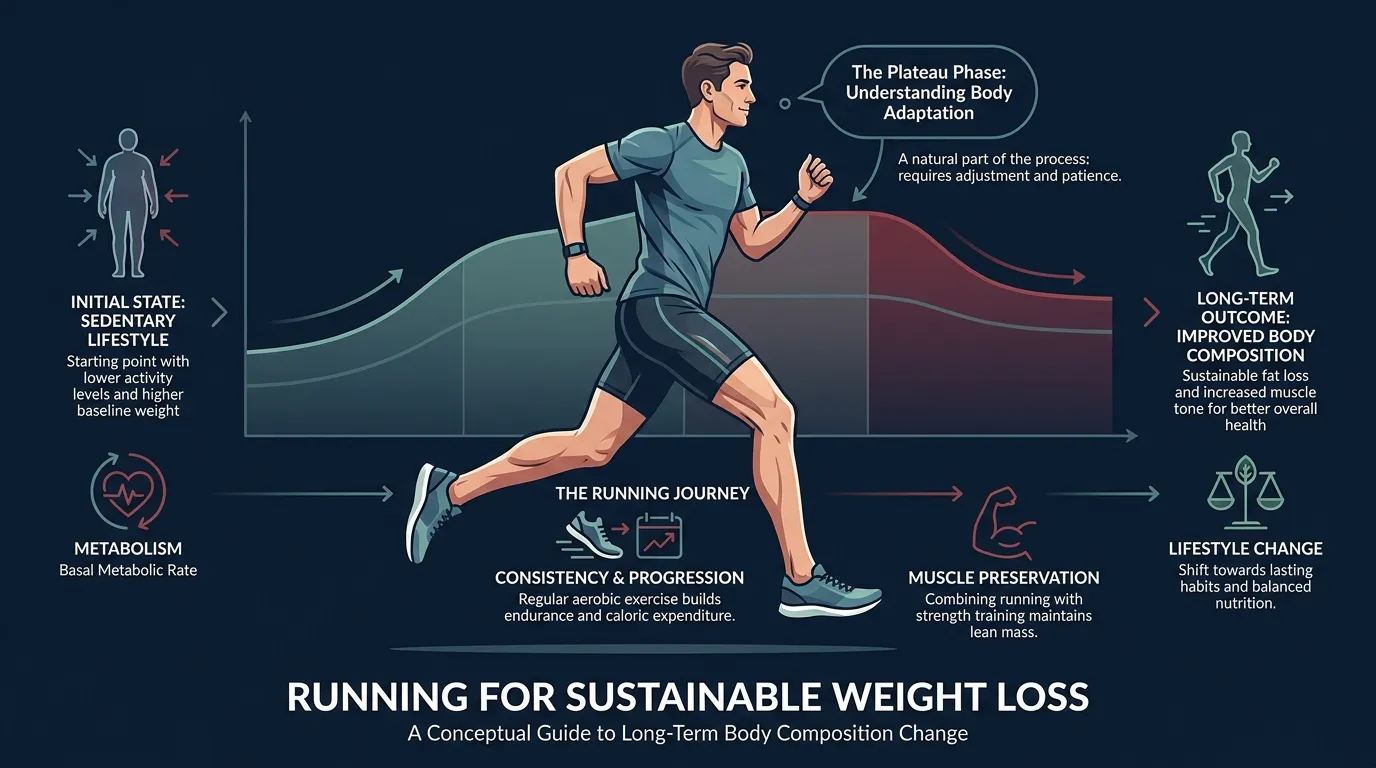
Running for weight loss works, just slower than the photos suggest. Expect the scale to start moving between weeks three and six, visible body-composition change by weeks eight to twelve, and roughly 0.5 to 1 pound per week once you are running 150 or more minutes weekly. Across 116 randomized trials, 150 minutes per week of aerobic exercise averaged 2.8 kg (about 6 pounds) of weight loss and 300 minutes per week averaged 4.2 kg (about 9 pounds). The week-six plateau almost everyone hits is compensation, not failure.
Updated September 2026: this article now includes the 2024 JAMA Network Open dose-response meta-analysis, a dose table that puts the ACSM guidance and the trial averages side by side, a weekly protocol table, and corrected ACSM thresholds (the position stand's cutoff for clinically significant weight loss is 250 minutes per week, not 300).
You search "running for weight loss results" and the internet shows you transformation photos with timestamps two months apart. Twenty pounds gone. Skin tightened. The new running shoes still spotless in the "after" shot. It looks like running is the most efficient weight loss tool in existence.
The research tells a different story. Running absolutely produces weight loss, but the timeline is slower than the photos suggest, the mechanism is more complicated than "burn more than you eat," and almost everyone who starts running hits a frustrating plateau around weeks five to seven that the Instagram montages skip past. The runners who actually keep losing weight aren't the ones who run hardest. They're the ones who understand what's happening physiologically and adjust.
Here's what 30 years of exercise-and-weight-loss research says you should actually expect, and how to get the results that the social media posts pretend are normal.
What Does Running Actually Do for Weight Loss?
Running burns more calories per minute than almost any common activity except cross-country skiing and competitive swimming. A 170-pound runner moving at a 10-minute-per-mile pace burns roughly 100 calories per mile, or around 600 calories per hour. That's real energy out. Run three times a week for an hour each and you've created a 1,800-calorie-per-week deficit on top of your normal life. By the simplest math, that's about half a pound of fat per week.
If weight loss worked by simple math, every consistent runner would lose 25 pounds a year. They don't. The body has elaborate, well-studied systems for resisting the energy deficit running creates.
The Calorie Math Works In Theory
The first law of thermodynamics is not optional. To lose body fat you have to expend more energy than you consume, period. Running expends energy. Therefore running, all else being equal, should produce weight loss. This part of the story is straightforward and correct.
The 2009 American College of Sports Medicine position stand on exercise and weight loss, written by Donnelly et al. in Medicine and Science in Sports and Exercise, pooled the available evidence and gave clear dose guidance. Moderate activity between 150 and 250 minutes per week prevents weight gain but produces only "modest" weight loss. Amounts above 250 minutes per week are what the evidence associates with "clinically significant" weight loss through exercise alone, and weight maintenance after a loss also improves above 250 minutes per week. Those numbers explain a lot of frustration. Three short runs of 30 minutes each (90 minutes total) sits below even the modest-weight-loss range. To use running to drive meaningful fat loss without changing what you eat, the dose is closer to 4 or 5 hours per week than 1.5.
A 2024 dose-response meta-analysis in JAMA Network Open (Jayedi et al.) pooled 116 randomized trials and 6,880 adults with overweight or obesity and turned those thresholds into a curve. Each additional 30 minutes per week of supervised aerobic exercise was associated with 0.52 kg less body weight, 0.56 cm less waist circumference, and 0.37 percentage points less body fat, with the reductions continuing roughly linearly up to 300 minutes per week. The authors concluded that more than 150 minutes per week at moderate intensity or above is probably needed for clinically important change.
| Weekly running or aerobic dose | ACSM 2009 position stand | Jayedi 2024 pooled trial average | What it looks like for a runner |
|---|---|---|---|
| Under 150 min | Below the range studied for weight loss | Roughly 0.5 kg per 30 min/week; about 1.5 kg at 90 min | Three 30-minute runs; fitness improves, scale barely moves |
| 150 to 250 min | Prevents weight gain, "modest" weight loss | About 2.8 kg at 150 min/week | Three to four 40 to 60 minute runs, or run plus walk days |
| More than 250 min | "Clinically significant" weight loss; better weight maintenance | About 4.2 kg at 300 min/week; 4.2 cm off the waist | Four to five runs plus daily walking; 4 to 5 hours total |
Trial averages hide a lot of variation, which is the subject of the next section. But the shape is clear: the dose that moves the scale is measured in hours per week, not in how hard any single run feels.
Why The Math Doesn't Play Out In Practice
The reason real-world results lag behind theoretical calorie math is documented in dozens of trials, but the cleanest illustration is King and colleagues' 2008 paper in the International Journal of Obesity. Researchers put 58 sedentary, overweight men and women on a 12-week supervised exercise program designed to produce a 500-calorie-per-day deficit through training alone. Total predicted weight loss for the group: about 12 kilograms over the trial. Actual mean weight loss: 3.7 kilograms. Less than a third of what the math predicted.
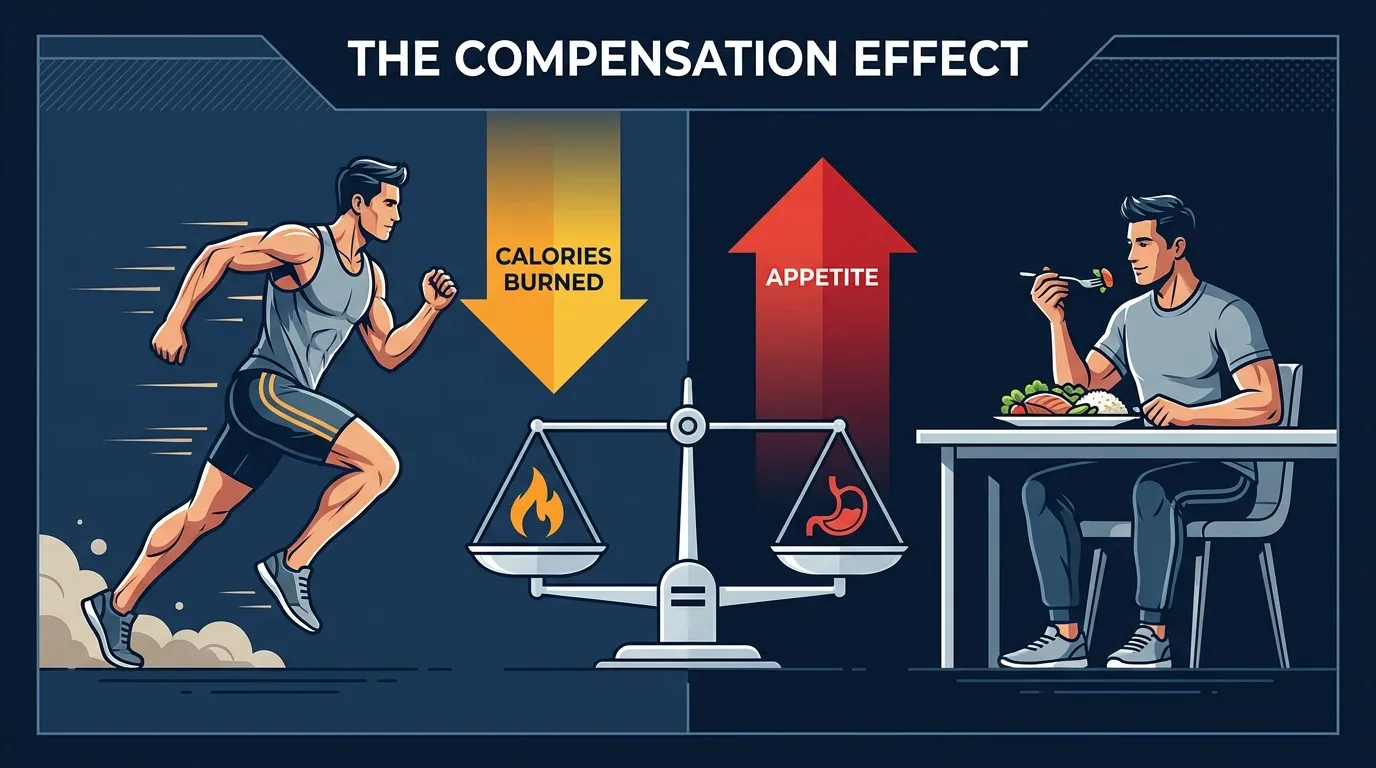
The variation was huge. Some participants lost as much as predicted. Others lost almost nothing. When the researchers broke the group into "responders" and "compensators," the compensators had unconsciously increased their food intake and decreased their non-exercise movement enough to offset most of the deficit the training created. They weren't lying. They didn't know they were doing it. The body was doing it.
This is the central, under-discussed fact of using exercise for weight loss. The deficit you create with the workout is not the deficit your body experiences. Your body fights back with hunger you barely notice, a slightly slower resting metabolism, and a near-imperceptible reduction in fidgeting and walking around. Pontzer and colleagues' 2016 paper in Current Biology formalized this as the "constrained total energy expenditure" model. Beyond a moderate threshold, additional exercise produces diminishing returns on total daily energy expenditure because the body compensates elsewhere.
Running doesn't break this rule. It just operates within it.
What Is the Real Running Weight Loss Timeline, Month by Month?
Here's a more honest sketch of what a beginner-to-intermediate runner aiming for weight loss can expect, based on the trial averages and accounting for compensation.
Weeks 1 to 4: Almost Everything Except Weight
The first month is fitness improvement, not fat loss. Your cardiovascular system adapts fast. Your resting heart rate drops. Sleep improves. Mood lifts. The scale might not move at all, and might even creep up a pound or two from increased muscle glycogen storage (each gram of glycogen binds about three grams of water) and post-run inflammation. Anyone who tells you "I lost 10 pounds in 4 weeks just from running" was either very overweight to start, very calorie-restricted alongside the running, or measuring water weight.
Weeks 4 to 8: The First Real Numbers
Around week four to six, if total weekly volume has crept up to roughly 90 to 150 minutes, the scale typically starts moving. Half a pound to a pound per week is the realistic range, lower if you're already lean, higher if you have more weight to lose. This is also when most people experience the first plateau. The compensation effect kicks in. Hunger ramps up. The body starts to recapture some of the deficit.
Weeks 8 to 16: Visible Change
By week eight to twelve, runners who have stayed consistent often see body-composition changes that show up in clothes and photos, not just on the scale. Faces look leaner. Pants fit differently. This is where most of the dramatic before-and-after content comes from. But getting here requires staying in the program through the week-five-to-seven plateau, which is where most people quit.
Months 4 to 6: The Long Tail
Past four months, the rate of loss usually slows further. The body becomes a more efficient runner (better economy means fewer calories per mile) and the compensation gets more pronounced. Runners who want continued losses past this point typically need to add dietary attention or increase total mileage, often both. Williams' 2007 analysis of 8,340 long-term runners in the National Runners' Health Study found that runners who held their weekly distance steady still gained weight as they aged, but the gain scaled with how much they were running: those holding 48 km per week or more gained about half as much per year as those holding under 24 km. Staying the same weight while aging took more mileage, not the same mileage.
Why Do Runners Plateau at Week Six?
This is the part the transformation photos won't tell you about. Around weeks five to seven, two things start happening at the same time. Your body has adapted enough that the same run feels easier, which means it burns fewer calories than it did when you started. And the compensation effect, the unconscious extra eating and reduced daily movement, has had enough time to build a real offset. The scale stops moving even though your training feels harder than ever.
Most people interpret this plateau as evidence that running "doesn't work" for them. Or they try to fix it by running more, which makes the hunger compensation worse and increases injury risk. Or they give up.
What Actually Works At The Plateau
The runners who break through the week-six plateau and keep losing weight tend to do three specific things, all backed by trial data.
They start tracking food intake honestly, for a limited window. Not forever. Just long enough to see the real picture. Most plateaued runners are not hungry monsters. They've added 200 to 400 calories a day in small ways. An extra snack. Bigger portions. More peanut butter on the toast. A two-week food log usually surfaces the leak without requiring a "diet."
They add walking on non-run days. Walking is the most underused fat-loss tool because the calorie burn per minute is modest. But it doesn't trigger the compensatory hunger response the way harder exercise does. Foster-Schubert and colleagues' 2012 trial in Obesity randomized 439 postmenopausal women to diet alone, exercise alone, both, or control. The combined diet-and-exercise group lost roughly twice as much weight as exercise alone, and the exercise component included walking, not high-intensity training. For runners, layering 30 to 60 minutes of daily walking on top of three or four running sessions widens the deficit without ramping hunger.
They protect muscle with strength work. Running alone, especially at higher volumes, tends to chip away at lean mass along with fat. Lower lean mass means lower resting metabolism, which means smaller deficit, which means slower loss. Two short strength sessions per week (bodyweight or light resistance) preserve muscle and keep the metabolic floor intact. The beginner-onramp guide covers the simplest entry points if you've never done structured strength work.
Knowing what to do is the easy part.
FitCraft, our mobile fitness app, pairs you with an AI coach who builds you a personalized plan around your goals, schedule, and fitness level. Every FitCraft program is designed by Domenic Angelino, MPH (Brown University) and NSCA-CSCS, with research published in the Journal of Strength and Conditioning Research and Medicine & Science in Sports & Exercise.
Take the Free Assessment Free • 2 minutes • No credit cardHow Do You Actually Lose Weight With Running?
Most "running for weight loss" advice online is recycled from couch-to-5k programs that were designed to get people running, not to optimize fat loss. The protocols that actually produce sustained weight loss share a few features.
Build To Volume, Not Intensity
If you're running for weight loss, the goal is total time on feet, not peak speed. Beginners do better at the easy conversational pace where they can hold a sentence between breaths. Hard intervals will improve fitness faster, but they also spike hunger more, increase injury risk on new runners, and don't burn meaningfully more calories per session than easy running of the same duration. The dose that matters is minutes per week. Build there first. Tempo and intervals can come later, once a 30 to 45 minute easy run feels routine.
Three To Five Days A Week, Not Seven
Daily running sounds disciplined and usually backfires. Soft tissue (tendons, ligaments, plantar fascia) adapts more slowly than cardiovascular fitness, and the first six to twelve weeks of running are when most injuries happen. Three to five days a week with one or two complete rest days lets connective tissue catch up and reduces the compensation-driven hunger of constant training. Daily running specifically has its own tradeoffs covered elsewhere.
Pair It With Walking, Not With Intense Cross-Training
The combo that works best for fat loss is running plus walking, not running plus cycling-sprints or running plus HIIT. The reason is the same compensation logic. Walking adds calorie burn without ramping the appetite-and-fatigue response that harder cross-training triggers. Aim for 8,000 to 12,000 daily steps as a background floor, with running on top.
Eat Enough To Recover, Less Than You Did Before
The runners who lose weight long-term don't crash-diet. They eat enough protein (around 1.6 g/kg of body weight per day) to support muscle repair, get carbohydrate around their runs so they don't bonk, and trim incidental calories elsewhere. A modest 300 to 500 calorie daily deficit, combined with consistent running, produces sustainable loss without wrecking energy levels or training quality. Bigger deficits tend to crater performance and trigger rebound eating.
A Week That Actually Produces Fat Loss
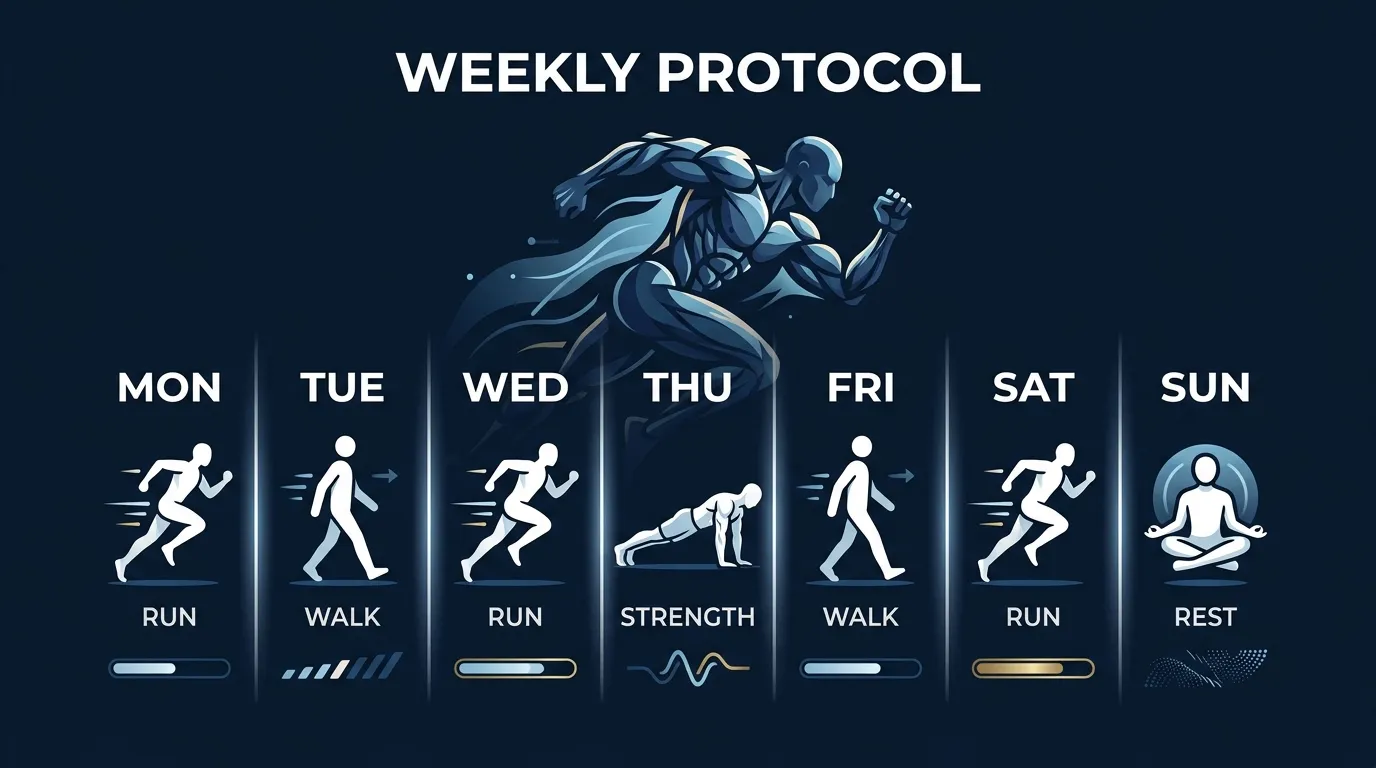
Put together, a week built for weight loss rather than for race speed looks like this. Total running time lands around 150 to 200 minutes, walking adds another 3 to 5 hours of low-hunger energy expenditure, and two short strength sessions protect lean mass. The reason that week holds both is cost per minute against cost per injury, which we worked through in which one actually burns more.
| Day | Session | Time | Purpose |
|---|---|---|---|
| Monday | Easy run | 40 to 50 min | Conversational pace; volume, not speed |
| Tuesday | Walk plus strength | 45 min walk, 20 min strength | Low-hunger calorie burn; squat, hinge, push, pull |
| Wednesday | Easy run | 40 to 50 min | Second volume day |
| Thursday | Walk | 45 to 60 min | Recovery for tendons; keeps the weekly deficit open |
| Friday | Easy run or run-walk | 30 to 40 min | Shorter third run; run-walk intervals if legs are heavy |
| Saturday | Long easy run plus strength | 50 to 60 min run, 20 min strength | Biggest single dose of the week; second strength session |
| Sunday | Rest or gentle walk | 0 to 30 min | Full recovery; step count only |
Can You Really Lose 100 Pounds by Running?
Big transformation stories are real. They also tend to involve more than just running. The threads where people credit running for losing 50, 75, or 100 pounds, when you read the full posts, almost always include some combination of: starting from a very high body weight (where deficits create faster initial loss), simultaneous dietary changes (often substantial), and sustained training over 12 to 24 months, not 12 weeks. The "I run and lost 100 pounds" headline compresses two years of consistent behavior into a single sentence.
That's not a knock on those stories. It's the opposite. They're proof that running plus consistency works for serious weight loss. They just rarely happen in the four-month window most people give themselves before quitting. If you're reading those threads to set your own expectations, set them long. The same Reddit posters who lost dramatic weight running almost universally describe the first three to six months as "barely visible" before the change accelerated.
What Does This Mean for You?
If you're starting a running program for weight loss, the most useful thing you can do today is detach from week-by-week scale movement. The body doesn't lose fat on a clean linear schedule. It loses water and glycogen first, plateaus, fights compensation, breaks through, plateaus again, breaks through again. Expecting that pattern instead of the steady downward slope the diet ads promise is the single biggest psychological edge you can give yourself.
Anchor your weeks to time on feet, not to the scale. Three to five running sessions. Walk on the rest days. Two short strength sessions if you can fit them. Eat enough to train well. Then check the scale every two weeks instead of every morning. The plateau at week six is normal. The visible change at week ten is normal. The two-step-forward-one-step-back pattern is normal. Quitting before you see month three is what makes "running for weight loss results" feel like a thing that works for everyone but you.
The runners who lose weight aren't the fastest. They're the ones still running in week 16. And the reason most quit before then isn't lack of willpower. It's that they were running a plan calibrated to make them faster, not a plan calibrated to make them keep going. Those are different programs. If you want an app to hold that plan for you, our roundup of the best workout apps for weight loss compares the options on exactly that criterion: which ones keep people training past month three.
Frequently Asked Questions
How long does it take to see weight loss results from running?
Most people see the first measurable scale change between week three and week six of consistent running, but visible changes in body composition usually take eight to twelve weeks. A 2024 meta-analysis of 116 randomized trials (Jayedi et al., JAMA Network Open) found that 150 minutes per week of aerobic exercise produced about 2.8 kg of weight loss over trials lasting eight weeks or more, and 300 minutes per week produced about 4.2 kg. Faster timelines on social media usually combine running with a substantial calorie deficit, not running alone.
How much running per week do you need to lose weight?
The American College of Sports Medicine's 2009 position stand on weight loss reports that 150 to 250 minutes per week of moderate activity produces only modest weight loss, and that more than 250 minutes per week is associated with clinically significant weight loss and with keeping weight off afterward. For most runners that means three to five sessions per week totaling around 15 to 25 miles, or a mix of running and walking that hits the same time on feet.
Why am I running and not losing weight?
The most common reason is compensatory eating. King and colleagues (2008) found that across 58 sedentary adults doing 12 weeks of supervised exercise, the average actual weight loss was only about half of what energy expenditure predicted, because participants unconsciously ate more and moved less outside of training. Other common causes include underestimating snack calories, weight regain from glycogen and water during high-mileage weeks, and plateau patterns from metabolic adaptation.
Is running better than walking for weight loss?
Running burns roughly twice as many calories per minute as walking, so for the same time invested it produces a larger energy deficit. Williams (2013) tracked 32,216 runners and 15,237 walkers over 6.2 years and found that changes in running distance predicted weight loss more strongly than equivalent changes in walking, though walking still moved body weight in the same direction. For most people, the best protocol is the one they will actually do consistently, which is often walking initially and running once cardiovascular fitness improves.
How does FitCraft help with running for weight loss?
FitCraft pairs you with an AI coach who builds a personalized running and cross-training program around your goals, current fitness level, and schedule. The plan progresses as you progress, layering in walk-run intervals, easy runs, strength work, and mobility based on what your weeks actually look like. The free version includes the assessment, program creation, and the in-workout 3D coaching that keeps you moving when motivation dips.