- Zone 2 cardio is sustained low-intensity exercise at 60–70% of your max heart rate. That's the range where fat oxidation peaks and mitochondrial density builds.
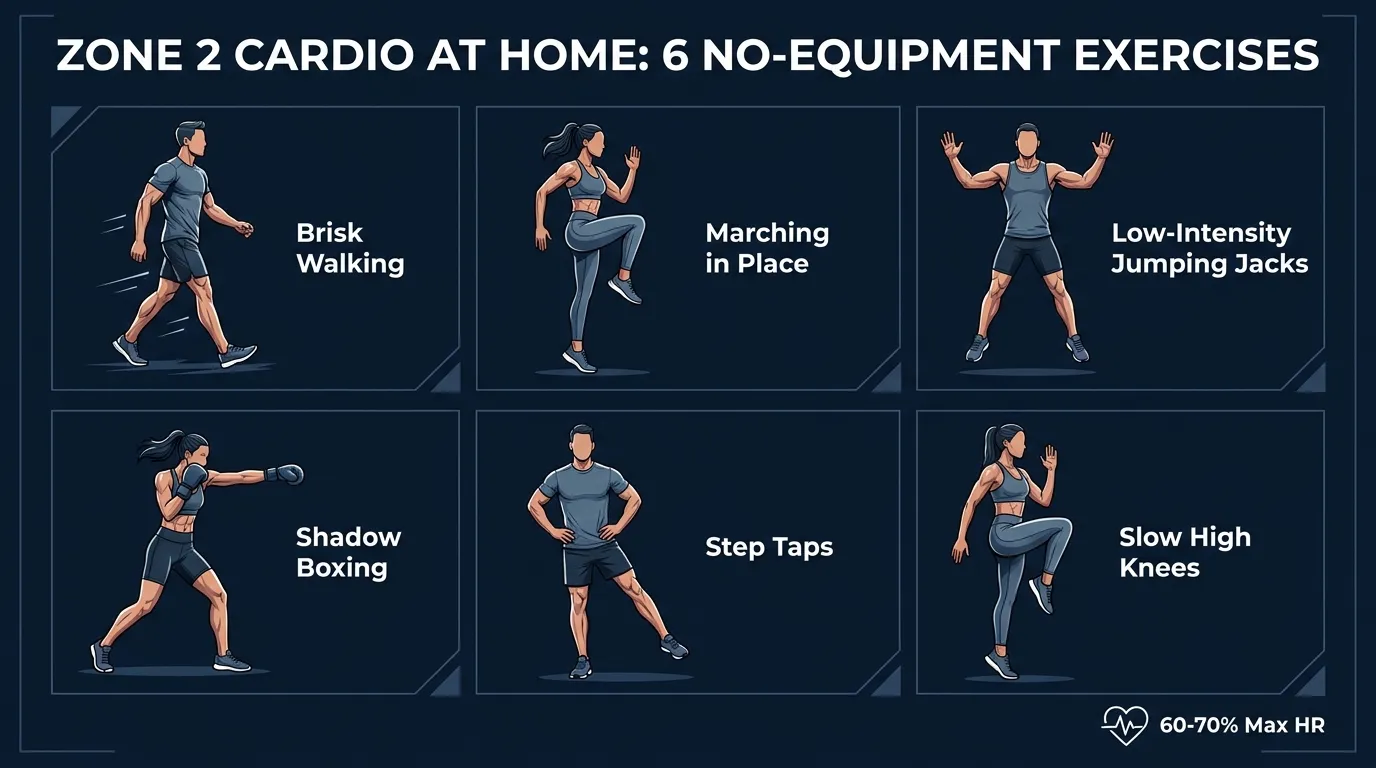
- You can do it at home with zero equipment: brisk walking, marching in place, slow jumping jacks, shadow boxing, and low-intensity step patterns all work.
- A 2025 narrative review in Sports Medicine found Zone 2 works best as the aerobic base of a broader program. It's a foundation, not a replacement for all other training.
- The hardest part of Zone 2 isn't the intensity. It's showing up for 30–60 minutes multiple times per week, consistently, over months.
Zone 2 cardio has taken over fitness conversations in 2026. Longevity podcasters won't stop talking about it. Researchers study it. #Zone2Cardio racks up millions of views on TikTok and Instagram. And yet most people who try it are either going too hard (accidentally training Zone 3 or 4 the whole time) or can't figure out how to do it at home without a treadmill.
So here's the actual guide. What Zone 2 is, what it does, which home exercises get you there, how to structure it, and the one thing most online coverage gets wrong about it.
What Is Zone 2 Cardio?
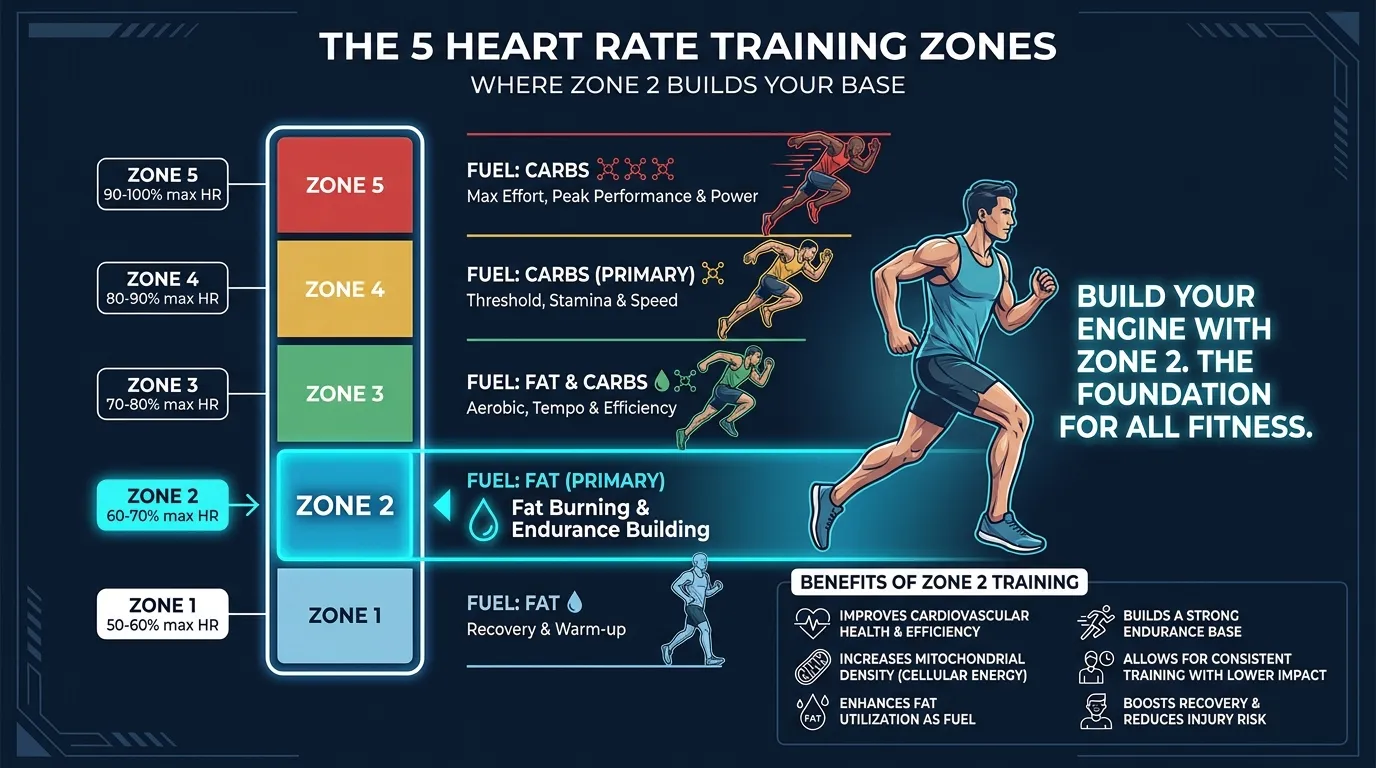
Zone 2 refers to a specific intensity range in a five-zone heart rate training model. The zones are determined as percentages of your maximum heart rate:
- Zone 1 (50–60%): Recovery pace. Easy walking. Almost no training stimulus.
- Zone 2 (60–70%): Low aerobic. Fat is the primary fuel. Lactate stays below ~2 mmol/L. You can talk in full sentences.
- Zone 3 (70–80%): Moderate aerobic. Breathing becomes labored. Conversation is possible but difficult.
- Zone 4 (80–90%): Threshold. Hard, sustainable effort. Lactate rising. Most HIIT sessions land here.
- Zone 5 (90–100%): Maximal effort. Sprints, VO₂ max intervals. Not sustainable for more than a few minutes.
Zone 2 is the "conversational" zone. You feel like you're working, your breathing is noticeably elevated, but you could narrate what you're doing to someone standing next to you.
The Physiological Mechanism
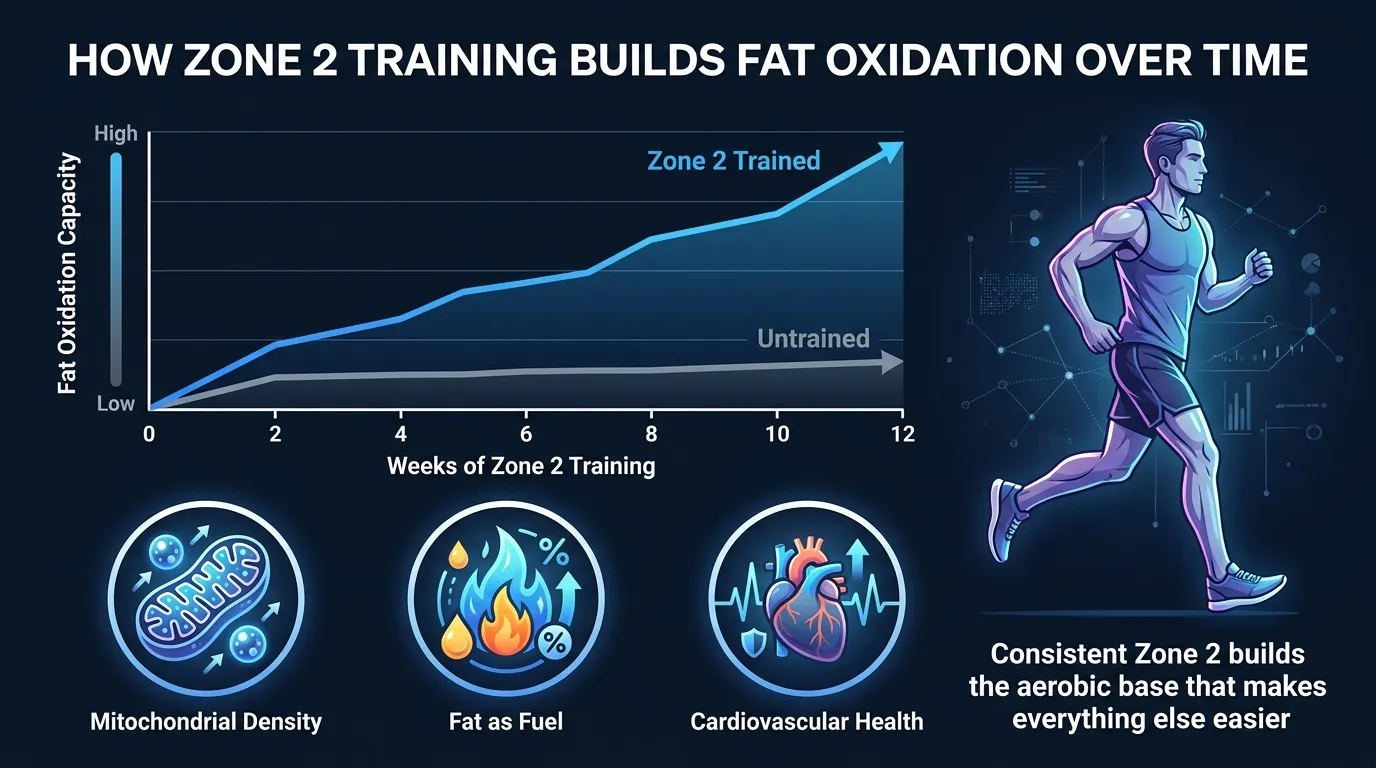
At Zone 2 intensity, your mitochondria (the energy-producing organelles in your muscle cells) are working near capacity without being overwhelmed. That creates an adaptation signal. The body responds by building more mitochondria and making existing ones more efficient. More mitochondria means more capacity to oxidize fat, better endurance, and improved metabolic health over time.
Researcher Iñigo San-Millán, who has studied Zone 2 in Tour de France cyclists and metabolic patients alike, describes it as the intensity where "mitochondrial function is maximized." His work on fat oxidation rates (San-Millán and Brooks, Sports Medicine, 2018) showed that metabolically healthy individuals have a significantly higher fat oxidation rate at Zone 2 compared to people with metabolic dysfunction. Training in this zone can partially restore that capacity.
How to Estimate Your Zone 2 Heart Rate
The standard formula for maximum heart rate is 220 minus your age. Zone 2 is 60–70% of that number.
- Age 25: Max HR ≈ 195 bpm → Zone 2: 117–137 bpm
- Age 35: Max HR ≈ 185 bpm → Zone 2: 111–130 bpm
- Age 45: Max HR ≈ 175 bpm → Zone 2: 105–123 bpm
- Age 55: Max HR ≈ 165 bpm → Zone 2: 99–116 bpm
The 220-minus-age formula has error bars of ±10-12 bpm. If you have a wearable that tracks heart rate, use it. If you don't, use the talk test. You should be able to speak in complete sentences without pausing to breathe, but you shouldn't feel like you're at a comfortable rest. Our heart rate zone calculator does this arithmetic for you, and it defaults to a formula that holds up better than 220 minus age.
Zone 2 Benefits: What the Research Shows
Let's be precise about what Zone 2 training actually does, because the popular coverage has both undersold and oversold it.
Mitochondrial Density and Efficiency
This is the best-supported benefit. Sustained low-intensity aerobic exercise is one of the strongest known stimuli for mitochondrial biogenesis (the creation of new mitochondria). More mitochondria per cell means more capacity to produce energy aerobically, which translates to better endurance, faster recovery between efforts, and improved metabolic health. Meinild Lundby et al. (2018) demonstrated that endurance training increases mitochondrial volume density in skeletal muscle, primarily by enlarging existing mitochondria rather than building new ones from scratch.
Fat Oxidation
Zone 2 is the intensity at which fat oxidation (burning fat as fuel) peaks. Research by Achten and Jeukendrup (2003) established that maximal fat oxidation (known as "fatmax") typically occurs at 45–65% of VO₂max, which corresponds closely to Zone 2 for most people. Above that intensity, carbohydrate starts to dominate. That's why endurance athletes do the bulk of their training in Zone 2. The point isn't to "burn fat" during the session per se. The point is to train the metabolic machinery that makes fat a reliable fuel source.
Cardiovascular Longevity Markers
Consistent Zone 2 training improves resting heart rate, heart rate variability (HRV), stroke volume, and VO₂max over time. These markers are strongly associated with all-cause mortality. A review by Franklin et al. (2018) in the American Journal of Cardiology found that cardiorespiratory fitness is among the most powerful predictors of long-term health outcomes, stronger than most traditional risk factors.
What Zone 2 Won't Do (The 2025 Reality Check)
A 2025 narrative review in Sports Medicine (Storoschuk et al., one of the most cited sports science journals) pulled back on some of the more enthusiastic claims around Zone 2. The reviewers found:
- Current evidence does not support Zone 2 as the optimal intensity for improving mitochondrial or fatty acid oxidative capacity when compared head-to-head with higher intensities.
- For people training fewer than six hours per week, prioritizing higher exercise intensities (Zone 4-5) may produce larger cardiometabolic benefits.
- Zone 2 works best as the aerobic base of a broader program, not as a standalone training method.
That doesn't mean Zone 2 is ineffective. It means the optimal prescription is a polarized approach: most of your weekly training in Zone 2, a small amount in Zone 4-5, and very little in the middle (Zone 3). Resistance training two to three times per week rounds it out. The popular narrative that "everyone should just do Zone 2 all the time" is a simplification.
Zone 2 Cardio at Home: 6 No-Equipment Exercises That Work
The challenge with Zone 2 at home is that most bodyweight exercises either sit below Zone 2 (slow walking) or blow past it quickly (burpees, jump squats). The goal is sustained moderate effort. Twenty to 60 minutes of continuous movement that keeps your heart rate in the 60–70% range.
Here are six exercises that work well for home Zone 2 sessions.
1. Brisk Walking (Indoors or Outdoors)
The gold standard. A brisk walk at 3–4 mph puts most people directly in Zone 2. If you don't have space to walk indoors, walk in place. Raise your knees to hip height at a quick but sustainable pace. For most people, this is the easiest way to dial in Zone 2 without any equipment or monitoring.
2. Marching in Place
A step up from walking in place. Lift your knees to about hip height with each step, pump your arms naturally, and keep a brisk pace. Works well for small spaces and is genuinely sustainable for 30–45 minutes once you find your rhythm. See the full form guide for marching in place.
3. Low-Intensity Jumping Jacks
Standard jumping jacks done at a slow, controlled pace. About 40–50% of the speed you'd do them in a HIIT workout. The slower tempo keeps your heart rate in Zone 2 rather than letting it spike into Zone 4. If your heart rate climbs too high, slow down further or switch to step jacks (tap each foot out to the side instead of jumping). Form cues for jumping jacks.
4. Shadow Boxing
Continuous, flowing punch combinations (jabs, crosses, hooks, uppercuts) at moderate intensity. Shadow boxing has the advantage of being easy to sustain without spiking heart rate, engaging your upper body, and staying interesting. Keep your footwork light, maintain movement between combinations, and focus on form over speed.
5. Step Taps
Step one foot out to the side and tap, then bring it back and repeat on the other side in a continuous lateral pattern. Add arm reaches overhead or out to the sides to slightly increase demand. Low impact, appropriate for all fitness levels, and easy to maintain for long sessions. Works well for people with joint concerns who want to avoid impact.
6. Slow High Knees
High knees at about 40–50% of your maximum pace. The point isn't to sprint. The point is to keep the movement fluid and continuous for 20-plus minutes. If your pace is slow enough that your heart rate stays in Zone 2, you're doing it correctly. High knees form guide.
Ready to put this into practice?
Take the free FitCraft assessment and get a personalized plan that builds Zone 2 cardio into a program built around your schedule and goals.
Take the Free Assessment Free • 2 minutes • No credit cardHow Long and How Often? Dosing the Research
The honest answer is: it depends on what you're trying to achieve and how much time you have.
For General Health (Most People)
The World Health Organization recommends 150–300 minutes of moderate-intensity aerobic activity per week. Zone 2 falls squarely in the "moderate-intensity" category. That translates to three to five sessions of 30–60 minutes each. For most people who aren't training for an event, this is the target.
For Aerobic Base Development (Active Fitness Enthusiasts)
If you're also doing resistance training two to three days per week (which you should be), a Zone 2 protocol might look like this.
- 3 Zone 2 sessions per week, 40–60 minutes each
- 1 brief high-intensity session (20–30 minutes of Zone 4-5 work, such as sprints or hard circuits)
- 2–3 resistance training sessions
This polarized structure (mostly low, some high, little in between) is what the research most consistently supports for non-athletes with limited training time.
Minimum Effective Dose
If you're just starting, 20 continuous minutes in Zone 2 three times per week is a legitimate training stimulus. Sessions under 20 minutes are generally too short to generate meaningful mitochondrial adaptation, though any movement is better than none. Aim to build toward 30–45 minutes per session within the first four to six weeks. Read more on the minimum effective exercise dose.
The Consistency Problem (What Most Zone 2 Coverage Misses)
Here's the part that almost never gets discussed. Zone 2 isn't hard in the sense that it hurts. But it demands something most fitness programs fail to address: the discipline to show up for 40-minute moderate-effort sessions multiple times per week, indefinitely.
The intensity is low enough that there's no adrenaline rush, no dramatic "I crushed it" feeling at the end. Zone 2 sessions are, frankly, a little boring compared to a hard HIIT circuit. And boring is the enemy of the fitness habit.
This is exactly the problem that consistency-focused fitness systems are designed to solve. If you can make low-intensity cardio sessions feel purposeful (tied to a streak, an XP counter, a daily quest) the behavior sustains. Research consistently shows that gamification increases exercise adherence precisely for this kind of low-drama, high-repetition work where intrinsic motivation alone tends to fade after a few weeks.
The people who get the most out of Zone 2 training aren't the ones who found it exciting. They're the ones who built a system around it that made skipping feel like losing something. If you want an app to provide that structure, we rounded up the best home cardio apps for people who don't run.
Putting It Together: A Simple Zone 2 Starting Point
If you're starting from scratch with Zone 2 cardio at home, here's a simple structure to follow for the first four weeks.
- Week 1–2: 3 sessions of 20 minutes. Brisk walking or marching in place. Focus on staying in Zone 2 (conversational pace) rather than going harder.
- Week 3–4: 3 sessions of 30 minutes. Mix modalities: one session walking, one shadow boxing, one jumping jacks or step taps. Same intensity target.
- Week 5+: Build toward 40–45 minute sessions. Add a fourth session if time allows. Consider adding one 20-minute high-intensity circuit per week for a balanced program.
The goal in the first month isn't to get fit. It's to build the habit. Once three Zone 2 sessions per week is a habit, adding duration and intensity on top of it is easy. Getting to that habit is the hard part.
What This Means for You
If you've been thinking about Zone 2 cardio but haven't started, the good news is the barrier to entry is near zero. You don't need a gym, a treadmill, special equipment, or even a heart rate monitor. A pair of shoes (optional, honestly) and 30 minutes of floor space is the entire equipment list.
The research is real. Zone 2 training builds mitochondrial density, improves fat oxidation capacity, and contributes meaningfully to cardiovascular health when performed consistently over weeks and months. The 2025 Sports Medicine review is a useful reality check. Zone 2 isn't magic, and it works best as part of a balanced program rather than a replacement for all other training. Still, it's genuinely valuable, especially for building the aerobic base that makes everything else feel easier.
The person who builds a 90-day Zone 2 habit doesn't just have a better aerobic base. They have proof that they can show up consistently. That identity shift, from "someone who tries to exercise" to "someone who exercises," is worth more than any specific training protocol.
"The real win is I actually want to work out now. That's never happened before." (Matt, FitCraft user)
Frequently Asked Questions
What is Zone 2 cardio?
Zone 2 cardio is low-intensity aerobic exercise at 60–70% of your maximum heart rate, where the body primarily burns fat for fuel and lactate stays below 2 mmol/L. You should be able to hold a full conversation but feel like you're working. In a five-zone heart rate model, Zone 2 sits just above recovery pace and below the aerobic threshold where breathing becomes labored.
Can I do Zone 2 cardio at home without equipment?
Yes. Brisk walking, marching in place, low-intensity jumping jacks, slow shadow boxing, and step taps all work well as no-equipment Zone 2 exercises. The key is keeping your heart rate in the 60–70% of max range for at least 20–30 continuous minutes. You don't need a treadmill or any special gear.
How long should a Zone 2 cardio session be?
A minimum effective session for Zone 2 is 20–30 minutes for beginners, with most research using 45–60 minute sessions for meaningful mitochondrial adaptation. For general health, accumulating 150 minutes of Zone 2 per week across three to five sessions aligns with WHO guidelines. Start with 20-minute sessions and build from there.
Is Zone 2 better than HIIT?
They serve different purposes. Zone 2 builds the aerobic base, improves fat oxidation, and can be done daily without recovery cost. HIIT produces faster cardiorespiratory improvements per minute of training. A 2025 review in Sports Medicine found that for people with limited training time, higher-intensity work may produce larger cardiometabolic benefits. So both modalities belong in a complete program rather than choosing one exclusively.
How do I know if I am in Zone 2 without a heart rate monitor?
Use the talk test. You should be able to speak in full sentences without pausing for breath, but you shouldn't feel like you're at rest. If singing feels easy, you're too slow. If you can only get out a few words before needing a breath, you've gone past Zone 2 into Zone 3. Aim for the steady, rhythmic breathing pattern where conversation is possible but slightly effortful.