Jumping jacks are the classic cardio exercise everyone learned as a kid, and there's a reason they've stuck around. They're simple, need zero equipment, and work the entire body in one movement. They land in warm-ups, between strength sets, in HIIT circuits, and as standalone home cardio. Done well they're a fantastic conditioning tool. Done poorly they're a fast track to sore knees and lazy shoulders.
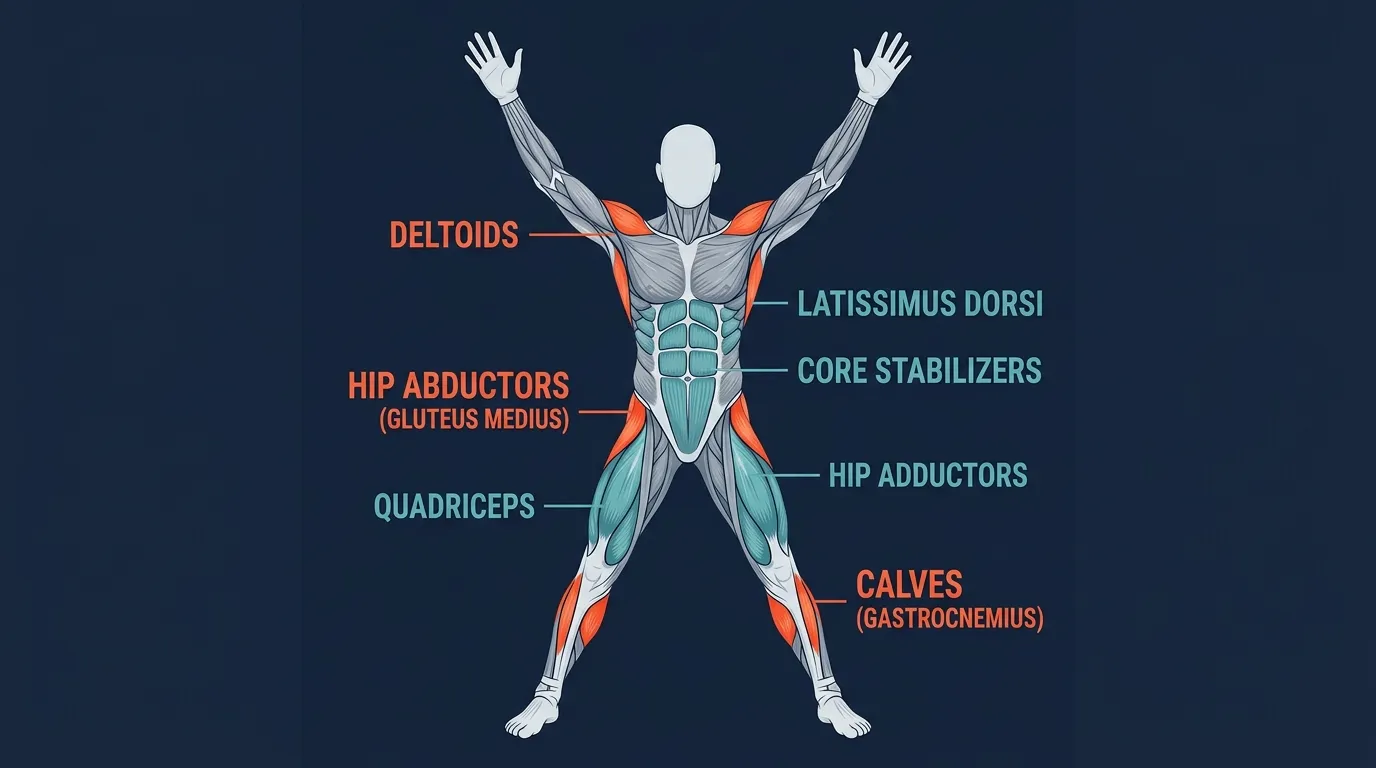
Muscles & Systems Worked
Primary movers. The hip abductors (gluteus medius, gluteus minimus, and tensor fasciae latae) drive the legs out to the side on the outbound jump, then the hip adductors (adductor longus, brevis, magnus, gracilis) pull the legs back together. The deltoids (especially the lateral and anterior heads) raise the arms overhead through the same abduction pattern, with the supraspinatus initiating the first 15-30 degrees of arm lift. The calves (gastrocnemius and soleus) and quadriceps generate the propulsion for each jump.
Secondary movers. The trapezius (especially the upper fibers) and serratus anterior rotate the scapula upward to allow full overhead arm reach. The latissimus dorsi assists on the way down. The gluteus maximus and hamstrings absorb the landing eccentrically. The tibialis anterior pre-tensions the ankle on each toe-off and each landing.
Stabilizers. The core (rectus abdominis, transverse abdominis, obliques) braces the trunk so the limbs can swing without rocking the spine. The deep ankle stabilizers (peroneals, tibialis posterior) control the foot strike and keep the load tracking through the big toe rather than rolling outside. The spinal erectors hold the upright posture. The cardiovascular system (heart, lungs) and the energy systems (phosphocreatine and glycolytic for short bursts, oxidative for sustained sets) are also doing real work. That's the whole point of cardio.
Mechanism. Jumping jacks load the body through repeated short bursts of plyometric work in the frontal plane (side-to-side), which is the plane most strength training ignores. That frontal-plane hip abduction is exactly the pattern that strengthens the gluteus medius and reduces the risk of knee valgus collapse during running and squatting. The continuous nature drives heart rate quickly because so many large muscle groups are firing at once. The overhead arm movement also opens the chest and shoulders, which is why jumping jacks make a useful first exercise in a warm-up: the body warms up and the upper back unsticks at the same time.
Quick Facts
Quick Facts: Jumping Jacks
- Equipment needed: None (bodyweight)
- Difficulty: Beginner-friendly (step-jack regression available; power jacks scale to advanced)
- Modality: Cardio / plyometric / full-body warm-up
- Body region: Full body (hip abductors and deltoids drive; calves, quads, and core support)
- FitCraft quest category: Conditioning
Step-by-Step Instructions
- Stand tall with feet together. Start with your feet touching or nearly touching, arms relaxed at your sides. Chest up, shoulders back, slight bend in the knees, core lightly braced.
Coach Ty's cue: "Set your posture before the first rep. Tall spine, soft knees, eyes forward. That posture is what you're returning to every time the feet come back together."
- Jump your feet out wide. In one explosive movement, jump your feet out to slightly wider than shoulder-width apart. As the feet leave the ground, start swinging the arms out and upward.
- Reach your arms fully overhead. As the feet land wide, the arms reach all the way up so hands nearly touch or clap above the head. Extend through the shoulders to use the complete range of motion.
Coach Ty's cue: "Reach your hands as high as you can. The higher they go, the more the shoulders actually work."
- Jump back to the starting position. Immediately spring your feet back together while sweeping the arms back down to the sides. Land softly with a slight knee bend so the calves and quads absorb the impact.
Coach Ty's cue: "Keep a slight bend in your knees as you land so the muscles absorb the shock, not the joints."
- Find a steady rhythm. Continue at a consistent pace. Each rep should feel smooth and controlled. Feet out and arms up, feet in and arms down, repeated continuously. Once form is dialed in, pace becomes the intensity dial.
Coach Ty's cue: "The goal is to get the heart rate up, so keep moving. Pauses kill the conditioning effect."
Get this exercise in a personalized workout
FitCraft, our mobile fitness app, uses its AI coach Ty to program conditioning work like this into your plan at the right volume and intensity, based on your level, goals, and equipment. Ty was designed and trained by Domenic Angelino, MPH (Brown University) and NSCA-CSCS, with research published in the Journal of Strength and Conditioning Research and Medicine & Science in Sports & Exercise.
Take the Free Assessment Free · 2 minutes · No credit card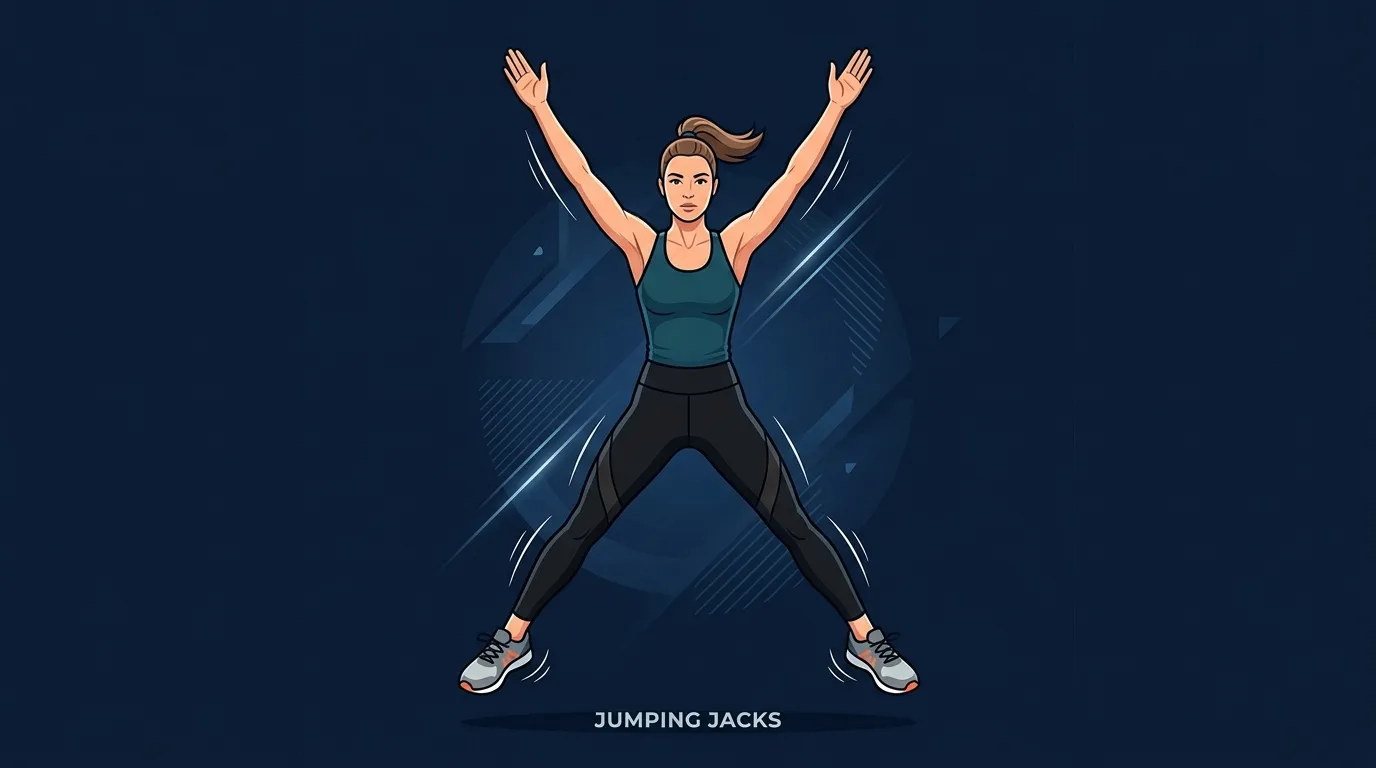
Common Mistakes
- Landing with stiff, locked knees. The most common mistake and the fastest path to knee pain. Maintain a slight knee bend on every landing so impact gets absorbed through the muscles instead of the joints.
- Lazy arm movement. Stopping the arms at shoulder height instead of reaching fully overhead cuts the upper-body and warm-up benefit in half. Commit to the full range so hands nearly touch above the head.
- Inconsistent rhythm. Jerky, stop-and-start jumping jacks are less effective and more tiring than smooth, rhythmic reps. Find a pace you can sustain and stay with it.
- Looking down at the feet. Eyes down rounds the upper back and throws off balance. Keep the eyes forward and the chin level.
- Feet landing too wide. Jumping out to an excessively wide stance puts unnecessary stress on the hip adductors and the medial knee. Slightly wider than shoulder-width is the sweet spot.
- Heavy heel landings. Heels-first landings transmit impact straight up the kinetic chain. Land on the ball of the foot first, then let the heel kiss the ground. The calves then act as natural shock absorbers.
Variations
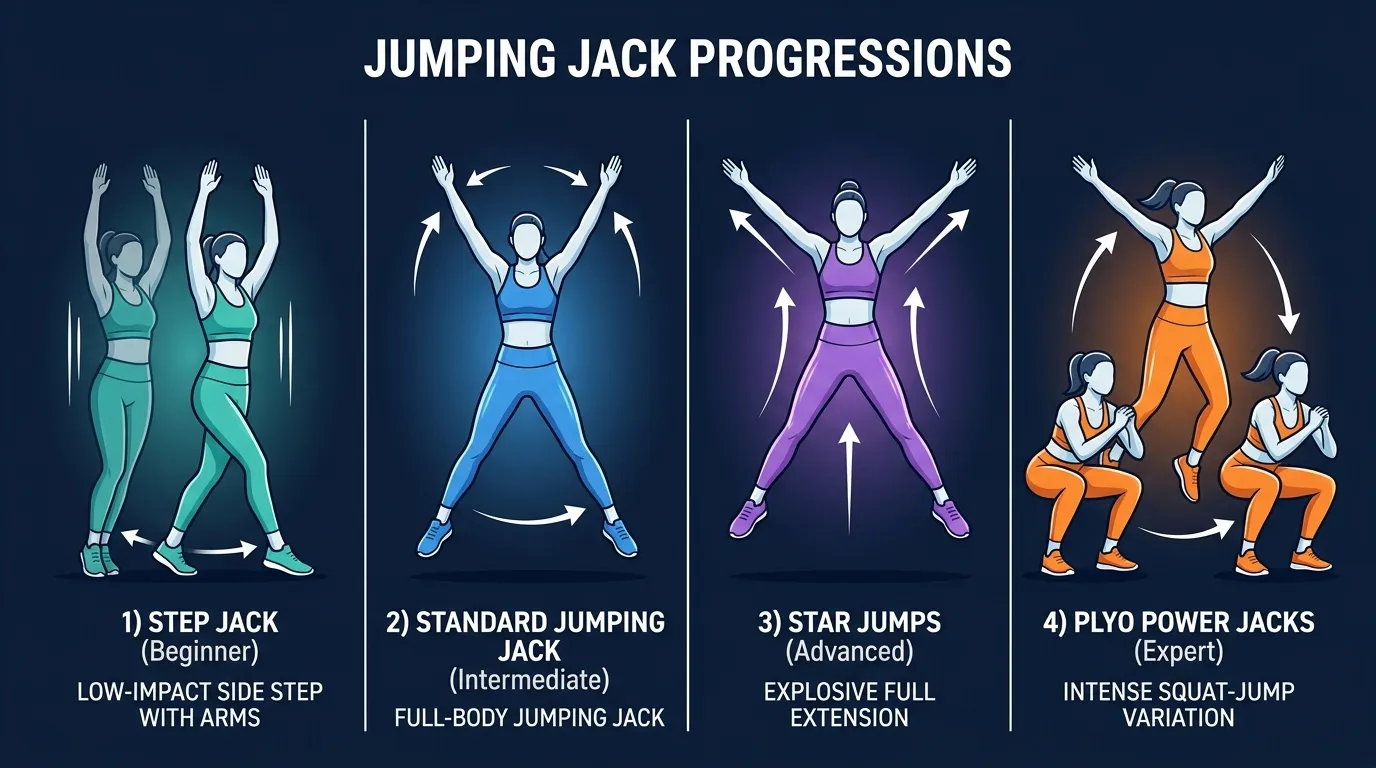
- Step jacks (low-impact). Step one foot out to the side at a time instead of jumping. Raise the arms overhead on the same timing. Ideal for beginners, anyone with joint issues, pregnancy, or active recovery days. Same muscles, none of the impact.
- Power jacks. Add a squat at the bottom of each rep. Jump feet out wide into a squat, arms overhead, then jump back together. Dramatically increases lower-body load and cardiovascular demand. Pairs naturally with jump squats in a circuit.
- Seal jacks. Instead of raising arms overhead, extend them straight out to the sides and clap in front of the chest. Shifts emphasis to the chest and front deltoids. Useful as a warm-up before pressing work.
- Star jacks. From a squat position, explode upward into a star shape (legs wide, arms wide) and return to the squat. Advanced plyometric variation that builds explosive power. Treat as a power exercise, not a high-rep finisher.
- Cross jacks. Cross one foot in front of the other on the inbound rep, alternating sides each time, and cross the arms in front of the chest instead of bringing them to the sides. Adds a frontal-plane twist and trains the adductors harder.
When to Avoid or Modify Jumping Jacks
Jumping jacks are safe for most healthy adults, but the repeated plyometric loading and rapid heart-rate spike mean a handful of conditions warrant a different approach. Always consult a qualified healthcare provider or physical therapist before starting or returning to a new exercise program, especially if any of the following apply.
- Known cardiovascular disease or uncontrolled hypertension. Jumping jacks elevate heart rate and blood pressure rapidly. Get cardiology clearance and stay within prescribed heart-rate zones. Substitute lower-intensity options like walking in place or running in place at a gentle tempo.
- Acute knee, ankle, hip, or foot injury (or plantar fasciitis, shin splints, patellar tendinopathy). Repeated jumping aggravates lower-extremity injuries. Switch to step jacks or marching in place until the injury is resolved and a clinician clears jumping.
- Pregnancy past the first trimester. Joint laxity, balance changes, and pelvic-floor demand make jumping movements a poor choice in the second and third trimesters. Substitute step jacks. In the first trimester, continue only if you were already doing jumping jacks and your obstetric provider has cleared cardio.
- First 6-12 weeks postpartum (or longer with pelvic-floor symptoms). Pelvic-floor recovery is the prerequisite for jumping. Get clearance from a pelvic-floor PT before resuming jumping jacks; in the meantime use deadbugs, bird-dogs, and walking.
- Stress incontinence or pelvic-floor weakness. Jumping movements often trigger leakage. Use step jacks while building pelvic-floor strength, and consider working with a pelvic-floor PT.
- Vertigo, balance disorders, or vestibular conditions. Fast direction changes and the rebound impact risk falls. Use step jacks with a wall or chair nearby for support, or skip the movement entirely until cleared.
- Asthma or exercise-induced bronchoconstriction. Have a rescue inhaler accessible, build into the intensity with a long warm-up, and consult your physician about heart-rate ceilings.
- Significant overweight with no jumping history. Repeated landings can stress joints that aren't yet conditioned to plyometric loading. Build a cardio base with walking in place and step jacks first, then introduce small numbers of jumping jacks once knees and ankles feel resilient.
Related Exercises
- Lower-impact alternative within the same pattern: walking in place and running in place for the same upright cardio stimulus without the rebound impact.
- Other foundational cardio movements: high knees, butt kicks, and mountain climbers for circuit variety and additional plane-of-motion coverage.
- Plyometric progressions: jump squats, jump lunges, and plank jacks when jumping jacks no longer challenge the cardiovascular and neuromuscular systems.
- Highest-intensity full-body progression: burpees, the combined squat-pushup-jump pattern that takes the jumping-jack stimulus to its conditioning extreme.
- Core stability foundation: forearm planks, hand planks, deadbugs, and bird-dogs to build the trunk control that keeps jumping mechanics clean.
- Ankle and calf conditioning: calf raises and calf hops to graduate the calves and Achilles into plyometric work safely.
How to Program Jumping Jacks
Jumping jack programming follows the time-based interval ranges established for high-intensity conditioning by Ratamess et al., 2009 (ACSM Position Stand on Progression Models in Resistance Training). Because jumping jacks are continuous and cardiovascular rather than load-based, they're programmed in seconds of work and rest, not sets and reps.
| Level | Work interval | Rest between intervals | Total session | Frequency |
|---|---|---|---|---|
| Beginner | 20-30 seconds | 60-90 seconds | 10-15 minutes | 2-3 sessions per week |
| Intermediate | 30-45 seconds | 45-60 seconds | 15-25 minutes | 3-4 sessions per week |
| Advanced | 45-60 seconds | 30-45 seconds | 20-30 minutes | 3-5 sessions per week |
Where in your workout. Jumping jacks fit naturally as the first movement in a general warm-up (1-2 minutes continuous gets heart rate up and shoulders mobile before the main work). They also work as an active-recovery filler between strength sets, as one station in a HIIT circuit, or as a 5-10 minute metabolic finisher at the end of a session. Avoid programming jumping jacks (or any HIIT) before heavy compound lifts because the glycolytic depletion compromises the strength work.
Form floor over rep targets. If knees stop landing softly, arms stop reaching overhead, or rhythm breaks down, end the interval early even if the timer says you have time left. A 25-second clean interval builds more conditioning than 45 seconds of sloppy reps with stiff landings, and it protects the joints that have to last for thousands more jumping jacks across the years.
How FitCraft Programs This Exercise
Jumping jacks might seem like a basic exercise, but when and how they show up in a plan matters. Ty uses your personalized diagnostic assessment to place jumping jacks where they earn their keep: typically as a warm-up opener, as an active-recovery interval between strength sets, or as one station in a conditioning circuit.
For beginners or anyone with joint sensitivity, Ty programs step jacks first to build the cardiovascular base without plyometric stress. For intermediate trainees, standard jumping jacks land in HIIT-style work blocks with structured work-to-rest ratios. For advanced trainees, power jacks and star jacks show up as plyometric finishers, paired with other high-output movements.
As your conditioning improves, Ty adjusts the variation, interval length, and circuit placement to match your progress. The programming sits on top of an exercise-science foundation built by Domenic Angelino (Ivy League-trained MPH and NSCA-CSCS strength coach) and surfaces through Ty's adaptive coaching so the right variation shows up on the right day.
Frequently Asked Questions
Can I do jumping jacks with bad knees?
If knees are sore or you have a known knee issue, switch to step jacks: step one foot out to the side at a time while raising the arms overhead, then step back together. The hip abductors, shoulders, and cardiovascular system get the same stimulus without the landing impact. If sharp knee pain occurs even with step jacks, stop and get cleared by a physical therapist before resuming high-rep lower-body work.
How many jumping jacks should I do per day?
For general conditioning, work in time blocks rather than rep counts. Beginners can do 20-30 seconds of jumping jacks followed by 60-90 seconds of rest, repeated 4-6 times. Intermediate trainees do 30-45 second work intervals with 45-60 second rest. As a warm-up, 1-2 minutes of continuous jumping jacks elevates heart rate enough to prepare the body for the main workout.
Are jumping jacks a good cardio workout?
Jumping jacks are an effective full-body cardiovascular exercise. They engage the shoulders, calves, quads, and hip abductors while elevating heart rate quickly, and they require no equipment. For sustained cardio adaptations they work best as part of an interval circuit or as 5-10 minute conditioning blocks, rather than as a single long set.
Do jumping jacks burn belly fat?
Jumping jacks burn calories and contribute to the overall energy deficit needed for fat loss, but spot reduction is not how the body loses fat. No single exercise targets belly fat specifically. A combination of consistent calorie deficit, full-body strength training, and cardio (including jumping jacks) is the evidence-based path to fat loss across the whole body, including the abdomen.
Are jumping jacks safe during pregnancy?
Many pregnant trainees can continue jumping jacks in the first trimester if they were already doing them and have clearance from their obstetric provider. In the second and third trimesters, joint laxity and pelvic-floor demands typically make jumping movements a poor choice; substitute step jacks or marching in place. Postpartum, wait for pelvic-floor and obstetric clearance (often 6-12 weeks minimum) before resuming jumping exercises.