In a standard curl, your elbows stay at your sides and the dumbbells travel up and out in an arc. The drag curl does the opposite with your elbows: it pulls them backward behind your torso, so the weight has no choice but to drag up close to your body.
Dragging the weight up close to your body takes away the forward arc. Because your elbows travel behind you, your shoulders move into slight extension, and two more muscles join the biceps: the upper trapezius holds your shoulders steady against the pull of the dumbbells, and the middle trapezius squeezes your shoulder blades back.
The drag path feels unfamiliar at first, so start with lighter dumbbells than you think you need. You should feel it mostly in the front of your upper arms, with your forearms gripping, the tops of your shoulders holding steady and the muscles between your shoulder blades squeezing.
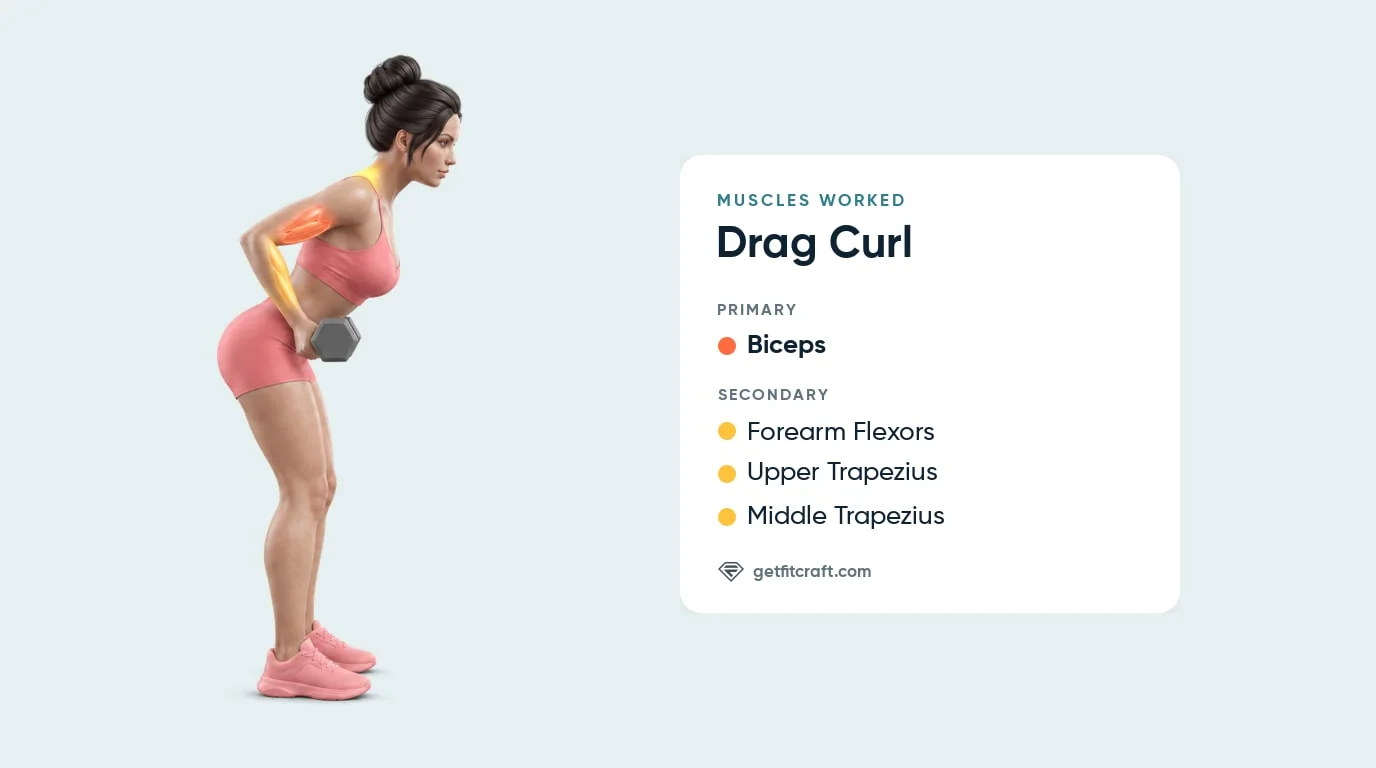
Muscles Worked
Primary muscle: the biceps, the muscle at the front of your upper arm. The biceps bend your elbows to lift the dumbbells as they drag up your body, then lengthen under control as you lower them.
Secondary muscles: the forearm flexors, on the palm side of your forearms, grip the handles and keep your wrists straight. The upper trapezius, across the tops of your shoulders, holds your shoulders steady against the pull of the dumbbells. The middle trapezius, between your shoulder blades, squeezes your shoulder blades back as your elbows travel behind your body.
What about the long head of the biceps? Drag curls are often said to target the long head of the biceps or the biceps peak. No study has measured the drag curl, so that claim has no evidence behind it. Treat the drag curl as a biceps curl with a different path, not a long-head specialist.
Quick Facts
Quick Facts: Drag Curl
- Equipment needed: A pair of dumbbells (a resistance band also works; outside the app, a barbell or EZ bar)
- Difficulty: Intermediate (as rated in the FitCraft app); lighter dumbbells or lower curls are easier
- Modality: Isolation, elbow flexion with shoulder extension
- Body region: Upper body: biceps, with the forearm flexors and the upper and middle trapezius helping
How to Do a Drag Curl (Step-by-Step)
- Hinge forward with the dumbbells in front of your thighs. Stand with your feet about hip-width apart and your knees slightly bent, a dumbbell in each hand. Use an underhand grip, palms facing forward. Lean your torso forward from your hips, anywhere from upright to about 40 degrees, so your arms hang straight down in front of your thighs. Keep your back flat, your chest up, your shoulders down and your head in line with your back. Standing tall, the classic way, works too. Don't round your back and don't arch your lower back.
Form tip: hinge from your hips with your back flat, never rounded, and keep your eyes on the floor a little ahead of you.
- Drive your elbows backward. Instead of curling the weights forward in an arc, drive your elbows straight back behind your torso. As your elbows travel back, the dumbbells drag up close to your body, from in front of your thighs toward your hips, palms facing up. If the dumbbells swing out in front of you, you're curling, not dragging.
Form tip: keep the dumbbells brushing or nearly brushing your thighs and hips, and keep your shoulders down as your elbows travel back.
- Pause with your elbows back. Stop when your elbows are behind your torso and bent to about a right angle, with the dumbbells near your hips. Going as high as your waist or lower chest is fine, as long as you get there by moving your elbows, not by leaning back or shrugging. Your elbows should point back, fairly close to your body, not flare wide to the sides. Squeeze your biceps and pause briefly. The range is intentionally shorter than a standard curl's.
Form tip: keep your wrists straight, in line with your forearms, at the top.
- Lower under control. Lower the dumbbells along the same path in about one to two seconds; slower is fine. Let them slide back down close to your body until your arms are straight or nearly straight, with the dumbbells in front of your thighs. No bouncing and no dropping.
Form tip: lower the dumbbells slowly and never let them drop.
- Reset and repeat. Check that your back is still flat, your shoulders are down, and your palms still face forward. Breathe out as you drag up, in as you lower. A practical start is 3 sets of 8-12 reps with dumbbells you can drag up without swinging.
Form tip: if the last reps swing away from your body or your back starts to round, end the set there.
Get this exercise in a personalized workout
FitCraft, our mobile fitness app, uses its AI coach Ty to program isolation exercises like this into your plan at the right volume and intensity, based on your level, goals, and equipment. Ty was designed and trained by Domenic Angelino, MPH (Brown University) and NSCA-CSCS, with research published in the Journal of Strength and Conditioning Research and Medicine & Science in Sports & Exercise.
Take the Free Assessment Free · 2 minutes · No credit card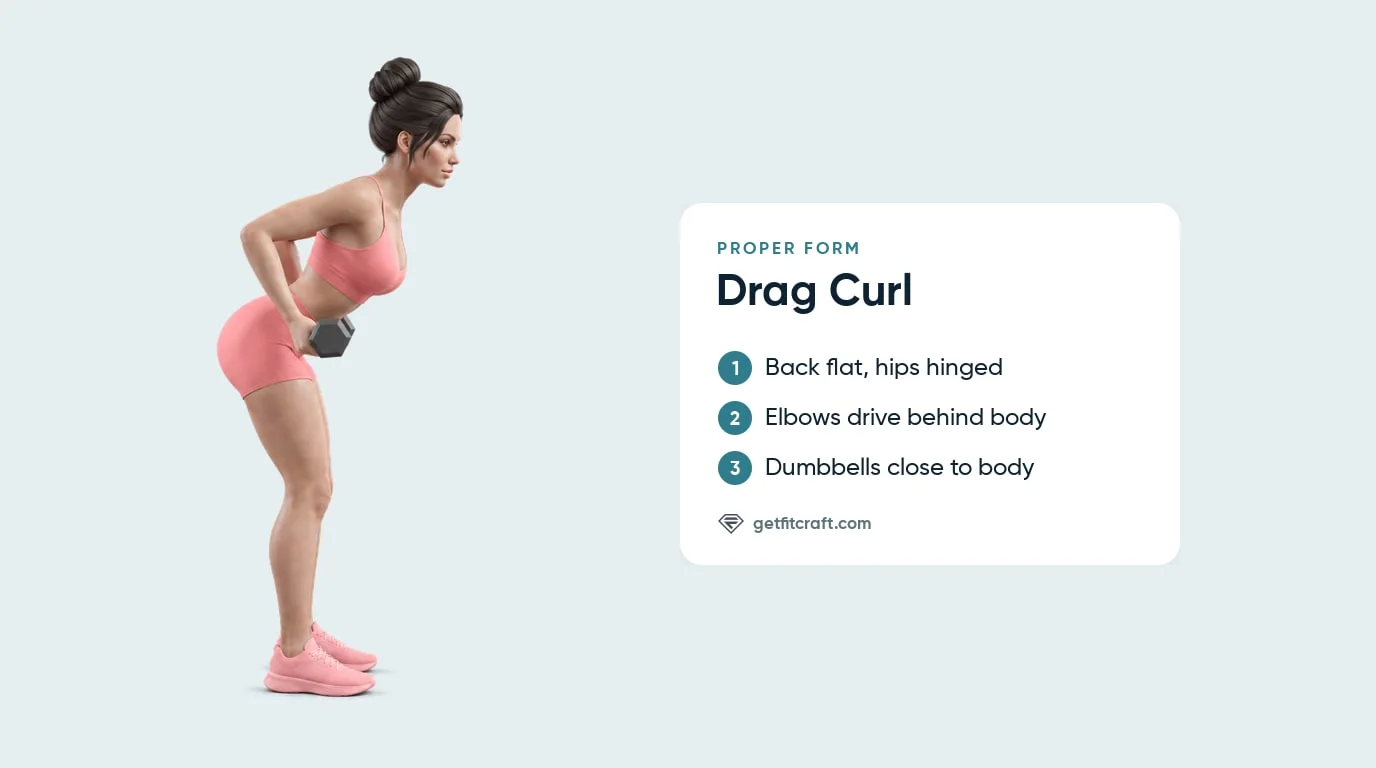
Common Mistakes to Avoid
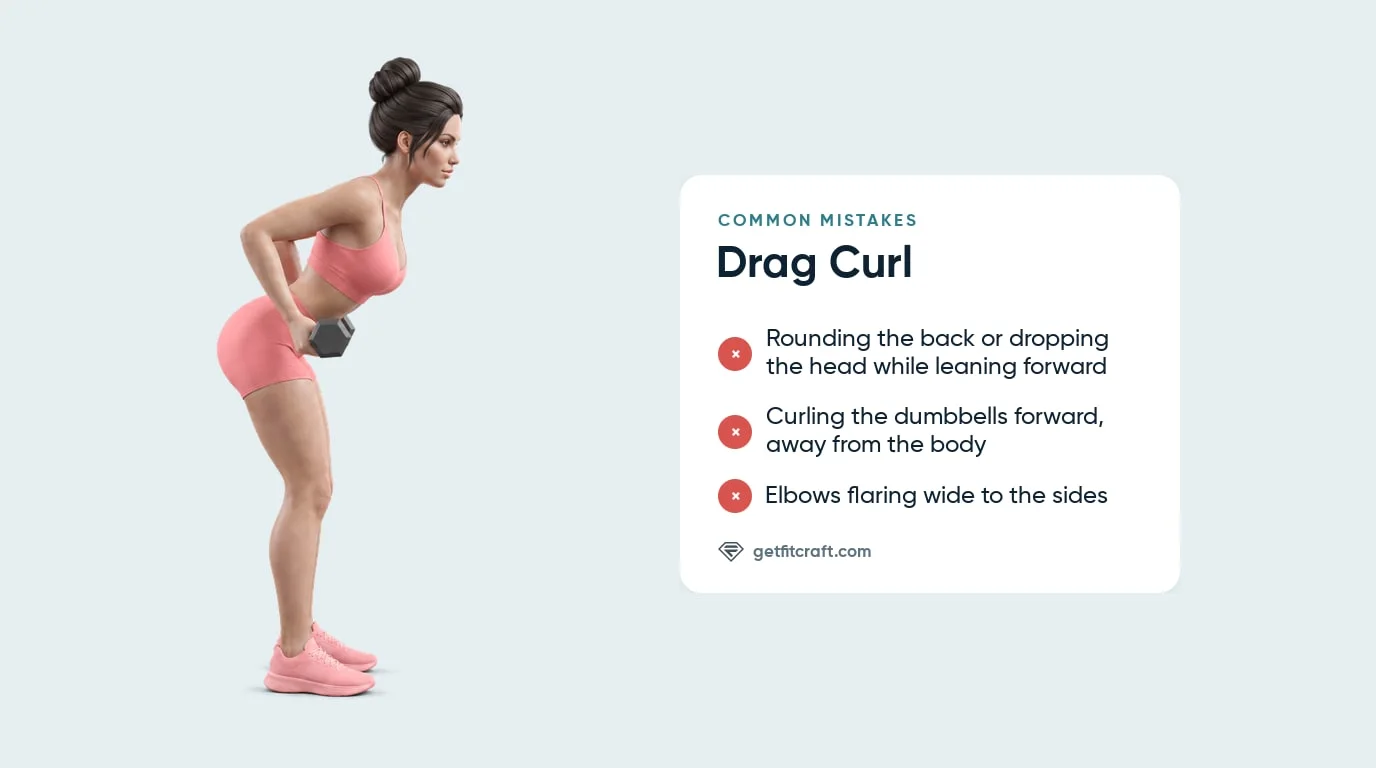
The drag path runs against habit at first. Watch for these mistakes:
- Curling the weight forward. If you fall back on the standard curl motion, the dumbbells travel in a forward arc instead of dragging up your body. The fix: pull your elbows back more and keep the dumbbells brushing or nearly brushing your thighs and hips the whole way up and down.
- Elbows flaring out to the sides. A little outward travel at the top is fine, but when the elbows flare wide to the sides, the exercise turns into a hybrid of a curl and an upright row. The fix: drive your elbows straight back, fairly close to your body, like you're trying to poke someone standing directly behind you.
- Using too much weight. A weight you can't control leads to swinging, a rounded back or shrugging. The fix: use dumbbells you can drag up without swinging, rounding your back or shrugging while you learn the path. Add weight only while your back stays flat and the dumbbells stay close.
- Rounding your back or dropping your head. With the forward lean, it is easy to let your upper back round and your head hang toward the floor. The fix: hinge from your hips with your back flat and your chest up, and keep your head in line with your back, eyes on the floor a little ahead of you. If you can't keep your back flat, stand a little more upright or use lighter dumbbells.
- Leaning back to create leverage. Some people try to compensate for the awkward feel by leaning their upper body backward, which swings the dumbbells up with your body instead of your arms. The fix: keep your torso still, your back flat and your weight evenly distributed, whether you lean forward from the hips or stand tall. If you have to lean back or swing to complete the rep, drop weight.
- Incomplete extension at the bottom. Stopping with your elbows well bent shortens the range of every rep. The fix: lower until your arms are straight or nearly straight, with the dumbbells hanging in front of your thighs, before the next drag. Reset between reps if you have to.
- Shrugging or dropping the dumbbells. Shrugging lifts your shoulders toward your ears, and dropping the dumbbells loses control of the rep. The fix: keep your shoulders down as your elbows travel back, and lower the dumbbells under control; never let them drop.
Variations: Dumbbells, Bands and Bars
Dumbbell Drag Curl (the App's Version)
The version described above, with both dumbbells together and the torso leaning forward from the hips, up to about 40 degrees. Standing tall, the classic way, is equally fine, and so is dragging one arm at a time, which lets you watch each elbow path on its own. Dumbbells let each elbow find its own path, so this is a good place to start.
Barbell Drag Curl (Outside the App)
Outside the app, a straight barbell can be dragged up the front of your body the same way, from your thighs toward your hips or lower chest. Start with just the bar until you groove the path.
EZ-Bar Drag Curl (Outside the App)
An EZ curl bar's angled grips set your wrists at a slight angle instead of fully palms up. The drag path is the same as with the barbell: elbows back, bar close to your body.
Resistance Band Drag Curl
No dumbbells? Stand on the middle of a resistance band, hold an end in each hand with your palms up, and drag your hands up along your body the same way, elbows driving back. A filled water bottle in each hand works too.
Alternative Exercises
If you want other curls that train your biceps, try these:
- Lower curls: A palms-up curl from straight arms to forearms level with your elbows at your sides. The FitCraft app rates it Beginner, so it is the easier curl to start with.
- Bicep curls: The regular palms-up curl, elbows at your sides, from straight arms up toward your shoulders.
- Hammer curls: A curl with a neutral grip, palms facing each other, useful as a complementary lift on an arm day.
When to Avoid or Modify Drag Curls
Drag curls are safe for most healthy adults, but a few situations are worth checking first. A burn in your biceps, forearms or between your shoulder blades is normal; any pain in your elbows, wrists, shoulders, lower back or neck means stop right away. Always consult your physician or physical therapist for personalized guidance.
- Bicipital tendinopathy or biceps tendon irritation. Have it checked by a doctor or physical therapist before you do drag curls, and ask them which arm exercises suit you. During any set, elbow or shoulder pain means stop right away.
- Carpal tunnel syndrome or wrist pain. Have it checked by a doctor or physical therapist before you curl, and ask them which exercises suit you. During any set, wrist pain, numbness or tingling means stop.
- Recent elbow, biceps, or shoulder surgery. Get clearance from your surgeon before any loaded biceps work, and ask them or your physical therapist when and how to return to curls.
- Shoulder impingement or rotator cuff irritation. Driving the elbows behind the torso moves your shoulders into extension. Have a shoulder problem checked by a doctor or physical therapist before you do drag curls. During any set, shoulder pain means stop.
- Lower-back pain. Drag curls are done standing, in the app with the torso leaning forward from the hips. If you have lower-back pain, see a doctor or physical therapist before doing them and ask which exercises suit you. During any set, lower-back pain means stop right away and set the dumbbells down.
Related Exercises
If drag curls are part of your routine, these movements complement or extend the same training pattern:
- Same muscle group (biceps): Hammer Curls use a neutral grip, palms facing each other. Zottman Curls curl up with the palms up and lower with the palms facing down.
- Variation in elbow path: Twist Curls are a full curl, one arm at a time, turning the palm up as you lift, a useful contrast to the drag curl's straight-line path.
- Antagonist pairing (triceps): Tricep Kickbacks and Tricep Extensions work the opposite side of the arm, and you can pair them with drag curls on an arm day.
- Compound that loads the biceps: Bent-Over Rows and Chin-Ups train the biceps as part of bigger pulls; drag curls can follow them as an accessory.
- Shoulder work: Bent-Arm Lateral Raises train the shoulders and fit well on the same upper-body day as drag curls.
How to Program Drag Curls
Drag curl programming follows the same principles as other single-joint exercises. The American College of Sports Medicine (ACSM) Position Stand on resistance training suggests that novices use loads they can lift for about 8 to 12 reps, at a slow to moderate pace, where moderate means about one to two seconds up and one to two seconds down (Ratamess et al., 2009). It sets no ranges for the drag curl itself, so the table below is a practical starting point, not figures from a study.
| Level | Sets × Reps | Rest between sets | Frequency |
|---|---|---|---|
| Easier | Lighter dumbbells, or start with lower curls | n/a | n/a |
| Intermediate (the app's version) | 3 × 8-12 | 60-90 seconds | 1-2 sessions/week |
| Harder (slower lowering or a pause with the elbows back) | 3-4 × 8-12 | 60-90 seconds | 2 sessions/week |
Where in your workout: drag curls are an accessory lift: do them near the end of an upper-body or pull session, after bigger pulls like bent-over rows or chin-ups. You can pair them with a triceps exercise such as tricep kickbacks.
Stop when your form slips: if your last 2 reps of a set swing away from your body, your back starts to round or your shoulders start to shrug, stop the set there. Hitting a target rep count with broken form is worse than hitting fewer reps cleanly.
How FitCraft Programs This Exercise
Knowing how to do a drag curl is step one. The next step is knowing when to do it, how many reps to do, and when to progress.
FitCraft maps your level, goals, and equipment during the diagnostic assessment and builds a plan around them. The app has one drag curl exercise, done with both dumbbells and rated Intermediate, and can include it in your plan; the lower curl, rated Beginner, is an easier curl in the app.
Its 3D demonstration shows the elbows driving back behind the body, which is easier to copy than a written description.
Frequently Asked Questions
Can I do drag curls if I have bicipital tendinopathy or elbow tendinitis?
Not while it hurts. Bicipital tendinopathy and elbow tendinitis need a doctor or physical therapist to check them before you do any curls, so ask them which arm exercises suit you and when. During any set, a burn in your biceps is normal, but any pain in your elbow, shoulder or wrist means stop right away. This is general guidance, not medical advice.
What muscles do drag curls work?
Drag curls work your biceps most: they bend your elbows to lift the dumbbells. Three muscles help. The forearm flexors grip the handles and keep your wrists straight. The upper trapezius, across the tops of your shoulders, holds your shoulders steady against the pull of the dumbbells. The middle trapezius, between your shoulder blades, squeezes your shoulder blades back as your elbows travel behind your body.
Are drag curls better than regular curls?
Drag curls are not better, just different. A regular curl keeps your elbows at your sides while the dumbbells travel up and out in an arc. A drag curl drives your elbows back so the dumbbells travel up close to your body, which also brings in the upper and middle trapezius. Both train your biceps, and using both in a program is fine.
Why are drag curls called drag curls?
The name comes from the movement: the dumbbells drag up along the front of your body, staying close to it, while your elbows drive back behind your torso. In a standard curl the weight travels in a forward arc instead.
How heavy should I go on drag curls?
Use dumbbells you can drag up without swinging, rounding your back or shrugging. Start lighter than you think you need while you learn the path, because pulling your elbows back feels unfamiliar at first. Go heavier only while your back stays flat and the dumbbells stay close to your body. If the weights swing away from your body instead of dragging up it, the weight is too heavy.
Are drag curls a good exercise for the biceps peak?
There is no evidence that drag curls do anything special for the biceps peak. No study has measured the drag curl, so claims that it targets the long head of the biceps or builds the peak have nothing behind them. It trains your biceps like other curls, through a different path, and works well alongside regular curls for variety.