The seated rear delt stretch targets the back of the shoulder with almost no setup. You can do it on the floor, in a chair, or during a quick work break when your upper back starts feeling stiff.
The big form detail is staying square. The arm moves across your chest, between chest and shoulder height, while your chest keeps facing forward. Twisting toward the arm doesn't add to the stretch, and the arm should never come up across your throat or face.
Use it as a gentle stretch. Light pressure is enough. A gentle stretch in the back of your shoulder is normal; any pain, tingling, or numbness means stop.
Quick Facts: Seated Rear Delt Stretch
- Equipment needed: None
- Difficulty: Beginner (as rated in the FitCraft app)
- Modality: Static stretch (a hold)
- Body region: Back of the shoulder, upper back, and side of the back (stretched)
Areas Stretched & Mobilized
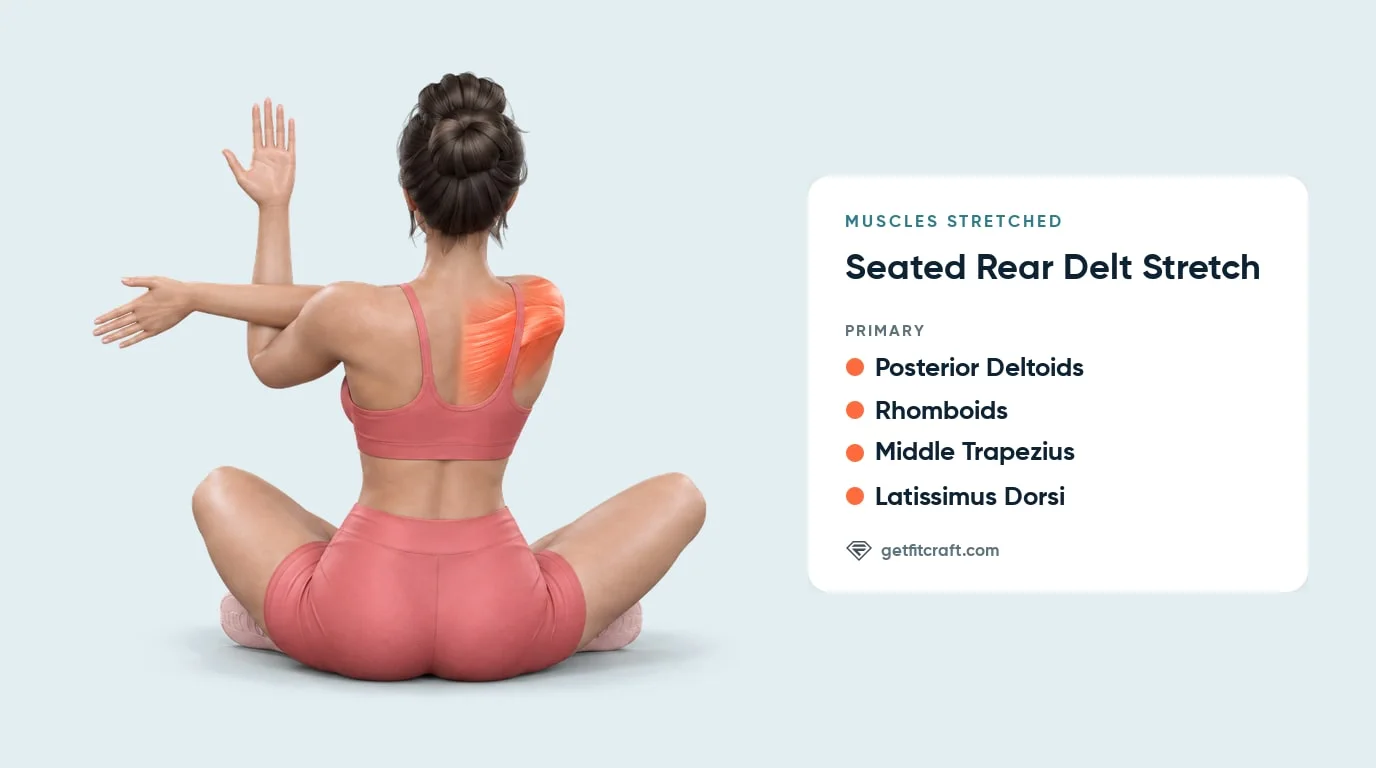
Muscles stretched: the posterior deltoids, rhomboids, middle trapezius, and latissimus dorsi. This is a stretch, so it lengthens these muscles rather than working them.
How each one stretches: drawing the arm across your chest lengthens the posterior deltoid at the back of that shoulder. It also lets the shoulder blade slide away from your spine, so the rhomboids and middle trapezius, the muscles between the shoulder blade and the spine, lengthen too. The same reach across lengthens the lat along the side of your back below the armpit.
Where you should feel it: a gentle stretch in the back of the shoulder of the arm crossing your chest, between that shoulder blade and your spine, and along the side of your back below the armpit. You shouldn't feel it in your neck or the front of your shoulder.
What the research shows: this cross-body stretch has been tested directly. In a randomized trial of 54 people with no shoulder symptoms, 15 had one shoulder that turned inward more than 10 degrees less than the other and did the cross-body stretch once a day, 5 holds of 30 seconds, for 4 weeks. They gained 20 degrees of shoulder internal rotation range, compared with 5.9 degrees in a control group without that difference who did not stretch (McClure et al., 2007). The trial measured shoulder range of motion, not which muscles stretched.
How to Do the Seated Rear Delt Stretch Step by Step
- Sit tall. Sit on the floor with your legs crossed, chest facing forward and shoulders relaxed. Sitting on a chair or standing works the same way.
- Bring one arm across your chest. Lift one arm to between chest and shoulder height and bring it across your chest. Keep it long, straight or with a soft bend at the elbow, and keep it below your chin, never across your throat or face.
- Hook the arm near the elbow. Raise your other forearm upright in front of you and hook the crossing arm on the upper arm near the elbow. Holding it there with your hand instead works just as well. Draw the arm gently toward your chest until you feel a stretch in the back of the shoulder. Tip: press lightly and never force the arm across.
- Hold and breathe. Hold about 20 to 30 seconds while breathing slowly. Keep your chest facing forward instead of twisting toward the arm, and let the back of your shoulder relax a little more each time you breathe out.
- Switch sides. Release slowly and repeat on the other side with the same pressure and hold time. Repeat a few rounds on each side.
Get this exercise in a personalized workout
FitCraft, our mobile fitness app, uses its AI coach Ty to program mobility work like this into your plan at the right volume and intensity, based on your level, goals, and equipment. Ty was designed and trained by Domenic Angelino, MPH (Brown University) and NSCA-CSCS, with research published in the Journal of Strength and Conditioning Research and Medicine & Science in Sports & Exercise.
Take the Free Assessment Free · 2 minutes · No credit card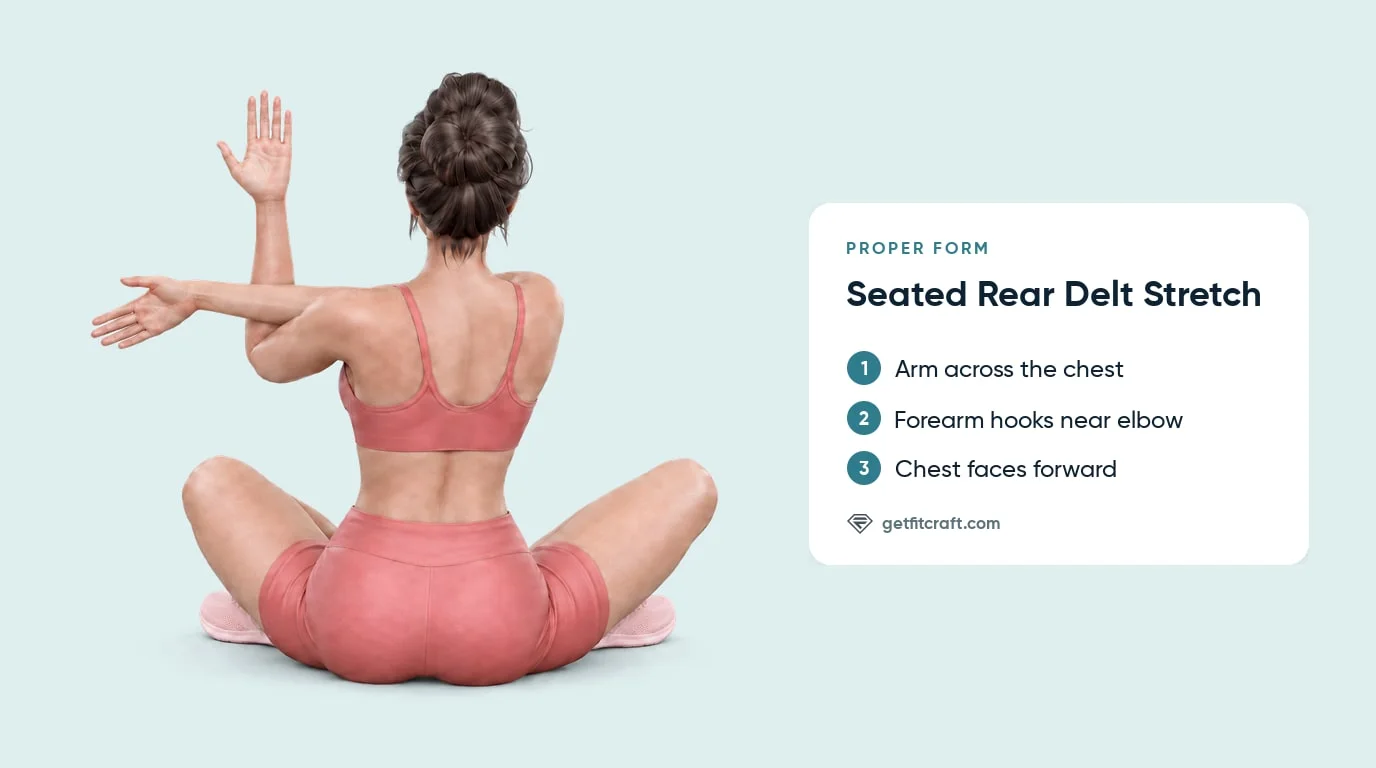
Common Mistakes to Avoid
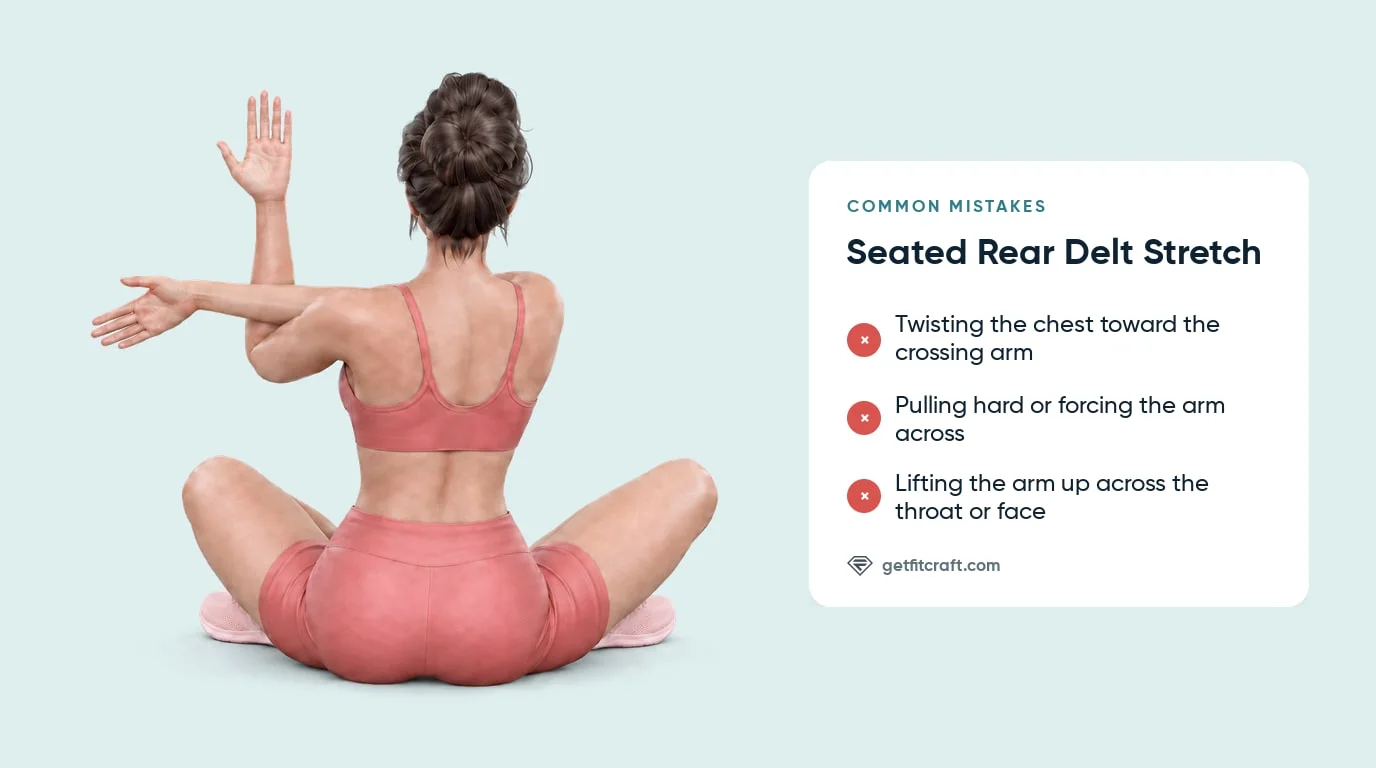
- Twisting toward the arm. Turning your chest toward the crossing arm doesn't add to the stretch. Keep your chest facing forward and let only the arm move across.
- Pulling hard or forcing the arm across. Keep the stretch gentle. Press lightly on the upper arm near the elbow, with your forearm or your hand, and stop where you feel the stretch.
- Raising the arm too high. If the hand crosses your throat or face, the arm has gone too high. Keep it between chest and shoulder height, below your chin.
- Slouching for more range. Stay tall: slouching lets the arm travel farther without adding to the stretch in the back of your shoulder.
- Holding your breath. Breathe slowly and steadily the whole time, and let the back of your shoulder relax a little more each time you breathe out.
Seated Rear Delt Stretch Variations and Progressions
Chair or Standing Rear Delt Stretch
Sit in a chair with your feet flat and your hips back in the seat, or stand tall. It is the same stretch, and the chair version is easy to repeat during the workday or if sitting cross-legged is uncomfortable.
Hand Hold Instead of the Forearm Hook
The FitCraft app hooks the crossing arm near the elbow with your other forearm held upright. Holding the upper arm near the elbow with your other hand works just as well. Either way, keep the pressure light.
Lower Arm, Lighter Pressure (Easier)
Let the crossing arm rest a little lower across your chest and use almost no pressure. A lower arm gives a gentler stretch.
Higher Arm or Closer Pull (More Stretch)
Bring the crossing arm up toward shoulder height, or draw it a little closer to your chest, still gently. Keep your chest facing forward and the arm below your chin.
When to Avoid or Modify the Seated Rear Delt Stretch
A few conditions call for a check with your doctor or physical therapist before you do the seated rear delt stretch. A gentle stretch in the back of your shoulder and upper back is normal. Any pain in a joint, your lower back, or your neck means stop, and so does tingling or numbness in your arm or hand.
- Acute shoulder injury or recent shoulder surgery. Get clearance from your doctor, surgeon, or physical therapist before you do this stretch, and follow their plan for when to start. Any shoulder pain means stop.
- Shoulder instability, dislocation history, or labral symptoms. See a doctor or physical therapist before you do this stretch. Any pain, or a feeling that the shoulder is sliding or catching, means stop.
- Hypermobility, Ehlers-Danlos, or connective tissue disorder. Ask your doctor or physical therapist whether stretching fits your plan. If they clear you, keep the pressure light and don't push for more depth. Any joint pain means stop.
- Acute muscle strain around the shoulder or upper back. See a doctor or physical therapist before you stretch a fresh strain. A gentle stretch is normal; any pain means stop.
- Nerve symptoms. Tingling, numbness, burning, or symptoms that travel into the hand mean stop. See a doctor or physical therapist before you try the stretch again.
- Pregnancy. Check with your doctor or midwife before you do this stretch. Any pain in a joint, your lower back, your neck, or your pelvis means stop.
Related Exercises
- Front of the shoulder: Rotator cuff stretch stretches the front of your shoulder and your chest, the other side of the shoulder from this stretch.
- Active mobility pairing: Shoulder rolls add gentle movement before or after the static hold.
- Upper-body stretch pairing: Tricep and lat stretch stretches the triceps and the lat with one arm bent overhead.
- Spine mobility pairing: Cat-cow rounds and arches your back and moves your shoulder blades before you stretch.
- Front-of-the-body pairing: Cobra pose is a face-down back bend that stretches your abs, a front-of-the-body stretch to pair with this one.
How to Program the Seated Rear Delt Stretch
The American College of Sports Medicine's guidance on flexibility exercise recommends a total of about 60 seconds per stretch, on at least 2 days a week (Garber et al., 2011). The randomized trial of this cross-body stretch described above used 5 holds of 30 seconds once a day. Holds of about 20 to 30 seconds a side, repeated for a few rounds, fit both. The easier and deeper versions use the same holds.
| Version | Holds per side | Between holds | Frequency |
|---|---|---|---|
| Every version (arm lower, the app's seated hold, or arm toward shoulder height) | A few holds of 20-30 seconds | Switch sides | At least 2 days a week, up to daily |
Where it fits: use this stretch after upper-body pressing or pulling, during a cool-down, or as a short break from sitting at a desk.
Good form first: end the hold and reset when your chest twists toward the arm, you start to slouch, or the arm drifts up toward your throat. Any pain means stop. A gentle 20-second hold is better than a forced longer one.
In the FitCraft app, the seated rear delt stretch is its own exercise, a seated hold done on each side and rated Beginner, with a 3D demonstration of the cross-legged stretch and the arm hooked near the elbow.
Frequently Asked Questions
What muscles does the seated rear delt stretch target?
The seated rear delt stretch stretches four muscles: the posterior deltoid at the back of your shoulder, the rhomboids and middle trapezius between your shoulder blade and your spine, and the latissimus dorsi along the side of your back below the armpit. Drawing the arm across your chest lengthens the back of that shoulder. It also lets the shoulder blade slide away from your spine, which lengthens the muscles between it and the spine, and it lengthens the lat along the side of your back.
How long should I hold the seated rear delt stretch?
Hold about 20 to 30 seconds a side while breathing slowly, then switch sides, and repeat a few rounds on each side.
Can I do the seated rear delt stretch every day?
Yes. In a randomized trial of this cross-body stretch, people did it once a day for 4 weeks, and the American College of Sports Medicine recommends stretching on at least 2 days a week. Keep the pressure light. A gentle stretch in the back of your shoulder is normal; any pain, tingling, or numbness means stop.
Can I do the seated rear delt stretch with shoulder pain?
If you have shoulder pain, an acute shoulder injury, recent shoulder surgery, shoulder instability, or symptoms that travel down your arm, see a doctor or physical therapist before you do this stretch, and after surgery, get clearance from your surgeon first. A gentle stretch in the back of your shoulder is normal. Any pain in your shoulder, elbow, or neck, or tingling in your arm, means stop.
Why does my neck hurt during the seated rear delt stretch?
You should feel this stretch in the back of your shoulder and your upper back, not in your neck. Any neck pain means stop; see a doctor or physical therapist before you try the stretch again.