
You want the kind of fitness soldiers have: strong, lean and ready for anything, with no gym. So you search for a military workout and find a hundred burpee circuits that promise to "break you down." You try one, go all out, can barely walk down the stairs for three days, and the plan is dead by Friday.
It's easy to blame yourself for that. You shouldn't. The workout skipped the part the Army itself never skips: a slow warm-up, a few reps of each move to start, and a gradual build to the full standard. Army training is built to progress gradually, so recruits who arrive out of shape can build up to the standard.
This guide gives you the drills straight from the Army's manual, explains how each exercise works, and turns them into conditioning workouts you can do at home. You'll also find a 4-week progression, the bodyweight events of the Army Fitness Test, and what the research says about whether this style of training works.
What Is a Military Calisthenics Workout?
A military calisthenics workout is bodyweight training organized the way armed forces train recruits: set sequences of exercises called drills, done in a fixed order and at a set rhythm. In the US Army, these drills live in ATP 7-22.02, Holistic Health and Fitness Drills and Exercises, published in October 2020 and updated with a change in 2025. It's free to download.
Every Army session has three parts:
- Preparation. A low-impact warm-up, most often the 10-exercise Preparation Drill.
- Activity. The main work: conditioning drills, climbing drills on a bar, running drills or strength work.
- Recovery. The Recovery Drill, a series of stretches that bring your heart rate and breathing back down.
Two details make it different from a random circuit. First, cadence. The Army runs exercises at a slow cadence of 50 counts a minute or a moderate cadence of 80, so every rep goes through a full range of motion. Second, the target is modest. After basic training, soldiers are expected to perform 10 repetitions of each Preparation Drill and Conditioning Drill exercise to standard, and the manual says that mastering those drills builds a very high level of foundational fitness.
Do Military Calisthenics Really Work?
Yes, and the best evidence comes from the Army testing its own program. In a 9-week basic training study of 2,580 recruits, Knapik and colleagues (2003) compared the drill-based Physical Readiness Training with a traditional program. Recruits on the traditional program had 1.5 times the risk of an overuse injury in men and 1.4 times in women. On the first attempt at the final fitness test, 85 percent of men on the new program passed against 81 percent on the old one, and 80 percent of women against 70 percent.
A later review by Knapik and colleagues (2009) looked at three field studies and found the same pattern: traditional training carried 1.5 to 1.8 times the injury risk, with fitness scores similar or better on the drill-based program. One caution matters here. The new program also cut running mileage and added variety, so the drills were part of the package. The research doesn't show that calisthenics alone prevent injuries.
Bodyweight work also builds real strength. In a 4-week trial of 23 moderately trained men, Kotarsky and colleagues (2018) found that progressive push-up training and bench press training both raised one-rep bench press strength, with no significant difference between them. The push-up group also moved further up a ladder of harder push-up variations. Calatayud and colleagues (2015) saw similar strength gains from push-ups and bench press when both were loaded to the same effort, using elastic bands on the push-ups. Both studies were small, but they point the same way: a push-up made progressively harder is a real strength exercise.
The Army Preparation Drill: The 10-Exercise Warm-Up
The Preparation Drill opens every session. The Army designed it to lower the chance of a muscle or joint injury during harder training, and the manual describes the goal as a total-body series of low-intensity, low-impact movements. Do 5 reps of each exercise when you start and build to 10. A rep is four counts, which in most exercises means doing the move twice, or once to each side.
| # | Exercise | How to do it | Cadence |
|---|---|---|---|
| 1 | Bend and Reach | With feet shoulder-width apart and arms overhead, drop into a partial squat and reach your hands back between your legs, then stand tall | Slow |
| 2 | Rear Lunge | Hands on hips, take a long step back onto the ball of your foot until you feel the front of the hip stretch, then return and switch legs | Slow |
| 3 | High Jumper | Leaning slightly forward, swing your arms and hop a few inches, then swing them overhead and jump higher, landing softly | Moderate |
| 4 | Rower | Lying on your back with arms overhead, sit up, bend your knees and reach your arms forward as if rowing, then lie back down | Slow |
| 5 | Squat Bender | Squat with your arms out in front, stand, then hinge forward with soft knees until the backs of your thighs stretch | Slow |
| 6 | Windmill | Arms out to the sides, bend and rotate to touch the outside of the opposite foot, then switch sides | Slow |
| 7 | Forward Lunge | Hands on hips, step forward and bend both knees with your back straight, then push back | Slow |
| 8 | Prone Row | Face down with arms overhead and off the floor, lift your chest and pull your arms back, making fists as your hands come toward your shoulders | Slow |
| 9 | Bent-Leg Body Twist | On your back with hips and knees bent to 90 degrees and arms out wide, lower both knees to one side, then the other | Slow |
| 10 | Push-Up | From a straight plank, lower until your upper arms are parallel to the floor, then press back up | Moderate |
The Army has you return to the standing position of attention between exercises. That short reset teaches you to get up and down from the floor under control, and it gives you a few seconds to breathe.
Conditioning Drill 1: The Army's Five-Move Conditioning Workout
Conditioning Drill 1 is where the work starts. The manual describes it as five exercises that improve muscular strength and endurance, balance and coordination, all done at a moderate cadence:
- Power Jump. With feet shoulder-width apart, squat and touch your palms to the floor, jump straight up swinging your arms overhead, land softly back in the squat and stand up.
- V-Up. Lie on your back with knees bent and arms out at your sides. Lift your straight legs and your trunk together into a V, using your arms for balance, then lower under control.
- Mountain Climber. From the top of a push-up with one foot under your chest, switch feet in a quick hop, keeping your back flat and your hips level.
- Leg-Tuck and Twist. Sit leaning back on your hands with your legs straight and feet 8 to 12 inches off the floor. Draw your knees toward one shoulder as you roll onto that side of your seat, extend, then repeat to the other side.
- Single-Leg Push-Up. Do a push-up while lifting one straight leg until your toes are about level with your other heel, then switch legs on the next push-up.
Start with 5 reps of each and build to 10. If jumping or deep core work bothers an old injury, the manual also has a modified version, Conditioning Drill 1 (Modified), meant for soldiers coming back from injury.
Army Conditioning Drills 1 and 2 Compared, and When to Add Drill 3
Conditioning Drill 2 trains strength, agility and mobility, with more turning and side-to-side movement than Drill 1. Each exercise is done for 5 to 10 reps.
| Conditioning Drill 1 | Conditioning Drill 2 | |
|---|---|---|
| Goal | Strength, endurance, balance, coordination | Strength, agility, mobility |
| Exercise 1 | Power Jump | Turn and Lunge |
| Exercise 2 | V-Up | Supine Bicycle |
| Exercise 3 | Mountain Climber | Half Jack |
| Exercise 4 | Leg-Tuck and Twist | Swimmer |
| Exercise 5 | Single-Leg Push-Up | 8-Count T Push-Up |
Two of the Drill 2 moves need a word of explanation. In the Turn and Lunge, you pivot 90 degrees, drop into a forward lunge and reach toward the floor, then turn back and repeat to the other side. In the 8-Count T Push-Up, you squat, kick back to a plank, lower your chest all the way to the floor, lift your hands and sweep your arms out into a T, bring them back, press up, jump your feet in and stand. That arm sweep is the same hand release the Army Fitness Test uses in its push-up event.
Conditioning Drill 3 is the advanced version: 10 exercises, mostly jumps and landings, from the Y Squat and Single-Leg Deadlift to Tuck Jumps, Frog Jumps and the Alternate Staggered Squat Jump. The manual calls it an advanced plyometric drill and says soldiers should move to it only after they can handle 10 reps of Drills 1 and 2. Follow the same rule at home.
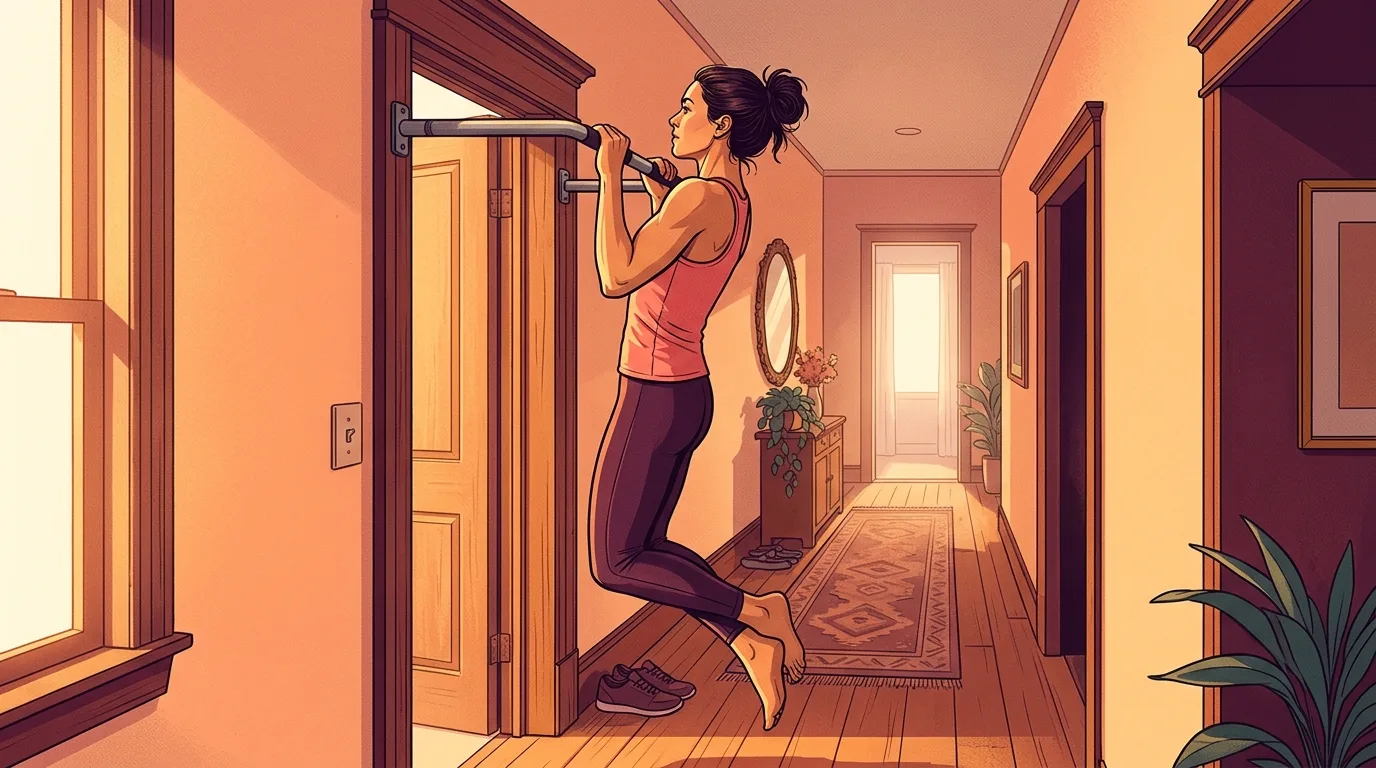
Climbing Drill 1: The Pull-Up Bar Work
Push-ups and conditioning drills leave out pulling, so the Army adds Climbing Drills on a bar. Climbing Drill 1 has five exercises, each done 5 to 10 times:
- Straight-Arm Pull. Hang with straight arms and pull your shoulder blades together, so your chest rises toward the bar without bending your elbows.
- Heel Hook. From a hang, bend your elbows, hips and knees to lift both feet above the bar.
- Pull-Up. From a straight-arm hang, pull until your head is above the bar, then lower all the way.
- Leg Tuck. From a hang, bend your elbows and hips to bring your thighs up to touch your elbows.
- Alternating Grip Pull-Up. Hang with one hand in front of the other, so your body sits side-on to the bar, and pull until your head passes beside the bar.
In the Army, spotters help anyone who can't do 5 reps on their own. At home, use a chair under your feet for support, or jump to the top and lower yourself slowly over 3 to 5 seconds. If you can't do a pull-up yet, our guide to doing your first pull-up lays out the steps. The Heel Hook in a doorway is risky, so swap it for a hanging knee raise you can control.
Find out what's really holding you back
FitCraft, our mobile fitness app, pairs you with an AI coach who builds you a personalized plan around your goals, schedule, and fitness level. Every FitCraft program is designed by Domenic Angelino, MPH (Brown University) and NSCA-CSCS, with research published in the Journal of Strength and Conditioning Research and Medicine & Science in Sports & Exercise.
Take the Free Assessment Free • 2 minutes • No credit cardThe Full Military Calisthenics Workout You Can Do at Home
This session puts the Army's drills together in the Army's order. It takes 35 to 45 minutes and needs a mat, some floor space and a pull-up bar.
| Block | What you do | Time |
|---|---|---|
| 1. Preparation | Preparation Drill, all 10 exercises, 5 to 10 reps each | About 10 min |
| 2. Conditioning | Conditioning Drill 1, then Conditioning Drill 2, 5 to 10 reps of each exercise. Rest 1 to 2 minutes, then repeat | 12 to 15 min |
| 3. Pulling | 3 rounds: Straight-Arm Pull, then Pull-Up or a slow lowering, 3 to 8 reps each | About 6 min |
| 4. Test practice | 2 sets of hand-release push-ups, stopping 2 reps short of failure, then 2 forearm planks held for as long as your form stays straight | About 5 min |
| 5. Recovery | Recovery Drill: Overhead Arm Pull, Rear Lunge, Extend and Flex, Thigh Stretch, Single-Leg Over, Groin Stretch, Calf Stretch and Hamstring Stretch, holding each stretch 20 to 30 seconds | About 8 min |
Keep the rhythm steady rather than racing. Counting the moderate cadence out loud, about 80 counts a minute or a little faster than one count a second, keeps every rep clean. If the floor work in the conditioning drills hurts your back, the Army's core warm-up, Four for the Core, is a gentler swap: the Bent-Leg Raise, Side Bridge, Back Bridge and Quadraplex, each worked for about 60 seconds.
Short Conditioning Workouts for Busy Days
On a day with no time, do the Preparation Drill and one round of Conditioning Drill 1, then finish with a short interval block. In a 4-week study, McRae and colleagues (2012) had young women do one bodyweight move, such as burpees, mountain climbers, jumping jacks or squat thrusts, for 8 rounds of 20 seconds hard and 10 seconds of rest, four days a week. Their aerobic fitness rose about as much as a group running 30 minutes on a treadmill, and their push-ups improved by 135 percent. The interval group had only 7 women, so treat it as a promising small trial. It's still a good finisher.
If you're new to bodyweight training altogether, start with our beginner calisthenics workout for two weeks, which has easier versions of every basic move, and then come back to this plan.

A 4-Week Military Calisthenics Progression
This plan follows the manual's range of 5 to 10 reps: start at 5 and build to 10. Train three days a week with a rest day between sessions, for example Monday, Wednesday and Friday. On one or two of your other days, walk briskly or jog easily for 20 to 30 minutes.
| Week | Preparation Drill | Conditioning Drills 1 and 2 | Pulling | Push-ups and plank |
|---|---|---|---|---|
| 1 | 5 reps each | Drill 1 only, 5 reps, 1 round | Straight-Arm Pull 2 x 5, slow lowerings 2 x 3 | 2 sets, 4 reps short of failure; plank 2 x 20 to 30 sec |
| 2 | 10 reps each | Drill 1, 5 to 8 reps, 2 rounds; add Drill 2 at 5 reps, 1 round | Straight-Arm Pull 3 x 5, slow lowerings 3 x 3 | 2 sets, 3 reps short; plank 2 x 30 to 40 sec |
| 3 | 10 reps each | Drill 1 and Drill 2, 8 to 10 reps, 2 rounds | Pull-ups or lowerings 3 x 3 to 5, Leg Tuck 2 x 5 | 2 sets, 2 reps short; plank 2 x 40 to 50 sec |
| 4 | 10 reps each | Drill 1 and Drill 2, 10 reps, 2 to 3 rounds | Pull-ups 3 x as many good reps as you can, Leg Tuck 2 x 8 | Test day: hand-release push-ups for 2 minutes and a max forearm plank |
If a week feels too hard, repeat it. You've done the plan right if you finish week 4 able to do 10 clean reps of every Drill 1 and Drill 2 exercise. Only then add the first two moves of Conditioning Drill 3, the Y Squat and Single-Leg Deadlift, which don't involve jumping. Our calisthenics workout plan builder can turn the next month into a weekly routine at your level.
The Army Fitness Test: Which Events Are Bodyweight
The Army Fitness Test became the Army's test of record on June 1, 2025, replacing the Army Combat Fitness Test. It has five events, and three of them need nothing but your body and a flat surface.
| Event | What it involves | Equipment |
|---|---|---|
| 3 Repetition Maximum Deadlift | Heaviest weight lifted for three reps | Hex bar and plates |
| Hand Release Push-Up, Arm Extension | As many reps as possible in 2 minutes | None |
| Sprint-Drag-Carry | A timed shuttle of sprints, a sled drag and a kettlebell carry | 90-pound sled, two 40-pound kettlebells |
| Plank | Forearm plank held as long as possible | None |
| Two-Mile Run | Run for time | None beyond a measured route |
The hand-release push-up starts flat on the floor. You push your whole body up as one unit, lower until your chest, hips and thighs touch the floor together, extend both arms straight out to the sides into a T, then return your hands and push again. The plank is a forearm plank with your body in a straight line from head to heels, and it ends if anything other than your feet, forearms and hands touches the floor. Soldiers in combat jobs need 350 total points with at least 60 in every event, on a sex-neutral, age-normed standard. Soldiers in other jobs need 300 points on a scale normed for sex and age.
You can't train the deadlift or the sled at home with this plan, but the push-up, plank and run are exactly what it builds. To see where you stand, our free at-home fitness test scores your push-ups and plank for your age and sex. If you're preparing to enlist, know that every soldier's body composition is checked at least twice a year with a waist-to-height measurement, which our Army body fat calculator walks through.
Push-up capacity matters beyond the test too. In a 10-year study of 1,104 male firefighters, Yang and colleagues (2019) found that men who could do more than 40 push-ups had a 96 percent lower rate of cardiovascular events than men who managed fewer than 10. That's an association in one group of active men, and it doesn't prove that push-ups protect your heart. Our review of the push-up test and heart health research reads that study in detail.
What Are the Top 5 Military Calisthenics Exercises?
If you only have time for five moves, these cover what the Army trains and tests:
- Hand-release push-up. The test version of the push-up. It removes the bounce at the bottom, so every rep starts from zero.
- Pull-up. The one big pulling exercise, and the base of every climbing drill.
- Forward and rear lunge. Both appear in the Preparation Drill and train the single-leg strength you use to climb, carry and change direction.
- Forearm plank. A test event and the simplest way to build trunk endurance.
- 8-Count T Push-Up. The Army's full-body squat-thrust and push-up combination, and a strong conditioning move on its own.
Mistakes That Make People Quit
- Skipping the Preparation Drill. It's the Army's injury-prevention step, and it takes 10 minutes.
- Starting at 10 reps of everything. The manual's range starts at 5 reps. So should you.
- Jumping into Conditioning Drill 3. It's an advanced plyometric drill. Earn it with 10 clean reps of Drills 1 and 2 first.
- Racing the reps. The Army sets a cadence so every rep goes through its full range. Half-reps done fast skip the range the drills are meant to train.
- Training hard every day. Three drill days a week plus easy walking or jogging gives your body time to adapt.
The Bottom Line
A real military calisthenics workout comes from the Army's own manual: the Preparation Drill to warm up, Conditioning Drills 1 and 2 for the main work, a bar for pull-ups, and the Recovery Drill to finish. Start at 5 reps, build to 10 over four weeks, and only then add the jumping drills. When the Army tested this kind of progressive, drill-based training against its old program, the old program carried more overuse injuries and fewer first-try passes on the fitness test.
The hard part at home is showing up three times a week once the novelty wears off. If you want a coach to plan and pace your bodyweight sessions for you, our page on the home workout app with no equipment shows how FitCraft works. An AI coach demonstrates each exercise on an interactive 3D model and says your name as you train, your workouts adjust as you progress, and streaks help you keep the habit. Mike, 23, got visibly stronger in four months: "The streak system got me hooked. I didn't want to break my chain."
Frequently Asked Questions
Do the military calisthenics really work?
Yes, as part of a progressive program. When the US Army tested its drill-based Physical Readiness Training against a traditional program in 2,580 recruits, the traditional group had 1.5 times the risk of an overuse injury in men and 1.4 times in women, and more PRT recruits passed the fitness test on the first try. That program also cut running mileage, so the drills were one part of the result.
What exercises are typical of military exercises for fitness?
Push-ups, lunges, squats, sit-up style core moves, pull-ups and jumping drills, done in set sequences called drills. The Army's Preparation Drill includes the Bend and Reach, Rear Lunge, Squat Bender, Windmill, Prone Row and Push-Up, and Conditioning Drill 1 adds the Power Jump, V-Up, Mountain Climber, Leg-Tuck and Twist and Single-Leg Push-Up.
Is there a free military workout plan?
Yes. The Army publishes its full drill manual, ATP 7-22.02 Holistic Health and Fitness Drills and Exercises, free on the Army Publishing Directorate website, and the Army Fitness Test page at army.mil/aft links to it. The 4-week plan in this guide is built from those drills and needs only a pull-up bar.
What is Conditioning Drill 1?
Conditioning Drill 1 is a five-exercise US Army bodyweight drill: the Power Jump, V-Up, Mountain Climber, Leg-Tuck and Twist and Single-Leg Push-Up, done at a moderate cadence of about 80 counts a minute. The Army designed it to build muscular strength, endurance, balance and coordination, and soldiers work up to 10 repetitions of each exercise.
What are the Army conditioning drills 1 and 2?
Conditioning Drill 1 is the Power Jump, V-Up, Mountain Climber, Leg-Tuck and Twist and Single-Leg Push-Up. Conditioning Drill 2 is the Turn and Lunge, Supine Bicycle, Half Jack, Swimmer and 8-Count T Push-Up, each done for 5 to 10 repetitions. Soldiers move on to the more advanced, jump-heavy Conditioning Drill 3 only once they can handle 10 repetitions of the first two.
What are the 12 army dozen exercises?
The Army's current drill manual, ATP 7-22.02, has no drill called the Army Dozen. Its standard warm-up is the 10-exercise Preparation Drill: Bend and Reach, Rear Lunge, High Jumper, Rower, Squat Bender, Windmill, Forward Lunge, Prone Row, Bent-Leg Body Twist and Push-Up.
How long does a military calisthenics workout take?
The full session in this guide takes about 35 to 45 minutes: 10 minutes of Preparation Drill, 15 to 20 minutes of conditioning and pull-up work, a few minutes of push-ups and planks, and about 8 minutes of Recovery Drill stretches. On a busy day, the Preparation Drill plus one round of Conditioning Drill 1 takes about 15 minutes.
Can women do the same military calisthenics workout?
Yes. The Army's drills are the same for women and men, and the combat standard of the Army Fitness Test is sex-neutral. Scale the volume to your level rather than the exercise list. The manual also has separate pregnancy and postpartum training drills, so check with your doctor and use those if you're pregnant or have recently given birth.