
Every Memorial Day your feed fills up with sweaty photos and finish times from the same workout. You'd like to do it too, maybe this coming May, but 100 pull-ups sounds like a lot when you can do a handful in a row. You don't want to quit halfway through, and you don't want to wreck your arms for a week.
That worry is fair. Murph is long, and the people who get hurt on it are usually the ones who try the full volume cold, on a hot morning, because everyone else is doing it. A plan fixes that. You can split the reps, scale the movements and build the volume over a few weeks, so the day itself feels hard but familiar.
This guide covers what the Murph workout is, the story of the man it's named after, how to partition the reps, scaled and beginner versions with no vest or pull-up bar, what a good time looks like, how many calories it burns, a 6-week build-up and the safety signs to watch for.
What Is the Murph Workout?
Murph is a CrossFit Hero workout done for time. Here's the official version from CrossFit's Murph page, along with its two scaled versions:
| Version | Workout | Time cap guidance |
|---|---|---|
| Rx'd | 1-mile run, 100 pull-ups, 200 push-ups, 300 air squats, 1-mile run, with a 14 or 20 lb vest or body armor if you have one | None |
| Intermediate | 1-mile run, 50 pull-ups, 100 push-ups, 150 air squats, 1-mile run | Start the second run by 25:00 |
| Beginner | 800-meter run, then 10 rounds of 5 ring rows, 10 push-ups (from the knees or hands on a box) and 15 air squats, then an 800-meter run | Start the second run by 20:00 |
Two rules matter most. First, CrossFit lets you partition the pull-ups, push-ups and squats however you like, so you don't have to finish 100 pull-ups before your first push-up. Second, the vest is conditional. The Rx wording says to wear a 14 or 20 lb vest or body armor if you've got one, which is why you'll see Murph done both ways. The usual split is 14 lb for women and 20 lb for men.
What does "Murph" mean in CrossFit?
In CrossFit, "Murph" is the name of this one workout. CrossFit names its Hero workouts after service members and first responders who died in the line of duty, and the athlete's name becomes the workout's name. If you're new to the jargon, our explainer on what CrossFit is covers WODs, scaling and how a class runs.
Who Was Murph? The Story Behind the Workout
Lt. Michael P. Murphy grew up in Patchogue, New York, and earned a political science degree from Penn State in 1998, according to Penn State's account of his life. He became a U.S. Navy SEAL officer.
On June 27 and 28, 2005, Murphy led a four-man special reconnaissance team near Asadabad in Afghanistan's Konar Province. His Medal of Honor citation says the team was surrounded by 30 to 40 enemy fighters. After their radio operator was mortally wounded and calls for help failed, Murphy moved into open ground to get a signal, reached his headquarters and asked for support while under direct fire. He kept fighting until he was mortally wounded. He died before his 30th birthday.
President George W. Bush presented the Medal of Honor to Murphy's parents at the White House on October 22, 2007. Penn State notes it was the first Medal of Honor awarded for combat in Afghanistan.
CrossFit introduced Murph as a Hero workout on August 18, 2005, seven weeks after his death. Thousands of CrossFit gyms now program it on Memorial Day, and since 2014 the Murph Challenge has been the official fundraiser for the Lt. Michael P. Murphy Memorial Scholarship Foundation. That's why people treat their Murph time as a tribute as much as a score.
How to Partition Murph
Partitioning means breaking the 100 pull-ups, 200 push-ups and 300 squats into rounds. It's allowed in the Rx version, and almost everyone does it. Small sets keep each muscle group fresh while the others work, and they stop the pull-ups from falling apart early.
| Scheme | Each round | Rounds | Totals | Best for |
|---|---|---|---|---|
| Cindy split (5-10-15) | 5 pull-ups, 10 push-ups, 15 squats | 20 | 100 / 200 / 300 | Most people, first Murph |
| Split push-ups (5-5-15-5) | 5 pull-ups, 5 push-ups, 15 squats, 5 push-ups | 20 | 100 / 200 / 300 | When push-ups are your weak link |
| Double Cindy (10-20-30) | 10 pull-ups, 20 push-ups, 30 squats | 10 | 100 / 200 / 300 | Strong pull-ups, fewer transitions |
| Unpartitioned | All pull-ups, then all push-ups, then all squats | 1 | 100 / 200 / 300 | Experienced athletes wanting the hardest version |
The Cindy split borrows its round from Cindy, another CrossFit benchmark. CrossFit suggests aiming to finish the middle section in 20 minutes or less, however you split it. In one published Murph study, 11 trained men used 10-20-30 rounds and three of them dropped to 5-10-15 when the sets got too hard (Carreker and Grosicki, 2020). Switching down mid-workout is normal and fine.
How to pace each part
- First mile: run it at an easy, conversational effort. In the same study the second mile took about 10.1 minutes on average against 7.5 for the first, so the first mile sets up everything after it.
- Pull-ups: stop each set with two or three reps left. Our guide on how to get better at pull-ups explains why stopping short keeps your rep count up across a long session.
- Push-ups: these often fail first, because there are twice as many of them as pull-ups. Split them into smaller sets before they start to fall apart.
- Squats: keep a steady rhythm and use them as active rest for your arms.
- Last mile: start it at a jog. Your legs will loosen after a few minutes.
Scaled and Beginner Versions of Murph
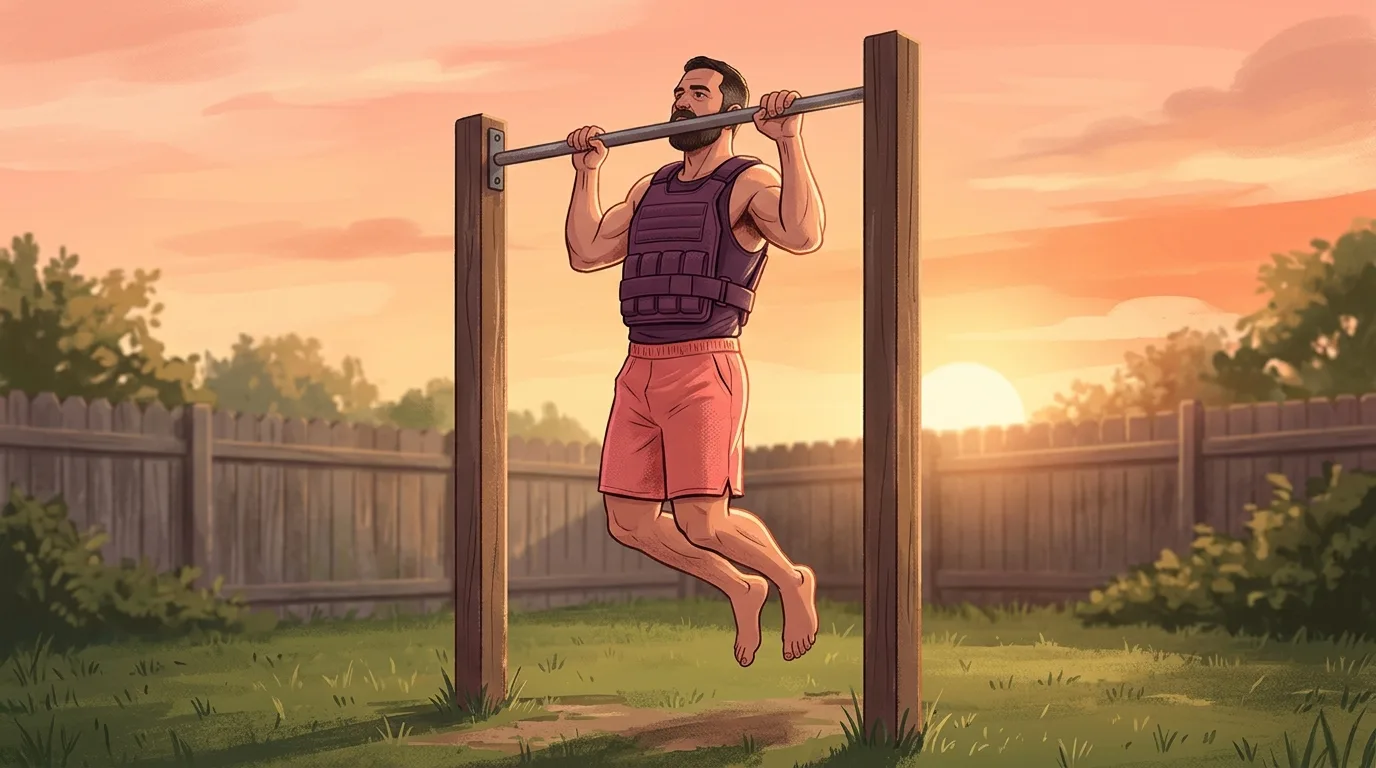
Scaling keeps the workout's purpose, a long steady effort, while matching the volume to what you can do today. CrossFit's own advice is to scale if you expect the Rx version to take you longer than 46 minutes. Here are the common swaps.
| Part | Easier option | Notes |
|---|---|---|
| Pull-ups | Jumping pull-ups, band-assisted pull-ups, ring rows | Ring rows are CrossFit's beginner swap. Use one rep for each pull-up. |
| No pull-up bar | Inverted rows under a sturdy table, or one-arm dumbbell rows | Test the table first. For dumbbell rows, count one rep per arm as one pull-up. |
| Push-ups | Hands on a box, bench or counter, or from the knees | The higher the hands, the easier the rep. Our push-up progression shows each step to the floor. |
| Air squats | Squat to a chair or box | Keep the full 300 if your knees are happy, or halve it. |
| Runs | 800 meters instead of a mile, or a run-walk | A steady bike or rowing machine works if you can't run, at a similar time and effort. |
| Vest | No vest | Skip it until you've done Murph at least once without one. |
Half Murph and Mini Murph
A Half Murph is CrossFit's intermediate version: 1-mile run, 50 pull-ups, 100 push-ups, 150 squats and a 1-mile run, usually as 10 rounds of 5-10-15. A Mini Murph or quarter Murph is a common gym option for a first try: a 400-meter run, 25 pull-ups, 50 push-ups, 75 squats and another 400-meter run, which works out to 5 rounds of 5-10-15. Both are honest ways to take part, and both make a good test before the full version.
Should you wear the vest?
Only if you've trained in it. A vest adds 14 to 20 lb to every pull-up, every push-up and both miles, and it traps heat against your chest. Our review of weighted vest research covers what extra load does over time. For Murph, do your first one without a vest, then add it the following year if you finished inside CrossFit's Rx range.
Find out what's really holding you back
FitCraft, our mobile fitness app, pairs you with an AI coach who builds you a personalized plan around your goals, schedule, and fitness level. Every FitCraft program is designed by Domenic Angelino, MPH (Brown University) and NSCA-CSCS, with research published in the Journal of Strength and Conditioning Research and Medicine & Science in Sports & Exercise.
Take the Free Assessment Free • 2 minutes • No credit cardWhat Is a Good Murph Time?
CrossFit publishes target ranges for each version on its Murph page. These are the clearest benchmarks available, because nobody keeps an official record.
| Version | Good time (CrossFit) |
|---|---|
| Beginner | 25 to 30 minutes |
| Intermediate | 32 to 40 minutes |
| Rx'd | 36 to 46 minutes |
| Elite | Rx'd in under 35 minutes |
What a Murph study found
Carreker and Grosicki (2020) tested 11 men aged about 27 with roughly four years of CrossFit experience. The paper doesn't report a vest. They averaged 43.4 minutes, from 36.6 to 54.2. The runs took about 17.6 minutes in total and the middle section about 25.5. Their heart rate averaged 169 beats a minute, about 85 percent of their maximum, so Murph is a hard effort from start to finish.
The surprising result was what predicted a fast time. Body fat percentage was the only lab measure linked to total time, with leaner men finishing faster. Aerobic capacity and strength tests didn't predict it. Body fat is extra weight to lift on every pull-up, push-up and stride, and it does none of the lifting. It's a small study of trained men, so treat it as a clue rather than a rule.
For a celebrity comparison, Fortune reported that Mark Zuckerberg finished Murph in 39:58 in 2023 wearing a 20 lb weighted pack, inside CrossFit's Rx range.
How Many Calories Does Murph Burn?
No study has measured the energy cost of Murph directly, so here's an estimate. The 2024 Adult Compendium of Physical Activities rates vigorous calisthenics such as pull-ups and push-ups at 7.5 METs, running at 10 minutes per mile at 9.3 METs and running at 12 minutes per mile at 8.5 METs. Calories are roughly METs times body weight in kilograms times hours.
| Body weight | 45-minute Murph (20 min running, 25 min reps) | 60-minute Murph (24 min running, 36 min reps) |
|---|---|---|
| 60 kg (132 lb) | About 370 calories | About 470 calories |
| 80 kg (176 lb) | About 500 calories | About 630 calories |
| 100 kg (220 lb) | About 620 calories | About 790 calories |
Rest between sets pulls these numbers down a little, and a vest pushes them up. Either way, Murph is a big session, roughly what a 4 to 5 mile run at a 10-minute pace burns for the same person.
A 6-Week Murph Training Plan
This build-up adds volume a little at a time, so your first full Murph isn't the first time your arms have seen 100 pull-ups and 200 push-ups. It runs three days a week. CrossFit also offers its own free 6-week program on its Murph page if you train at a gym.
- Day 1, strength: 4 to 5 sets of pull-ups (or your scaled version) and 4 to 5 sets of push-ups, each set stopped with two or three reps left.
- Day 2, easy run: 20 to 30 minutes at a conversational pace, then 3 sets of 25 air squats.
- Day 3, practice Murph: the partitioned session in the table below, in Cindy rounds of 5 pull-ups, 10 push-ups and 15 squats.
| Week | Day 3 practice session | Total pull-ups / push-ups / squats |
|---|---|---|
| 1 | 400 m run, 5 rounds, 400 m run | 25 / 50 / 75 |
| 2 | 800 m run, 7 rounds, 800 m run | 35 / 70 / 105 |
| 3 | 1-mile run, 10 rounds, 1-mile run (Half Murph) | 50 / 100 / 150 |
| 4 | 1-mile run, 12 rounds, 1-mile run | 60 / 120 / 180 |
| 5 | 1-mile run, 15 rounds, 1-mile run | 75 / 150 / 225 |
| 6 | Early in the week: 5 easy rounds only. End of the week: Murph, 20 rounds | 100 / 200 / 300 |
If you can't do strict pull-ups yet, run the whole plan with your scaled version and start with our guide to getting your first pull-up on Day 1. If your arms are still sore three days after a practice session, repeat that week instead of moving on. For a full bodyweight week built around your schedule, our calisthenics workout plan builder sets one up in a minute, and our military calisthenics workout builds the same push-up, squat and pull-up bar base with Army drills.
Race-day checklist
- Eat a normal breakfast two to three hours before and drink water through the morning.
- Start early on a warm day, and pick shade for the rep section if you can.
- Decide your partition before you start and write it down.
- Keep water within reach during the rounds and sip between them.
- Leave the vest at home unless you trained with it.
Is Murph Safe? Rhabdomyolysis and Heat
Murph is safe for trained people who build up to it. The main danger is a first attempt at full volume, when your arms meet far more push-ups and pull-ups than they're used to, often on a hot morning.
What rhabdomyolysis is
Rhabdomyolysis, often called rhabdo, is a fast breakdown of damaged muscle that releases its contents into the blood. In serious cases it can harm the kidneys. These reports show how it relates to a workout like Murph:
- It has happened after Murph itself. A case report from UCLA Health by Doughty (2017) describes a fit 31-year-old man who had eased off training after a half Ironman, then did Murph in a 20 lb vest. He was taking a statin. Two days later his arms and upper back were sore, stiff and mildly swollen, and his creatine kinase was 6,794 U/L. Two days after that it had risen to 19,940 U/L, and he was admitted for IV fluids. His levels were back to normal at an outpatient check 10 days later.
- Upper-body volume can do it in one session. In a report by Cohen (2018), a group of fit trainees did 125 push-ups and 85 assisted pull-ups in 12 minutes. Three women came to the clinic three and four days later with swollen, weak arms and creatine kinase levels of 10,000 to 78,000 U/L, and all three spent 7 to 8 days in hospital before recovering fully. None of them had brown urine. That session had fewer push-ups and pull-ups than Murph.
- Many of the cases were beginners. At one US academic hospital, Hopkins and colleagues (2019) found 11 rhabdomyolysis cases among 523 CrossFit-related injuries. About half the patients were beginners, 10 of the 11 had dark urine and 6 had arm pain.
- Muscle damage peaks days later. When Clarkson and colleagues (2006) had 203 people do 50 hard lowering reps with the elbow flexors, creatine kinase was highest on day 4, the first day it was measured, and 51 of them passed 10,000 U/L. None developed kidney problems, which shows that sore, damaged muscle is common and that kidney trouble is the rarer, serious end of it.
Why heat raises the risk
Memorial Day often falls on a warm morning, and many people add a vest. In the US military, about 75 percent of exertional rhabdomyolysis cases from 2019 to 2023 happened from April through September, and recruits, who are new to hard training, had rates 6 to 10 times higher than other service members (MSMR, 2024). The American College of Sports Medicine's position stand on exertional heat illness advises adjusting or delaying hard exercise when heat and humidity are high. Our guide to running in the heat covers pacing and drinking on hot days.
Warning signs after Murph
- Dark, tea- or cola-colored urine, though in Cohen's three cases the urine looked normal
- Arms or legs that swell, feel tight or get weaker over the next day or two
- Muscle pain far beyond normal soreness, especially in the arms
- Nausea, or very little urine
If you notice any of these, get medical care the same day and tell the clinician about the workout and any painkillers you've taken. Don't wait it out.
The Bottom Line
The Murph workout is a 1-mile run, 100 pull-ups, 200 push-ups, 300 squats and a second mile, done to honor Lt. Michael P. Murphy. Split the reps, skip the vest the first time, use the scaled versions without apology and build the volume over about six weeks. A time between 36 and 46 minutes for the full version is good, and finishing your first one safely is the real win. CrossFit is a trademark of CrossFit, LLC, and FitCraft isn't affiliated with it.
If you'd like help building the base, a personalized training program can carry you through the weeks before. FitCraft's strength workouts use bodyweight and dumbbells, an AI coach demonstrates each exercise on an interactive 3D model and says your name while you train, and your workouts adjust as you progress. Streaks and calendar tracking keep the three sessions a week on track. Mike, 23, got visibly stronger in four months and said the streak system got him hooked. Pick your scaled version, write down your partition and start week 1 on Monday.
Frequently Asked Questions
What is a good Murph time without a vest?
There's no official benchmark for Murph without a vest. In one published Murph study, 11 men with about four years of CrossFit experience, with no vest reported, averaged 43.4 minutes, ranging from 36.6 to 54.2 (Carreker and Grosicki 2020). CrossFit's own guide calls 36 to 46 minutes good for the full Rx'd version and under 35 minutes elite.
How many calories are burned in a Murph?
A Murph burns roughly 370 to 790 calories for most adults, depending on body weight and how long it takes. That's an estimate from the 2024 Compendium of Physical Activities, which rates vigorous calisthenics at 7.5 METs and running at 10 to 12 minutes per mile at 8.5 to 9.3 METs. An 80 kg (176 lb) person finishing in 45 minutes burns about 500 calories.
What happens if I do a Murph every day?
Doing a Murph every day piles 100 pull-ups and 200 push-ups onto muscles that haven't recovered from the last ones. Muscle damage from hard, unfamiliar work peaks several days after the session, so daily repeats raise the risk of rhabdomyolysis and overuse pain in the elbows and shoulders. Treat Murph as an occasional test, once or a few times a year, and train for it with smaller sessions.
Who is the Murph workout named after?
The Murph workout is named after U.S. Navy SEAL Lt. Michael P. Murphy of Patchogue, New York, who was killed in Afghanistan on June 28, 2005, while leading a four-man reconnaissance team. He received the Medal of Honor after his death, and CrossFit introduced Murph as a Hero workout on August 18, 2005.
Is there a Murph world record?
There's no official Murph world record. CrossFit's Murph page publishes target times instead of a record, and it calls an Rx'd Murph in under 35 minutes elite. The fast times shared online are self-reported, often with different rules for the vest, the partitioning and the run.
What was Mark Zuckerberg's Murph time?
Mark Zuckerberg posted a Murph time of 39 minutes and 58 seconds in 2023, done while wearing a 20 lb weighted pack, according to Fortune. That sits inside CrossFit's 36 to 46 minute range for a good Rx'd time.
Can a beginner do the Murph workout?
Yes, with the beginner version: an 800-meter run, 10 rounds of 5 ring rows, 10 push-ups from the knees or with hands on a box and 15 air squats, then another 800-meter run. CrossFit suggests starting the second run by 20 minutes. Build up to the full volume over several weeks rather than attempting 100 pull-ups and 200 push-ups cold.