Maybe you noticed it in a side-on photo, or lying on your back after a workout: the bottom of your rib cage pokes up like a little ledge above your stomach. Or a coach told you "ribs down" during an overhead press and you weren't sure what to move. Then the internet hands you a mix of strap ads, five-minute fixes and clinic pages about surgery.
That's a lot of worry over a shape most people never get explained to them. Flared ribs come in two very different kinds. One is a rib cage held up in a breathing-in position by habit, which you can train. The other is a chest wall that grew in a particular shape, which a doctor should look at. Telling them apart is the first job.
Below you'll find what causes rib flare, a simple self-check, when to see a clinician, seven breathing and core drills with step-by-step cues, and an honest note on what the research does and doesn't show.
What Is Rib Flare?
Rib flare describes the shape of the bottom of your rib cage. Your lower ribs curve down and around from your breastbone to form the costal margin, the edge you can feel under your chest. When that edge angles forward and out, so it lifts away from your belly instead of blending into it, people call it rib flare or flared ribs. It shows most when you lie on your back, raise your arms overhead or take a big breath in.
Rib flare is a description of shape, so it doesn't tell you the cause. A rib cage tipped up by posture and breathing habits can look the same in a mirror as a rib cage shaped by a chest-wall condition. The causes below are split along that line, because what helps one does little for the other.
What Causes Rib Flare?
If you're asking what causes rib flaring, the answer depends on which kind you have. The posture and breathing kind comes from how your spine, diaphragm and abdominal muscles hold the rib cage. The structural kind comes from the shape of the bones and cartilage themselves.
Posture: your rib cage follows your spine
Your ribs attach to your spine at the back, so when your back arches, your lower ribs tip forward with it. Lee and colleagues (2010) measured the chest walls of 7 healthy adults in seven sitting postures while keeping their breathing volume the same. Posture alone changed the three-dimensional shape of the rib cage and how it moved with each breath. In the posture with the lower back arched, the sides of the lower rib cage at the 9th rib moved more with every breath. The study tested sitting, but standing "up straight" by lifting your chest and arching your lower back puts your spine in the same arched position. So does leaning back to finish an overhead press, which has its own section below.
Breathing: ribs parked in the breathing-in position
Your diaphragm is a dome of muscle under your lungs. Part of it runs straight down along the inside of your lower ribs before it curves into the dome, and that strip is called the zone of apposition. Gauthier and colleagues (1994) rebuilt the diaphragm in 3D from MRI scans of 4 healthy adults at four lung volumes. Between a full breath out and a full breath in, the muscle surface of the diaphragm shrank by about 41 percent, and the size of the zone of apposition depended mostly on how far the diaphragm shortened, with the widening of the lower rib cage playing a smaller part. Physical therapists reason that a rib cage held lifted between breaths keeps you closer to that full-breath shape, which is why the drills below start with a long exhale.
That matters because the diaphragm does more than breathe. Hodges and Gandevia (2000) placed fine-wire electrodes in the diaphragm of 4 adults doing fast, repeated arm movements. Instead of switching off when they breathed out, the diaphragm stayed active through the whole exhale at about 78 percent of its peak breathing-in level, which tied it to holding the trunk steady. In a second study, the same team showed that the diaphragm and the deepest abdominal muscle, the transversus abdominis, worked together during arm movement to raise the pressure inside the abdomen, which helps stiffen the trunk.
A quiet deep core
Your deep abdominal muscles are your main breathing-out muscles. The transversus abdominis and internal oblique attach to the inside and the edge of your lower ribs, so when they contract they draw the bottom of the rib cage down and in. Abe and colleagues (1996) recorded all four abdominal muscles with fine-wire electrodes in 9 healthy adults. Standing at rest, the transversus abdominis was the most active muscle during the exhale, the obliques were in between, and the rectus abdominis, the six-pack muscle, did almost nothing.
A full exhale recruits these muscles hard. Ishida and colleagues (2012) measured 33 healthy men with ultrasound and EMG. Breathing all the way out and holding it thickened the transversus abdominis and internal oblique more than the classic "draw your belly button in" cue, and the external oblique worked at about 30 percent of its maximum. If you rarely breathe out fully, these muscles rarely get asked to pull your ribs down.
Breathing and trunk control are linked in people with back pain too. Kolar and colleagues (2012) used dynamic MRI on 18 people with chronic low back pain and 29 without. When their arms and legs pushed against resistance, the people with back pain had a higher diaphragm and smaller diaphragm movements. That doesn't prove rib position causes back pain, but it shows why physical therapists pay attention to breathing when they work on the trunk.
Pregnancy
Pregnancy reshapes the rib cage to make room for the growing uterus. LoMauro and colleagues (2019) followed 18 women through their first pregnancy with a 3D motion-capture system. Across the three trimesters the rib cage got wider and deeper, and the subcostal angle, the angle where the lower ribs meet under the breastbone, got bigger, while the rib cage got shorter and its volume stayed the same. The study didn't follow the women after delivery, so it can't say how much of that change reverses afterward. If your ribs feel wider after a baby, that fits with these changes, and the breathing drills below are a reasonable place to start once your doctor or midwife clears you for exercise.
Chest-wall shape: the structural kind
Some flared ribs are built in. Pectus excavatum, where the breastbone sits sunken, is the most common chest-wall condition, and a 2024 review by Janssen and colleagues notes that rib flare is often seen alongside it. It's uncommon in adults: in a study of adults in the Dallas Heart Study by Biavati and colleagues (2020), about 0.4 percent, or 1 in 250, met both scan-based measures of pectus excavatum. Pectus carinatum, a breastbone that pushes outward, is another chest-wall shape. NHS England's 2023 pectus policy statement notes that both can run in families and can come with scoliosis, Marfan syndrome or Ehlers-Danlos syndrome. This kind belongs with a doctor, who can decide whether exercise, bracing or another treatment fits.
Flared Ribs From Posture or From a Chest-Wall Condition?
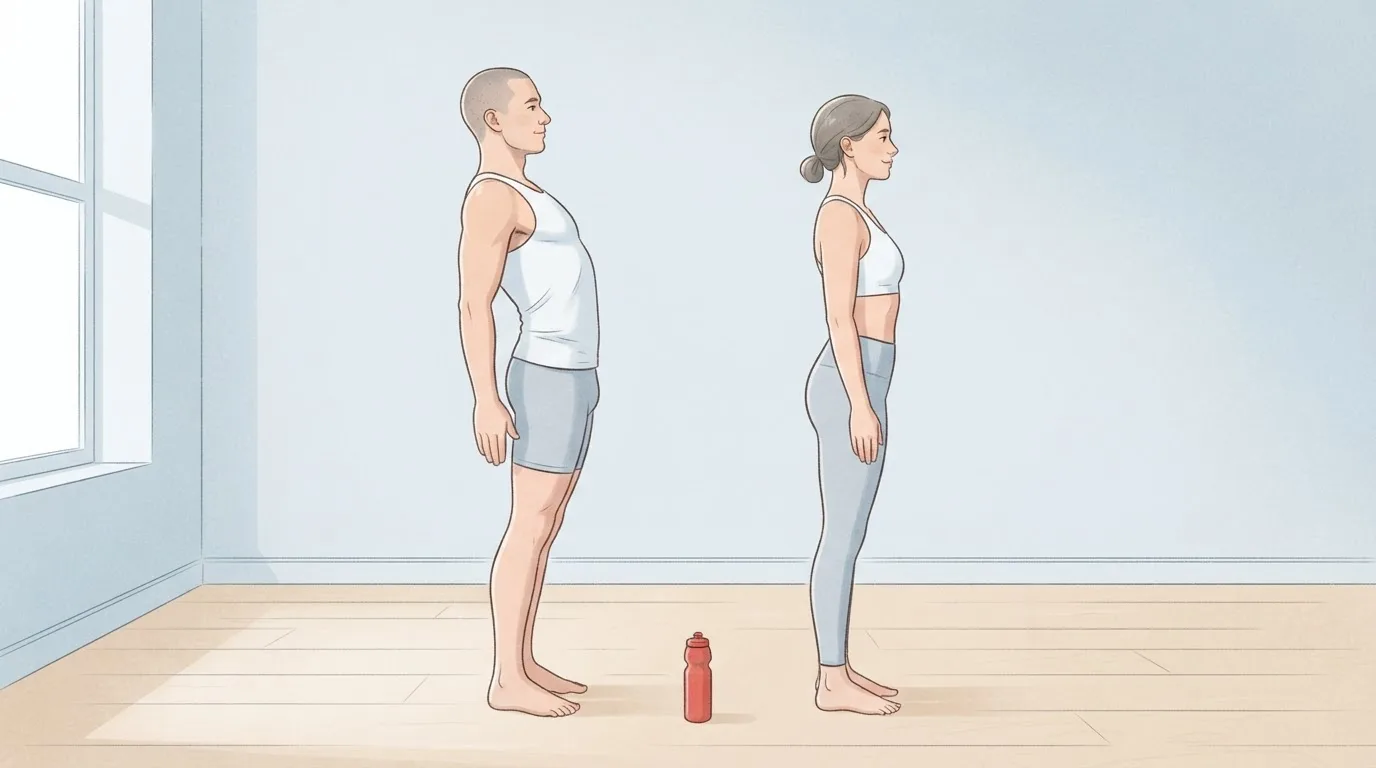
You can't diagnose yourself, but a few clues point one way or the other. Use this table to decide whether to start with the drills or with a doctor's visit.
| Clue | Points to posture and breathing | Points to a chest-wall condition |
|---|---|---|
| Full exhale | The rib edge sinks noticeably | The shape barely changes |
| Arms overhead | Flare appears or gets much bigger | Flare looks about the same in every position |
| Breastbone | Looks flat | Looks sunken or pushed out |
| Sides | Roughly even | Clearly one-sided, or one side much bigger |
| When you noticed it | Adulthood, with training or after pregnancy | Since childhood or the teenage growth spurt |
| Symptoms | None, or a feeling of stiffness | Pain, breathlessness, a racing heart or fainting with exercise |
When to see a clinician
Book a visit with your doctor or a physical therapist before you start any drills if any of these apply:
- Pain in your ribs, chest or upper belly, especially new pain or pain with breathing.
- Flare on one side only, or a clear difference between the two sides.
- A breastbone that looks sunken or pushed out.
- Breathlessness, palpitations or fainting when you exercise. NHS England's policy lists these among the symptoms of pectus excavatum.
- A shape that is changing, or that appeared after a fall or a blow to the chest.
- A known diagnosis of scoliosis, Marfan syndrome or Ehlers-Danlos syndrome.
Do I Have Rib Flare or Am I Just Skinny?
Leaner people see their ribs more, so a visible rib edge on its own doesn't mean anything is wrong. The question is whether your ribs can come down. This two-minute self-check answers it:
- Lie on your back with your knees bent and your feet flat. Let your arms rest by your sides.
- Find the lower edge of your rib cage with your fingertips, a few inches either side of your breastbone.
- Breathe in through your nose, then breathe out slowly through pursed lips, as if blowing through a straw, until you can't push out any more air.
- Notice whether the rib edges sink down and in under your fingers, and whether your lower back settles closer to the floor.
- Keep breathing gently and try to keep the ribs from popping back up. Then raise both arms overhead and see whether the edges lift again.
If the edges sink on a full exhale and only pop up when you arch or reach overhead, you're looking at the posture and breathing kind, and the drills below are for you. If the shape stays the same no matter how you breathe or move, or the breastbone looks dipped or raised, have a doctor look before you assume it's a habit.
Find out what's really holding you back
FitCraft, our mobile fitness app, pairs you with an AI coach who builds you a personalized plan around your goals, schedule, and fitness level. Every FitCraft program is designed by Domenic Angelino, MPH (Brown University) and NSCA-CSCS, with research published in the Journal of Strength and Conditioning Research and Medicine & Science in Sports & Exercise.
Take the Free Assessment Free • 2 minutes • No credit card7 Exercises for Rib Flare: Breathing and Core Drills
These drills train two skills: breathing out fully so the lower ribs come down, and keeping them down while your arms and legs move. The first two are breathing drills you can do every day. The rest add movement and load, so do them three or four days a week. Move slowly, and stop a rep as soon as your ribs pop up or your lower back arches.
1. 90-90 breathing
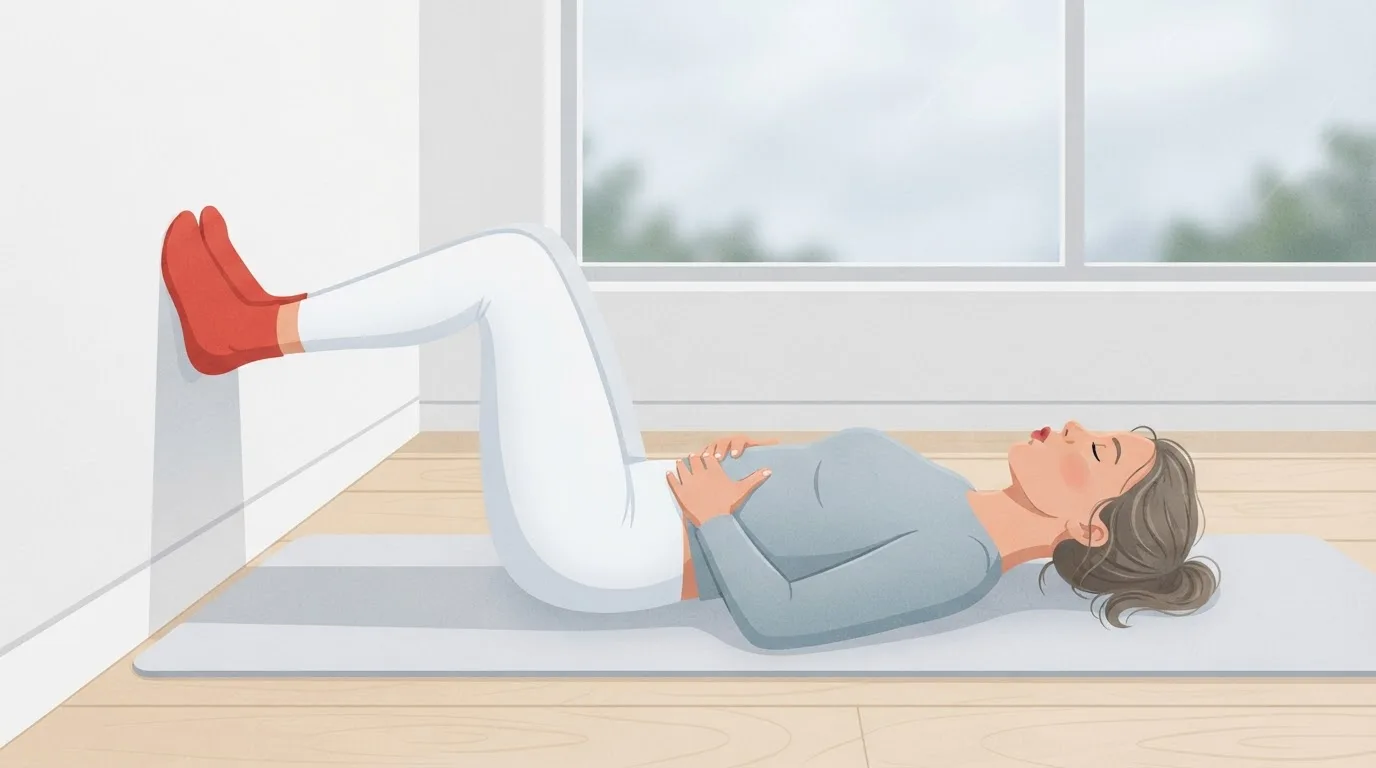
This is the base drill, and the one in the illustration at the top of this page.
- Lie on your back with your feet flat on a wall, your hips and knees both bent to about 90 degrees.
- Press your heels gently down into the wall until you feel the backs of your thighs switch on and your tailbone curl up slightly. Your lower back should rest on the floor.
- Put one hand on your lower ribs. Breathe in through your nose for about 4 seconds, feeling your sides and back widen rather than your chest rising.
- Breathe out through pursed lips for 6 to 8 seconds, until your ribs sink under your hand. Pause for 2 to 3 seconds before the next breath.
- Do 5 breaths, rest, and repeat once or twice.
Some physical therapists add a balloon: you breathe in through your nose and out into the balloon without letting the air back out, which makes the exhale long and forceful. Boyle, Olinick and Lewis (2010) described this version as a clinical suggestion built around the zone of apposition, and they didn't test it as a treatment. A small four-week trial by Seo and Cho (2018) in female university students found that lung-function scores improved with the balloon version, but it didn't measure rib position at all.
2. Crocodile breathing
- Lie face down with your forehead resting on your stacked hands and your legs relaxed.
- Breathe in slowly through your nose and feel your lower back and sides rise against the floor and the ceiling. Your belly presses into the floor too.
- Breathe out through pursed lips for twice as long as the inhale.
- Do 8 to 10 slow breaths.
Lying face down makes chest-lifting breaths awkward, so you learn to expand your lower ribs out to the sides and back instead of up and forward.
3. Dead bug
- Lie on your back with your arms pointing at the ceiling and your knees bent at 90 degrees above your hips.
- Breathe out fully until your lower ribs sink and your lower back rests on the floor.
- Keeping that position, slowly reach one arm back toward the floor behind your head as you straighten the opposite leg toward the floor.
- Go only as far as your ribs and lower back stay down, then return and switch sides.
- Do 2 to 3 sets of 6 slow reps per side, breathing out as you reach.
Start by tapping a heel to the floor with the knee still bent, and only straighten the leg fully when that feels easy. The dead bug is where many people first feel how quickly their ribs want to flare when an arm goes overhead.
4. Glute bridge with a full exhale
- Lie on your back with your knees bent and your feet flat, hip-width apart.
- Breathe out fully, letting your ribs sink, and gently tuck your tailbone.
- Squeeze your glutes and lift your hips until your knees, hips and shoulders make a line. Don't push higher by arching your lower back.
- Hold for 2 breaths, keeping the ribs down, then lower slowly.
- Do 2 sets of 8 to 10 reps.
5. Bear hold with breathing
- Start on your hands and knees, hands under your shoulders and knees under your hips.
- Push the floor away so your upper back rounds slightly, and breathe out fully.
- Lift your knees about an inch off the floor and hold, keeping your back still.
- Take 3 to 5 slow breaths in the hold, breathing out fully each time, then set your knees down.
- Do 3 holds.
6. Wall reach
- Stand with your back against a wall, your heels about a foot in front of it and your knees soft.
- Breathe out and let your lower ribs sink back toward the wall, so your lower back comes closer to it.
- Raise your arms in front of you and slowly overhead, keeping the backs of your hands near the wall.
- Stop the moment your ribs lift away from the wall or your back arches, breathe out again, and lower.
- Do 2 sets of 6 slow reps.
This shows you how much overhead range you have with your ribs down. If your arms stop well short of the wall, the limit may be your shoulders, and our shoulder mobility exercises start with a lying version of this test.
7. Half-kneeling dumbbell press
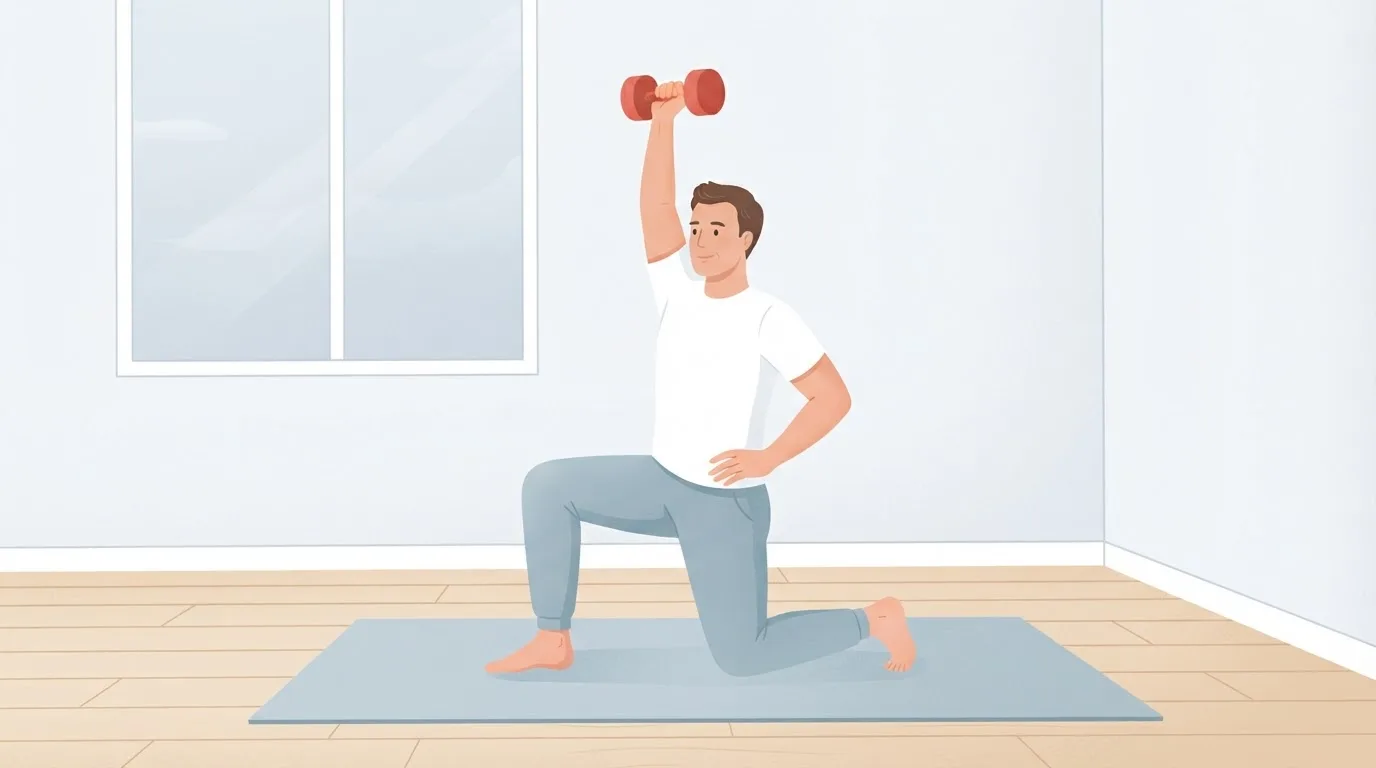
- Kneel on one knee with the other foot flat in front of you, both knees at about 90 degrees.
- Hold a light dumbbell at your shoulder on the same side as the down knee.
- Squeeze the glute of the down leg, breathe out and let your ribs sink so they stack over your pelvis.
- Press the dumbbell straight up without leaning back or letting your ribs lift, then lower it slowly.
- Do 2 to 3 sets of 8 per side with a weight you could press about 12 times.
| Drill | What it trains | How often |
|---|---|---|
| 90-90 breathing | A full exhale with the ribs down | Daily, 2 to 3 rounds of 5 breaths |
| Crocodile breathing | Expanding the lower ribs sideways and back | Daily, 8 to 10 breaths |
| Dead bug | Keeping the ribs down while the arms and legs move | 3 to 4 days a week |
| Glute bridge with exhale | Hip extension without arching | 3 to 4 days a week |
| Bear hold | Breathing out fully under load | 3 to 4 days a week |
| Wall reach | Arms overhead with the ribs down | 3 to 4 days a week |
| Half-kneeling press | The same skill with a weight in your hand | 2 to 3 days a week |
The deeper version of this work, with progressions for the transversus abdominis and pelvic floor, is in our guide to deep core exercises.
Rib Flare During Overhead Presses and Squats
If your ribs only flare when you lift, the fix sits in your setup rather than in extra breathing drills. These cues work for presses, push-ups and squats:
- Breathe out before you brace. Exhale until your ribs sink, then take a smaller breath into your belly and sides and hold it for the hard part of the rep.
- Squeeze your glutes on presses. It helps keep your pelvis from tipping forward and your lower back from arching.
- Press from one knee or while seated with your back supported. Both make leaning back harder, so you find out how much overhead range you really have.
- Lower the weight. A weight you can only finish by arching is too heavy for your current range.
- Film one set from the side. Watch for your chest lifting and your lower back curving at the top of the press or the bottom of the squat.
For the bigger picture of how breathing patterns and posture work together, see our review of diaphragmatic breathing research and our guide to exercises for posture, which covers what posture work can and can't change.
Do Flared Ribs Ever Go Away?
The posture and breathing kind changes the moment you change how you stand and breathe. A full exhale brings the ribs down in your first session, and daily practice makes it easier to keep them down while you move. What hasn't been tested is whether months of the drills above change the resting angle of your ribs when you aren't thinking about it. We couldn't find a trial that measured rib angle before and after breathing or core exercise, so anyone promising a permanent fix in days is guessing.
A realistic goal is control. You want ribs that come down when you breathe out, stay down while you move, and don't flare every time you reach overhead. That's trainable, and it's what the drills above build.
Structural rib flare is different, and a doctor should guide it. NHS England's policy lists posture and exercise programmes, bracing and psychological support as non-surgical options for pectus deformities, and makes surgery routinely available only for pectus excavatum that causes very severe symptoms. It expects 5 to 10 patients a year to qualify.
A 10-Minute Rib Flare Routine
Put the drills together like this. The breathing block takes three minutes and fits before bed or at your desk. The core block takes about ten minutes and fits after a walk or at the start of a strength workout.
| Block | Drills | When |
|---|---|---|
| Daily breathing (3 minutes) | 90-90 breathing, 2 rounds of 5 breaths; crocodile breathing, 8 breaths | Every day |
| Core block (10 minutes) | Dead bug 2 x 6 per side; glute bridge 2 x 10; bear hold 3 holds; wall reach 2 x 6 | 3 to 4 days a week |
| Strength add-on | Half-kneeling dumbbell press 3 x 8 per side | 2 to 3 days a week, in your strength workout |
The hard part is doing three minutes of breathing every day for a month when nothing hurts and nobody is checking. If that's where routines usually fall apart for you, an AI personal trainer app can carry the plan. FitCraft has the dead bug and the glute bridge as exercises with interactive 3D demos you can zoom in on, and its exercise tips name the muscles to focus on. Your AI coach says your name while you train, your workouts adjust as you progress, and streaks help keep short sessions from slipping.
The Bottom Line
Rib flare is a shape, and the cause decides what helps. If your ribs sink when you breathe out fully and only pop up when you arch or reach overhead, it's a posture and breathing habit, and a few minutes of 90-90 breathing, dead bugs and careful overhead work trains you to control it. If the flare comes with pain, sits on one side, or comes with a sunken or raised breastbone, see a clinician first.
Working out consistently is hard, but it doesn't have to be. As Stacy, 41, put it after her second baby, "I needed something stupidly simple." Three minutes of breathing on the floor tonight is about as simple as it gets.
Frequently Asked Questions
What are rib flare ups?
A rib flare up usually means a flare of pain in the ribs or chest wall, which is a different thing from rib flare, the shape of the lower rib cage. One common cause is costochondritis, an inflammation where the ribs join the breastbone. A review in American Family Physician notes that coronary artery disease is present in 3 to 6 percent of adults with chest pain and a tender chest wall, so new chest or rib pain needs a doctor before any exercise routine.
Is rib flare a real thing, and does the NHS treat it?
Rib flare is a real, visible shape, but on its own it describes how the lower ribs sit rather than naming a disease. Doctors look for a chest-wall condition behind it, such as pectus excavatum, which often comes with flared lower ribs. In England, NHS England's 2023 policy statement makes pectus surgery routinely available only for pectus excavatum that causes very severe symptoms, such as heart rhythm problems, fainting or pressure on the heart, and it expects 5 to 10 patients a year to qualify. It also lists posture and exercise programmes and bracing among the non-surgical options.
What organ is at the bottom of your ribcage?
The liver sits under your lower right ribs with the gallbladder tucked beneath it, and the stomach and spleen sit under your lower left ribs. The kidneys sit toward your back, partly behind the lowest ribs. Pain under the ribs can come from any of these organs, so have it checked rather than assuming it comes from your rib shape.
Is rib flare unattractive?
That's a matter of taste. Visible lower ribs are a normal sight on lean bodies, and a rib edge that shows when you lie down or lift your arms isn't a flaw. If it bothers you, a full exhale brings the lower ribs down and in, and the drills in this guide train you to keep them there while you move.
Do rib flare straps or braces work?
We found no study testing the rib flare straps sold online. NHS England lists bracing among the non-surgical options for pectus deformities, but that's a medical treatment chosen and supervised by a clinician. For rib flare that comes from posture and breathing, training a full exhale and core control is the approach with a physiological rationale.
How long does it take to fix rib flare?
You can lower flared ribs with a full exhale in your first session, and daily practice makes it easier to keep them down while you move. Whether months of breathing and core drills change the resting angle of flared ribs hasn't been tested in a trial. Rib flare from a chest-wall condition needs a doctor's assessment, and any exercise plan for it should come from that clinician.