Every trainer tells you to engage your core, and few explain which muscles that means. Maybe your lower back aches after a long day, maybe you leak a little when you cough or jump, or maybe you were told after a pregnancy that your deep core is weak. The crunches you know don't seem to touch any of it.
Below are 10 deep core exercises in the order of a deep core workout, each matched to the deep muscle it loads most, then transverse abdominis exercises, drawing-in versus bracing, breathing, deep core exercises for women, and a 10-minute routine.
If you've struggled to feel these muscles, nothing is wrong with you. They work underneath the muscles you can see, so they respond to different cues: slow movement, steady breathing and a gentle squeeze rather than a burn.
10 Deep Core Exercises, Ordered by the Muscle Each One Trains
The first four teach you to find the deep muscles while you lie still. The next six keep those muscles working while your arms, legs and trunk hold a position against your body weight. Go slowly. If you feel a burn in your six-pack and nothing deeper, ease off and lengthen your exhale.
| # | Exercise | Main focus | Position |
|---|---|---|---|
| 1 | 360 breathing | Diaphragm | On your back |
| 2 | Abdominal drawing-in | Transverse abdominis | On your back |
| 3 | Pelvic floor lift on the exhale | Pelvic floor | Lying or sitting |
| 4 | Bent-knee fallout | Keeping the drawing-in as a leg moves | On your back |
| 5 | Dead bug | Keeping the drawing-in as arms and legs move | On your back |
| 6 | Bird dog | Transverse abdominis | Hands and knees |
| 7 | Glute bridge | Multifidus | On your back |
| 8 | Side plank | Transverse abdominis and internal obliques | On your side |
| 9 | Plank with arm and leg lift | Transverse abdominis | Forearms and toes |
| 10 | Brace holds | Internal obliques and the whole wall | Standing or sitting |
1. 360 breathing
Lie on your back with your knees bent and wrap a hand around each side of your lower ribs. Breathe in slowly through your nose and let your ribs widen into your hands at the front, sides and back, instead of lifting your chest. Then breathe out through pursed lips for longer than you breathed in, and notice your lower belly firm up gently at the end of the breath. Do 6 to 8 slow breaths. It teaches your diaphragm and abdominal wall to share the work, which the rest of this list builds on. Our review of the diaphragmatic breathing research covers what slow breathing does beyond the core.
2. Abdominal drawing-in
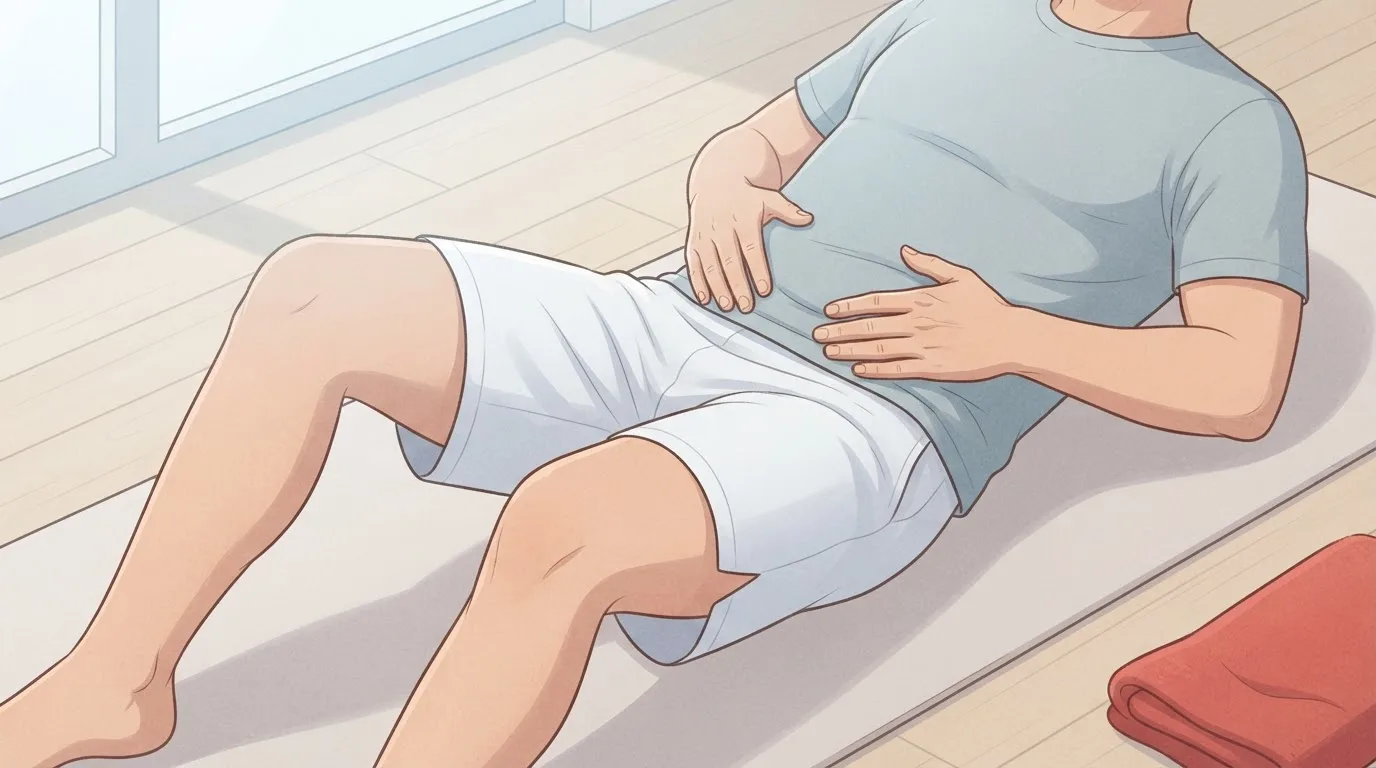
Stay on your back with your knees bent. Press two fingertips lightly into your belly just inside the bony points at the front of your hips. Breathe out and gently draw the part of your belly below your navel in toward your spine, without moving your pelvis, ribs or back. You're looking for a light, deep tension spreading under your fingertips. A hard bulge pushing your fingers out means the outer muscles have taken over, so use less effort. Hold for 10 seconds while you keep breathing, 8 to 10 times.
3. Pelvic floor lift on the exhale
Sit or lie comfortably. Breathe in, and as you breathe out, squeeze and lift the muscles you'd use to hold in urine and wind at the same time, drawing them up and in. Hold for 3 to 5 seconds, then let go completely and rest for as long as you held. Do 8 to 10. Letting go fully matters as much as the squeeze. Men have a pelvic floor too, and the same cue works for them.
4. Bent-knee fallout
Lie on your back with your knees bent and feet flat, and draw in gently as in exercise 2. Let one knee fall slowly out to the side, only as far as you can without your pelvis rolling, then bring it back and switch. Keep an eye on the bony points at the front of your hips: if one rises, the range was too big. Do 8 to 10 per side. It's the first step in keeping the deep muscles on while a limb moves.
5. Dead bug
Lie on your back with your arms pointing at the ceiling and your knees lifted over your hips, bent at 90 degrees. Draw in gently so your lower back rests on the floor. Slowly reach one arm overhead and straighten the opposite leg toward the floor, stopping before your back lifts, then return and switch. Breathe out as your arm and leg reach. Do 6 to 8 per side. Domenic's dead bug guide has easier and harder versions.
6. Bird dog
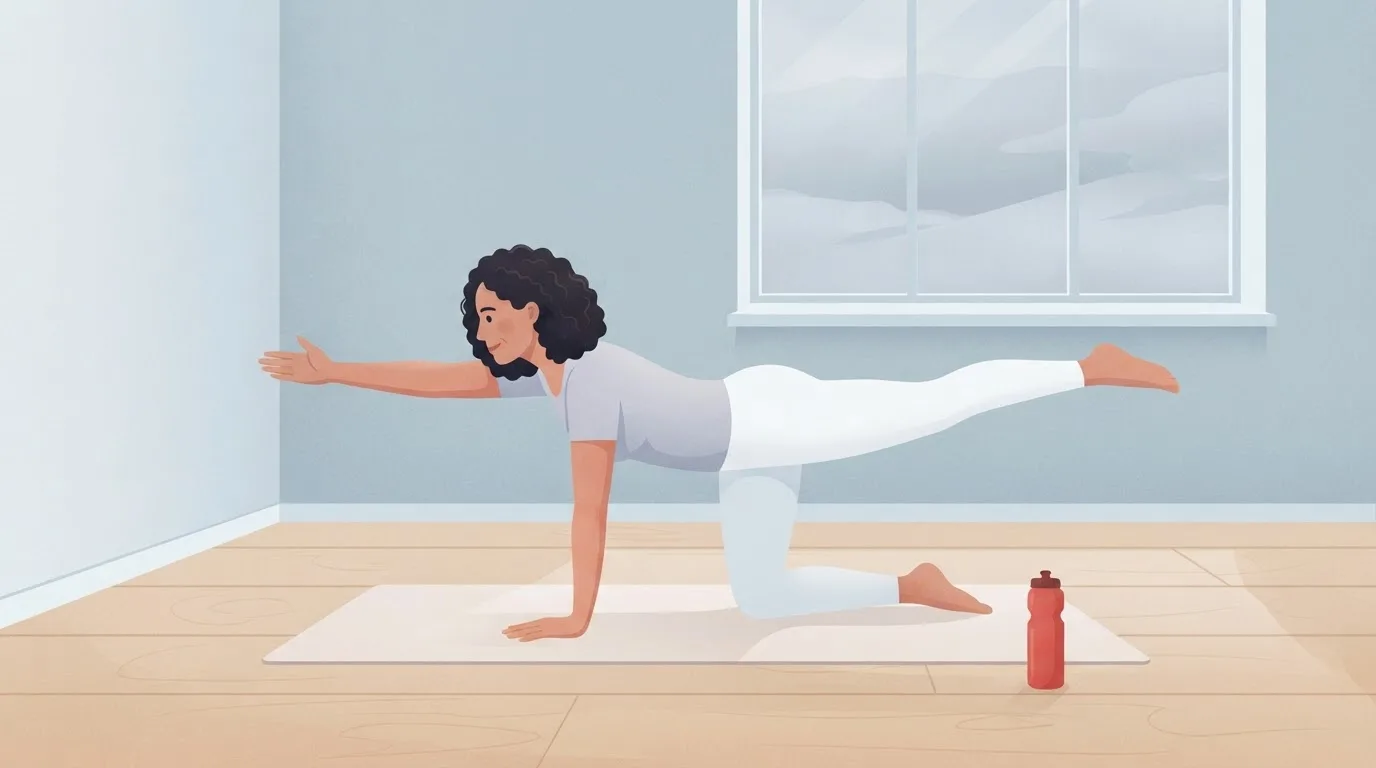
Get on your hands and knees with your hands under your shoulders and your knees under your hips. Draw in, then slide one hand forward and the opposite foot back until both are level with your back, without letting your hips tip or turn. Pause for two slow breaths, come back and switch. Do 6 to 8 per side. In Teyhen and colleagues' ultrasound study (2008), this arm-and-leg lift thickened the transverse abdominis with little change in the internal oblique above it, so it trains the deepest layer more than the one on top. Domenic's bird dog guide covers the form.
7. Glute bridge
Lie on your back with your knees bent and feet flat, hip-width apart. Breathe out, draw in and press through your heels to lift your hips until your knees, hips and shoulders line up. Keep your ribs down, so the lift comes from your hips and not from an arch in your lower back. Hold for two seconds and lower. Do 2 sets of 10 to 12. Of five stabilization exercises tested with fine-wire electrodes by Okubo and colleagues (2010), bridges produced the highest activity in the multifidus, the small muscles along your spine.
8. Side plank
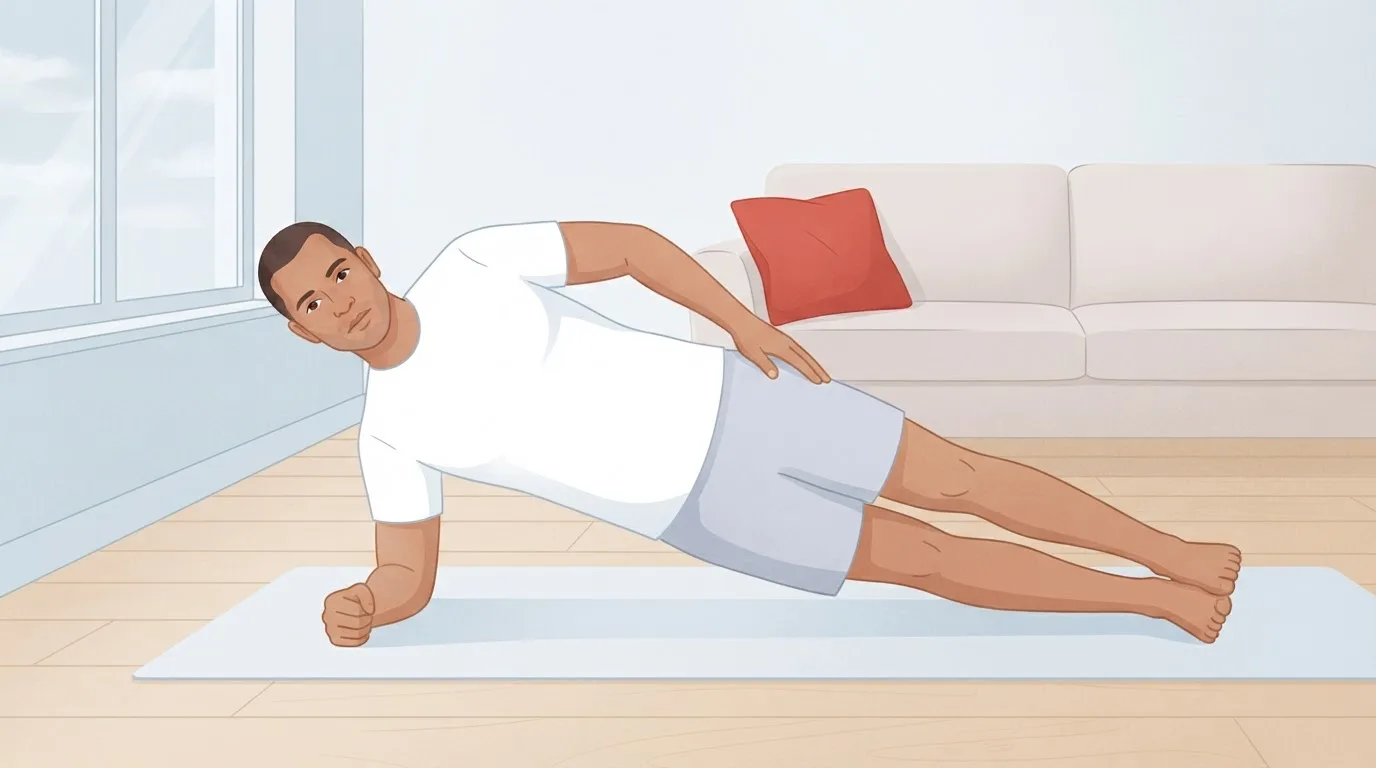
Lie on your side with your elbow under your shoulder and your knees bent behind you, then lift your hips until your body is straight from your knees to your head. Move to straight legs with your feet stacked once 30 seconds on your knees feels steady. Of six common trunk exercises, the side plank produced the largest increase in both transverse abdominis and internal oblique thickness. Do 3 holds of 15 to 30 seconds per side.
9. Plank with arm and leg lift
Set up in a forearm plank with your elbows under your shoulders and your body in one line from head to heels. Lift one arm forward and the opposite leg back an inch or two, hold for three seconds, return and switch, without letting your hips twist or sag. Do it from your knees first if the full version makes you twist. This was the exercise with the highest transverse abdominis activity in the Okubo fine-wire study of nine men. Do 2 sets of 4 to 6 per side.
10. Brace holds
Stand or sit tall. Tighten your whole waist as if someone were about to poke you in the stomach, front, sides and back together, without sucking in or pushing out. Keep breathing in short, steady breaths while you hold the brace for 10 seconds, then relax. Build up to 5 holds. Bracing is the one move here you can practice anywhere, and it's the version of core control you'll use when you lift something heavy.
What Are the Deep Core Muscles?
The deep core muscles form a pressurized cylinder underneath your six-pack and your outer obliques. Five muscles make its walls, its top and its bottom:
| Muscle | Where it sits | Its main job |
|---|---|---|
| Transverse abdominis | The deepest layer of the abdominal wall, wrapping around your waist like a wide belt | Tightens the wall and raises the pressure inside your abdomen |
| Internal obliques | At the sides, between the transverse abdominis and the external obliques | Turn and side-bend the trunk, and help stiffen it |
| Multifidus | Small muscles along the back of the spine, joining each vertebra to the next one and to others a few levels away | Control each segment of the lower spine |
| Pelvic floor | A sling of muscle across the bottom of the pelvis | Supports the bladder and bowel and keeps them closed under pressure |
| Diaphragm | A dome under the lungs, forming the top of the cylinder | Breathing, and raising abdominal pressure to steady the trunk |
Together they control the pressure inside your abdomen, and that pressure stiffens your spine. In a study of three people by Hodges and colleagues (2005), electrically stimulating the diaphragm raised abdominal pressure by 27 to 61 percent of a maximal effort and stiffened the lower spine by 8 to 31 percent, with no abdominal or back muscles switched on. The deepest core muscle, the transverse abdominis, is where most deep core training starts.
Transverse Abdominis Exercises: How to Activate Your Deepest Core Muscle
The transverse abdominis became famous through one finding. Hodges and Richardson (1996) had 15 people with low back pain and 15 matched people without it raise an arm as fast as they could. In the people without pain, the transverse abdominis was always the first trunk muscle to switch on, whatever direction the arm moved. In the people with back pain, it switched on significantly later on every movement. The authors suggested the delay meant the spine was less well supported.
Later work made that picture less tidy. Recording both sides of the body with fine wires, Allison, Morris and Lay (2008) found the transverse abdominis on each side responded differently depending on which arm moved, rather than both sides switching on together like a corset. So the muscle matters, but the authors said the picture of it as a stabilizer that works the same on both sides needs rethinking.
How to activate the transverse abdominis
- Lie on your back with your knees bent, and find the bony points at the front of your hips.
- Move two fingertips about an inch inward and slightly down from those points, and press in lightly.
- Breathe out slowly, and as the breath ends, draw your lower belly gently in and up, as if tightening a belt one notch.
- Feel for a flat, firm tension under your fingers. If your fingers get pushed out, you're squeezing too hard.
- Hold it while you breathe normally for 10 seconds. If you have to hold your breath, start with less effort.
Which exercises work it hardest
Once you can find it lying down, harder positions load it more. Teyhen and colleagues (2008) used ultrasound to measure how much the transverse abdominis and internal oblique thickened in 120 adults aged 18 to 50 during six common exercises. The side plank produced the biggest change, with the transverse abdominis thickening to 1.95 times its resting size and the internal oblique to 1.88 times. The ordinary crunch came next for the transverse abdominis, at 1.74 times, so crunches work the deep layer too. The drawing-in maneuver thickened the transverse abdominis to 1.73 times with almost no change in the internal oblique, and age made no difference to the results.
With fine-wire electrodes inside the muscle in nine men, Okubo and colleagues (2010) found the highest transverse abdominis activity in a front plank with one arm and the opposite leg lifted. In 7 of the 11 exercises they tested, the transverse abdominis on the left and right worked at different levels, which is a good reason to give both sides the same number of reps.
How long it takes to strengthen is better measured than most core claims. In a trial by Koh, Cho and Kim (2014), 30 middle-aged women did either drawing-in or bracing exercise in 60-minute sessions, three times a week for six weeks. The drawing-in group's transverse abdominis grew in cross-sectional area on both sides.
Find out what's really holding you back
FitCraft, our mobile fitness app, pairs you with an AI coach who builds you a personalized plan around your goals, schedule, and fitness level. Every FitCraft program is designed by Domenic Angelino, MPH (Brown University) and NSCA-CSCS, with research published in the Journal of Strength and Conditioning Research and Medicine & Science in Sports & Exercise.
Take the Free Assessment Free • 2 minutes • No credit cardMultifidus and Internal Obliques: The Back and Sides of Your Deep Core
The multifidus is a column of short muscles along the back of your spine. It doesn't always recover by itself after back pain. Hides, Richardson and Jull (1996) followed 39 people through their first episode of acute low back pain. In those who got medical care alone, the multifidus on the painful side was still smaller 10 weeks later, even though their pain had gone and they were back to normal activity. In those who also did specific exercises for it, the muscle recovered faster and more completely.
The same team followed both groups for three years. In the long-term report (Hides 2001), back pain came back within a year in 30 percent of the exercise group against 84 percent of the group without it, and within two to three years in 35 percent against 75 percent. It's one small trial of first-episode pain, so treat it as a reason to keep training after back pain settles rather than as proof that deep core work prevents it. Bridges and bird dogs are the simplest home exercises for the multifidus.
The internal obliques sit at the sides, under the external obliques, and their fibers run roughly at right angles to them. They respond well to bracing. In a trial by Tayashiki and colleagues (2016), 11 young men did 5 sets of 10 all-out 2-second braces, three days a week for eight weeks, with no weights. Their internal oblique thickness rose 22.4 percent, trunk extension strength 14.4 percent, hip extension strength 34.7 percent and lifting power 15.6 percent, while a control group didn't change. The side plank is the other strong choice, as the ultrasound numbers above show.
Pelvic Floor and Diaphragm: The Bottom and Top of Your Deep Core
The pelvic floor
Your pelvic floor and abdominal wall work as a team. In seven women who had given birth, Sapsford and colleagues (2001) recorded the abdominal muscles with fine wires and found their activity rose above resting levels when the women squeezed the pelvic floor, in every woman in at least one of the three spine positions tested. In a two-person pilot in the same paper, the pelvic floor also switched on during abdominal contractions.
That teamwork has limits, though, so train the pelvic floor directly. In 20 female physical therapists, Bø, Sherburn and Allen (2003) used ultrasound to watch the pelvic floor during three kinds of contraction. A direct pelvic floor squeeze lifted it 11.2 mm on average, against 4.3 mm for a transverse abdominis contraction, and in 6 of the 20 women the transverse abdominis contraction pushed the pelvic floor down instead of up.
Direct training works for leaking. A 2018 Cochrane review of 31 trials and 1,817 women (Dumoulin) found women with stress urinary incontinence who did pelvic floor muscle training were about eight times more likely to report a cure than women without it: 56 percent against 6 percent, pooled from 4 trials and 165 women with stress incontinence.
The diaphragm
The diaphragm is a breathing muscle and a posture muscle at the same time. When standing people raised an arm as fast as possible, Hodges and colleagues (1997) found the diaphragm contracted about 20 milliseconds before the shoulder muscle, at the same moment as the transverse abdominis, whatever point in the breath the movement started. Pressure in the abdomen rose before the arm moved.
It can do both jobs at once. During repeated arm movements, Hodges and Gandevia (2000) found the diaphragm and transverse abdominis stayed active throughout, with their activity rising and falling with both the breath and the arm. That's why you can keep a brace and keep breathing. In 18 people with chronic low back pain compared with 29 without it, Kolar and colleagues (2012) saw smaller diaphragm movements and a higher diaphragm position on MRI when the limbs were loaded. That's a link, not proof that a lazy diaphragm causes back pain.
Drawing-In vs Bracing: What the Studies Found
Drawing in, also called hollowing, pulls the lower belly in toward the spine and mostly works the transverse abdominis. Bracing tightens the whole wall, front, sides and back together, without pulling in. The two have been argued over for decades, and the studies point to different jobs for each.
- Bracing gives more stability. In a modeling study of eight men holding weights, Grenier and McGill (2007) estimated that bracing improved spine stability by 32 percent at the cost of 15 percent more compression, while the transverse abdominis alone added almost nothing. They concluded there was no mechanical reason to hollow for stability.
- Bracing handles sudden loads better. When Vera-Garcia and colleagues (2007) applied sudden loads to 11 men from behind, hollowing didn't reduce how much the trunk moved, while bracing cut lower-back movement, again with more spinal compression.
- Each one grows mostly different muscles. In the six-week Koh trial, hollowing enlarged the transverse abdominis on both sides, while bracing enlarged the internal and external obliques on both sides. Both also enlarged the left side of the rectus abdominis.
Use both. Drawing in is the easiest way to find and feel the transverse abdominis, which makes it the right first step. Bracing is the strategy to use when a load arrives: carrying shopping, lifting a child or a dumbbell, or holding a plank. A light brace, firm but well short of a full squeeze, is enough for most everyday tasks. The stomach vacuum is a held, exaggerated version of drawing in, with its own progressions.
How to Breathe During Deep Core Exercises
Holding your breath feels stable, which is why most people do it in a plank. But for these low-load exercises, steady breathing is part of the training: your diaphragm and abdominal wall have to learn to keep the brace while air moves in and out, as the Hodges and Gandevia work showed they can.
- Breathe out on the hard part. Exhale as your arm and leg reach in a dead bug, as your hips lift in a bridge or as you settle into a plank.
- Make the exhale long. Your abdominal muscles help push air out, so a slow, full exhale through pursed lips firms up your lower belly by itself and makes the deep muscles easier to feel.
- Breathe into your sides and back. Let your lower ribs widen as you breathe in, rather than your chest rising or your belly pushing out against the brace.
- Keep your ribs down. If your ribs flare up and your lower back arches as you breathe in, the hold is too hard for now.
- Count breaths, not seconds. Holding a position for 3 to 5 slow breaths keeps you breathing instead of bracing against the clock.
A 10-Minute Deep Core Workout
This routine runs from finding the muscles to loading them. Rest about 20 seconds between exercises. Do it on its own or before a strength session, three days a week or more.
| Order | Exercise | Dose | Cue |
|---|---|---|---|
| 1 | 360 breathing | 6 slow breaths | Ribs widen into your hands |
| 2 | Abdominal drawing-in with a pelvic floor lift | 6 holds of 10 sec | Gentle, deep and flat, never a bulge |
| 3 | Dead bug | 2 sets of 6 per side | Breathe out as you reach |
| 4 | Bird dog | 2 sets of 6 per side, 2-breath pause | Hips stay square |
| 5 | Glute bridge | 2 sets of 10 | Ribs down, lift from the hips |
| 6 | Side plank, knees or feet | 2 holds of 20 sec per side | Keep breathing |
When this feels easy, swap the dead bug for the plank with an arm and leg lift and add brace holds at the end. Is 10 minutes enough? For learning and strengthening the deep core, yes. In the Tayashiki trial, three short bracing sessions a week for eight weeks were enough to thicken the internal obliques. It won't replace regular strength training for the rest of your body.
If you'd like the routine planned around the rest of your week, an AI personal trainer app can do that. FitCraft has the dead bug, the bird dog, the glute bridge and the side plank as exercises with interactive 3D demos you can zoom in on, and the demos highlight the working muscles. Your AI coach says your name while you train, your workouts adjust as you progress, and streaks help keep short sessions from slipping.
Deep Core Exercises for Women: Pelvic Floor, Pregnancy and Postpartum
Most of this page applies to everyone, but women ask about the deep core most often because pregnancy stretches the abdominal wall and loads the pelvic floor. Two findings are worth knowing.
First, a gap between the two sides of the six-pack after pregnancy, called diastasis recti, isn't only about width. In 26 women with the condition and 17 people without it, Lee and Hodges (2016) found an ordinary curl-up narrowed the gap but distorted the band of tissue between the two sides. Switching on the transverse abdominis first narrowed the gap less but distorted that tissue less. The authors suggested that the smaller narrowing seen with the transverse abdominis switched on, which some programs discourage, may help the two sides of the abdomen pass force to each other.
Second, a postpartum exercise program didn't make the gap less common. In a randomized trial of 175 first-time mothers, Gluppe and colleagues (2018) gave half a weekly supervised class with pelvic floor and abdominal training plus daily pelvic floor exercises at home, for four months starting six weeks after birth. At six weeks, before the program began, about 55 percent of both groups had a gap of at least two finger widths. There was no difference between the groups at six or twelve months after birth.
In practice, start with 360 breathing, pelvic floor lifts and gentle drawing-in, then add the dead bug, bridge and bird dog as they feel controlled. Leaking, heaviness in the pelvis, or a bulge down the middle of your belly when you sit up are reasons to see a pelvic health physical therapist before you add harder moves. If you're pregnant, ask your midwife or doctor which positions suit your stage.
What Deep Core Training Can and Can't Do
For long-lasting back pain, deep core training helps about as much as other good exercise. A 2016 Cochrane review of 29 trials and 2,431 people with chronic low back pain (Saragiotto) found motor control exercise, the clinical name for this kind of training, reduced pain more than minimal treatment did, but wasn't clinically better than other forms of exercise. Our guide to core stability exercises covers the back pain research and the McGill big three in more depth.
Deep core work also won't flatten your stomach by burning the fat on it. Drawing in narrows your waist only while you hold it. In a six-week trial by Vispute and colleagues (2011), ab exercises alone didn't change abdominal fat or waist size. Our guide to lower ab exercises explains why lower abs show up last, and our abs workout at home covers the six-pack muscles that sit on top of your deep core.
The Bottom Line
Deep core exercises train the transverse abdominis, internal obliques, multifidus, pelvic floor and diaphragm, the muscles that hold your trunk steady from the inside. Learn to find them lying down, then keep them working as your arms and legs move, and breathe the whole time. Use drawing in to learn, bracing when a load arrives, and train the pelvic floor directly.
Working out consistently is hard, but it doesn't have to be. As Stacy put it, "After my second kid, I needed something stupidly simple." Ten minutes, three days a week, is simple enough to start today.
Frequently Asked Questions
Do deep core exercises flatten the stomach?
Deep core exercises don't burn the fat on your stomach. Drawing your belly in narrows your waist while you hold it, and a stronger deep core helps you hold a firmer posture, but a flatter stomach at rest comes from losing body fat overall. In a six-week trial, ab exercises alone didn't change abdominal fat or waist size.
How do I know if my deep core is weak?
There's no reliable at-home test for deep core strength. Clinicians can use ultrasound to see how the transverse abdominis and pelvic floor respond, as the studies on this page did. Leaking urine when you cough, laugh or jump, ongoing back pain, or a gap or bulge down the middle of your belly after pregnancy are reasons to see a physical therapist, who can check what's going on.
Can I train deep core every day?
Yes, most people can do low-load deep core exercises such as breathing drills, drawing-in, pelvic floor lifts, dead bugs and bird dogs every day, because they're gentle. The drawing-in and bracing trials on this page used three sessions a week, so daily practice isn't required. Harder moves like side planks and brace holds do well with a day off between sessions.
Is 10 minutes of core a day enough?
Ten minutes is enough to learn the deep core muscles and train them, as long as you also do regular strength training. In one trial, eight weeks of short bracing sessions three times a week thickened the internal obliques by 22.4 percent.
Does a plank work the transversus abdominis?
Yes, planks work the transversus abdominis. In an ultrasound study of 120 adults, the side plank thickened it more than five other common exercises, and in a fine-wire EMG study, a front plank with one arm and the opposite leg lifted produced its highest activity of all the exercises tested.
How long does it take to strengthen your transverse abdominis?
Training studies show measurable change in about six to eight weeks. In a trial of 30 middle-aged women, six weeks of drawing-in exercise, in three 60-minute sessions a week, increased the size of the transverse abdominis on both sides.