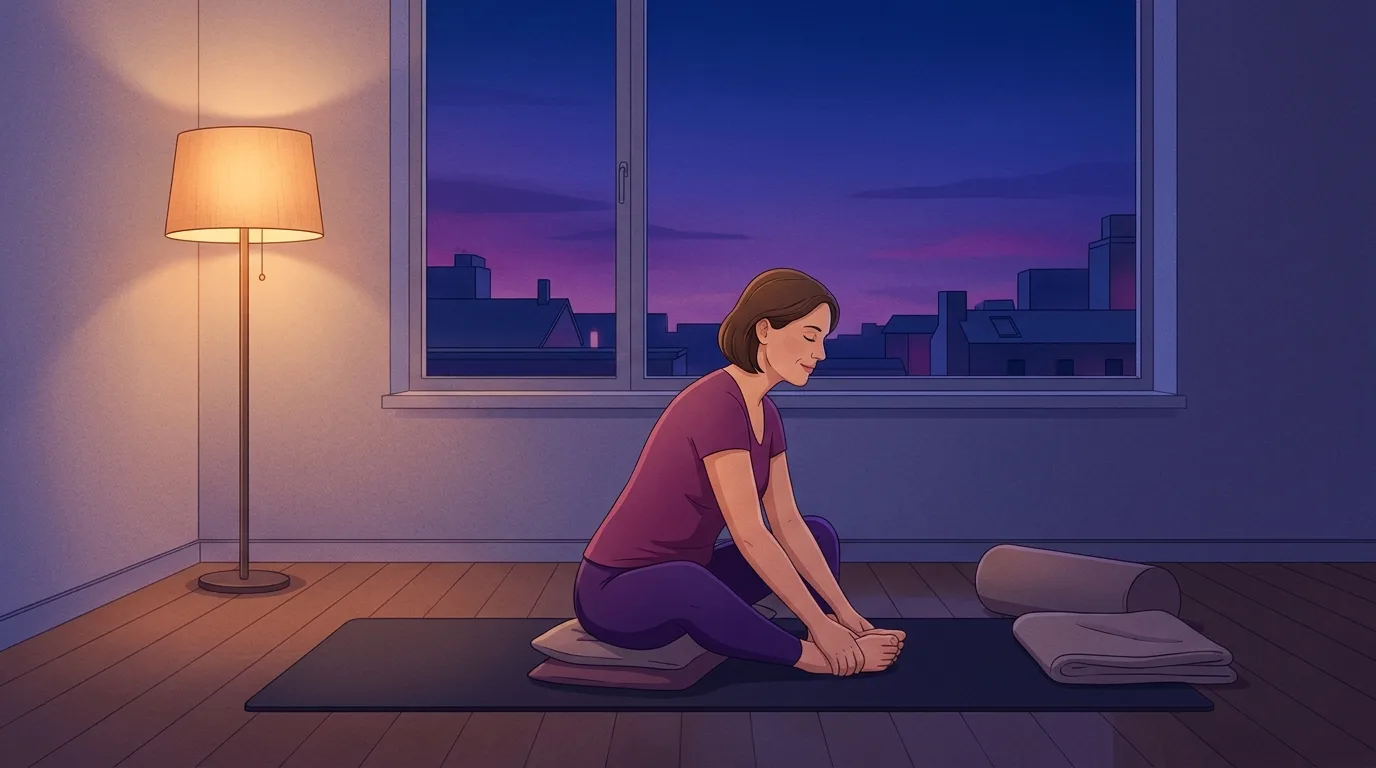
Your hips feel stiff after a day in a chair, your hamstrings feel like cables, and you know you should stretch. So you hold a couple of stretches for 20 seconds at the end of a workout, already halfway out the door, and nothing changes. Or you tried a vinyasa class and spent the hour trying to keep up with poses you'd never seen before.
It's easy to decide you're just not a flexible person. You aren't broken. The usual plan squeezes stretching into the last two minutes of a session, when you're tired and in a hurry, and that's the part people skip first. Yin yoga turns it into its own short, quiet session on the floor, often in the evening, with nothing to keep up with.
This guide explains what yin yoga is and where it came from, how it compares with restorative, hatha and vinyasa yoga, and what the research does and doesn't show. Then it gives you an 8-pose beginner sequence with hold times and props, and explains who should modify it.
What Is Yin Yoga?
Yin yoga is a slow practice made of mostly seated and lying poses that you hold passively, with the muscles around the joint relaxed, for several minutes at a time. A typical class strings together 6 to 10 poses. Holds of 3 to 5 minutes are the norm, beginners often start at 1 to 2 minutes, and experienced students may stay 5 minutes or longer. Most of the poses target the hips, legs and spine, and you use blocks, cushions, a bolster and a blanket to set how strong the stretch feels.
Teachers who follow Paul Grilley's approach boil the practice down to three rules:
- Come to your edge. Ease into the pose until you feel a clear but mild stretch, then stop. You aren't trying to reach your limit.
- Be still. Once you're in the shape, let the working muscles go soft and stop adjusting. Back off if the feeling turns sharp.
- Hold for time. Stay for minutes, not breaths, breathing slowly through your nose.
That makes yin yoga the opposite of a flowing class. In vinyasa you move with every breath and your muscles work. In yin you barely move, your muscles rest, and the challenge is staying with a steady sensation.
Which yin yoga claims come from tradition, and which have been tested
A lot of what you'll hear in a yin class is the tradition's explanation, not a measured result. Here's how the common claims line up against the research.
| Claim | Where it comes from | What studies show |
|---|---|---|
| Long holds stress ligaments, joint capsules and fascia rather than muscle | Paul Grilley's teaching | Not tested in people. We found no study that measured a yin pose changing human ligaments or fascia. |
| Poses move qi along meridians | Taoist yoga and Chinese medicine, through Paulie Zink and Hiroshi Motoyama | Not tested. Treat it as the tradition's language. |
| Long holds make you more flexible | Teachers and common sense | Partly tested. Static stretching improves range of motion, but longer total stretching time didn't make the gains bigger (Konrad 2024). |
| Long holds relax the muscle and tendon | Teachers | Partly tested. Repeated 30-second calf stretches adding up to 2 to 8 minutes lowered stiffness, but it was back to normal within 10 to 20 minutes (Ryan 2008). Single holds of several minutes weren't tested. |
| Yin calms stress and helps you sleep | Teachers and students | Partly tested in small trials. Five weeks of classes eased anxiety and sleep problems compared with no classes (Daukantaite 2018). |
Where Yin Yoga Came From: Paulie Zink, Paul Grilley and Sarah Powers
Yin yoga borrows old poses from hatha and Taoist yoga, but the class format and the name are modern. The history most teachers accept runs like this:
- Paulie Zink, a martial arts champion, began teaching long-held floor poses in North America in the late 1970s, as part of a blend of hatha and Taoist yoga that he later called "Yin and Yang yoga."
- Paul Grilley studied with Zink in the 1980s, then combined those floor poses with his anatomy training and the meridian theories of the Japanese scholar and yoga practitioner Hiroshi Motoyama. His book Yin Yoga: Outline of a Quiet Practice came out in 2002. He first called his approach Taoist yoga, the name Zink used for his own practice.
- Sarah Powers, a student of Grilley's, suggested the name "Yin Yoga," because she and Grilley taught only the yin poses, a reworked part of Zink's system. The history page on yinyoga.com, run by yin teacher and author Bernie Clark, credits her with the term. Her book Insight Yoga (2008) set out her own yin sequences.
What is yin and yang yoga?
Yin and yang yoga is a class that pairs the two halves on purpose: a yang section of active, warming poses or flow, then a yin section of long, passive floor holds. It's also the name Zink gave his original system, in which yin meant still and passive and yang meant active and moving. Most yin classes today teach only the yin half, which is why they work best alongside something more active in your week.
Yin Yoga vs Restorative, Hatha and Vinyasa
People mix up yin and restorative yoga because both are slow and both use props. The difference is the stretch: restorative props hold you up so you feel almost nothing, while yin props let you find a stretch you can stay in.
| Style | Pace | Typical hold | Your muscles | Props | Best for |
|---|---|---|---|---|---|
| Yin | Very slow, mostly floor | 3 to 5 minutes (1 to 2 for beginners) | Relaxed | Blocks, cushions, bolster, blanket to set the stretch | Flexibility, winding down, rest days |
| Restorative | Slowest, fully supported | 5 to 20 minutes | Fully relaxed, little or no stretch | Many, so the body is held up | Deep rest, stress, easing back after illness |
| Hatha | Moderate, pose by pose | About 5 to 10 breaths | Working | Some | Learning the basic poses |
| Vinyasa | Flowing, one move per breath | One breath to a few breaths | Working, often sweaty | Few | Fitness, heat, strength endurance |
Your heart's response tells the same story. In a crossover trial of 41 adults with depression or anxiety disorders, Brinsley and colleagues (2022) reported cardiovascular changes after aerobic exercise and vinyasa yoga. Yin is closer to rest for your heart and lungs. If you're new to yoga altogether, our yoga for beginners at home routine teaches the active basics that yin leaves out.
Find out what's really holding you back
FitCraft, our mobile fitness app, pairs you with an AI coach who builds you a personalized plan around your goals, schedule, and fitness level. Every FitCraft program is designed by Domenic Angelino, MPH (Brown University) and NSCA-CSCS, with research published in the Journal of Strength and Conditioning Research and Medicine & Science in Sports & Exercise.
Take the Free Assessment Free • 2 minutes • No credit cardWhat the Research Shows About Yin Yoga
Yin yoga has only a handful of trials of its own, and the only one we found that measured flexibility was small. Of its 24 young women, the 12 who did yin twice a week for six weeks, holding poses for 2 to 5 minutes, improved on a sit-and-reach test more than the 12 who didn't (Doymaz 2025). So the honest picture combines a few small yin trials with the larger research on static stretching, which is what a yin pose physically is.
Flexibility: real gains, but long holds aren't proven better
A 2024 meta-analysis by Konrad and colleagues pooled 77 studies with 3,870 participants, in which stretch training lasted at least two weeks. Stretch training improved range of motion by a moderate amount compared with no stretching, and static and PNF stretching beat dynamic stretching. But neither total stretching time nor sessions per week changed the size of the gain. That's the key point for yin: holding a pose for 5 minutes hasn't been shown to beat the same stretch in shorter holds.
What changes when you get more flexible? In a review of the research, Weppler and Magnusson (2010) concluded that gains after single sessions and 3 to 8 week programs come mostly from a changed sensation. Your nervous system tolerates more stretch before it says stop, while the muscle itself lengthens only briefly. Longer programs hadn't been studied well enough to say more.
Minutes of passive stretching do have a short-term effect you can feel. In a lab study of 12 adults, Ryan and colleagues (2008) found that repeated 30-second passive calf stretches adding up to 2, 4 or 8 minutes all lowered muscle and tendon stiffness. The drop faded within 10 minutes after 2 minutes of stretching and within 20 minutes after 4 or 8 minutes. The study used short repeated stretches rather than one long hold, but it suggests the loose, heavy feeling after a yin class is real and temporary.
Connective tissue: the tradition's main idea, still untested in people
The core yin claim is that relaxed muscles let a long hold reach the ligaments, joint capsules and fascia. It's a plausible idea, and stretching does act on connective tissue in animals. In rats with inflamed connective tissue in the back, Berrueta and colleagues (2016) found that 48 hours of regular stretching left thinner inflamed areas with fewer inflammatory cells, building on the same lab's earlier finding that 10 minutes of stretching twice a day eased inflammation over two weeks. But no study has shown that yin poses change human ligaments or fascia, or that they protect your joints. Treat that part as the reason teachers give for the practice.
Stress, anxiety and sleep: small trials, promising results
This is where yin yoga has its best evidence. Daukantaite and colleagues (2018) randomly assigned 105 stressed adults, average age 53.5 and 78% women, to five weeks of yin yoga, five weeks of yin yoga plus psychoeducation and mindfulness, or no classes. Both yoga groups had larger drops in anxiety, sleep problems and blood levels of adrenomedullin, a stress-linked marker, than the control group. Only the group that added mindfulness also had larger drops in perceived stress and depression. An earlier trial by the same team, Hylander and colleagues (2017), found that the yin and mindfulness program lowered stress and worry compared with a waiting list, and the changes held five weeks later.
Keep these results in proportion. Both trials were small, relied mostly on questionnaires, and compared yin with doing nothing rather than with another calm activity. And in the Brinsley trial, one session of yin, vinyasa, aerobic exercise or simple stretching all improved mood about equally compared with no activity. Yin seems to help stress and sleep the way gentle, regular movement does, rather than through something only yin can do.
Safety
Yoga in general is low risk. A 2015 meta-analysis by Cramer and colleagues of 94 randomized trials and 8,430 people found no more adverse events with yoga than with usual care or other exercise. Yin's risks come from staying a long time in a position that doesn't suit your joints, which is why the edge rule and the modifications below matter.
A Beginner Yin Yoga Sequence (8 Poses, About 35 Minutes)
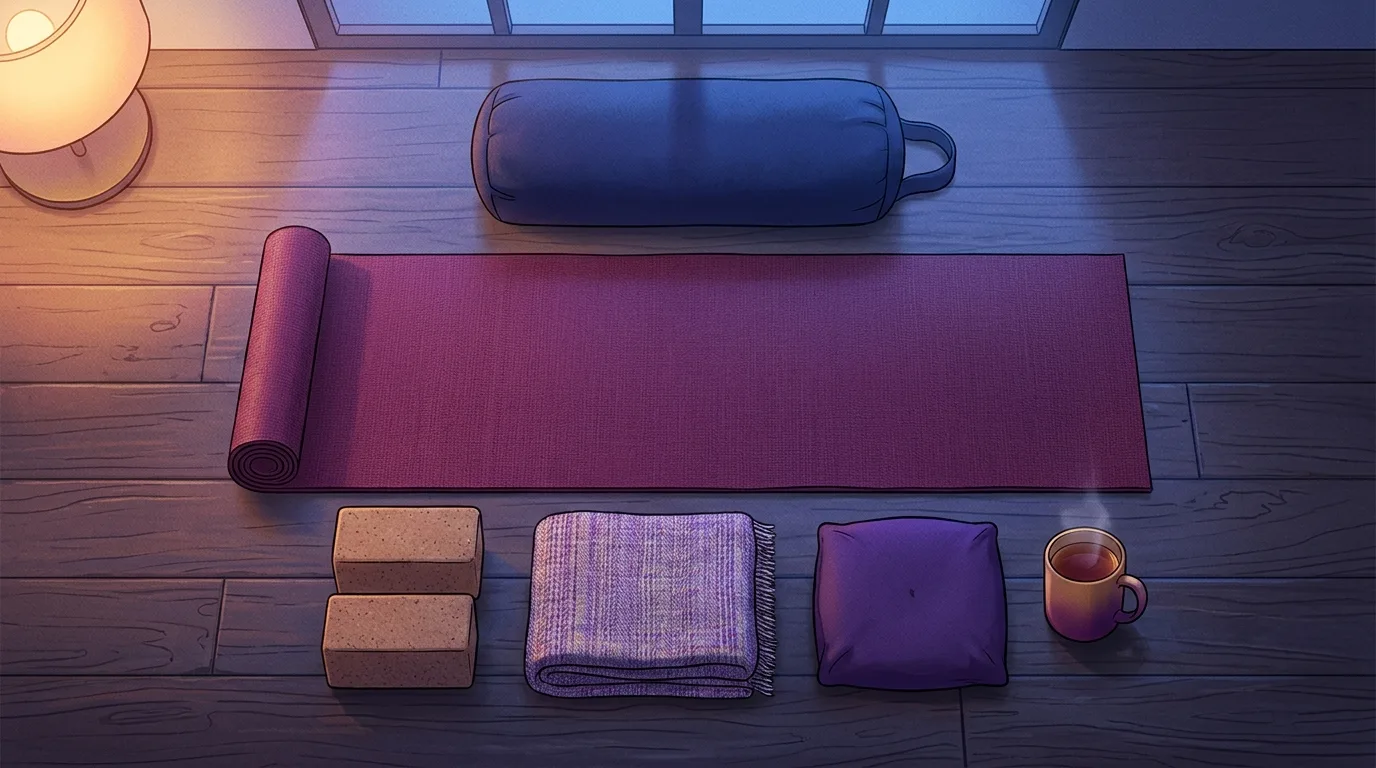
This sequence works your hips, legs and spine in an order that warms you gradually: seated poses, a lunge, gentle backbends and folds, then twists and rest. You need a mat, two blocks or firm cushions, a bolster or a firmly rolled blanket, and one more blanket. Take about 30 seconds between poses to move slowly and notice how you feel.
| # | Pose | Hold | Props | Where you feel it |
|---|---|---|---|---|
| 1 | Butterfly | 3 min | Cushion under your seat, blocks under your knees | Inner thighs, lower back |
| 2 | Caterpillar (seated forward fold) | 3 min | Bolster under your knees or across your thighs | Back of the legs, spine |
| 3 | Dragon (low lunge) | 2 min each side | Blanket under the back knee, blocks under your hands | Front of the back hip |
| 4 | Sphinx | 3 min | Blanket under your forearms | Lower back, belly |
| 5 | Child's pose | 2 min | Bolster under your chest, cushion between heels and seat | Hips, upper back |
| 6 | Reclined figure four | 2 min each side | Cushion under your head | Outer hip, glutes |
| 7 | Lying twist | 2 min each side | Cushion under the top knee | Spine, chest, outer hip |
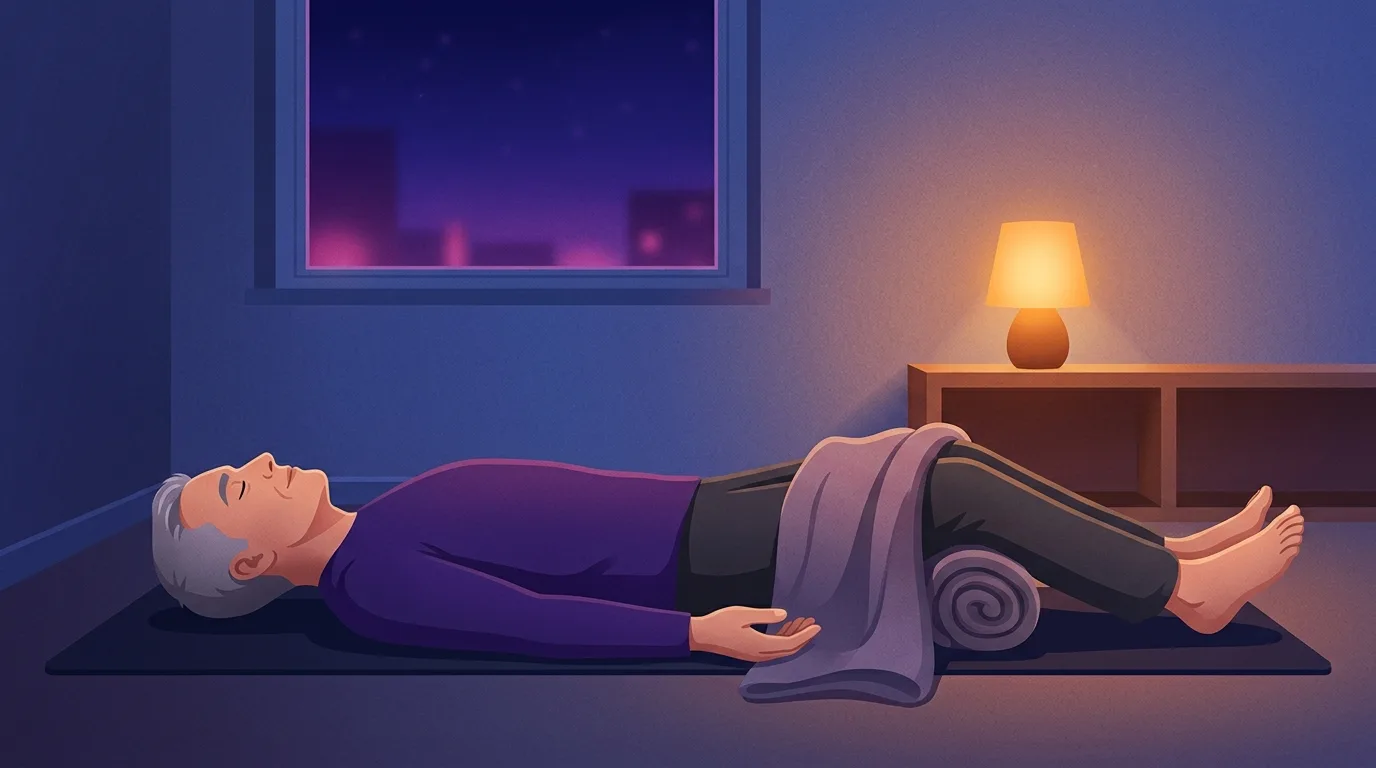
| 8 | Final rest (savasana) | 5 min | Rolled blanket under your knees | Whole body |
In your first two weeks, halve every hold. Add about 30 seconds a week until you reach the times in the table.
1. Butterfly
Sit on a folded cushion, bring the soles of your feet together and slide them a foot or so away from you. Let your knees fall open onto the blocks and fold forward only as far as your back rounds easily. Rest your hands on your feet or the floor. To come out, press up through your hands and slowly bring your knees together.
2. Caterpillar
Sit with your legs out straight and a bolster under your knees, which takes the strain off the backs of your knees. Fold forward and let your spine round, resting your forearms or chest on the bolster if it reaches. In the yin version of a forward fold, you let gravity draw you down instead of pulling yourself toward your toes.
3. Dragon
From hands and knees, step your right foot forward between your hands and slide your left knee back onto a folded blanket. Rest your hands on blocks and let your hips sink until you feel a stretch in the front of your left hip. Keep your front heel down. Switch sides after 2 minutes.
4. Sphinx
Lie on your front and prop yourself up on your forearms, elbows a little ahead of your shoulders. Let your belly and legs relax into the mat. You should feel a gentle arch in your lower back, never a pinch. If it pinches, slide your elbows further forward or lie flat.
5. Child's pose
Kneel, take your knees wide, sit back toward your heels and fold forward onto a bolster lengthwise under your chest. Turn your head to one side and switch halfway. A cushion between your heels and your seat helps if your knees complain.
6. Reclined figure four
Lie on your back with both knees bent, cross your right ankle over your left knee, and draw your left thigh toward you. This is a kinder stand-in for the swan or pigeon pose found in many yin classes, because you control the depth with your arms. Switch sides after 2 minutes.
7. Lying twist
Lie on your back, draw both knees toward your chest and lower them to the right, resting the top knee on a cushion. Stretch your arms out wide and turn your head the other way if your neck likes it. Switch sides after 2 minutes.
8. Final rest
Lie flat with a rolled blanket under your knees and your arms by your sides. Let your breathing slow down. Stay for 5 minutes, then roll onto your side and press up slowly.
How to Practice Yin Yoga Safely
Yin feels easy because nothing moves, which is exactly why people overdo it. A stretch that feels fine at 30 seconds can feel very different at 4 minutes. These habits keep it comfortable:
- Stop well short of your maximum. Aim for a stretch you could stay in calmly for the whole hold. If you're holding your breath or clenching your jaw, back off.
- Know which feelings mean stop. A dull, spreading stretch in the muscle is fine. Sharp pain, pain inside a joint, tingling or numbness mean come out now.
- Use props generously. A block under a knee or a cushion under your seat is how you tune each pose to your body today.
- Come out slowly. After a long hold your joints can feel stiff or wobbly for a moment. Move back to neutral in stages and pause before the next pose.
- Stay warm. You aren't moving, so a long-sleeve top or a blanket over your legs keeps you comfortable.
What not to do after yoga
Don't jump straight into a max-effort lift, a sprint or a jump after a long yin session. Long static holds briefly lower muscle stiffness, and our review of static vs dynamic stretching covers how stretches held past 60 seconds cut strength and power for a short while afterward. That's why yin fits best after training, in the evening or on a rest day. Also don't spring up from the floor: roll to your side and rise slowly if you tend to feel light-headed. And skip a heavy meal right before you practice, since several poses press on your belly.
Who Should Modify or Skip Yin Yoga
Most adults can do yin yoga. These groups need a modified version, and some should check with a clinician first.
- Very flexible or hypermobile joints. If your elbows or knees bend backward, or you can put your palms flat on the floor without warming up, more flexibility probably isn't what you need. Stop far short of your end range, keep a little muscle switched on, and shorten the holds.
- Pregnancy. The 2019 Canadian guideline for physical activity in pregnancy (Mottola 2018) advises women who feel light-headed, nauseous or unwell when exercising flat on their back to change position, and notes that adding yoga or gentle stretching may also be beneficial. Swap lying poses for side-lying versions, skip deep twists and folds that press on your belly, and stay well short of your end range. Talk to your obstetric provider before you start.
- Recent injury or surgery. Skip any pose that loads the injured area, and follow your surgeon's limits on bending and rotation after a hip or knee replacement.
- Osteoporosis or low bone density. Ask your clinician about deep rounded forward folds and twists before you hold them for minutes.
- Sore knees or lower back. Pad your knees in dragon and child's pose, and swap sphinx for lying flat if it pinches. Our guide to yoga and mobility at home has active options that load these joints more gently.
How Often to Do Yin Yoga, and What to Pair It With
Two or three sessions a week is a good place to start, and the five- and six-week yin trials above all used two classes a week. Our page on how often you should do yoga goes through the wider research. The 35-minute sequence above fits that dose. Evenings and rest days suit yin best, and a short 15-minute version after a workout works on other days.
Yin won't build strength or fitness. It barely raises your heart rate and your muscles rest the whole time, so it works best as the quiet half of a week that also includes two or three strength sessions and some walking or cardio. If planning that half is what keeps falling apart, an AI personal trainer app can build it for you. FitCraft's workouts include yoga, mobility, cardio and strength with dumbbells and bodyweight, an AI coach demonstrates each exercise on an interactive 3D model and says your name as you train, and your workouts adjust as you progress.
The Bottom Line
Yin yoga is a slow, floor-based style in which you hold relaxed stretches for minutes at a time. Its connective tissue and meridian ideas come from the tradition and remain untested in people. Its tested benefits look like the benefits of regular static stretching and calm movement: more range of motion and less stress and trouble sleeping. Start with the 8-pose sequence twice a week, halve the holds at first, and stop at a mild stretch. One FitCraft user, Tim, went from zero flexibility to completing a yoga program in 60 days. You can start with butterfly pose tonight.
Frequently Asked Questions
How long should you hold a yin yoga pose?
Most yin yoga classes hold each pose for 3 to 5 minutes, and experienced students sometimes stay 5 minutes or longer. Beginners do better starting at 1 to 2 minutes and adding about 30 seconds a week. The stretch should stay mild enough that you can breathe slowly and stay still the whole time.
What is the calmest type of yoga?
Restorative yoga is usually the calmest type, because props hold your whole body so there's little or no stretch at all. Yin yoga comes a close second: you stay still and your heart rate barely rises, but you do feel a mild, steady stretch in your hips, legs or spine.
What is the most gentle yoga?
Restorative and chair yoga are the most gentle styles, since they ask for almost no strength or balance. Yin yoga is gentle on your heart and lungs, but its long holds can feel intense in tight hips, so beginners should use props and shorter holds.
What is the hardest yoga style?
Physically, fast styles such as Ashtanga and power vinyasa are the hardest, because they link strength-heavy poses with little rest and raise your heart rate. Many people find yin yoga hard in a different way: staying still in one stretch for 3 to 5 minutes takes patience that a fast flow never asks for.
What is the king of all yoga poses?
Headstand (Sirsasana) is traditionally called the king of yoga poses, and shoulder stand is often called the queen. Neither is part of yin yoga, which stays on the floor, and neither belongs in a beginner's routine without a teacher.
Is yin yoga good for beginners?
Yes. Yin yoga uses a few simple floor poses, needs no balance or strength, and lets you set the intensity with cushions and blocks. Start with 1 to 2 minute holds, stop at a mild stretch rather than your limit, and come out of each pose slowly.
Is yin yoga enough exercise on its own?
No. Yin yoga can help flexibility, stress and sleep, but it doesn't raise your heart rate or load your muscles enough to build strength or fitness. Pair it with strength training two or three days a week and some walking or cardio.