The drop squat looks simple: you hop out, land in a squat, reach and hop back in. The details still matter. Every rep asks for a soft landing, knees that stay over your toes and a long back as you reach, while the steady rhythm gets your heart rate up.
The wide landing is what separates the drop squat from other bodyweight jumps. You start with your feet together and land with them about one and a half to two shoulder-widths apart, so the glute medius on the side of each hip has to hold your knees out over your toes. Done well, your quads and glutes control the landing. Done poorly, your knees cave inward and your knee joints take the load instead.
Drop squats also double as cardio, because the hop, land and reach rhythm keeps your heart rate up without any equipment at all.
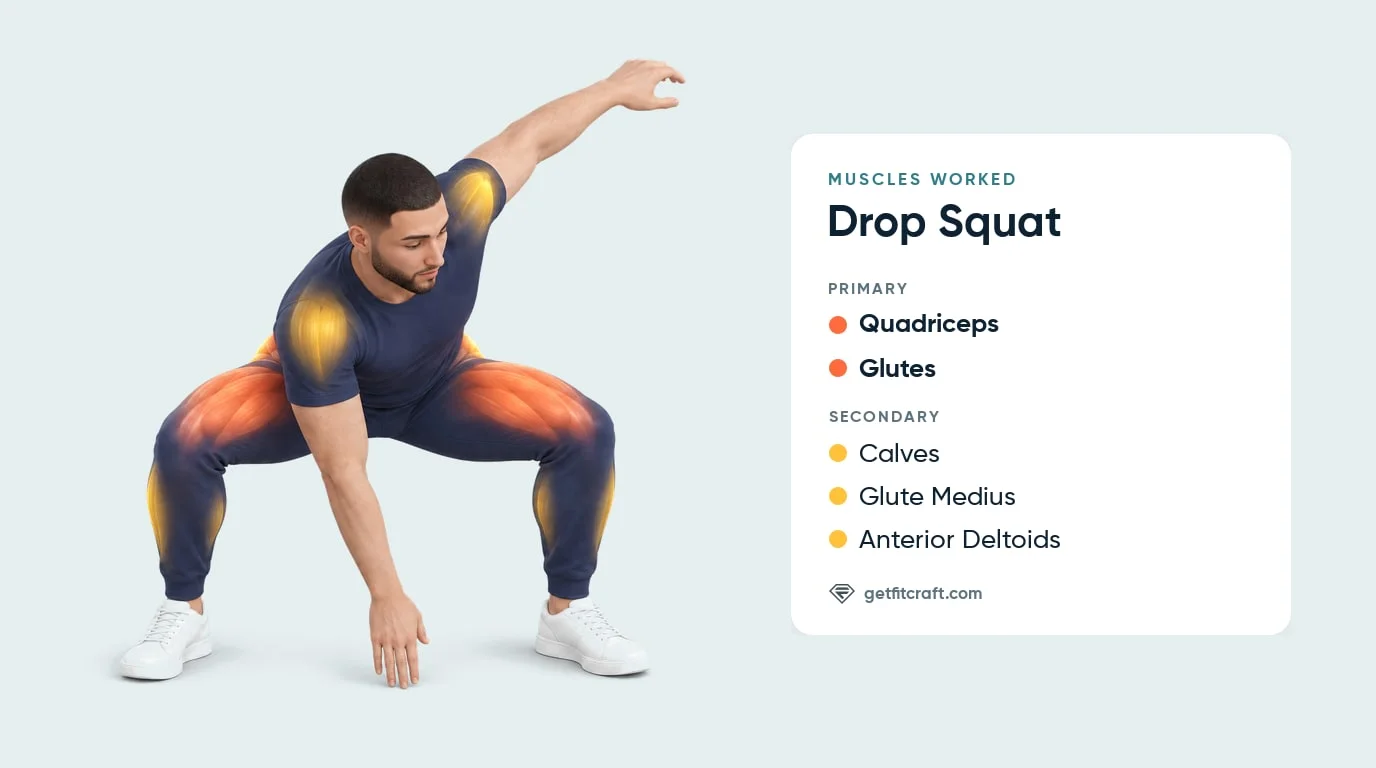
Muscles Worked
Primary muscles. The quadriceps, at the front of your thighs, bend your knees to cushion each landing, control the drop into the squat and straighten your knees as you stand back up. The glutes control your hips as they sit back and down, then drive your hips forward to bring you back to standing.
Secondary muscles. Three muscles help. The calves push off for each hop and cushion the landing as your feet touch down; on the harder wide-step version they lift your heels as both feet slide out wide. The glute medius, on the side of each hip, holds your knees out over your toes in the wide stance. The anterior deltoids, at the front of your shoulders, lift the reaching arm out and up on every rep.
Quick Facts: Drop Squats
- Equipment needed: None (bodyweight only)
- Difficulty: Advanced (the hopping version) and Expert (the wide-step version), as rated in the FitCraft app
- Modality: Bodyweight cardio
- Body region: Lower body (quads and glutes), with the calves, the sides of the hips and the front of the shoulders helping
How to Do Drop Squats (Step-by-Step)
- Stand with your feet together. Stand tall with your feet together or a few inches apart, knees soft and hands loosely in front of your hips. Clear some floor space on both sides of you. No equipment is needed.
- Hop your feet out wide. Make a low, quick hop and land with your feet about one and a half to two shoulder-widths apart, toes turned out a little. The hop moves your feet out to the sides, not up. Tip: keep the hop low. Your feet only need to clear the floor.
- Land softly into the squat. Land through the balls of your feet onto your whole foot, bending your knees and sitting your hips back and down as your feet touch down. Lower until your thighs are about level with the floor, or a little higher if that is where your heels start to lift. Tip: keep your knees pushed out over your toes and your heels down. Quiet landings mean you're doing it well.
- Reach down and up. At the bottom, reach one hand down toward the floor between your feet while the other arm reaches out to the side or up. Keep your hips back and your back long; some forward lean from the hips is normal. Tip: reach only as low as your back stays long. Touching the floor is optional, and reaching to your shins is fine.
- Hop back in and switch hands. Press up and hop your feet back together. That's one rep. Reach down with the other hand on the next rep. About two seconds a rep is a good pace. Tip: breathe steadily, out as you push back up, and end the set when your landings get loud or your knees start to cave.
Get this exercise in a personalized workout
FitCraft, our mobile fitness app, uses its AI coach Ty to program conditioning work like this into your plan at the right volume and intensity, based on your level, goals, and equipment. Ty was designed and trained by Domenic Angelino, MPH (Brown University) and NSCA-CSCS, with research published in the Journal of Strength and Conditioning Research and Medicine & Science in Sports & Exercise.
Take the Free Assessment Free · 2 minutes · No credit card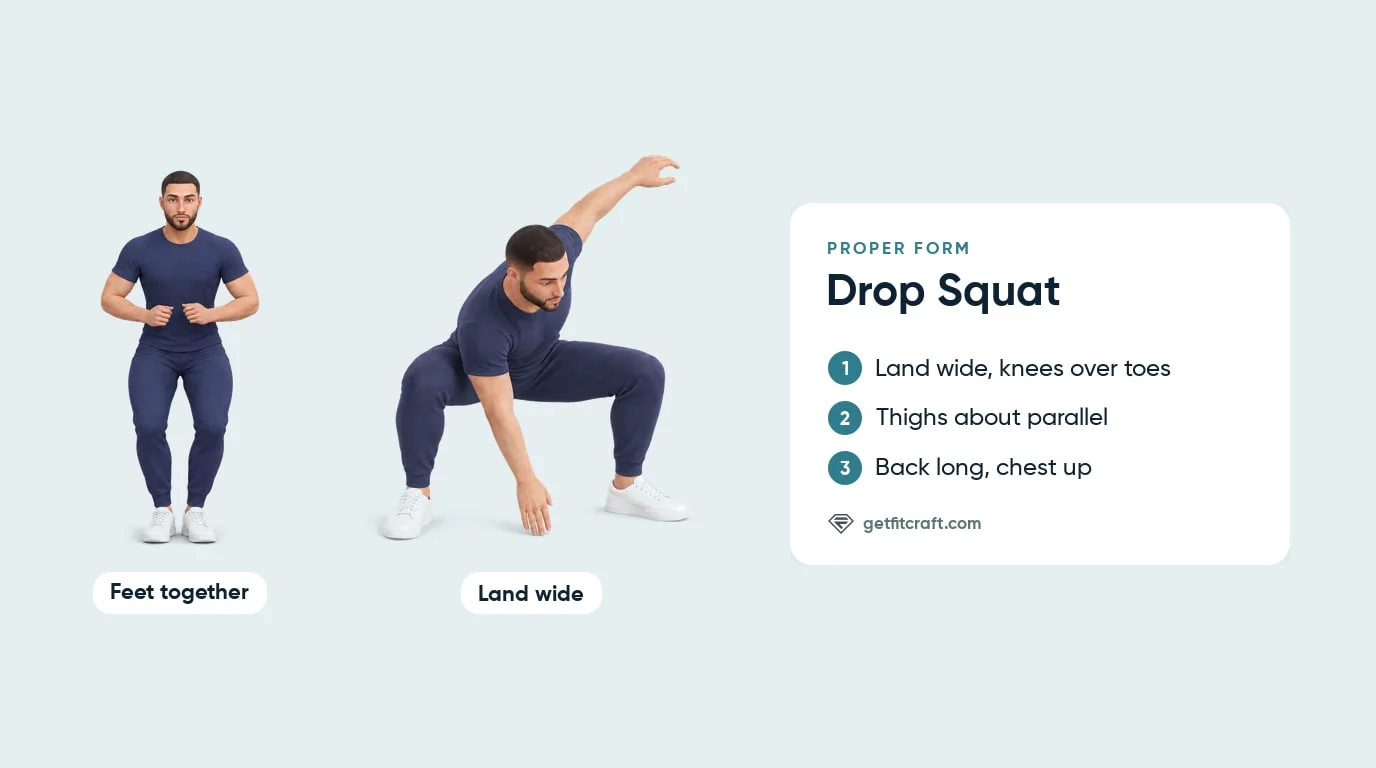
Common Mistakes to Avoid
Drop squats mix a quick hop with a squat. These are the mistakes that make the exercise less effective or put your joints at risk:
- Knees caving inward on landing. This is the most important one to fix. Landing with your knees collapsing inward is linked to knee injuries, so your knees should point the same way as your toes on every landing. Fix: squat a little less deep or step out instead of hopping, push your knees out over your toes, and end the set when they start to cave.
- Landing with straight legs. If you don't bend your knees as you land, the impact goes straight into your knee and ankle joints. You should bend into the squat as your feet touch down, not land first and then squat. Fix: land softly with your knees already bending.
- Jumping too high. The hop goes out, not up. Jumping high off the ground only makes the landing harder. Fix: keep the hop low and quick, just enough to get your feet wide.
- Rounding the back to touch the floor. Some forward lean from the hips is normal as your hand reaches down. Rounding your back to get your hand to the floor is not. Fix: keep your hips back and your chest lifted, and reach only as low as your back stays long. Reaching to your shins or knees is fine.
- Heels lifting at the bottom. Your heels stay down at the bottom of the squat. Fix: if they lift, sink a little less deep and land on your whole foot. Bodyweight squats are a good place to practice keeping them down.
- Going too fast too soon. The drop squat takes practice to time well. Rushing until your landings get loud and sloppy loads your joints and builds bad habits. Fix: start with slow, controlled reps and pick up the pace only while every landing stays soft and quiet.
Variations and Progressions
Step-Out Drop Squat (Easier)
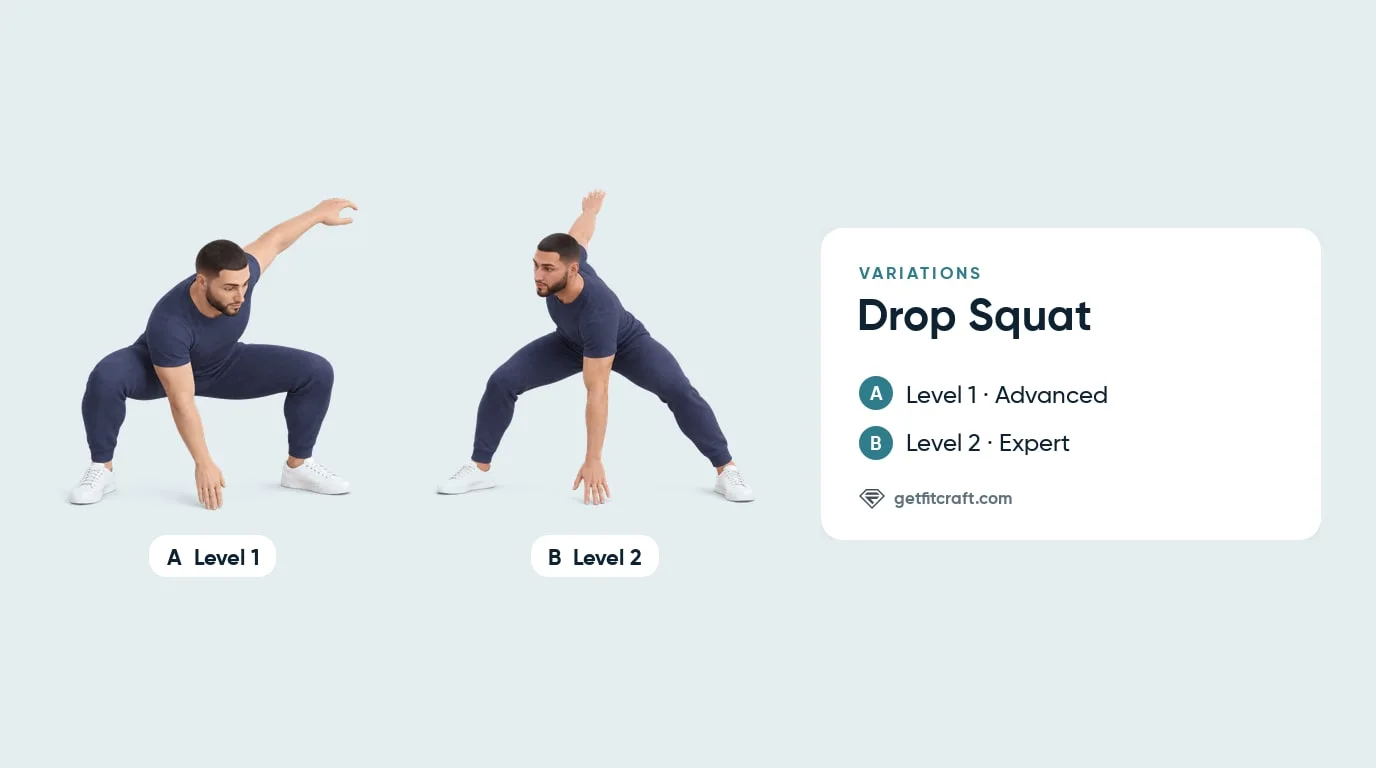
Instead of hopping, step one foot out to the side, then the other, and lower into the squat with the same reach. This removes the impact while you practice the same wide stance. You can also squat less deep and reach only to your shins or knees. It is a good place to start if the hop feels too hard.
Drop Squat with a Pause or a Faster Pace (Harder)
Hold the bottom for about a second before you come back up. You can also pick up the pace, as long as every landing stays soft and quiet.
Wide-Step Drop Squat (Expert)
The FitCraft app's harder drop squat has no hop. From feet together, move both feet out at the same time, quickly and very wide, roughly three shoulder-widths (narrower is fine), keeping them low so they barely leave the floor. Push your hips back into about a half squat with your chest leaning well forward, and reach one hand to the floor between your feet as your chest turns toward the raised arm. Then bring both feet back together and switch sides, about two seconds per side. The challenge is the wide stance, the bigger forward lean from your hips (your chest nearly level with the floor, your back long) and the twist, not impact. Turn your chest only as far as feels easy, with your back long.
Alternative Exercises
- Jump squats: Jump straight up instead of hopping out. They work the quadriceps, glutes and calves, with a bigger landing.
- Sumo squats: Wide-stance squat without the hop. Works the glutes, quadriceps and glute medius, with the adductors on the inner thigh helping, and no impact.
- Squat walks: Step forward into a low lunge and back up to standing, one leg at a time. Works the quadriceps and glutes with no jumping.
When to Avoid or Modify Drop Squats
Drop squats need no equipment, but if any of the situations below applies to you, check with a doctor or physical therapist before you do them. A burn in your thighs or glutes is normal; stop any rep that causes pain in a joint, your lower back or your neck.
- Known cardiovascular disease or uncontrolled hypertension. Drop squats raise your heart rate and blood pressure quickly. Check with your doctor or cardiologist first, and do drop squats only with their go-ahead. Stop if you feel dizzy, lightheaded or unwell.
- Acute lower-extremity injury (knee, ankle, hip, shin splints, plantar fasciitis). Hopping and landing load all of these. See a doctor or physical therapist first, and do drop squats only once they clear you. Any pain in your shins, feet or a joint during a set means stop.
- Pregnancy and after giving birth. Check with your doctor or midwife first, and do drop squats only with their go-ahead. Stop if you feel pelvic pressure, dizziness or any pain.
- Stress incontinence or pelvic-floor weakness. Hopping and landing can trigger leakage. See a doctor or a pelvic-floor physical therapist first, do drop squats only once they clear you, and stop if you leak or feel pressure in your pelvis.
- Vertigo, balance disorders, or vestibular conditions. The quick hops and the reach toward the floor can throw off your balance and risk a fall. Check with your doctor first, do drop squats only with their go-ahead, and stop if you feel dizzy.
- Not yet comfortable with bodyweight squats. If your knees cave or your heels lift in a bodyweight squat, you are not ready for the hopping version. Build the base with squats and the step-out version first.
- Recent ankle sprain or chronic ankle instability. The hop and the wide landing load the ankles. See a doctor or physical therapist first, do drop squats only once they clear you, and stop at any ankle pain.
Related Exercises
- Lower-impact alternative: Squat walks step forward into a low lunge and back up to standing, working the quadriceps and glutes with no jumping.
- Vertical counterpart: Jump squats jump straight up from a squat instead of hopping out wide.
- Harder next step: Jump lunges jump from a lunge and switch legs in the air, a harder landing to try once drop squats feel easy.
- Glute medius work: Fire hydrants and side lunges both work the glute medius, the muscle on the side of your hip that holds your knees out over your toes on the landing.
- Strength foundation: Bodyweight squats and sumo squats build the leg strength and squat form you need first.
- Cardio circuit partners: Mountain climbers and high knees pair well with drop squats in a cardio circuit.
How to Program Drop Squats
The ACSM position stand on resistance training says to make training harder gradually, for example with more reps, more total work, or shorter rests when the goal is endurance (Ratamess et al., 2009). It gives no ranges for a cardio drill like drop squats, where the work-and-rest structure matters more than fixed sets and reps. The ranges below are a practical starting point for each version, not figures from the position stand:
| Version | Sets × Reps (or Work) | Rest between sets | Frequency |
|---|---|---|---|
| Easier (step out instead of hopping) | 2 sets × 8 to 10 reps | 60 to 90 seconds | 2 sessions/week |
| Advanced (the hopping drop squat) | 3 sets × 12 to 15 reps, or 30 sec work and 45 to 60 sec rest | 45 to 60 seconds | 2 to 3 sessions/week |
| Expert (the wide-step drop squat), or the hopping version at a faster pace | 3 to 4 sets × 15 to 20 reps, or 45 sec work and 30 sec rest | 30 to 45 seconds | 3 sessions/week |
Where in your workout. While you're still learning the landing, do drop squats early in the session when you're fresh. As a finisher, use them in the last 5 to 10 minutes of a strength workout. In a cardio circuit, pair them with mountain climbers, high knees or jump lunges.
Good form over rep targets. The set ends when your landings break down, however many reps you planned. Knees caving, your back rounding as you reach, or loud landings mean stop. Adding more sloppy reps loads your joints and builds bad habits. Twelve clean reps are better than twenty with collapsing knees.
The FitCraft app has two drop squat exercises, each with a 3D demonstration: the hopping drop squat, rated Advanced, and the wide-step version with no hop, rated Expert. Both switch the reaching hand every rep.
Frequently Asked Questions
Can I do drop squats with knee pain?
No. Knee pain means stop: see a doctor or physical therapist before you do drop squats, and do them only once they clear you. During a set, a burn in your thighs or glutes is normal, but any other pain, especially sharp pain or pain in a joint, your lower back or your neck, means stop right away.
What muscles do drop squats work?
Drop squats work the quadriceps and glutes as the primary muscles: the quadriceps bend your knees to cushion each landing and straighten them as you stand, and the glutes control your hips as they sit back and drive them forward to stand. Three secondary muscles help. The calves push off for the hop and cushion each landing, the glute medius on the side of your hip holds your knees out over your toes in the wide stance, and the anterior deltoids at the front of your shoulder lift the reaching arm out and up every rep.
What is the difference between a drop squat and a jump squat?
The key difference is direction. A jump squat goes up: you squat, then jump straight up and land softly into the next squat. A drop squat goes out: you start with your feet together, hop them out wide into a squat with one hand reaching toward the floor, then hop them back in. The drop squat's hop stays low because the move travels out, not up.
Are drop squats good for cardio?
Yes. Drop squats get your heart rate up because you hop out, squat, reach and hop back in, rep after rep. Keep a steady rhythm you can hold with soft, quiet landings, and end the set when your landings get loud or your knees start to cave.
How many drop squats should I do?
Start with 2 sets of 8 to 10 reps, stepping your feet out one at a time instead of hopping. Then build to 3 sets of 12 to 15 hopping reps, or 30-second rounds with 45 to 60 seconds of rest. The harder wide-step version, or the hopping version at a faster pace, can go to 3 to 4 sets of 15 to 20 reps or 45-second rounds. End the set when your landings get loud or your knees start to cave, whatever the rep count.
Can beginners do drop squats?
Not as a first exercise. The FitCraft app rates the hopping drop squat Advanced and its wide-step version Expert. Start with bodyweight squats, then try the drop squat by stepping your feet out one at a time instead of hopping, squatting less deep and reaching only to your shins. Add the hop once your landings are soft and your knees stay over your toes.