Every time you sit down, stand up, or pick something off the floor, you're squatting. Train this movement deliberately and you build a foundation for nearly everything else, in the gym and in life.
The catch: most people either skip squats because they feel awkward, or grind them out with form that sets up knee and back issues down the road. Neither is necessary. With the right cues and a smart progression, anyone can squat safely and effectively.
This guide covers the full picture, from the partial squat as a starting point through the full squat and beyond. Each section includes cues from FitCraft's AI coach Ty, who coaches thousands of users through this exact movement every week.
Quick Facts: Squat
- Equipment needed: None (bodyweight); dumbbell or barbell optional for weighted variations
- Difficulty: Beginner (partial) to Advanced (jump, weighted)
- Modality: Strength
- Body region: Lower body
- FitCraft quest category: Strength
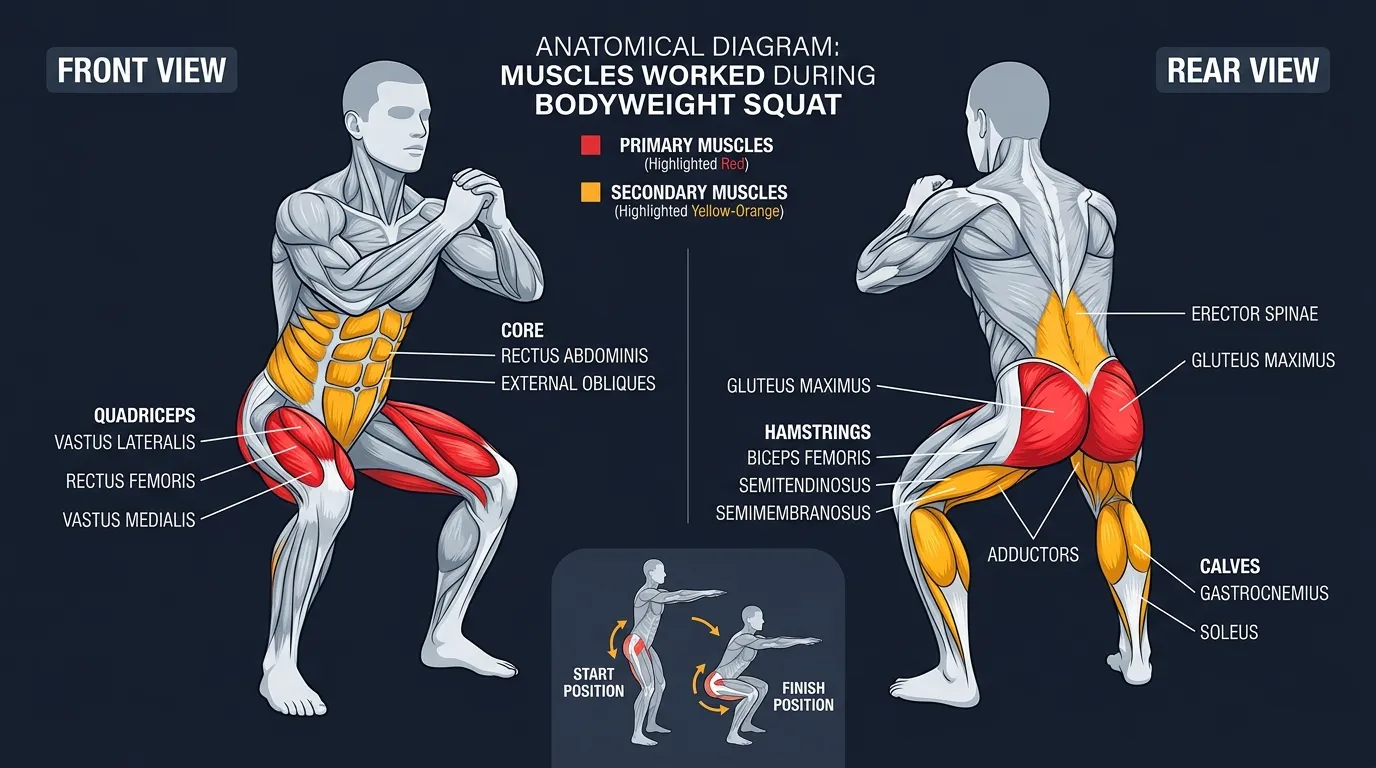
Muscles Worked
Primary movers: the quadriceps (rectus femoris, vastus lateralis, vastus medialis, vastus intermedius), gluteus maximus, and hamstrings. The quads drive knee extension on the ascent, the glutes drive hip extension, and the hamstrings work eccentrically to control the descent and contribute to hip extension out of the hole. All three lengthen under load on the way down and shorten to drive you back up, which is what produces the strength and hypertrophy stimulus.
Secondary movers: the adductor magnus (the largest muscle in the inner thigh, a major hip extensor at the bottom of a deep squat), the gastrocnemius and soleus (calves, which stabilize the ankle and assist plantarflexion as you rise), and the erector spinae (which work isometrically to keep the spine extended through the descent).
Stabilizers: the entire anterior core (rectus abdominis, transverse abdominis, obliques) works isometrically to brace the trunk against the downward load. The gluteus medius and minimus prevent the knees from caving inward. The rotator cuff and upper-back musculature stabilize the bar position in front-loaded variations (goblet squat, front squat). Bracing is the difference between a controlled rep and a wobbly one, especially as load increases.
How depth changes which muscle you bias: the deeper you squat, the more the gluteus maximus and adductor magnus contribute relative to the quadriceps. Quarter and partial squats are quad-dominant. Full-depth (thighs parallel or below) recruits the glutes and posterior chain more aggressively. This is a real programming lever. If you want more glute, go deeper. If you're rehabbing patellofemoral pain, partial-depth squats reduce knee shear while still loading the quads. Squats also load the spine in compression, which is why bracing and a neutral lumbar position matter as the load goes up.
Step-by-Step: How to Squat
These steps apply to both the partial and full squat. The only difference is how deep you go.
Step 1: Set Your Stance
Stand with your feet shoulder-width apart and toes pointed slightly outward (about 15-30 degrees). Distribute your weight evenly across both feet, with most of the load through the heel and midfoot.
Coach Ty's cue: "Plant your feet like you're screwing them into the floor. That spiral tension locks the hips and stops the knees from caving."
Step 2: Brace Your Core
Stand tall, take a deep breath into your belly, and engage your core as if someone were about to tap your stomach. Keep your chest up and your eyes looking straight ahead.
Ty's cue: "Brace before you move. The breath in and the brace happen at the top, not on the way down."
Step 3: Initiate the Descent
Push your hips back and bend your knees at the same time, as if sitting back into a chair. Keep your weight in your heels and midfoot, not your toes. The hips move first, the knees follow.
Ty's key cue: "Sit back, don't drop down. The chair cue is the easiest way to keep the load through your heels instead of your toes."
Step 4: Lower to Your Target Depth
For a partial squat, lower until your thighs are about halfway to parallel. For a full squat, lower until your thighs are at least parallel to the floor. Keep your knees tracking over your toes throughout. Slight forward knee travel past the toes is normal at depth, what matters is the line, not the absolute position.
Ty's cue: "Knees stay over the second and third toe. If they cave in toward each other, you've lost the position. Stop, reset, and try again."
Step 5: Drive Back Up
Press through your heels and squeeze your glutes to stand back up. Exhale as you rise. Fully extend your hips at the top without hyperextending your back or locking the knees aggressively.
Ty's reminder: "Imagine pushing the floor away with your heels. That keeps the glutes online and the hips moving in the right direction."
Get this exercise in a personalized workout
FitCraft, our mobile fitness app, uses its AI coach Ty to program compound strength exercises like this into your plan at the right volume and intensity, based on your level, goals, and equipment. Ty was designed and trained by Domenic Angelino, MPH (Brown University) and NSCA-CSCS, with research published in the Journal of Strength and Conditioning Research and Medicine & Science in Sports & Exercise.
Take the Free Assessment Free · 2 minutes · No credit card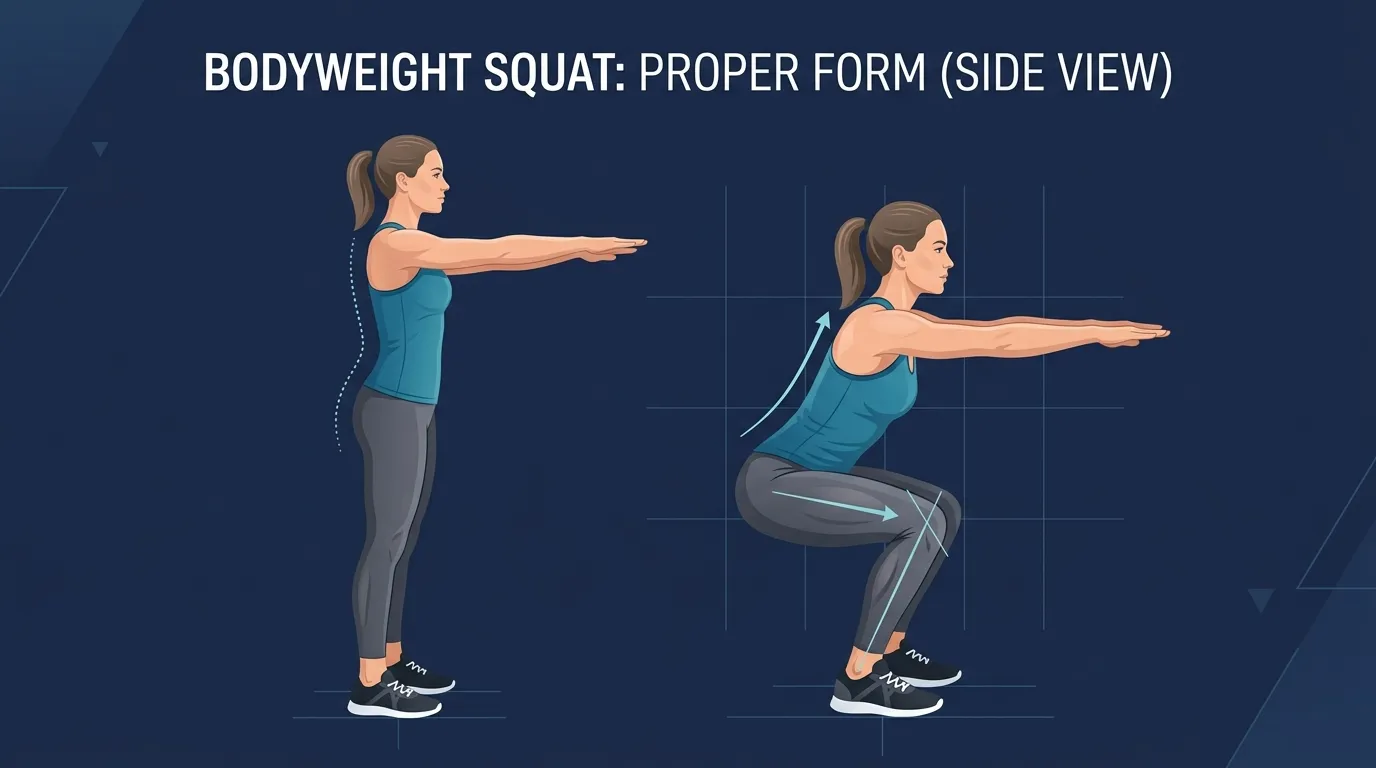
Common Mistakes (and How to Fix Them)
These are the form breakdowns Ty corrects most often.
- Knees caving inward. This usually signals weak glutes or tight hips. Fix: cue "spread the floor" with your feet and actively push your knees out over your toes. If the cue alone doesn't fix it, loop a light resistance band just above your knees and press against it through the rep.
- Heels lifting off the floor. If your heels rise as you descend, you're shifting weight forward. Usually a calf or ankle mobility limit. Fix: use the chair-sit cue to drive the hips back first, then bend the knees. Stretch your calves and ankles before squatting. Elevating the heels slightly (small plates or weightlifting shoes) is a legitimate fix while you work the mobility.
- Rounding the lower back at the bottom. Often called "butt wink." Your pelvis tucks under at the bottom of the squat. Usually a hip mobility issue, sometimes a hamstring issue. Fix: reduce depth until you can hold a neutral spine the whole way, and work on hip flexor and hamstring flexibility over time.
- Leaning too far forward. If your torso drops toward the floor, your upper back is weak or your core isn't engaged. Fix: chest up, eyes forward. For loaded squats, a goblet hold in front of the chest is a great teacher because the load forces the torso upright.
- Going too fast. Rushing reps robs you of time under tension and hides form breakdown. Aim for a 2-3 second descent and a controlled ascent. Speed is a reward you earn after you own the position.
- Stopping above parallel. Quarter and partial squats have their place (rehab, knee-pain protocols, plyometric prep), but a healthy adult who never goes below parallel leaves glute and adductor development on the table. If mobility allows, hit at least parallel on your working sets.
Squat Variations: Regressions and Progressions
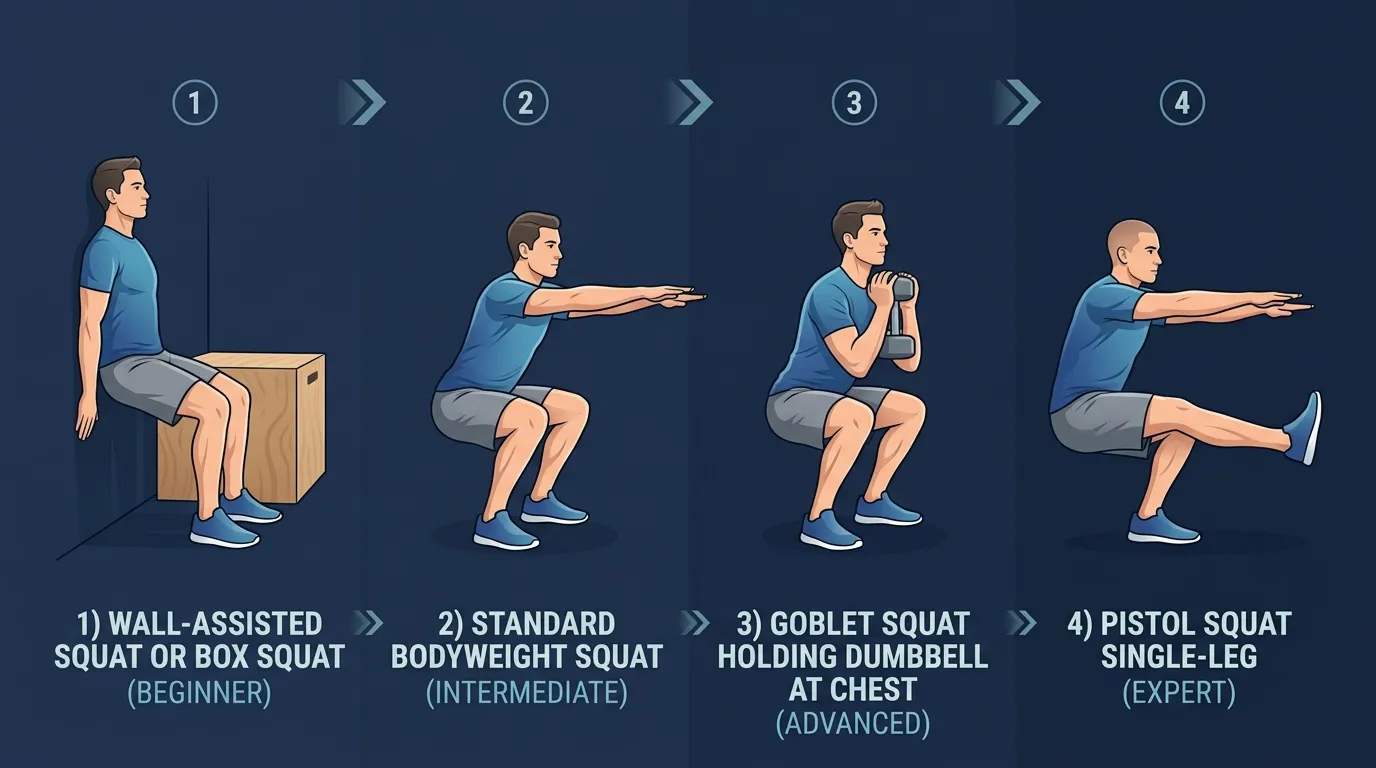
The squat is a family of movements. Start where your form is solid and progress when the current variation feels controlled at the target rep range.
Wall Sit (Beginner Regression)
Slide your back down a wall until your thighs are parallel to the floor and hold. Same muscles as a squat, no movement, low coordination demand. A great starting point if standing squats feel too coordinated or if you're rehabbing patellofemoral knee pain.
Quarter Squat (Beginner Regression)
Lower only a quarter of the way down. Builds the motor pattern with the lowest joint stress. Useful for absolute beginners, older adults returning to training, and rehab from knee or hip surgery once cleared.
Partial Squat (Beginner to Intermediate)
Halfway between standing and parallel. The standard regression for people who don't yet have the mobility for parallel-or-below, and a useful pain-management option for patellofemoral issues.
Full (Parallel) Squat (Intermediate)
Thighs parallel to the floor or slightly below, bodyweight only. The standard squat that builds serious lower-body strength and muscle. Once you can do 3 sets of 10-12 with controlled form, you're ready to load it.
Sumo Squat (Variation)
Wide stance with toes pointed further outward. Shifts emphasis to the inner thighs (adductors) and glutes. A great variation for hip mobility and for biasing muscles the standard squat underloads.
Goblet Squat (Loaded Progression)
Hold a dumbbell or kettlebell at your chest. The front-loaded position forces an upright torso, which protects the lower back and trains the same pattern you'd use under a barbell. The single best teaching tool for the full squat pattern.
Front Squat (Advanced Loaded Progression)
Barbell racked in the front position (across the shoulders, elbows high). Heavier than a goblet squat, more quad-dominant than a back squat, and uncompromising about upright posture. Earn this after the goblet squat feels easy.
Bulgarian Split Squat (Unilateral Progression)
Rear foot elevated on a bench, front leg does most of the work. Brutal on the quads and glutes, exposes side-to-side strength imbalances, and demands real balance. A favorite of strength coaches for everyone past the beginner stage.
Jump Squat (Plyometric Advanced)
Adds an explosive jump at the top of each rep. Develops power, athleticism, and cardiovascular conditioning. Only progress here once your full squat form is rock solid. Sloppy jump squats are a fast track to knee problems.
When to Avoid or Modify Squats
Squats are safe for most healthy adults, but a few conditions call for modification or temporarily swapping in regressions. None of these are permanent restrictions. They're starting points. Always consult your physician or physical therapist for personalized guidance.
- Patellofemoral knee pain or recent knee surgery. Full-depth squats can aggravate the patellofemoral joint when the joint is irritated or healing. Drop to quarter squats or wall sits, slow the tempo, and stay above the depth where pain begins. Get clearance from your surgeon or PT after any knee procedure before reloading the joint.
- Acute lower-back pain or known disc pathology. Loaded squats compress the lumbar spine. If bracing under load makes things worse, drop the weight, reduce depth, and rebuild core bracing with deadbugs, bird-dogs, and forearm planks. Return to loaded squats only when the back tolerates the bodyweight version pain-free.
- Uncontrolled hypertension or known cardiovascular disease. Heavy squats and the Valsalva brace spike intrathoracic and intra-arterial pressure. Use lighter loads, longer rest, and avoid 1-rep-max attempts. Follow your cardiologist's exercise guidance.
- Pregnancy, especially second and third trimester. Use bodyweight or light dumbbell variations only, stay above parallel, and avoid the Valsalva. Goblet squats with a light dumbbell are usually well tolerated through most of pregnancy. Stop and consult your OB if you feel pelvic pressure, dizziness, or any pain.
- First 6-8 weeks postpartum or active diastasis recti. The bracing demand of a loaded squat can widen abdominal separation. Start with glute bridges and bodyweight partial squats. Rebuild deep-core function with deadbugs and bird-dogs before reloading the squat.
- Severe hip or ankle mobility limits. If you can't reach parallel without your heels lifting or your lower back rounding, force isn't the answer. Squat to the depth your mobility allows, elevate the heels with a small plate or weightlifting shoe, and work mobility drills (deep-squat hold, ankle dorsiflexion stretching) alongside your strength work.
Related Exercises
If squats are part of your routine, these movements complement or extend the same training pattern:
- Same movement pattern (squat variations): Sumo Squats, Bulgarian Split Squats, and Split Squats bias the same muscles with different stance and load distributions. Goblet Squats and Front Squats are the natural loaded progressions.
- Same movement pattern (hinge): Deadlifts, Romanian Deadlifts, and Good Mornings train the hip-hinge pattern that pairs with squats in a balanced lower-body program. Hinge plus squat is the foundation of every serious lower-body session.
- Same movement pattern (unilateral lower body): Rear Lunges, Side Lunges, and Curtsy Lunges develop single-leg strength and expose side-to-side imbalances that bilateral squats can mask.
- Glute-focused accessory: Glute Bridges and Single-Leg Deadlifts isolate the gluteus maximus and posterior chain, useful when your squat is quad-dominant or your glutes don't fire well.
- Core foundation for spinal bracing: Deadbugs, Bird-Dogs, and Forearm Planks train the bracing pattern squats rely on, especially as loads increase.
- Plyometric progression: Jump Squats add a power-development stimulus once the standard squat pattern is automatic.
How to Program Squats
Squat programming follows the same evidence-based ranges as any compound lower-body lift. The American College of Sports Medicine (ACSM) Position Stand on resistance training recommends roughly 8-12 reps per set for strength and hypertrophy and 3-6 reps for maximal strength, with at least 48 hours between heavy sessions training the same muscle group (Ratamess et al., 2009).
| Level | Sets × Reps | Rest between sets | Frequency |
|---|---|---|---|
| Beginner (bodyweight, partial to full) | 2-3 × 8-12 | 90-120 seconds | 2-3 sessions/week |
| Intermediate (goblet, light barbell) | 3-4 × 6-12 | 120-180 seconds | 2-4 sessions/week |
| Advanced (front squat, jump squat, heavy back squat) | 3-5 × 3-10 (load-dependent) | 180-300 seconds | 3-5 sessions/week |
Where in your workout: Squats belong first or second in a lower-body session, when you're fresh. They're a compound movement that demands maximum motor unit recruitment, so don't grind them after a long accessory list has fried your legs. Pair them with a hinge pattern (deadlift, Romanian deadlift, or good morning) for a balanced lower-body day. If you're doing a full-body session, squats go in the first half before isolation work.
Form floor over rep targets: if your last 2 reps of a set break form (knees caving, heels lifting, lower back rounding), stop the set there. Hitting a target rep count with broken form is worse than hitting fewer reps cleanly. As the weight goes up, the form floor matters more, not less.
How FitCraft Programs This Exercise
Knowing how to squat is step one. Knowing when to do it, how many reps, what variation, and when to progress is where most people get stuck.
FitCraft's AI coach Ty handles that. During your personalized diagnostic assessment, Ty maps your fitness level, goals, mobility, and available equipment. Then Ty builds a program that slots squats into a balanced training plan at the right variation for your level.
As you get stronger, Ty adjusts the variation and volume to match your level. Partial squats become full squats. Bodyweight becomes goblet, then front squat or Bulgarian split squat as appropriate. Volume adjusts based on your recovery and consistency. Every program is designed by an Ivy League-trained exercise scientist and NSCA-certified strength coach using evidence-based periodization, then adapted to you by the AI.
Frequently Asked Questions
What muscles do squats work?
Squats primarily target the quadriceps, glutes, and hamstrings. They also engage the core, hip flexors, calves, and lower back as stabilizers. This makes the squat one of the most efficient compound exercises for lower-body strength.
Are partial squats effective for beginners?
Yes. Partial squats are an excellent starting point for beginners because they build foundational strength, teach proper mechanics, and reduce strain on the knees and hips. As you develop strength and mobility, you can progressively increase your depth to a full squat.
How deep should I squat?
For a full squat, aim to lower your thighs until they are at least parallel to the floor. Depth depends on your current mobility and strength. Beginners should start with partial squats (about halfway down) and increase depth as their flexibility and control improve.
How many squats should I do per day?
For most people, 3 sets of 10-15 bodyweight squats, 2-3 times per week, is a solid starting point. More important than daily volume is consistency over weeks and months. FitCraft's AI coach Ty programs the right squat volume based on your fitness level and goals.
Can I do squats if I have knee pain?
Mild knee pain often improves with squat practice once you reduce depth and dial in form. Drop to partial or quarter squats, slow the descent to 3-4 seconds, and make sure your knees track in line with your toes rather than caving inward. Sharp pain, instability, or pain that worsens after the session is different. Stop, ice if needed, and see a physical therapist before continuing. For ongoing patellofemoral pain, wall sits and partial squats are often the safest re-entry point.