Your glute medius sits on the outer side of your hip, and your glutes sit behind it. This stretch lengthens both on the side of the leg you cross. FitCraft teaches it as a seated hold: one ankle across the other knee, both hands hugging the bottom knee toward your chest, chest lifted.
You may also see a standing version, where one leg crosses behind the other and the hip pushes out to the side. That is a different stretch. This page teaches the seated hold the app shows, and it needs no equipment.
Quick Facts: Hip Abductor Stretch
- Equipment needed: None (a mat makes sitting on the floor more comfortable)
- Difficulty: Advanced (as rated in the FitCraft app)
- Modality: Static stretch (a hold)
- Body region: Outer hip and glutes (glute medius and glutes, stretched)
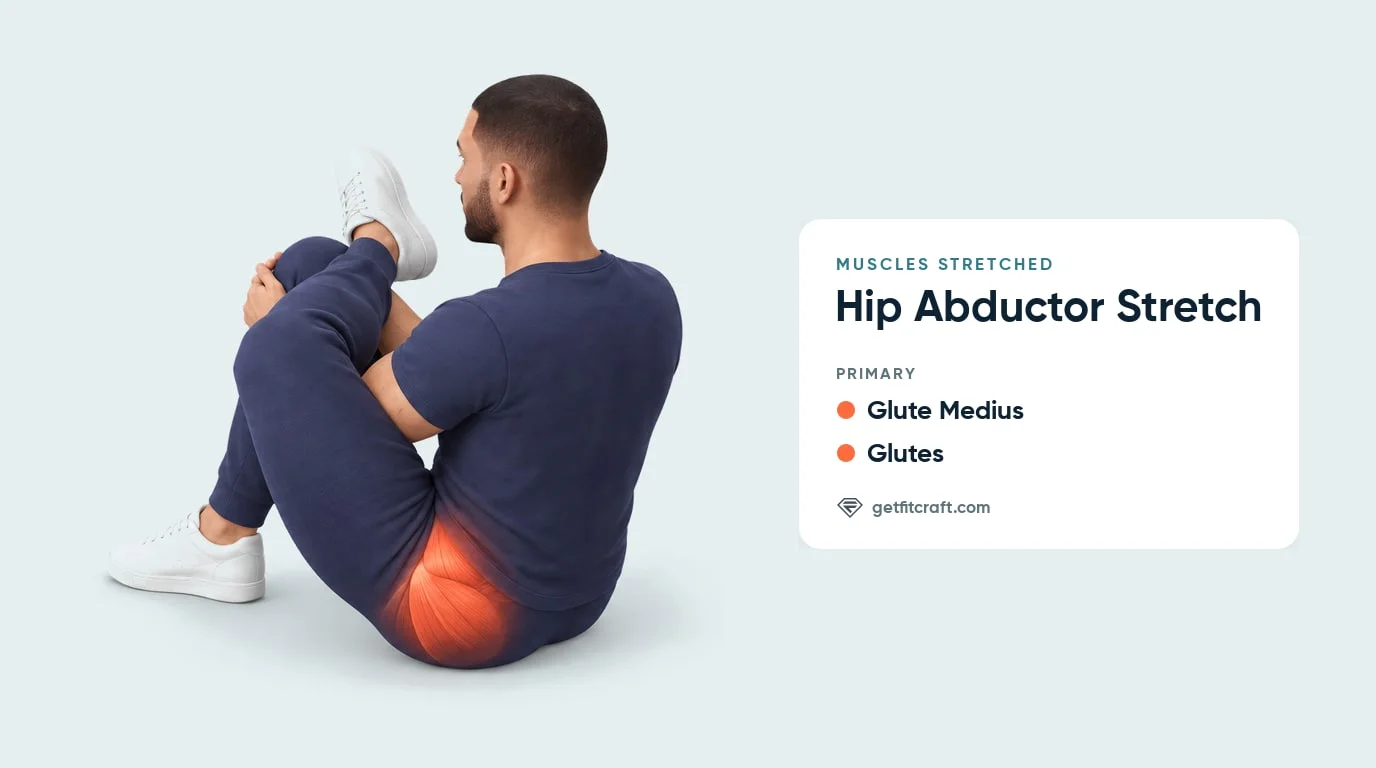
Muscles Stretched
Muscles stretched: the glute medius and the glutes of the leg you cross. The glute medius is the muscle on the outer side of your hip, and the glutes are the large muscles at the back of the hip. With your ankle crossed over the other knee, the crossed knee turns out to the side. Hugging the bottom knee toward your chest then bends the crossed hip further while it stays turned out, which lengthens the glute medius on its outer side and the glutes behind it.
Where you should feel it: a mild stretch on the outside of the hip of your crossed leg and through the glutes behind it. You shouldn't feel it in your knees or your lower back, and any pain in your knees, hips, lower back or neck means stop.
Step-by-Step: How to Do the Hip Abductor Stretch
FitCraft teaches the seated version. All you need is a patch of floor, and a mat makes it more comfortable.
Step 1: Sit With Both Knees Bent
Sit on the floor with both knees bent and both feet flat in front of you.
Step 2: Cross One Ankle Over the Other Knee
Lift one leg, let that knee turn out to the side and rest its ankle across the top of the other knee. The leg you cross is the side you stretch. Resting the ankle on your thigh just above the knee is a gentler option.
Tip: keep the crossed knee turned out to the side, not drifting in.
Step 3: Hug the Bottom Knee
Wrap both hands around the knee your ankle rests on. Keep your bottom foot flat on the floor, heel and toes down, so it gives you a stable base.
Step 4: Sit Tall and Draw the Knee In
Sit tall with your chest lifted and your gaze forward. Gently hug the bottom knee toward your chest until you feel a mild stretch in the glute and on the outer side of the hip of the crossed leg. A slight lean back is fine, but don't slump back onto your tailbone.
Tip: hug the knee in gently, never yank it, and don't bounce in the stretch.
Step 5: Hold, Breathe and Switch Sides
Hold for about 15 to 30 seconds at a time, or for the time your workout sets. Breathe slowly and steadily, and let your hip soften a little each time you breathe out, without forcing deeper. Then uncross your legs and give the other side the same time.
Get this exercise in a personalized workout
FitCraft, our mobile fitness app, uses its AI coach Ty to program mobility work like this into your plan at the right volume and intensity, based on your level, goals, and equipment. Ty was designed and trained by Domenic Angelino, MPH (Brown University) and NSCA-CSCS, with research published in the Journal of Strength and Conditioning Research and Medicine & Science in Sports & Exercise.
Take the Free Assessment Free · 2 minutes · No credit card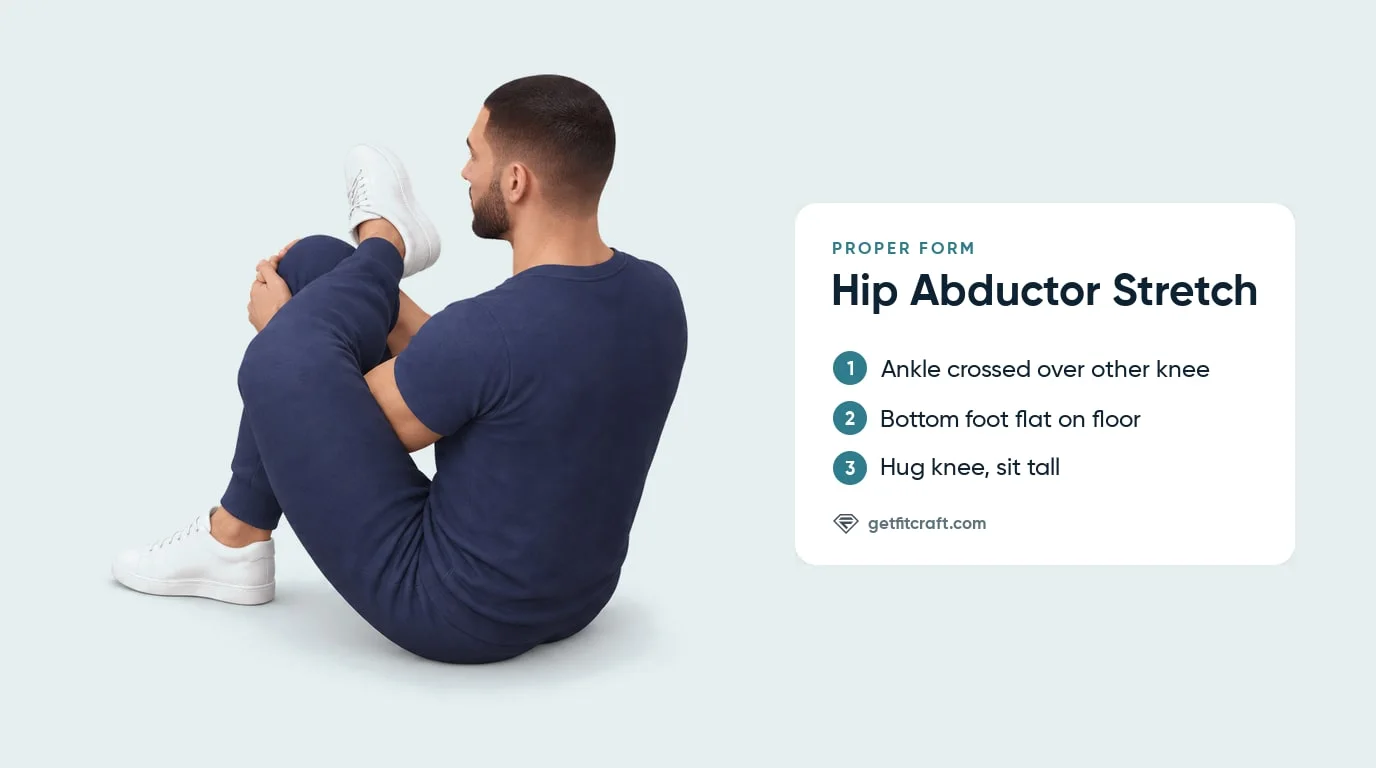
Common Mistakes (and How to Fix Them)
The hip abductor stretch looks simple, but these errors either weaken the stretch or push it past mild.
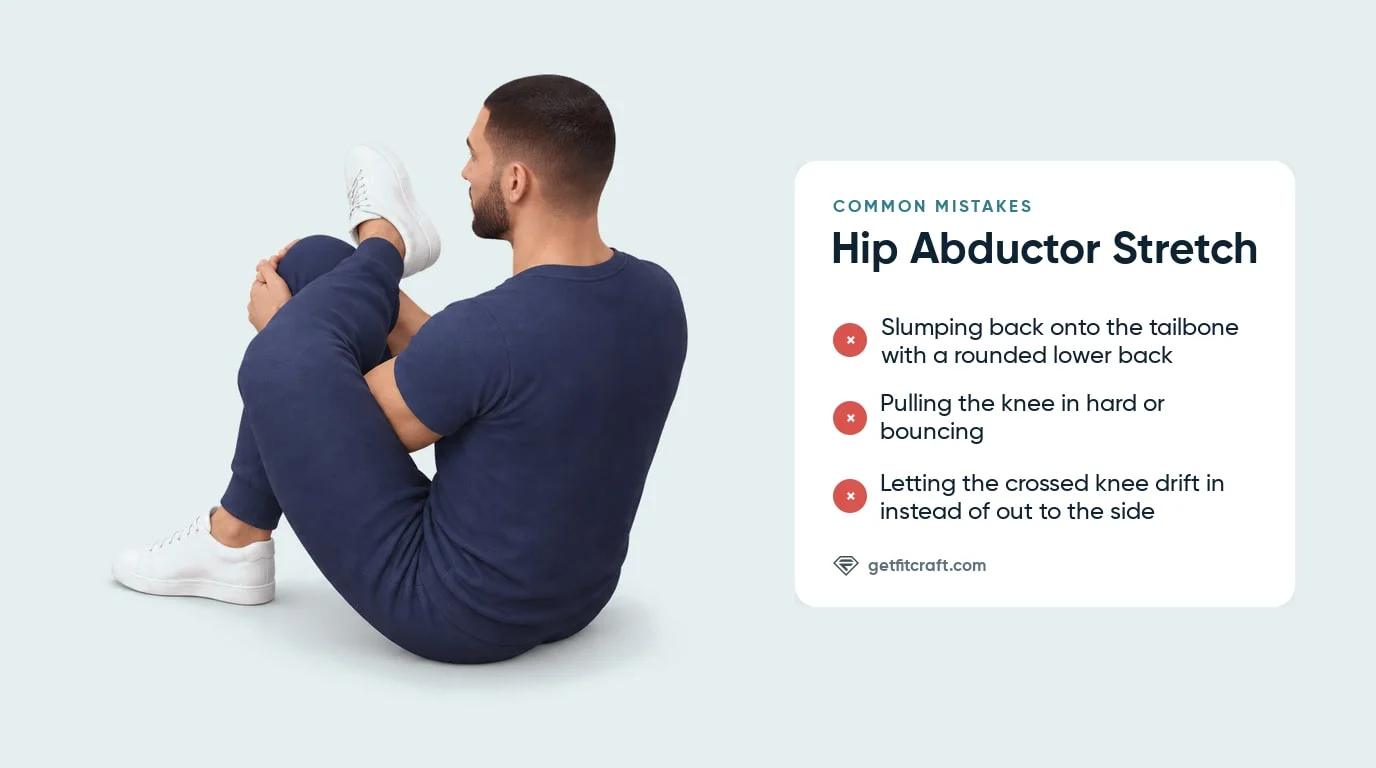
- Slumping back onto your tailbone. Leaning far back with a rounded lower back weakens the stretch in the hip. Sit tall with your chest lifted. A slight lean back while you hug the knee is fine.
- Pulling the knee in hard or bouncing. Forcing the knee toward your chest pushes the stretch past mild. Hug it in gently and hold still.
- Letting the crossed knee drift in. Keep the crossed knee turned out to the side, with the ankle resting across the other knee.
- Letting the bottom foot slide away or lift. Keep the bottom foot flat on the floor, heel and toes down. It is your base for the stretch.
- Holding your breath. Breathe slowly and steadily the whole time, and let your hip soften a little each time you breathe out.
- Stretching only one side. The leg you cross is the side you stretch, so switch legs and give the other side the same time.
Variations
Easier Versions
- Bottom foot farther away. Slide your bottom foot farther from your hips and hug your knee in less. The closer the bottom foot, the stronger the stretch, so moving it away makes the hold gentler.
- Ankle above the knee. Rest your ankle on your thigh just above the knee instead of on top of the knee, and keep hugging the bottom knee gently.
- Lying on your back. Lie on your back with both knees bent and both feet on the floor, cross one ankle over the other thigh the same way, and pull the bottom thigh toward you.
- In a chair. Sit in a chair, rest one ankle on your other thigh and lean forward a little from your hips.
Deeper Version
Draw your bottom foot a little closer to your hips, sit taller and bring your chest a little closer to your shin. Keep it a mild stretch, never forced.
Different Stretches That Are Not This One
In the standing crossover, one leg crosses behind the other and the hip pushes out to the side. In the seated twist, one foot sits outside the opposite knee while the trunk turns. Both are different stretches from the seated hold this page teaches.
When to Avoid the Hip Abductor Stretch
A few conditions call for a check with your doctor or physical therapist before you do the hip abductor stretch. A mild stretch in your glutes and outer hip is normal; any pain in a joint (your knees and hips included), your lower back or your neck means stop. Always consult your physician or physical therapist for personalized guidance.
- Hip injury, labral tear, or recent hip surgery. After hip surgery, get your surgeon's okay first. With a hip injury or a labral tear, see a doctor or physical therapist before you try this stretch. Any hip pain means stop.
- Hypermobility, Ehlers-Danlos, or other connective tissue disorders. Ask your doctor or physical therapist whether deep hip stretches fit your plan before you try it. Any joint pain means stop.
- A recent strain in the glutes or outer hip. Skip the stretch and see a doctor or physical therapist, and ask them when and how to return to stretching that area.
- Pregnancy. Check with your doctor or midwife before doing the hip abductor stretch. Any pain in your hips, groin, lower back or pelvis means stop.
- Sciatica or disc problems. See a doctor or physical therapist before doing this stretch. Any pain in your lower back, or pain running down your leg, means stop.
- Knee pain during the stretch. Stop right away. You shouldn't feel this stretch in your knees. If your knee hurts, see a doctor or physical therapist before you try it again.
Related Exercises
If the hip abductor stretch is part of your routine, these exercises pair well with it:
- Same joint, other side of the hip: Butterfly Pose stretches the adductors along your inner thighs, the muscles that move your leg back in toward the midline. It pairs well with this stretch in a mobility session.
- Harder floor stretch: Royal Pigeon Pose is built on the pigeon leg shape and is rated Expert in the app. Among other muscles, it also stretches the glutes and the glute medius.
- Mobility pairing: Cat-Cow moves your spine through rounding and arching, and the Half-Kneeling Triplanar Stretch stretches the front of the hip from a low lunge with the back knee lifted. Both fit into the same mobility session.
- Lower-body strength work: Side Lunges step out to the side and work the quadriceps, glutes, adductors and glute medius.
- Strength for the same muscles: Clamshells and Fire Hydrants work the glute medius and the glutes, the same muscles this stretch lengthens.
- Another stretch for the same session: Downward Dog stretches the hamstrings, calves, lats and the muscles along your spine.
How to Program the Hip Abductor Stretch
The American College of Sports Medicine's guidance on flexibility exercise recommends stretching each major muscle group on at least 2 days a week, for about 60 seconds in total per stretch (Garber et al., 2011). For the hip abductor stretch, that means holds of about 15 to 30 seconds per side, repeated, or the time your workout sets. A longer hold is fine while the stretch stays mild.
| Version | Hold time | Total per side | Frequency |
|---|---|---|---|
| Easier: bottom foot farther away, ankle above the knee, lying on your back, or in a chair | About 15 to 30 seconds per hold | Repeat to about 60 seconds | At least 2 days a week |
| Advanced: the seated hold as the app teaches it | About 15 to 30 seconds per hold, or the time your workout sets | Repeat to about 60 seconds; longer is fine while the stretch stays mild | At least 2 days a week |
Where in your workout: use the hip abductor stretch after lower-body training, during a standalone mobility session, or in a cooldown. Give both sides the same time.
Good form over hold targets: the hold only counts while you sit tall, your bottom foot stays flat and the stretch stays mild in the glutes and outer hip. If you feel any pain in your knees, hips, lower back or neck, stop.
How FitCraft Programs This Exercise
Knowing how to do the hip abductor stretch is step one. Knowing when to do it, how long to hold it, and what to pair it with is where most people get stuck.
FitCraft maps your level, goals, and equipment during the diagnostic and builds a plan around them. The app has two hip abductor stretch exercises, one for each side, both rated Advanced, and can include them in your plan.
Its 3D demonstrations show the seated hold: one ankle across the other knee with that knee turned out, both hands hugging the bottom knee toward the chest, and the bottom foot flat on the floor. Every program is designed by an Ivy League-trained exercise scientist and NSCA-certified strength coach using evidence-based mobility principles, then adapted to you by the AI.
Frequently Asked Questions
Can I do the hip abductor stretch if I have lateral knee pain or IT band syndrome?
Not before you check with a doctor or physical therapist. If you have knee pain or a knee condition such as IT band syndrome, see them first and ask whether this stretch suits you. You shouldn't feel this stretch in your knees at all: any knee pain during the hold means stop right away.
What muscles does the hip abductor stretch target?
The hip abductor stretch stretches the glute medius and the glutes on the side of the leg you cross. With your ankle crossed over the other knee and the crossed knee turned out, hugging the bottom knee toward your chest bends the crossed hip further while it stays turned out. That lengthens the glute medius on the outer side of the hip and the glutes behind it. You should feel a mild stretch there, not in your knees or your lower back.
How long should I hold a hip abductor stretch?
Hold the hip abductor stretch for about 15 to 30 seconds at a time, or for the time your workout sets, breathing slowly. A longer hold is fine while the stretch stays mild. Give both sides the same time. The general guideline for stretching is about 60 seconds in total per stretch, on at least 2 days a week.
Is the hip abductor stretch safe to do every day?
Yes, while the stretch stays mild. The general guideline is to stretch on at least 2 days a week, so daily practice fits within it. Hug the knee in gently and never bounce or force the stretch. A mild stretch in your glutes and outer hip is normal; any pain in your knees, hips, lower back or neck means stop right away.
What is the difference between hip abductors and hip adductors?
Hip abductors move your leg out to the side, away from your body's midline; the glute medius on the outer hip is one of them. Hip adductors, the muscles along your inner thighs, move your leg back in toward the midline. The hip abductor stretch stretches the glute medius and the glutes. Butterfly pose is a seated stretch for the adductors.