The name namaste often brings to mind an upright prayer pose with the palms together at the chest. The namaste in the FitCraft app is a different shape: a standing forward bow. You sweep your arms up, fold forward from your hips with your knees soft, and hold with your palms pressed lightly together in front of you while your head, neck and upper back relax. The upright prayer pose and its seated, overhead and reverse versions are different poses, and this guide does not teach them.
The bow stretches the backs of your thighs and the long muscles beside your spine. It needs no equipment and only enough space to stand and fold forward, so it fits a warm-up, a cool-down or a short break from sitting.
The most common slip is treating the bow like a toe touch: locking the knees and bouncing to reach lower. Fold from your hips, keep your knees soft, and let the stretch build slowly while you breathe.
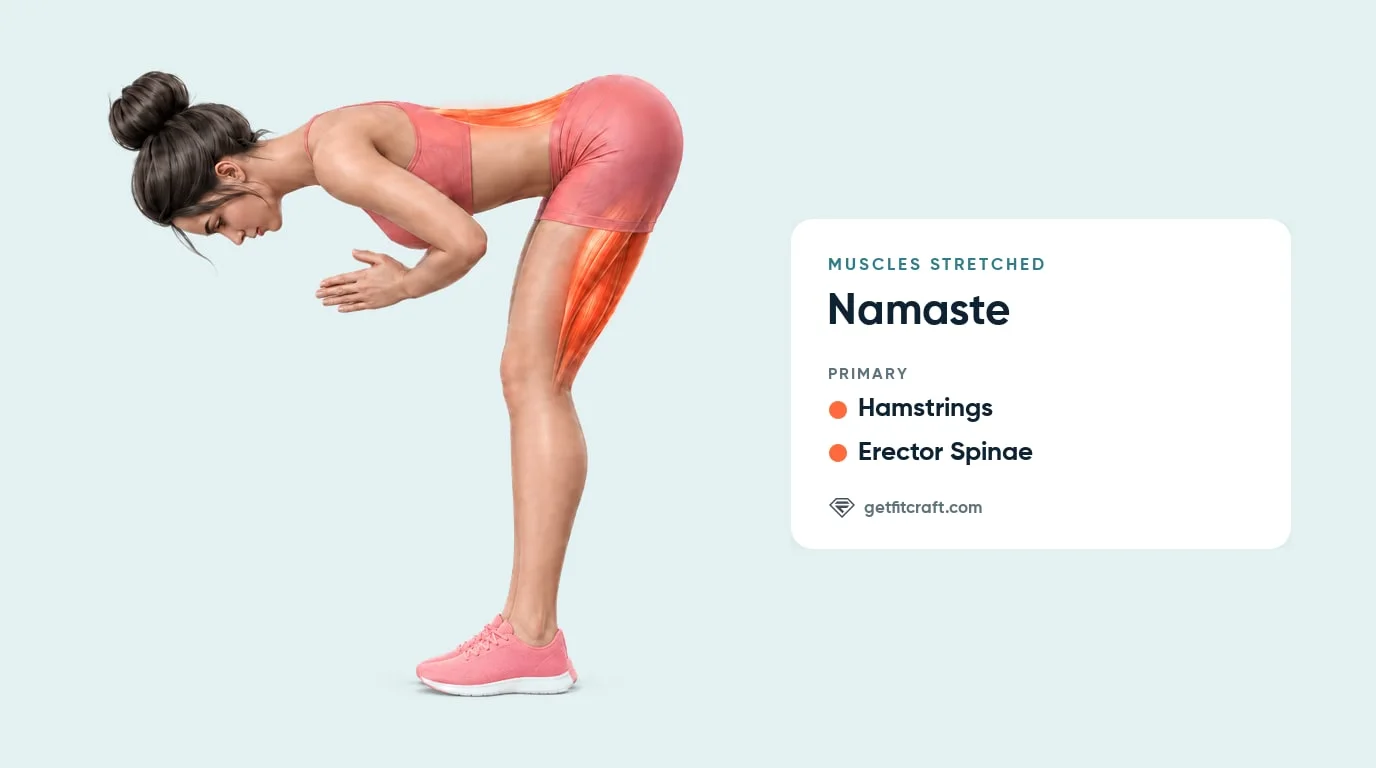
Muscles Stretched
Muscles stretched. The namaste pose stretches the hamstrings and the erector spinae. It is a stretch, not a strength exercise. The hamstrings run down the backs of your thighs, and they lengthen as your hips fold forward with your knees nearly straight. The erector spinae are the long muscles on either side of your spine that straighten your back, and they lengthen as your back, neck and head relax and round gently into the bow.
How your knees change the stretch. Softly bent knees keep the stretch along the backs of your thighs gentle. Straightening them a little more, never locked, makes that stretch grow, and bending them more eases it and takes strain off your lower back. That is why the knee bend is the main way to make namaste easier or harder.
Where you should feel it. A gentle stretch along the backs of your thighs and along the muscles beside your spine as your back softens. You shouldn't feel pain in your lower back or behind your knees, and any pain there means come up slowly and stop.
Get this exercise in a personalized workout
FitCraft, our mobile fitness app, uses its AI coach Ty to program yoga poses like this into your plan at the right volume and intensity, based on your level, goals, and equipment. Ty was designed and trained by Domenic Angelino, MPH (Brown University) and NSCA-CSCS, with research published in the Journal of Strength and Conditioning Research and Medicine & Science in Sports & Exercise.
Take the Free Assessment Free version available · 2 minutes · No credit cardQuick Facts: Namaste Pose
- Equipment needed: None
- Difficulty: Beginner (as rated in the FitCraft app)
- Modality: Static stretch, a standing forward bow held while you breathe
- Body region: Backs of the thighs (hamstrings) and back (erector spinae), both stretched
How to Do Namaste Pose (Step-by-Step)
- Stand tall with soft knees. Stand with your feet together or up to about hip-width apart, whichever feels steadier. Soften your knees so they are not locked, and let your arms hang by your sides.
- Sweep your arms overhead. Breathe in and sweep both arms up overhead as you stand tall.
- Fold forward from your hips. Breathe out and fold forward from your hips, leading with your chest and keeping your knees soft, until your upper body is about level with the floor or as far as the backs of your legs allow. Start the fold with a long back. Ease into it over a few seconds and never bounce to go deeper.
- Press your palms together and relax your head. Bring your palms together in front of you, below your chest, with your elbows bent, and keep them lightly pressed together. Let your head, neck and upper back relax so your back rounds gently. Your shoulders relax too, so there is no need to pull them back.
- Hold, then come up slowly. Hold while breathing slowly and evenly, and don't hold your breath. Hold for the time your workout sets; about 15 to 30 seconds at a time is a good stretch. To finish, bend your knees a little more and come up slowly so you don't get dizzy. If you feel dizzy or lightheaded, stop and rest.
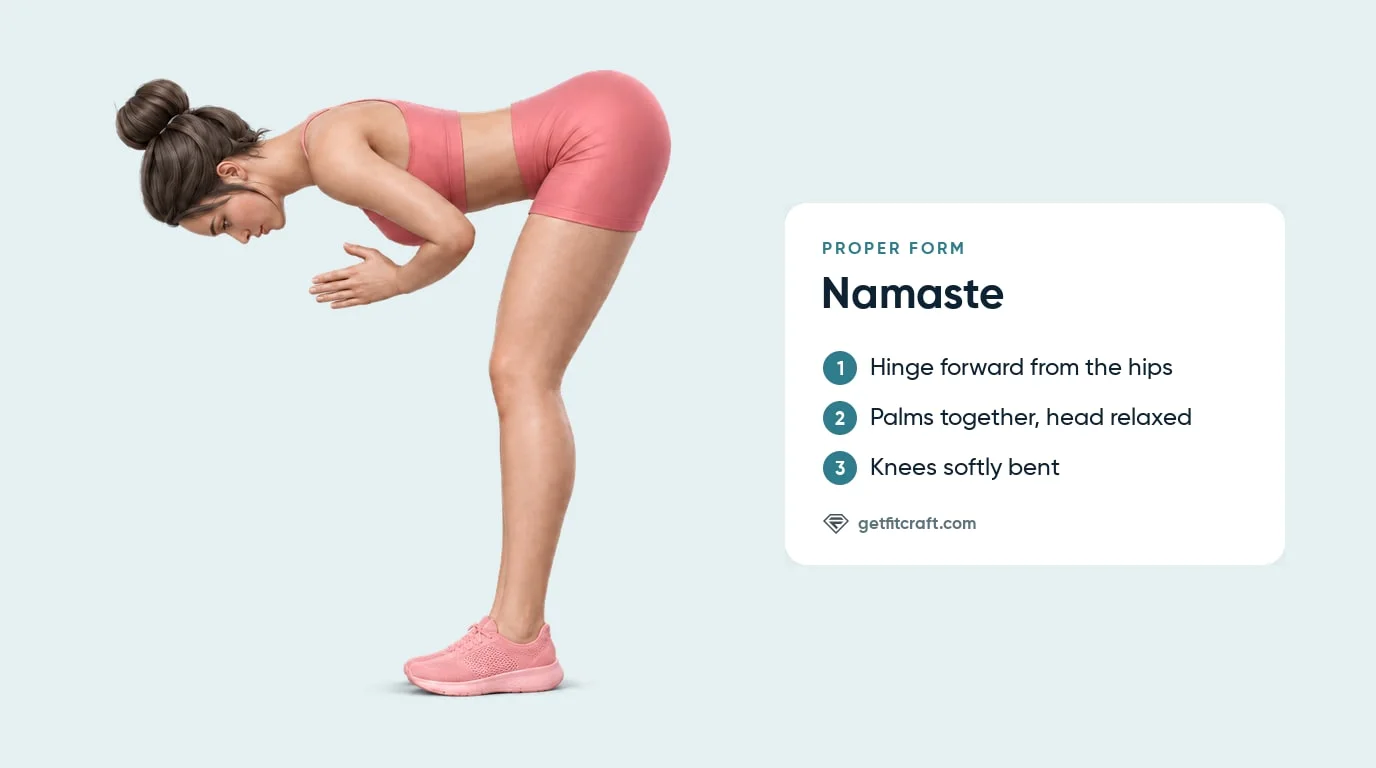
Common Mistakes to Avoid
These are the slips that make the namaste bow less comfortable or less safe.
- Locking the knees straight to fold deeper. Locked knees put more strain on the backs of your thighs and your lower back. Fix: keep your knees soft and let the fold stop where the backs of your legs allow. Bend your knees more if the backs of your legs are tight; the fold stops at about level with the floor.
- Bouncing or forcing the fold. Bouncing to reach lower is not how a static stretch works, and it can strain the muscles you are stretching. Fix: ease in slowly over a few seconds as you breathe out, then stay still.
- Holding your breath. A static stretch is held relaxed, and holding your breath keeps you tense. Fix: breathe in as you stand tall, breathe out as you fold, then keep breathing slowly and evenly while you hold.
- Rounding the lower back while the hips stay still. If you bend only at the waist, your lower back does the folding instead of your hips. Fix: fold from your hips with a long back on the way down, and let only your head, neck and upper back relax and round once you are down.
- Standing back up quickly. Coming up fast from a head-down position can make you dizzy or lightheaded. Fix: bend your knees a little more and come up slowly. If you feel dizzy or lightheaded, come up slowly, then stop and rest; don't go back into the fold.
Namaste Variations: Easier and Harder Versions
Easier Namaste
Bend your knees more and fold only partway, so the stretch in the backs of your legs stays gentle. You can also rest your hands on your thighs instead of pressing your palms together and keep your back long, or hold the back of a chair in front of you and fold until your back is about level.
Namaste (Standard, Beginner in the App)
The version in the step-by-step above: arms sweep overhead, then you fold forward from your hips with soft knees until your upper body is about level with the floor, palms pressed together below your chest and head relaxed. The FitCraft app has one namaste exercise and rates it Beginner.
Harder Namaste
Straighten your knees a little more, never locked, so the stretch along the backs of your thighs grows. Go only as far as the stretch stays comfortable and your back feels fine.
Downward Dog (Harder)
Downward dog puts your hands and feet on the floor with your hips high, for a stronger stretch down the backs of your legs and along your back. The FitCraft app has it as a separate exercise, rated Intermediate.
The Upright Prayer Pose Is a Different Pose
The upright prayer pose (pranamasana), with your body upright and your palms together at your chest, is a different pose from the namaste bow, and so are its seated, overhead and reverse versions. They are not easier or harder versions of this exercise, and this guide does not teach them.
When to Avoid or Modify Namaste Pose
A gentle stretch in the backs of your thighs and along your back is normal in the namaste pose. Any pain in a joint, your lower back or your neck means come up slowly and stop, and so does dizziness, lightheadedness or pressure in your head or eyes. If any of the following applies to you, see a doctor or physical therapist before you do this exercise.
- Lower back pain or a back injury. See a doctor or physical therapist before you do the namaste pose or any forward fold, and ask them which exercises suit you. Any lower back pain during the bow means come up slowly and stop.
- Glaucoma. The bow lowers your head to about the level of your hips. If you have glaucoma, ask your eye doctor before you do head-down folds like this one. Pressure in your head or eyes means come up slowly, then stop and rest.
- Vertigo, balance disorders or frequent dizziness. Check with a doctor before you do head-down folds. If you feel dizzy or lightheaded during the bow, come up slowly, then stop and rest.
- Recent shoulder surgery or a shoulder injury. The pose starts with your arms sweeping overhead. Get clearance from your surgeon or physical therapist first. Any shoulder pain means stop.
- Pregnancy. Check with your doctor or midwife before you do the namaste bow, and ask them which version fits each stage of your pregnancy. Any pain in your back, belly or pelvis, or feeling dizzy, means stop.
- Hypermobility or connective tissue disorders. Ask your doctor or physical therapist whether stretching fits your plan. If they clear you, keep the stretch mild and never lock your knees. Any joint pain means stop.
Related Exercises
Namaste fits into a larger network of standing and floor yoga poses. These pair well as you build a practice.
- Standing balance: Tree pose is a balance on one leg that pairs well with the namaste bow in a short yoga routine.
- Standing strength hold: Chair pose is a standing hold with your knees bent that works your legs, a strength pose to pair with the namaste stretch.
- Standing yoga hold: Warrior pose is a standing lunge-shaped hold that fits next to namaste in a yoga flow.
- Spine mobility: Cat-cow moves your spine gently between rounding and arching on your hands and knees, a good warm-up before the bow.
- Stronger stretch for the same areas: Downward dog puts your hands and feet on the floor with your hips high, for a stronger stretch down the backs of your legs and along your back.
- Standing balance partner: Warrior 3 is a balance on one leg with your body tipped forward, a harder balance challenge to pair with the namaste bow.
How to Program Namaste Pose
Stretching follows different rules from resistance training: slow, relaxed holds and steady breathing matter more than load. The American College of Sports Medicine's guidance on flexibility exercise recommends stretching each major muscle group on at least two days a week, for about 60 seconds in total per exercise (Garber et al., 2011). The table below is a practical starting point.
| Version | Hold time | Holds per session | Frequency |
|---|---|---|---|
| Easier (knees bent more, a partial fold, hands on the thighs or a chair) | About 15-30 seconds, breathing slowly | 2-4 holds, about 1 minute in total | At least 2 days a week; more often is fine |
| Beginner (the standard namaste bow, as rated in the app) | About 15-30 seconds, breathing slowly | 2-4 holds, about 1 minute in total | At least 2 days a week; more often is fine |
| Harder (knees a little straighter, never locked) | About 15-30 seconds, breathing slowly | 2-4 holds, about 1 minute in total | At least 2 days a week; more often is fine |
Where in your workout. Namaste fits at the end of a warm-up, in a cool-down after training, or as a short break from sitting. Hold it for the time your workout sets, and come up slowly each time.
Form over hold time. If your knees are locked, you are bouncing, or you are holding your breath, ease off and bend your knees more. Any pain in your lower back, knees or neck means come up slowly and stop. A gentle stretch with soft knees beats a deeper fold that strains your back.
Frequently Asked Questions
Can I do namaste pose with lower back pain?
Not while your back hurts. If you have lower back pain or a back injury, see a doctor or physical therapist before you do the namaste pose or any forward fold, and ask them which exercises suit you. A gentle stretch in the backs of your thighs and along your back is normal in the bow. Any pain in your lower back, knees or neck means come up slowly and stop.
What does the namaste pose do?
In the FitCraft app, namaste is a standing forward bow with the palms pressed together. You sweep your arms overhead, fold forward from your hips with your knees soft, and hold with your palms together and your head relaxed. It stretches the hamstrings along the backs of your thighs and the erector spinae, the long muscles beside your spine. It is a gentle stretch, not a strength exercise, and it fits a warm-up, a cool-down or a break from sitting.
What muscles does the namaste pose stretch?
The namaste pose stretches two muscle groups: the hamstrings and the erector spinae. The hamstrings, along the backs of your thighs, lengthen as your hips fold forward with your knees nearly straight. The erector spinae, the long muscles beside your spine that straighten your back, lengthen as your back, neck and head relax and round gently into the bow. You should feel a gentle stretch in both places, never pain in your lower back or behind your knees.
How long should you hold namaste pose?
Hold for the time your workout sets, breathing slowly. About 15 to 30 seconds at a time is a good stretch, and about a minute in total is plenty. American College of Sports Medicine guidance on flexibility exercise suggests about 60 seconds in total per stretch on at least two days a week (Garber et al., 2011).
Should my back be straight in the namaste pose?
Start the fold with a long back, hinging from your hips. Once you're down, let your head, neck and upper back relax and round a little. Don't force your lower back into a deep round while your hips stay still, and bend your knees more if the backs of your legs pull. Any lower back pain means come up slowly and stop.
Can I do namaste pose every day?
Yes, as long as it never hurts. Namaste is a gentle stretch that needs no equipment. Flexibility guidance asks for at least two days a week, and doing it more often is fine. Come up slowly each time so you don't get dizzy, and if you have glaucoma, ask your eye doctor before you do head-down folds like this one.