The deadbug looks easy. Lie on your back, wave your arms and legs around. That's the part most people see, and it's why the exercise gets dismissed as a beginner movement.
It's not. Done correctly, the deadbug forces your deep core to fight against your lower back arching as your limbs extend. That anti-extension demand is what physical therapists and strength coaches reach for when someone needs to learn how to brace the spine before adding load.
The cost of getting it wrong: zero training stimulus and a tweaked lower back. Get the lower-back contact right and you've got a movement that shows up in serious rehab protocols and elite strength programs alike.
Quick Facts: Deadbug
- Equipment needed: None (mat optional)
- Difficulty: Intermediate (alt partial) to Expert (full alternating)
- Modality: Strength / Core stability
- Body region: Anterior core
- FitCraft quest category: Strength
Muscles Worked
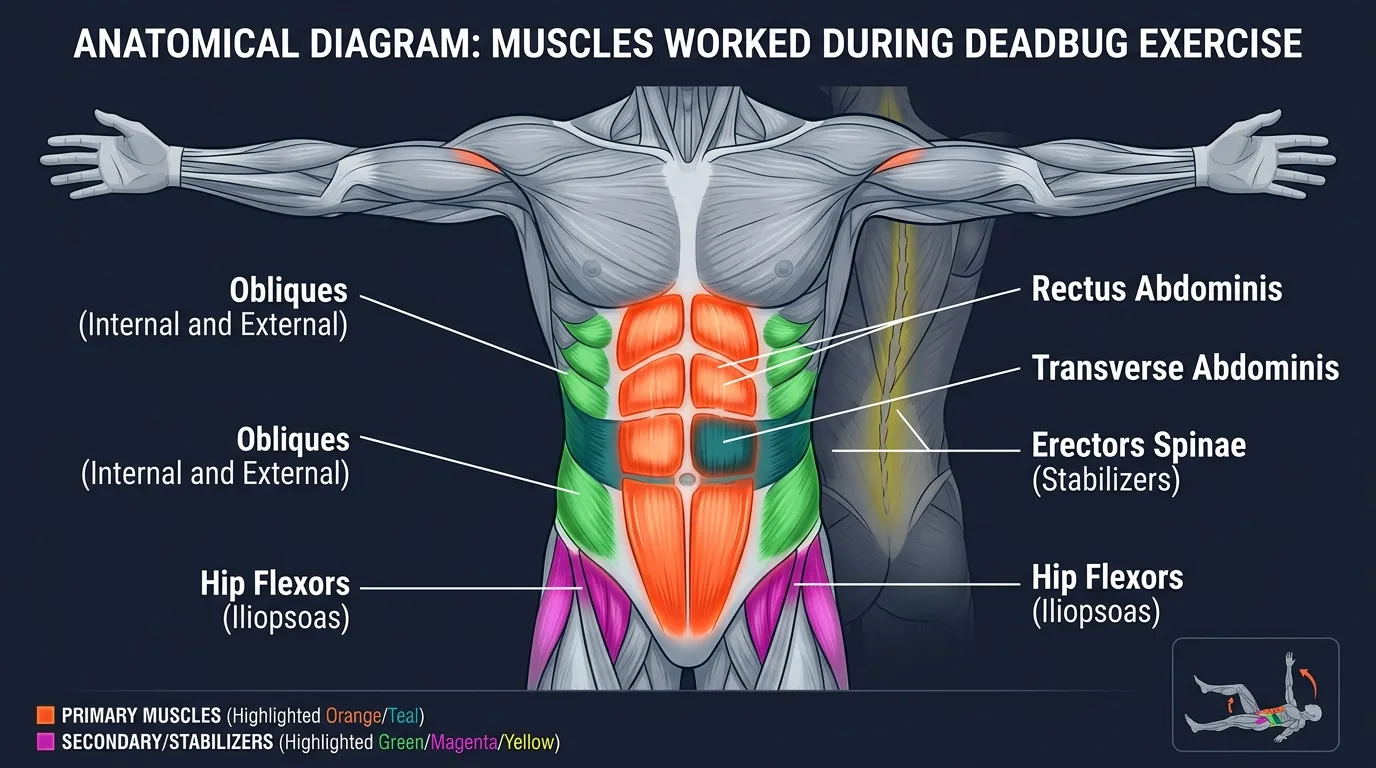
Primary movers: the rectus abdominis, transverse abdominis, and obliques. These work isometrically to hold the lower back flat against the floor while the limbs extend. The transverse abdominis (your deepest abdominal muscle, wrapping the trunk like a corset) is the key player because its job is to maintain intra-abdominal pressure and resist spinal extension.
Secondary movers: the hip flexors (psoas and rectus femoris) work eccentrically as the leg lowers and concentrically as it returns. In the full alternating variation, the anterior deltoids and long head of the triceps move the arm overhead, adding a shoulder-flexion component.
Stabilizers: the diaphragm and pelvic floor (the deep core canister); the spinal erectors lengthen eccentrically as the trunk braces against extension; the rotator cuff stabilizes the shoulder in the full variation. The breath is a critical stabilizer in the deadbug. Exhaling during the limb-extension phase increases transverse abdominis activation and helps maintain the lumbar-floor contact that defines the exercise.
Mechanism (why anti-extension matters): when you extend a limb away from your body, gravity pulls it toward the floor and your lumbar spine wants to arch up to compensate. The deadbug trains your core to resist that arch. This is the same bracing skill you need under load in a squat, deadlift, or overhead press. The deadbug isolates the skill in an unloaded supine position so you can train it without the stakes of a barbell on your back. It's a textbook example of motor pattern training: you build the neural wiring for spinal bracing in a low-risk setup, then carry it into loaded compound work.
Step-by-Step: How to Perform a Deadbug
The cues below apply to both the alt partial and the full alternating variation. The only difference between them is whether the arms move with the legs.
Step 1: Set Your Starting Position
Lie face up on the floor with your arms extended toward the ceiling directly above your shoulders. Bend your knees to 90 degrees and lift your feet off the floor so your shins are parallel to the ground. Head rests on the floor in a neutral position.
Coach Ty's cue: "Keep your spine neutral and head resting on the floor." Lifting your head creates neck strain and can subtly arch the lower back.
Step 2: Press Your Lower Back into the Floor
This is the rep before the rep. Brace your core and flatten your lower back against the floor. There should be no gap between your lumbar spine and the ground. You should feel your abs engage.
Ty's non-negotiable cue: "Keep your lower back pressed against the floor for ultimate core engagement." The moment your lower back lifts off the floor, the exercise stops training your core and starts stressing your spine. Press down hard.
Step 3 (Alt Partial): Extend One Leg
Slowly extend one leg away from your body, lowering it toward the floor without touching down. Keep your arms stationary, pointed at the ceiling. Your lower back stays pressed into the ground.
Ty's tempo cue: "The slower the movement, the more you will engage your abs. Don't rush!" Each leg extension should take 2 to 3 seconds down and 2 to 3 seconds back. The slow tempo eliminates momentum and maximizes time under tension.
Step 4 (Full Alternating): Extend Opposite Arm and Leg
Simultaneously extend your right arm overhead and your left leg toward the floor. Both move at the same slow tempo. The non-moving arm stays pointed at the ceiling. The non-moving knee stays bent at 90 degrees.
Ty's coaching cue: "Ensure your lower back maintains contact with the floor throughout." The full variation is significantly harder because the arm overhead increases the lever arm. If your back starts to arch, you have extended too far. Bring the range back in.
Step 5: Return and Alternate
Return to the start position with the same slow tempo. Reset your bracing if you lost it. Then repeat with the opposite arm and leg.
Ty's reminder: "Don't rush, each extension should be slow and controlled." Quality reps beat fast reps. Six clean reps per side beat fifteen rushed ones.
Get this exercise in a personalized workout
FitCraft, our mobile fitness app, uses its AI coach Ty to program core stability work like this into your plan at the right volume and intensity, based on your level, goals, and equipment. Ty was designed and trained by Domenic Angelino, MPH (Brown University) and NSCA-CSCS, with research published in the Journal of Strength and Conditioning Research and Medicine & Science in Sports & Exercise.
Take the Free Assessment Free · 2 minutes · No credit card
Common Mistakes (and How to Fix Them)
Here are the mistakes Ty corrects most often.
- Lower back arching off the floor. The cardinal sin of the deadbug. The moment the lumbar spine lifts, the exercise stops working the core. Fix: shorten the range of motion until your strength catches up. Stop the leg extension at whatever angle still lets you keep the back flat, even if that's only halfway down.
- Moving too fast. Speed is the enemy of a good deadbug. Fast reps use momentum instead of muscle. Fix: 2 to 3 seconds down, 2 to 3 seconds back. Count it out loud if you have to.
- Holding your breath. Breath-holding creates intra-abdominal pressure that can mask poor core engagement. Fix: exhale as you extend your limbs, inhale as you return. The exhale on extension is what fires the transverse abdominis hardest.
- Lifting the head and shoulders off the floor. Strains your neck and pulls your spine out of alignment. Fix: head rests on the floor, eyes on the ceiling, shoulders anchored. If your shoulders lift, your core is compensating for a weak brace. Reduce range until you can stay flat.
- Extending the leg too low. Your leg only needs to go as low as you can control with the back flat. Fix: if your back arches when your foot is 6 inches from the floor, stop at 12 inches and build down from there over weeks.
- Letting the non-working leg drift. The bent knee should stay locked at 90 degrees through the rep. If it drifts toward your chest or away from it, you're losing the bracing position. Fix: think "concrete pillar" for the non-working side.
Deadbug Variations: Regressions and Progressions
Start where you are and progress when your form is solid at the current level. The deadbug family scales further than most people realize.
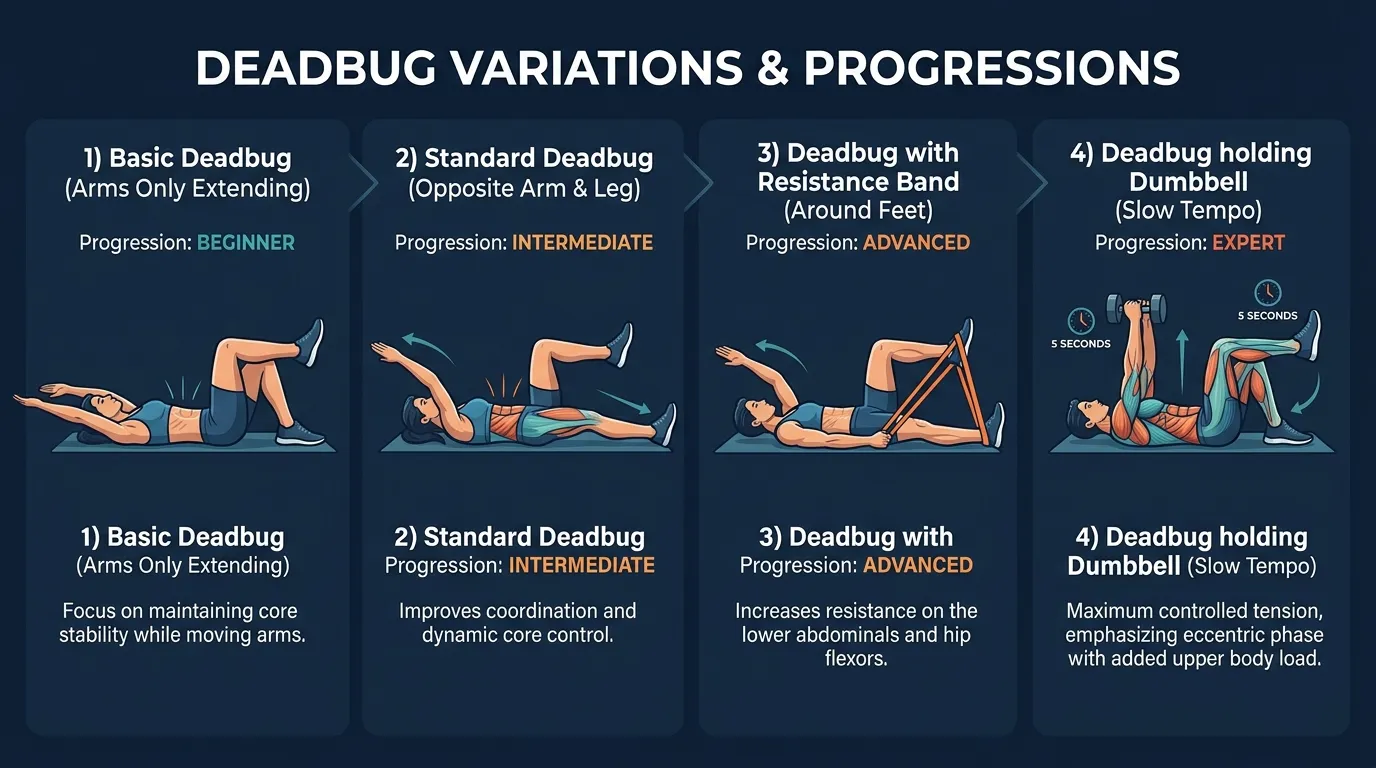
Deadbug Partial (Beginner Regression)
Only one limb moves at a time, and the leg extends through a shorter range (foot stays well above the floor). The shorter lever arm makes lumbar-floor contact much easier to maintain. Start here if the standard alt partial pulls your back off the floor.
Alt Partial Deadbug (Intermediate)
Legs-only version with arms held stationary overhead. One leg extends through full range, returns, then the other leg extends. This builds foundational anti-extension strength and is the version most rehab and strength coaches start with.
Full Alternating Deadbug (Expert)
Opposite arm and leg extend simultaneously. The arm overhead doubles the lever load on the core. Don't progress here until you can do 8 to 10 clean alt partials per side with the back staying flat the entire time.
Banded Deadbug (Advanced Variation)
Anchor a resistance band behind your head and hold the loose end with both hands as you press your arms toward the ceiling. The band pulls your arms (and indirectly your spine) into extension, forcing your core to work even harder to keep the back flat. A favorite of strength coaches working with intermediate lifters.
Stability Ball Deadbug (Advanced Variation)
Press a stability ball between your knees and hands. Lift one hand and the opposite knee off the ball simultaneously, hold briefly, return. The ball provides tactile feedback for whether your bracing has slipped.
When to Avoid or Modify Deadbugs
Deadbugs are one of the safer core exercises and are routinely prescribed in rehab settings, but a few conditions still call for modification or surgeon clearance first. Always consult your physician or physical therapist before starting or returning to any exercise program.
- Acute lower-back pain or known disc pathology. Deadbugs are usually fine and often prescribed in lower-back rehab because the lumbar spine stays flat throughout, but acute disc pain warrants clearance from a PT first. Start with the partial variation and short range, and stop the rep the moment the back lifts.
- First 6-8 weeks postpartum or active diastasis recti. Deadbugs are one of the few core exercises that work well in this window because they avoid spinal flexion and rotation. Restore deep-core function first with diaphragmatic breathing and transverse abdominis activation, then progress to bird-dogs and the deadbug partial before the full version. Avoid if doming or coning appears along the midline during the rep.
- Recent abdominal surgery (C-section, hernia repair, appendectomy). Get clearance from your surgeon before any core work. Most post-surgical protocols start with diaphragmatic breathing, then gentle bracing, then deadbugs as the first dynamic core movement because of how core-protective the supine position is.
- Hernia (umbilical, inguinal, ventral). The intra-abdominal pressure spike during the brace can aggravate some hernias. Consult your physician about safe options. Deadbugs are usually OK at low intensity with light exhalation rather than a hard valsalva brace, but the call is your doctor's.
- Pregnancy (second and third trimester). The supine position can compress the vena cava and reduce blood return when held for long durations. Use upright or side-lying core alternatives in the later trimesters. Early pregnancy is typically fine; check with your provider.
- Pelvic-organ prolapse or pelvic-floor dysfunction. The valsalva-style brace that some people default to during deadbugs increases intra-abdominal pressure and can worsen prolapse. Work with a pelvic-floor PT on a coordinated breath-and-brace pattern before adding deadbugs.
Related Exercises
If deadbugs are part of your core routine, these movements complement or extend the same training pattern:
- Anti-rotation foundation: Bird-Dogs train the same deep-core bracing skill from a quadruped position. Bird-dogs and deadbugs are commonly paired in rehab protocols as the two foundational anti-extension and anti-rotation movements.
- Isometric anti-extension progression: Forearm Planks take the same bracing skill into a loaded prone position. If your deadbugs are clean, planks are the natural next demand.
- Hand-position variant of plank: Hand Planks add wrist load to the bracing pattern and double as a top position for push-ups.
- Anti-lateral-flexion partner: Side Planks round out a core program by training the lateral core, complementing the anterior focus of deadbugs.
- Easier regression: Deadbug Partial reduces the range and lever arm, useful when the standard version still pulls your back off the floor.
- Glute foundation (often paired): Glute Bridges train hip extension from the same supine position, building the posterior-chain counterpart to the anterior-core deadbug.
How to Program Deadbugs
Deadbug programming sits in the dynamic rep-based core category. The American College of Sports Medicine (ACSM) Position Stand on resistance training recommends progressive overload through volume and complexity for core stability work, with at least 48 hours between heavy sessions training the same pattern (Ratamess et al., 2009). For the deadbug specifically, tempo and range of motion are the primary progression levers, not raw rep count.
| Level | Sets × Reps per side | Rest between sets | Frequency |
|---|---|---|---|
| Beginner (partial) | 2-3 × 6-10 | 45-60 seconds | 2-4 sessions/week |
| Intermediate (alt partial) | 3 × 8-12 | 45-60 seconds | 3-5 sessions/week |
| Advanced (full alternating, banded, stability ball) | 3-4 × 10-15 (slow tempo) | 60 seconds | 4-6 sessions/week |
Where in your workout: deadbugs work in three slots. As a warm-up activation before compound lifts (2 sets of 6 reps per side wakes up the deep core before squats or deadlifts). At the end of a strength session as part of a core finisher. Or as a standalone in a dedicated core-day routine alongside bird-dogs, forearm planks, and side planks. Avoid programming heavy core work like deadbugs right before compound lifts that need strong spinal bracing; you don't want to fatigue the core stabilizers before they're needed under load.
Form floor over rep targets: the deadbug rep count is meaningless if the back arches. If your last 2 reps of a set break form, stop the set there. Hitting 10 reps with broken form is worse than hitting 6 reps cleanly. Quality of bracing under tempo is the actual training stimulus.
How FitCraft Programs This Exercise
Knowing how to do a deadbug is step one. Knowing when to do it, which variation, and how to layer it with the rest of your core training is where most people get stuck.
FitCraft's AI coach Ty handles that. During your personalized diagnostic assessment, Ty maps your fitness level, training goals, and any flagged considerations like postpartum status or lower-back history. Then Ty builds a program that slots deadbugs into a balanced training plan at the right variation for your level.
As you get stronger, Ty adjusts the variation and volume to match your level. Partial becomes alt partial. Alt partial becomes full alternating. Volume scales based on your recovery and consistency. Deadbugs get paired with complementary core work like bird-dogs and planks to build a comprehensive program. Every plan is designed by an Ivy League-trained exercise scientist and NSCA-certified strength coach using evidence-based periodization, then adapted to you by the AI.
Frequently Asked Questions
What muscles do deadbugs work?
Deadbugs primarily target the rectus abdominis, transverse abdominis, and obliques. They also engage the hip flexors, spinal erectors (eccentrically), and the anterior deltoids in the full variation. The defining stimulus is anti-extension: your deep core works to stop the lower back from arching as the limbs move away from the midline.
Why is the deadbug so hard?
The deadbug is harder than it looks because it requires you to keep your lower back pressed against the floor while your limbs move independently. That demand falls on the deep core stabilizers, which most people have underdeveloped. Moving slowly, which is the correct form, eliminates momentum and dramatically increases the difficulty.
How many deadbugs should I do per set?
Most people benefit from 6 to 10 reps per side for 2 to 3 sets at a controlled tempo. Quality reps matter far more than total volume. If your lower back starts to arch off the floor, stop the set. You have reached your effective limit, and continuing past that point shifts load onto the lumbar spine instead of training the core.
Can I do deadbugs with lower-back pain?
Deadbugs are one of the few core exercises commonly prescribed for lower-back rehab because the lumbar spine stays pressed flat against the floor throughout. The exercise trains anti-extension without loading the spine into flexion or extension. Start with the alt partial variation, keep the leg extension short, and stop the rep the moment your back lifts. If you have acute pain or a known disc issue, get clearance from a physical therapist first.
Are deadbugs safe during pregnancy?
Deadbugs are generally safer than crunches during pregnancy because they avoid spinal flexion, but the supine position becomes problematic in the second and third trimesters due to vena cava compression. In early pregnancy, deadbugs are typically fine. Later, switch to upright or side-lying core work, or talk to your provider about an inclined alternative. If you have active diastasis recti, focus on diaphragmatic breathing and transverse abdominis activation first.