The bird-dog is one of the most underrated exercises in fitness. It looks simple: extend an arm, extend a leg, come back. But when performed with intent, it builds the kind of deep spinal stability and anti-rotation strength that prevents injuries and makes every other exercise in your program more effective.
Spine biomechanist Dr. Stuart McGill famously included the bird-dog in his "Big 3" exercises for spinal health, alongside the curl-up and side plank. It is that important. And because FitCraft programs two distinct levels (a beginner variation focusing on leg-only extension and an intermediate version adding the opposite arm), there is a progression path for every fitness level.
Quick Facts: Bird-Dog
- Equipment needed: None (optional: mat for knee comfort, resistance band for advanced loading)
- Difficulty: Beginner (Level 1) to Intermediate (Level 2)
- Modality: Strength / Stability
- Body region: Core (deep stabilizers and posterior chain)
- FitCraft quest category: Strength
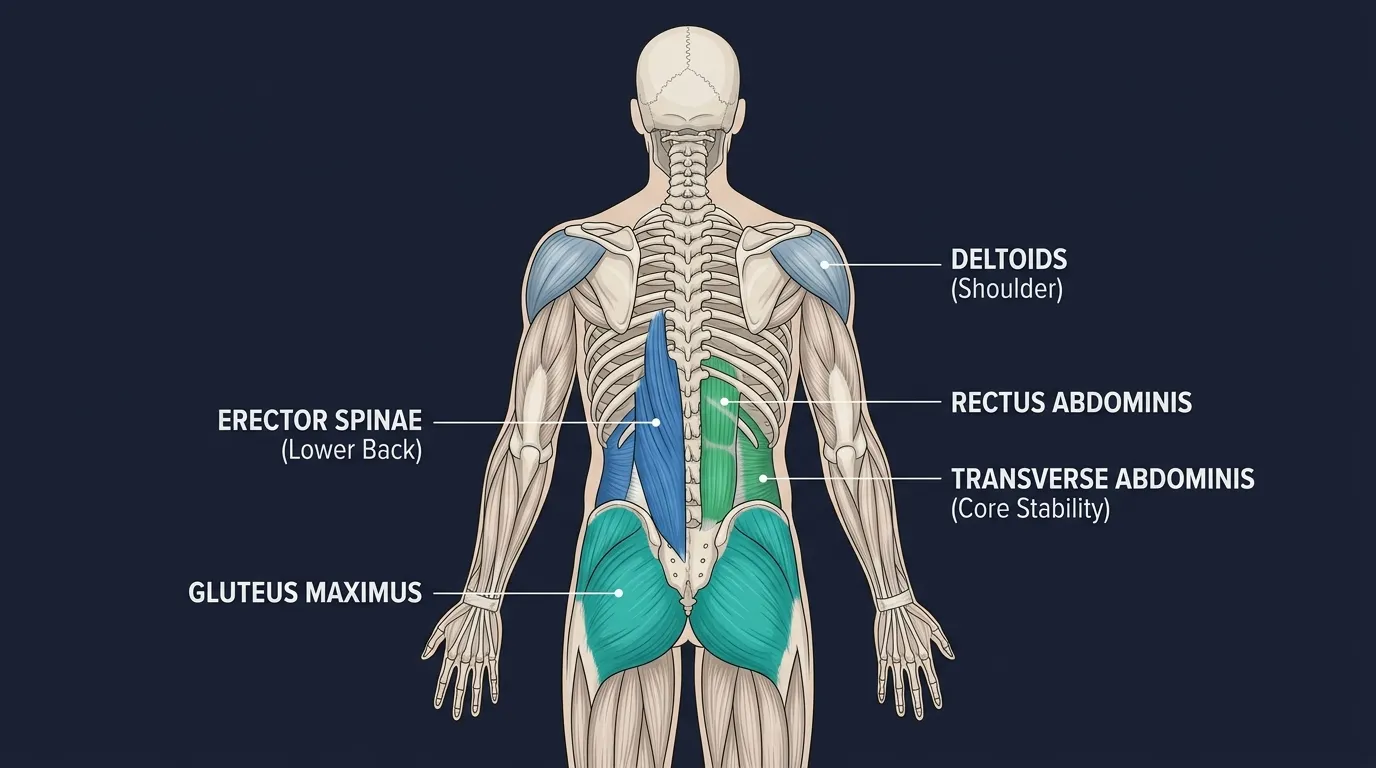
Muscles Worked
Primary movers: the erector spinae (the long muscles running alongside the spine that produce extension), the gluteus maximus on the extending leg (which drives the hip into extension), and the deep core canister (transverse abdominis, multifidus, internal obliques). The deep core works isometrically throughout the rep to prevent the spine from rotating or extending under the asymmetric load of one limb (or two opposite limbs) reaching away from the body.
Secondary movers: on the Level 2 contralateral variation, the posterior deltoid, mid and lower trapezius, and rhomboids on the extending arm fire to hold the arm at shoulder height with the thumb pointing up. The hamstrings of the extending leg assist the glute in producing hip extension. The serratus anterior and forearm muscles of the supporting arm stabilize the scapula and wrist against the bodyweight load on hand and knee.
Stabilizers: the diaphragm and pelvic floor (the deep core canister) coordinate with the transverse abdominis to maintain intra-abdominal pressure; the shoulder girdle of the supporting arm holds scapular position against gravity; the hip stabilizers of the supporting knee (gluteus medius, deep external rotators) keep the pelvis from tilting. The breath is itself a stabilizer: exhaling steadily through the reach reinforces transverse abdominis activation and prevents the rib cage from flaring.
Mechanism (why anti-rotation is the point): when the right arm and left leg extend, the body wants to twist clockwise (viewed from above). The deep core's job is to resist that twist. Holding the spine perfectly square through the reach is what trains the multifidus and transverse abdominis to fire reflexively during real-world tasks (carrying a grocery bag on one side, lunging onto one leg, reaching with one arm). This anti-rotation quality is why McGill's lab made the bird-dog one of three foundational spine-health movements: it loads the stabilizers without loading the vertebrae in flexion or compression, which is the safer training environment for back-pain populations and the more transferable stimulus for healthy lifters.
Step-by-Step: How to Perform a Bird-Dog
Whether you're starting with Level 1 (leg only) or going straight to Level 2 (opposite arm and leg), the setup and bracing pattern are the same. The cues below apply to both.
Step 1: Set Your Quadruped Position
Position yourself on your hands and knees with your hands directly under your shoulders and your knees directly under your hips. Spread your fingers and press the floor away through the heel of your palm. Keep your spine in neutral with your head in line with your back, gaze on the floor between your hands.
Coach Ty's cue: "Press your palms and knees firmly into the ground, creating a stable base." A solid foundation prevents wobbling and lets your core do its job. Think of rooting yourself into the floor.
Step 2: Brace and Set Your Spine
Before you move, brace. Pull your belly button gently up toward your spine, squeeze your glutes lightly, and exhale to set the deep core. Your back should be flat enough that you could balance a glass of water on it.
Ty's cue: "Maintain a neutral spine, imagine a straight line from head to tailbone." Any arching or rounding of your back means your core has lost control. If you can't maintain neutral, reduce your range of motion.
Step 3: Level 1 (Extend One Leg)
Slowly extend one leg straight behind you until it is in line with your torso (not higher). Keep your hips perfectly level and square to the floor. Hold for 1 to 2 seconds, return to the starting position with control, and repeat on the other side.
Ty's cue: "Kick back with your extended leg as if pushing something away." This encourages full hip extension and glute engagement. Don't just lift your leg, drive it backward with intention through the heel.
Step 4: Level 2 (Extend Opposite Arm and Leg)
Once Level 1 feels stable, progress to the full McGill pattern. Simultaneously extend your right arm forward (thumb up, at shoulder height) and your left leg backward (at hip height) until both are in line with your torso. Hold briefly at full extension. Return to the starting position with control, then repeat with the opposite arm and leg.
Ty's key cue: "Reach out with your fingers and toes, as if touching the walls on opposite sides." The lengthening cue maximizes the anti-rotation demand and creates tension through your entire posterior chain.
Step 5: Hold, Control, Alternate
Hold the extended position for a moment at the peak of each rep. Then return, reset your brace, and alternate sides for the desired number of reps. Every rep should look the same: same tempo, same height of the extending limbs, same flat back.
Ty's reminder: "Make sure your arm and leg move smoothly and at the same pace." Synchronizing the extension and return trains coordination alongside strength. Jerky or mismatched timing suggests you're rushing.
Get this exercise in a personalized workout
FitCraft, our mobile fitness app, uses its AI coach Ty to program core stability work like this into your plan at the right volume and intensity, based on your level, goals, and equipment. Ty was designed and trained by Domenic Angelino, MPH (Brown University) and NSCA-CSCS, with research published in the Journal of Strength and Conditioning Research and Medicine & Science in Sports & Exercise.
Take the Free Assessment Free · 2 minutes · No credit card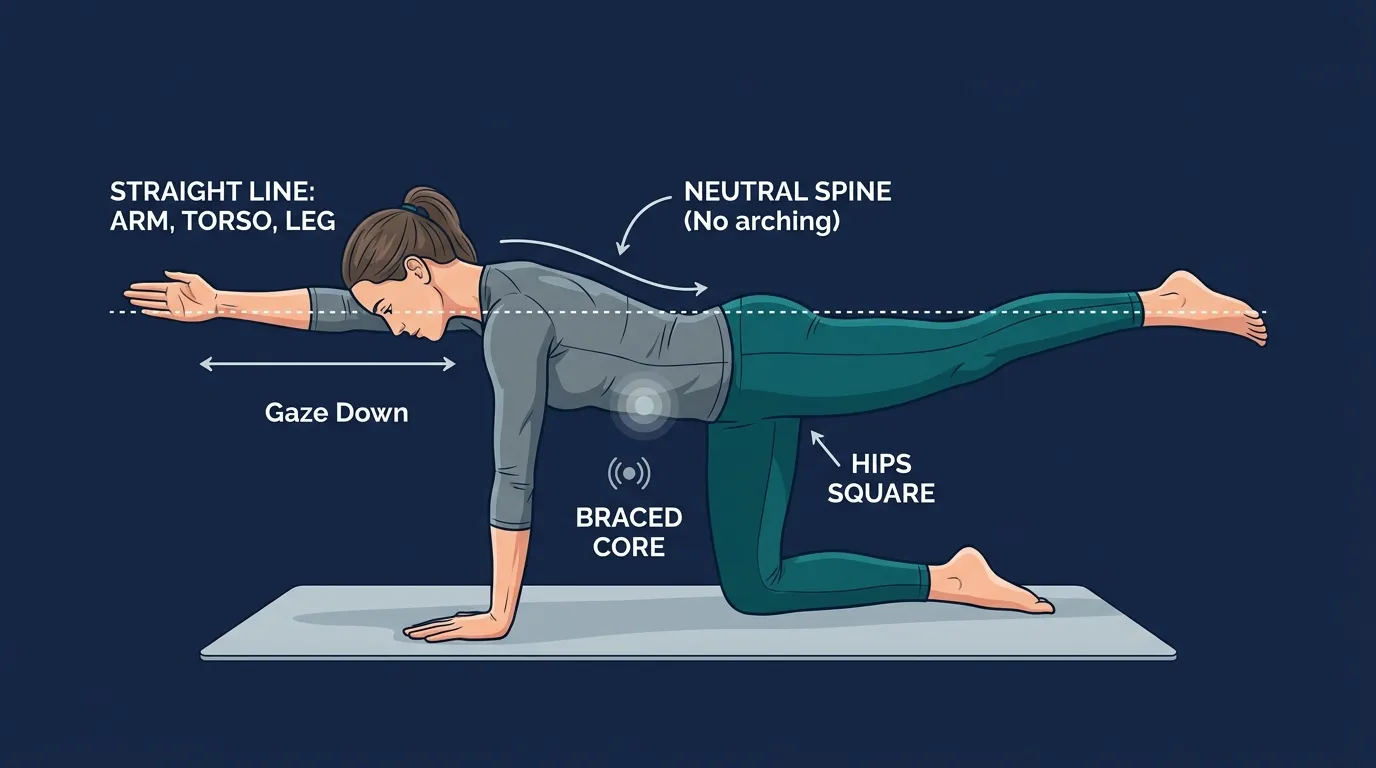
Common Mistakes (and How to Fix Them)
Here are the mistakes Ty corrects most often.
- Arching the lower back. When the leg extends, the lumbar spine wants to hyperextend. Fix: brace the core, squeeze the glute of the extending leg, and only lift the leg as high as the torso line, not higher. If you cannot keep a flat back, reduce range.
- Rotating the hips. The most common error in Level 2. When you extend opposite limbs, the pelvis naturally wants to twist toward the supporting side. Fix: imagine balancing a glass of water on your lower back and hold the pelvis perfectly square through the entire reach.
- Rushing through reps. Bird-dogs are not about speed. Slow, controlled movement is the point. Fix: 2 seconds to extend, 1-to-2-second hold at the top, 2 seconds to return. Each rep takes 5 to 6 seconds.
- Lifting the head to look forward. Cranes the neck and pulls the spine out of alignment. Fix: keep the neck neutral and the gaze on the floor between your hands. Your head moves as part of the spine, not independently.
- Lifting the leg too high. Going above the torso line forces the lower back to extend instead of the hip. Fix: stop the leg at hip height and let the glute do the work, not the lumbar erectors.
- Sagging or shrugging the supporting shoulder. The hand on the floor can collapse into the shoulder joint. Fix: press the floor away, keep a slight bend in the supporting elbow, and feel the serratus engage at the side of the ribcage.
Bird-Dog Variations: Regressions and Progressions
Start where you can hold form and progress when the current level feels easy and stable.
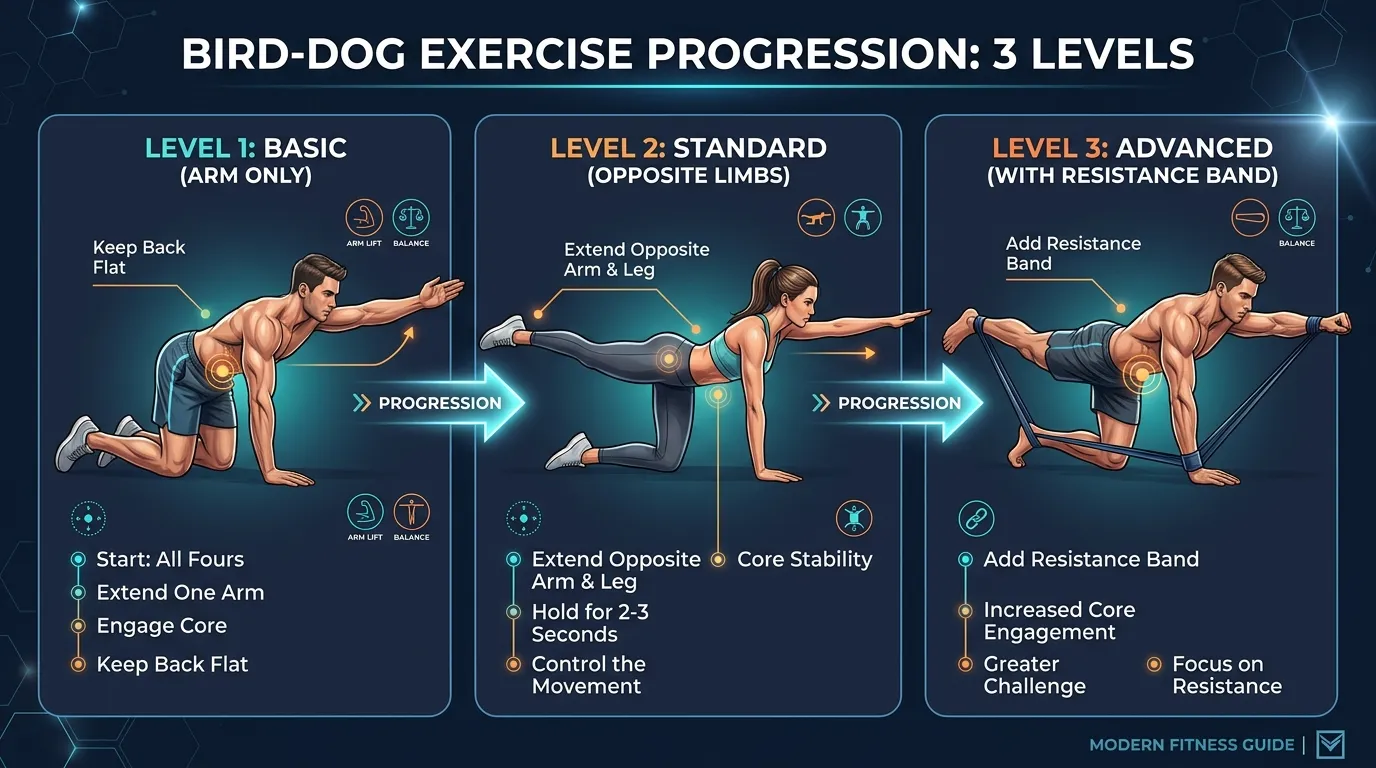
Level 1: Leg Only (Beginner Regression)
Extend only one leg at a time while both hands stay on the floor. This builds foundational glute and core strength with maximum stability. Use this as your starting point if you're new to the movement, working through back pain, or in the early postpartum window.
Level 2: Opposite Arm and Leg (Standard)
The classic McGill contralateral pattern. Extend the right arm and left leg simultaneously, then switch. This adds the full anti-rotation and coordination demands that make the bird-dog one of the "Big 3" spine-stability exercises.
Bird-Dog with Hold (Advanced)
Hold the extended position for 5 to 10 seconds per rep to increase isometric strength and stability endurance. This is the highest-yield core stimulus the movement offers and the version most often programmed in McGill's protocols.
Bird-Dog with Resistance Band (Advanced Loading)
Loop a light resistance band around the extending foot (held in the opposite hand) for added glute activation and a stronger anti-rotation challenge. The band pulls asymmetrically, which forces the deep core to work harder to keep the pelvis square.
Bird-Dog Crunch (Dynamic Progression)
From the extended Level 2 position, bring the opposite elbow and knee together under the torso, then re-extend. This adds a dynamic flexion-extension component and trains the rectus abdominis alongside the deep stabilizers.
When to Avoid or Modify Bird-Dogs
Bird-dogs are among the safest core exercises and are widely used in back-pain rehabilitation. Still, a few conditions warrant modification or surgeon clearance before starting. None of these are permanent restrictions. Always consult your physician or physical therapist for personalized guidance.
- Acute lower-back pain with radiating leg symptoms. If pain is sharp, radiates down the leg, or worsens with extension, see a physical therapist before starting. Disc-related symptoms sometimes flare with extension patterns. For non-acute, non-radiating back pain (the more common scenario), bird-dogs are usually a first-line exercise: start with Level 1 only and keep range short.
- Recent abdominal, spinal, or hip surgery. Get clearance from your surgeon. Most post-surgical protocols introduce quadruped work fairly early, but the specific timing depends on the procedure. Start with the quadruped hold (no limb extension) and progress to Level 1 once cleared.
- Active diastasis recti or first 6-8 weeks postpartum. Bird-dogs are usually one of the first core exercises reintroduced postpartum because the quadruped position takes pressure off the abdominal wall. Watch for coning or doming through the midline during the extension; if you see it, reduce range. Build deep-core function with deadbugs alongside Level 1 bird-dogs before progressing to Level 2.
- Wrist pain or carpal tunnel. The hands-and-knees position loads the wrists. Modify by placing the hands on push-up handles, light dumbbells held in a neutral grip, or on padded fists to keep the wrist neutral. If pain persists, drop to forearm position (forearms and knees on the floor) for the leg-only variation.
- Knee pain or recent knee surgery. The supporting knee bears bodyweight against a hard floor. Use a folded mat or thick towel under the knees. If pain continues, substitute with deadbugs, which train the same anti-rotation pattern in supine.
- Shoulder injury that limits arm extension overhead. The Level 2 arm reach can aggravate impingement or rotator-cuff irritation. Stay with Level 1 (leg only) until the shoulder tolerates the reach. Progress to Level 2 with the arm at chest height before reaching all the way to shoulder height.
Related Exercises
If bird-dogs are part of your routine, these movements complement or extend the same training pattern:
- Same plane (anti-rotation core): Deadbugs train the same deep-core stabilization pattern in supine instead of quadruped, and are the natural pairing in a "core foundations" block.
- Other "Big 3" stabilizers: Forearm Planks (anti-extension), Side Planks (anti-lateral-flexion), and Crunches or the curl-up complete the three core stabilization planes McGill identified.
- Dynamic progression: Bird-Dog Crunch adds flexion-extension dynamics on top of the anti-rotation pattern, useful once Level 2 holds feel easy.
- Glute foundation (often paired): Glute Bridges isolate the hip-extension pattern bird-dogs use on the extending leg, and pair well in core finishers and rehab programs.
- Posterior-chain endurance: Superman Holds work the erectors and glutes in prone, complementing the quadruped pattern of the bird-dog.
- Compound that demands strong core: Squats and Deadlifts rely on the spinal bracing pattern bird-dogs train, which is why bird-dogs are commonly programmed as a warm-up activation before heavy lower-body work.
How to Program Bird-Dogs
Bird-dog programming follows the same evidence-based ranges as any rep-based core exercise. The American College of Sports Medicine (ACSM) Position Stand on resistance training recommends moderate-rep sets with controlled tempo for muscular endurance and stability work, performed 2 to 4 times per week (Ratamess et al., 2009). McGill's protocols add a brief isometric hold at the top of each rep, which raises the stimulus per rep meaningfully.
| Level | Sets × Reps per side | Hold at top | Rest between sets | Frequency |
|---|---|---|---|---|
| Beginner (Level 1, leg only) | 2–3 × 8–12 | 1–2 seconds | 45–60 seconds | 2–4 sessions/week |
| Intermediate (Level 2, contralateral) | 3 × 10–15 | 3–5 seconds | 45–60 seconds | 3–5 sessions/week |
| Advanced (held reaches, band loading) | 3–4 × 8–12 | 5–10 seconds | 60 seconds | 4–6 sessions/week |
Where in your workout: bird-dogs work well in three places. As a warm-up activation (low-rep sets of Level 1 or 2) before a heavy lower-body session to wake up the deep core and glutes. As part of a "core day" or core finisher alongside deadbugs, forearm planks, and side planks. Or as a standalone daily rehab habit if you're working through lower-back pain, in which case McGill's protocol of 1 to 2 sets of low-rep holds done daily often outperforms higher-volume weekly programming.
Form floor over rep targets: if you can't keep your hips square and your back flat through the reach, the rep doesn't count. Stop the set when form breaks. Hitting 15 reps with a rotating pelvis is worse than hitting 8 perfectly square reps.
How FitCraft Programs This Exercise
Knowing how to do a bird-dog is step one. Knowing when to program it, which level fits your current ability, and how to dose it for warm-up versus core finisher versus rehab work is where most people get stuck.
FitCraft's AI coach Ty handles that. During your personalized diagnostic assessment, Ty maps your fitness level, goals, history of back issues, and available equipment. Then Ty slots bird-dogs into a balanced training plan at the right level (Level 1 if your core stability needs development, Level 2 once your anti-rotation strength is solid) and the right placement (warm-up activation, core finisher, or standalone stability work).
As your control improves, Ty adjusts the variation and volume to match your level. Level 1 progresses to Level 2. Brief 1-second holds extend to 5-second holds. Volume scales based on your consistency and recovery. Every program is designed by an Ivy League-trained exercise scientist and NSCA-certified strength coach using evidence-based periodization, then adapted to you by the AI.
Frequently Asked Questions
Can I do bird-dogs if I have lower-back pain?
Bird-dogs are one of the most widely recommended exercises for non-acute lower-back pain and prevention. Spine biomechanist Dr. Stuart McGill included the bird-dog in his "Big 3" exercises for spinal health because it builds the muscles that support the spine without loading the vertebrae in flexion. Start with Level 1 (leg-only extension) if you have active pain, keep range limited to where you can maintain a flat back, and progress to Level 2 only when the leg-only version is pain-free. If pain is acute, sharp, or radiates down the leg, see a physical therapist before starting.
What muscles do bird-dogs work?
Bird-dogs primarily target the erector spinae (lower back), gluteus maximus, and deep core stabilizers including the transverse abdominis and multifidus. The Level 2 contralateral variation also engages the posterior deltoids, mid-trapezius, and rhomboids as the arm extends. The defining stimulus is anti-rotation: the deep core works isometrically to prevent the torso from twisting while opposite limbs reach away from each other.
How many bird-dogs should I do?
A good starting point is 8 to 12 reps per side for 2 to 3 sets at the beginner level, holding the extended position for 1 to 2 seconds at the top of each rep. Intermediates work in the 10 to 15 reps per side range across 3 sets with 5-second holds. Quality and control matter far more than rep count: a slow, perfectly aligned rep with a brief hold builds more spinal stability than five rushed reps.
Are bird-dogs better than planks?
They train different qualities and pair well rather than compete. Planks build isometric anti-extension strength (the core's ability to resist the spine arching backward). Bird-dogs build anti-rotation strength (the core's ability to resist the torso twisting). Both belong in a balanced core program. McGill's "Big 3" includes the curl-up, side plank, and bird-dog precisely because they cover the three primary stabilization patterns the spine needs.
Can I do bird-dogs while pregnant or postpartum?
Bird-dogs are one of the safest and most-recommended core exercises during pregnancy and the early postpartum window. The quadruped position takes pressure off the abdominal wall and avoids supine positions that can compress the vena cava in later pregnancy. During pregnancy, reduce range of motion as the bump grows and stop if you feel coning or doming through the midline. Postpartum, bird-dogs are usually a first-line exercise after the initial healing window to rebuild deep-core function before progressing to crunches or higher-flexion movements. Get clearance from your provider, especially after a C-section, and consult a pelvic-floor physical therapist if you have diastasis recti or pelvic-floor symptoms.