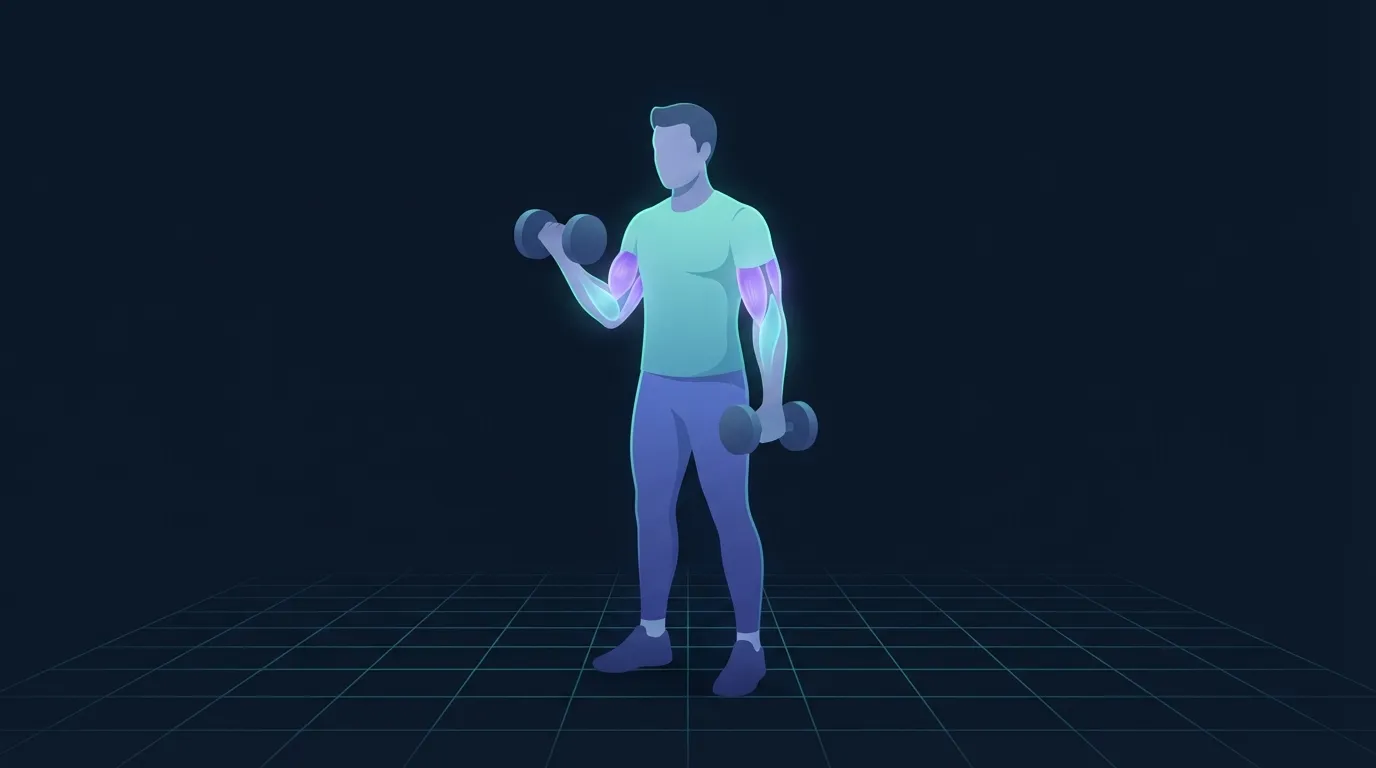
Arm training is the easiest part of a program to do a lot of and the easiest part to do badly. Almost nobody skips curls. What most home lifters skip is the half of the elbow's range where the muscle is long, and that is the half the research keeps pointing at.
The session below is built backwards from two trials that trained one of a person's arms one way and the other arm the other way, so the comparison is about as clean as exercise science gets. It puts the stretched positions first, while you're fresh, and treats the shortened-position work as accessory. It also gives you a weekly set number that comes from a study on elbow flexors specifically, rather than from a general hypertrophy meta-analysis that pooled quads, pecs and arms together.
Five Muscles Cross the Elbow, and Three of Them Set Arm Size
Three muscles bend the elbow. The biceps brachii is the one everybody trains, and it has two heads: the long head, whose tendon runs up over the shoulder joint and attaches to the top of the socket, and the short head, which attaches lower on the shoulder blade. Because the long head crosses the shoulder, its length depends on where your upper arm is, which is the entire reason an incline curl feels different from a standing curl. The brachialis sits underneath the biceps, attaching from the upper arm bone to the ulna, and it does not cross the shoulder at all. When the brachialis grows, it lifts the biceps from below, which is where arm width seen from the side comes from. The brachioradialis runs from the upper arm to the thumb-side forearm bone and takes over as the grip rotates toward neutral, which is why a hammer curl feels like a forearm movement as much as a biceps one.
One muscle straightens the elbow, and it's the bigger half of the arm. The triceps brachii makes up roughly two thirds of the cross-sectional area of the upper arm, so a person chasing sleeve size who only curls is working on the smaller piece. Its long head crosses the shoulder joint the same way the biceps long head does, which means it only reaches full length when the upper arm is raised overhead. The lateral head gives the arm its outer sweep and the medial head sits underneath doing quiet work on every rep. Neither of those two cares where your shoulder is. That anatomy is the whole map: two of the five muscles change length with shoulder position, and those two are the ones most home programs never stretch.
Where the Arm Sits When You Load It Changes How Much It Grows
Sato and colleagues (2021) used a within-person design on the elbow flexors: participants trained one arm through a range where the elbow stayed relatively straight, keeping the flexors long, and the other arm through a range where the elbow stayed bent and the muscles short. Total work was matched. After the training block, the arm that had worked in the stretched range showed greater gains in both muscle thickness and strength, and the effect showed up in the untrained arm too through cross-education. Same dumbbell, same sets, different joint angles, different result.
Maeo and colleagues (2023) did the equivalent experiment on the other side of the arm. Participants trained elbow extensions with one arm in the overhead position, where the long head of the triceps is stretched, and the other arm in the neutral position with the upper arm at the side. Twelve weeks later the overhead-trained side had gained substantially more triceps size, on the order of 1.4 times the growth of the neutral side, with the long head accounting for most of the difference. This is the study that should reorder most people's triceps work. If your entire triceps volume is pressdowns and kickbacks, you have been training the long head in its shortest position and wondering why the back of the arm looks flat.
The practical translation is simple. Put the incline curl and the overhead extension first in the session, while you have the most to give them, and let the standing curl and the lying extension be the accessories. That is the opposite of how most arm days are written, and it's the single biggest change on this page.
The 30-Minute Dumbbell Arm Workout
Four exercises ordered by joint angle rather than by tradition: stretched positions first, shortened positions after. Plan on 30 to 40 minutes door to door, twice a week. Loads are written for a general trainee, so treat every number as a starting point and adjust to your own two-reps-in-reserve.
Warm-up (4 minutes)
- 1 minute of easy cardio, enough to warm the hands and shoulders
- 15 slow elbow circles, then 15 wrist rotations in each direction
- 1 set of 12 very light curls and 12 very light extensions, moving through the full range you're about to load
- 1 ramp-up set of the incline curl at roughly half your working load
A) Incline Dumbbell Curl: 4 sets of 8 to 12 reps
Set an adjustable bench to roughly 60 degrees and sit back against it so your arms hang straight down beside the pad. The shoulder is now behind the torso, which is what pre-stretches the long head of the biceps. Curl without letting the elbow travel forward, because the moment the elbow drifts, the shoulder takes over and the stretch you set up disappears. Lower on a slow three-count all the way to a straight arm; this is the part of the rep the Sato data says is paying you. Expect to handle 60 to 70 percent of your standing curl load here. No incline bench? Kneel behind a flat bench with your working arm hanging off the far edge and the elbow above shoulder height, and curl from there. See our dumbbell bicep curl exercise page for the muscles worked and common form errors.
B) Overhead Triceps Extension: 4 sets of 8 to 12 reps
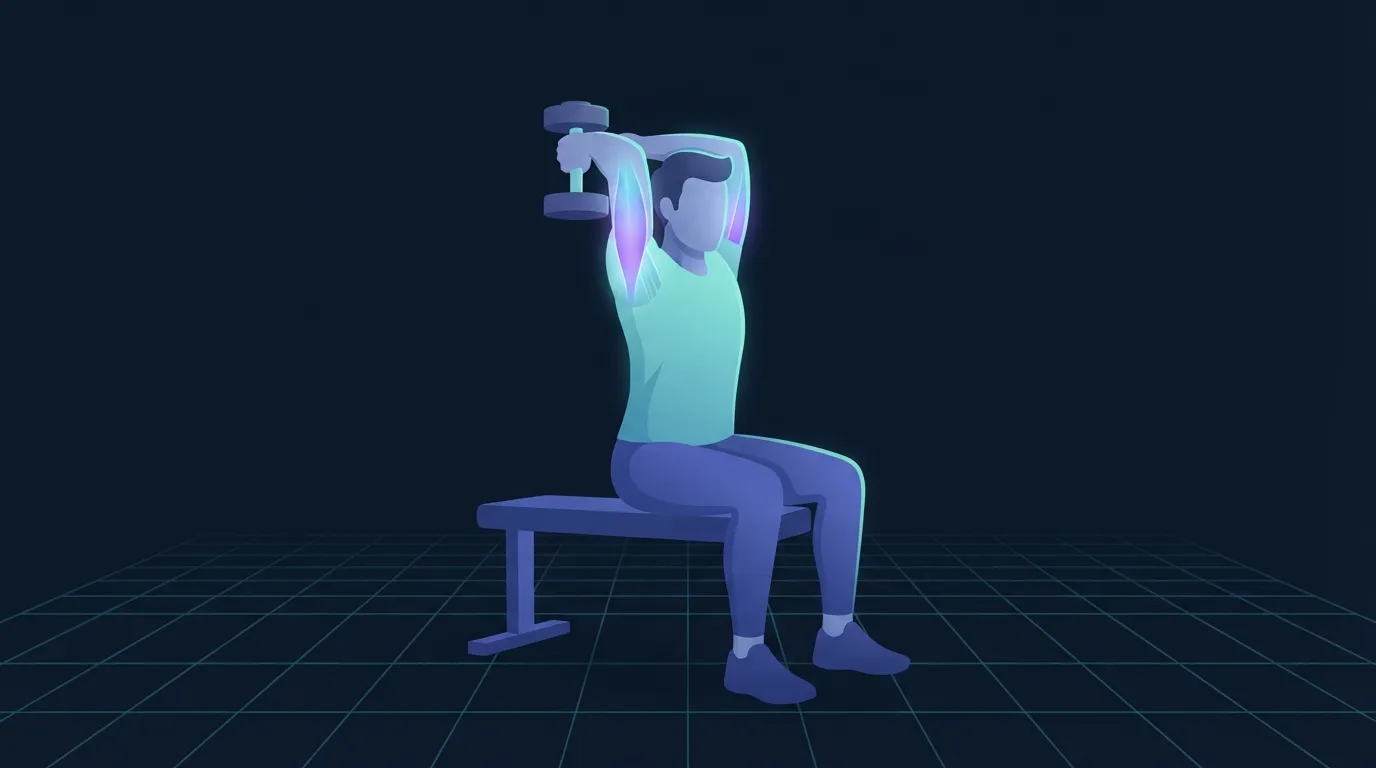
One dumbbell held vertically with both palms cupping the top plate, pressed to arms' length above your head. Sit with your back supported if standing makes you arch. Bend at the elbows and lower the dumbbell behind your head until you feel a hard stretch through the back of the arms, keeping the upper arms pointing at the ceiling instead of drifting forward. Press back to lockout. This is the overhead position from the Maeo trial, so it deserves your freshest sets, not the last four minutes of the session. See our overhead triceps press exercise page for setup cues and how to protect the elbows as the load climbs.
C) Standing or Hammer Curl: 3 sets of 10 to 15 reps
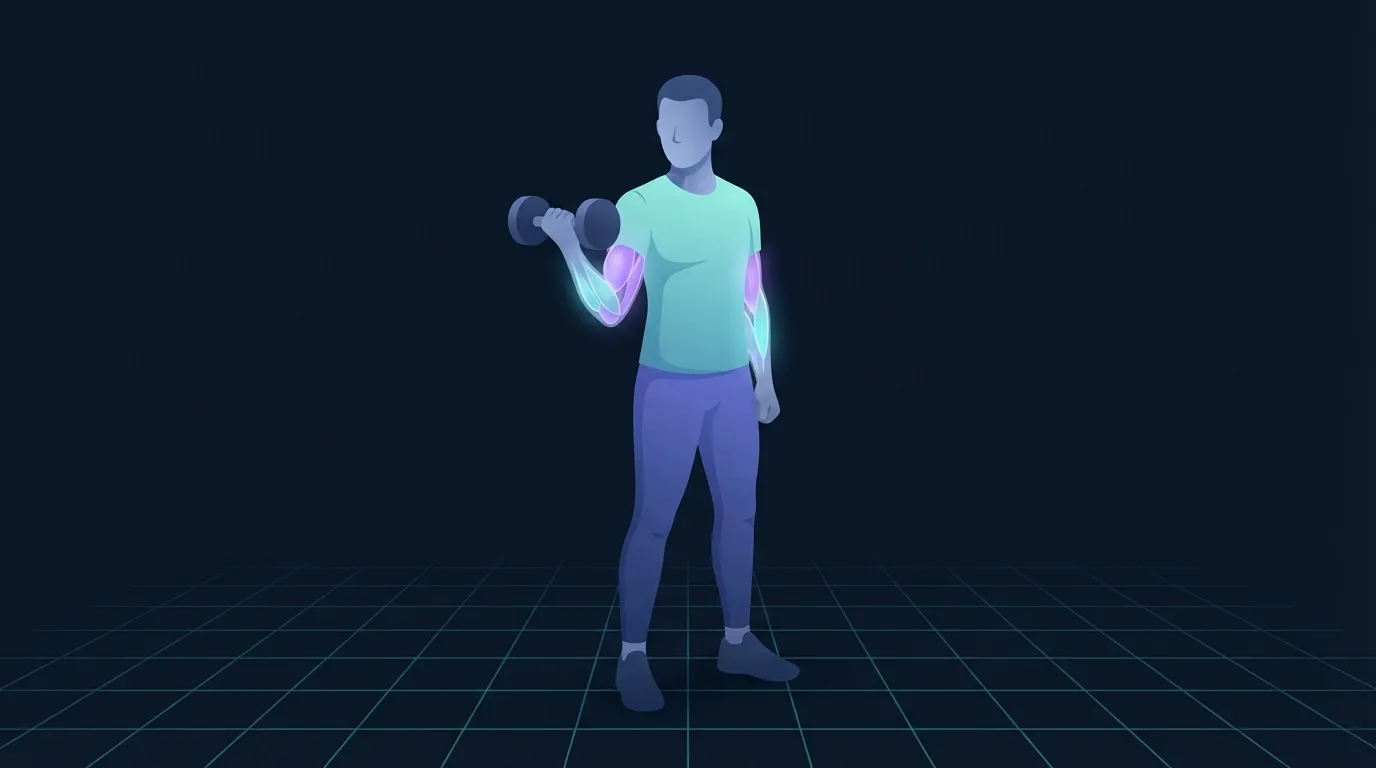
With the arm vertical, the biceps is at a mechanical advantage, so this is where the heaviest loads live. Stand tall, elbows pinned to the ribs, and curl without letting the hips contribute. Alternate blocks: run supinated curls for a month, then run hammer curls for a month. The neutral grip shifts work onto the brachialis and brachioradialis, and those two are what fill the gap between the biceps and the triceps when you look at the arm from the side. See our hammer curl exercise page for the grip detail.
Find out what's really holding you back
FitCraft, our mobile fitness app, pairs you with an AI coach who builds you a personalized plan around your goals, schedule, and fitness level. Every FitCraft program is designed by Domenic Angelino, MPH (Brown University) and NSCA-CSCS, with research published in the Journal of Strength and Conditioning Research and Medicine & Science in Sports & Exercise.
Take the Free Assessment Free • 2 minutes • No credit cardD) Lying Dumbbell Extension or Tate Press: 3 sets of 10 to 15 reps
Lying on a bench with the upper arms vertical, the long head is no longer stretched, which is exactly the point: this slot exists to load the lateral and medial heads, which grow from any hard extension regardless of shoulder position. Lower the dumbbells toward the sides of your head, keep the upper arms still, and press back. If the elbows object, switch to a tate press, where the dumbbells travel in an arc toward the outside of the chest, or a close-grip floor press. Both change the elbow track without changing the target. See our dumbbell triceps extension exercise page for the form cues.
How Much Weekly Curl and Extension Volume Actually Helps
Most volume advice for arms is borrowed from studies that measured the quadriceps. There is a better source. Heaselgrave and colleagues (2019) assigned trained men to 9, 18 or 27 weekly sets for the elbow flexors and tracked muscle thickness and strength over six weeks. Eighteen sets produced the largest increase in muscle thickness. Nine produced a bit less. Twenty-seven produced no more than nine did, which is the interesting part: the top group did three times the work of the bottom group for the same result. Arms are not a muscle group where more is automatically better.
Pair that with the general dose-response picture from Schoenfeld, Ogborn and Krieger (2017), who pooled 15 studies and found growth continuing up to at least 10 weekly sets per muscle, and the window for arms sits somewhere between 12 and 18 hard sets per week for the biceps and the same for the triceps. Start at 12, add two sets a week only while your loads are still climbing, and stop adding the moment they stall. The two-day template further down lands at 14 per muscle, which is a deliberate middle.
One nuance on how you count. A set only belongs in that total if it finished within a couple of reps of failure. Schoenfeld and colleagues (2017) meta-analysed 21 trials of low-load versus high-load training and found comparable hypertrophy when sets were taken close to failure, which is good news for arm work because it means a clean set of 15 counts the same as a heavy set of 7. It also means a comfortable set of 12 that you walked away from with five in the tank does not count at all.
How Often to Train Arms
Schoenfeld, Grgic and Krieger (2019) pooled 25 studies and found that training a muscle twice a week beat training it once when weekly sets were equated, with no further benefit past three sessions. For arms the practical case for twice is stronger than the meta-analysis alone suggests, because 14 sets crammed into one session is a long, low-quality hour where the last four sets are done with a tired grip. Splitting the same 14 sets across two days keeps every set sharp.
Leave 48 to 72 hours between the two. Elbow flexor soreness after a heavy stretched-position session is real and it peaks about a day and a half later, so back-to-back arm days will cost you load on the second one. If you train four days a week, arms fit naturally after a lower-body day when your upper body is fresh.
Counting the Curl and Press Work You Already Do
Arms are the only muscle group that gets trained whether you plan it or not. Every row and pulldown asks the elbow flexors to work hard; every push-up, bench press and overhead press asks the triceps to finish the rep. That indirect work is real, and ignoring it is the most common way people end up at 27 sets without meaning to.
Count it at roughly half value. Three hard sets of dumbbell rows contribute something like one and a half sets to your weekly biceps total, and four sets of pressing contribute about two to the triceps. If you already run a dumbbell chest workout and a dumbbell shoulder workout each week, that is roughly five indirect triceps sets before you touch an extension, which is why the triceps half of your dedicated arm day can be a little leaner than the biceps half without anything being lost. Lifters who spend most of their week on pulling patterns have the opposite problem and should bias the other way.
Elbow Pain Is the Limiter, Not Recovery
The thing that ends most arm specialization blocks is not fatigue. It is a sore tendon on the inside or outside of the elbow that turns every curl into a negotiation. Cook and Purdam (2009) described tendon pain as a continuum rather than an on-off injury: the first stage is a reactive response to a sudden, unaccustomed jump in load, which is reversible in days to weeks if the load comes back down, and which turns into something slower to fix if you keep pushing through it. Their model is why the volume ramp above is two sets a week rather than doubling your curls because a video told you arms can take it.
Three practical rules follow from it. Raise weekly arm sets gradually rather than in jumps. When a movement hurts in a specific spot, change the elbow track rather than resting completely; a tate press instead of a skull crusher, or a hammer curl instead of a supinated curl, usually lets you keep training while the irritated tissue calms down. And treat the last rep of each set as a form checkpoint: a rep you have to heave is a rep the tendon absorbs. Pain that is still there after two weeks of sensible loading has stopped being a programming question and is worth a clinician's opinion.
Rest, Progression and Mistakes: Take Them From the Chest Session
Rest. Grgic and colleagues (2018) reviewed rest-interval studies and found strength gains suffer below 60 seconds and level off somewhere past 90. Because none of these four movements is systemically taxing, 60 to 90 seconds is plenty, and you can pair a curl with an extension back to back and rest 90 seconds after the pair. The full treatment of set counts, rep ranges and rest is on the dumbbell chest workout page, which is the anchor page for this cluster.
Progression. Hold sets and reps steady and let load be the variable: when you complete every working set at the top of its rep range with two reps still in reserve, across two sessions in a row, go up. On arm work that jump is usually 2.5 pounds per hand rather than 5, because a 5-pound jump on a 20-pound curl is a 25 percent increase and your elbow notices. The chest guide walks through the same two-reps-in-reserve rule in more detail.
Mistakes. The arm-specific ones are short: letting the elbow drift forward on the incline curl, which cancels the stretch you set the bench up to create; swinging the standing curl from the hips; and putting all your triceps volume in shortened positions. The general errors that apply to every dumbbell session, like chasing failure on every set or skipping the second weekly session, are covered on the chest page. If what actually bothers you is softness rather than size, our guide to losing arm fat covers the diet side, because spot reduction is not a thing and body-fat percentage is the variable that decides what the arm looks like.
Splitting Arm Volume Across Two Days
Fourteen hard sets per muscle per week, arranged so the stretched-position work gets a heavy day and a moderate day rather than being buried at the end of a session. Written the way it would appear in a training log:
| Day | Position emphasis | Structure |
|---|---|---|
| Arm day 1 (heavier) | Stretched positions loaded | Incline curl 4×8-10 · Overhead extension 4×8-10 · Standing curl 3×10-12 · Tate press 3×10-12 |
| Arm day 2 (higher rep) | Shortened positions and grip variation | Hammer curl 4×12-15 · Lying extension 4×12-15 · Incline curl 3×12-15 · Overhead extension 3×12-15 |
That is 14 sets on the elbow flexors and 14 on the triceps, which sits between the 9 and 18 that came out best in the Heaselgrave comparison and leaves you headroom to add two sets when progress stalls. Add your indirect work from pressing and pulling days on top and most people are in the right zone without doing anything clever.
What Actually Grows Arms
Position first, volume second, patience third. Load the biceps with the shoulder behind the torso and the triceps with the arm overhead, because those are the two positions where the within-person trials found a real difference. Keep weekly hard sets in the low-to-mid teens per muscle rather than chasing a number you saw online. Add 2.5 pounds when you own the rep range, and protect the elbows by raising volume in small steps instead of jumps.
The rest of it is turning up twice a week for three months, which is where most arm plans actually fail. If that is your sticking point rather than exercise selection, our comparison of the best dumbbell workout apps looks at how the leading options handle programming and adherence for people training at home with one pair of adjustable dumbbells.
Frequently Asked Questions About Arm Training
Can you build big arms with just dumbbells?
Yes, and the elbow is the one joint where dumbbells give up almost nothing. The two positions that matter most for arm growth both need a free weight: a curl with the shoulder behind the torso, and an extension with the upper arm overhead. Sato and colleagues (2021) had people curl one arm through a stretched elbow range and the other through a shortened one, and the stretched arm gained more strength and more muscle thickness from identical work. Maeo and colleagues (2023) ran the equivalent study on the triceps and found the overhead position produced roughly 1.4 times the growth of the same sets done with the upper arm at the side. An adjustable bench and one pair of dumbbells put you in both positions.
How many sets per week do biceps and triceps need?
Somewhere between 12 and 18 hard sets per week for each, split over two days. Heaselgrave and colleagues (2019) put trained men on 9, 18 or 27 weekly sets for the elbow flexors for six weeks and measured muscle thickness: 18 sets produced the largest gain, 9 produced slightly less, and 27 produced no more than 9. That is the clearest arm-specific volume data available, and it argues for a middle number rather than piling on curls. Start at 12 sets per muscle per week, add two sets a week only while you're still adding load, and back off if the elbows start complaining before the muscle does.
How often should I train arms with dumbbells?
Two arm sessions a week, 48 to 72 hours apart, and then let pressing and pulling days do the rest. Schoenfeld, Grgic and Krieger (2019) pooled 25 studies and found twice-weekly training beat once-weekly when weekly sets were matched, with no extra benefit past three sessions. The arms are unusual because they also get loaded on every row, pulldown, push-up and overhead press you do, so a dedicated arm day plus a short curl-and-extension block appended to one upper-body session is usually enough to reach the weekly set target.
What are the best dumbbell exercises for biceps?
Lead with the incline dumbbell curl. Sitting back on a bench set to roughly 60 degrees puts the shoulder behind the torso, which lengthens the long head of the biceps before the rep even starts, and that stretched position is where the strongest growth signal sits. Follow it with a standing curl for heavier loading with the arm vertical, and a hammer curl for the brachialis, the muscle underneath the biceps whose growth pushes the biceps up and adds width when you look at the arm from the side. Three patterns, all with one pair of dumbbells.
What are the best dumbbell exercises for triceps?
An overhead extension first, then a horizontal extension. The long head of the triceps crosses the shoulder, so it only reaches full length when the upper arm is overhead, and Maeo and colleagues (2023) measured substantially more triceps growth from overhead work than from identical sets with the arm at the side. Lying dumbbell extensions, tate presses and close-grip floor presses then cover the lateral and medial heads, which don't care about shoulder position. A kickback is a fine finisher and a poor main lift, because the load peaks where the muscle is shortest.
Why do my elbows hurt after curls and extensions?
Usually a volume spike rather than a form error. Cook and Purdam (2009) described tendon pain as a continuum that starts with a reactive response to a sudden increase in load, which is exactly what happens when someone adds three curl and extension exercises in one week. Raise weekly arm sets by about two at a time, keep the last rep of each set clean instead of grinding, and swap the movement that hurts for one with a different elbow track: tate press or close-grip floor press instead of a skull crusher, hammer curl instead of a supinated curl. Pain that persists past two weeks of sensible loading is worth a clinician's eyes rather than another deload.