If you've been chasing bigger arms with curls alone, you're skipping the muscle on the back of your arm. The triceps straighten your elbow, and the overhead tricep press trains them through a long stretch with nothing more than two light dumbbells and a mat.
What makes the overhead version different is the stretch. When your arms are overhead, the long head of the triceps, the one part of the muscle that crosses the shoulder, is lengthened, so it is stretched at the bottom of each rep. The Muscles Worked section below explains what one study found about training elbow extensions in this position.
The triceps also straighten your elbow in everyday tasks, like lifting a bag into an overhead bin or pushing yourself up from the floor.
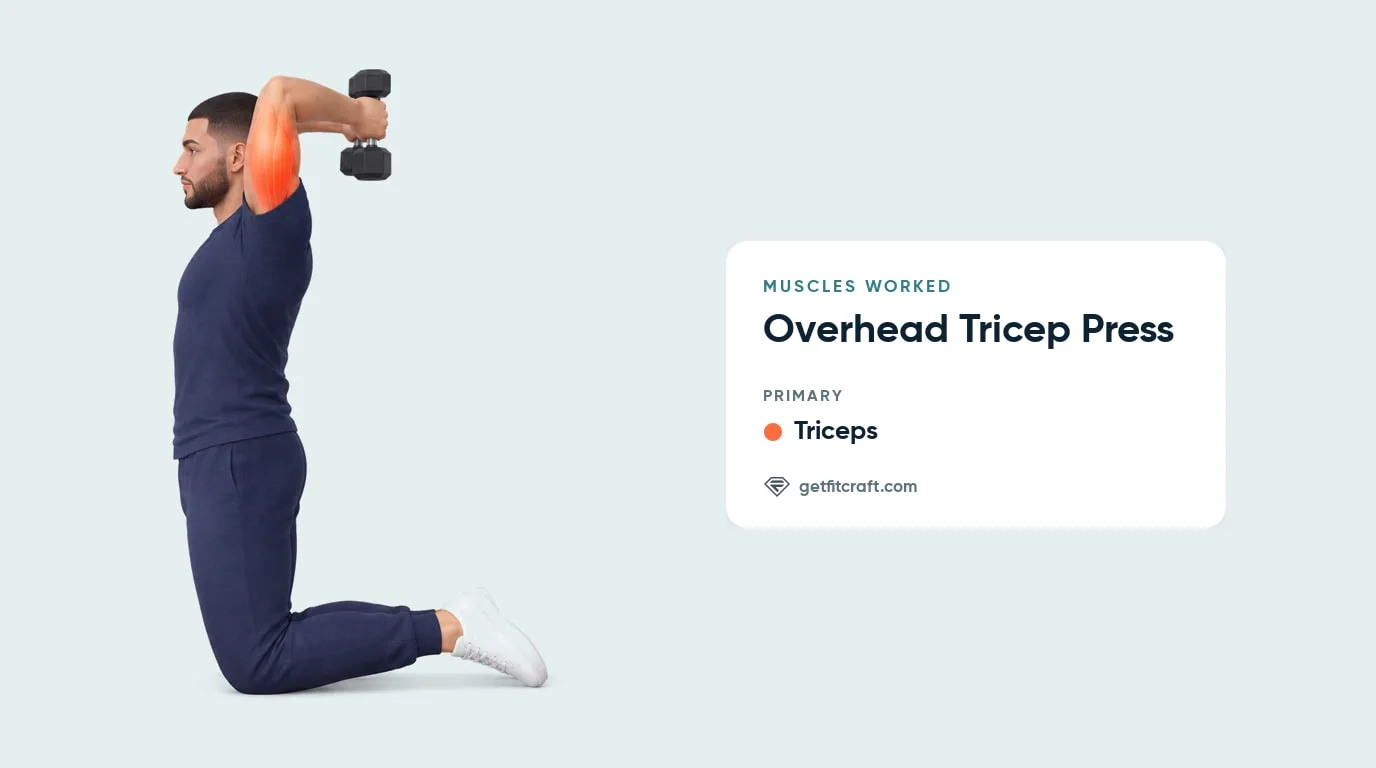
Muscles Worked
Primary mover. The triceps, on the back of the upper arm, drive every rep. They straighten your elbows to press the dumbbells back overhead and control them as they lower behind your head. The long head is the one part of the triceps that crosses the shoulder, so with your arms overhead it is stretched at the bottom of each rep. The overhead tricep press is an isolation exercise: the triceps are the one muscle it trains.
Evidence. In a 12-week study of 21 adults, Maeo et al. (2023) trained one arm with cable elbow extensions overhead and the other with the arm down at the side, and the overhead arm gained substantially more triceps muscle. The study used a cable machine, not dumbbells, so it speaks to the overhead arm position rather than to this exact exercise.
Quick Facts: Overhead Tricep Press
- Equipment needed: A pair of light dumbbells, plus a mat or folded towel for your knees
- Difficulty: Beginner in the FitCraft app (heavier dumbbells or a slower lowering make it harder)
- Modality: Strength
- Body region: Upper body (backs of the upper arms)
How to Do the Overhead Tricep Press (Step-by-Step)
- Kneel tall with the dumbbells overhead. Kneel tall on both knees on a mat, shins on the floor behind you, hips straight over your knees and torso upright, with your abs braced and your ribs down. Hold a dumbbell in each hand with your palms facing each other and press them straight up overhead. Your upper arms sit close beside your head, elbows pointing forward about shoulder-width apart, not out to the sides, with the dumbbells close together above your head.
Form tip: kneel on a mat or a folded towel to cushion your knees.
- Lower the dumbbells behind your head. Keeping your upper arms mostly still, bend your elbows to lower the dumbbells slowly behind your head until your elbows are bent about 90 degrees and your forearms are about level with the floor, or only as far as your upper arms stay still and your shoulders feel comfortable. You should feel a stretch in the backs of your upper arms.
Form tip: never let the dumbbells touch your head or neck.
- Press back up. Straighten your elbows to press the dumbbells back up until your arms are straight or nearly straight, without snapping into lockout, the dumbbells close together above your head and your elbows still pointing forward. Your upper arms should stay mostly still during the rep. If they swing forward and back, the rep turns into a press: use lighter dumbbells.
- Control the descent and repeat. Lower slowly, over about a second or two, with no bouncing at the bottom. Keep your abs braced and your ribs down so your lower back does not arch. Breathe in as you lower and out as you press.
Form tip: if your lower back still arches, use lighter dumbbells or sit on a bench with back support.
Common Mistakes to Avoid
The overhead tricep press is a simple movement, but a few errors turn it into a less effective or riskier exercise:
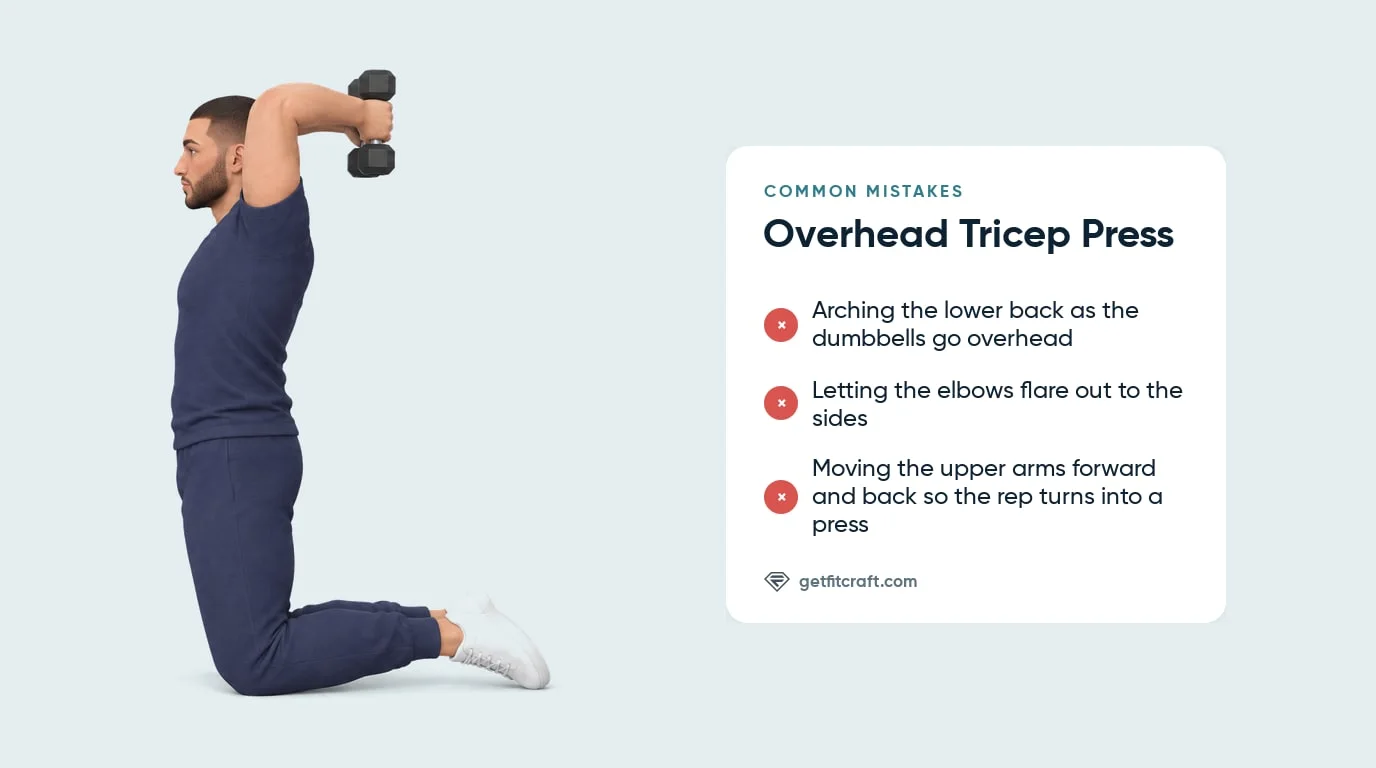
- Flaring the elbows outward. When your elbows drift wide, they point out to the sides instead of forward. Fix: keep your upper arms close beside your head with your elbows pointing forward, about shoulder-width apart; a little wider is fine if it is more comfortable. If they keep flaring, the dumbbells are too heavy.
- Moving the upper arms. Swinging the upper arms forward and back turns the rep into a press. Fix: film yourself from the side. Your upper arms should stay close to your head and mostly still through every rep.
- Arching the lower back. This usually means the dumbbells are too heavy. Fix: brace your abs and keep your ribs down, use lighter dumbbells, or sit on a bench with back support.
- Bouncing or dropping into the bottom. Fix: lower slowly and press back up smoothly. No bouncing.
- Lowering too far. If your upper arms drift back or the dumbbells hit your head, you have gone too deep. Fix: stop when your elbows are bent about 90 degrees and your forearms are about level with the floor.
- Stopping short at the top. Fix: press until your arms are straight or nearly straight overhead, without snapping your elbows.
- Going too heavy too soon. Pick dumbbells you can lower slowly behind your head without your elbows flaring or your back arching. If the last rep looks like the first, the weight is right.
Get this exercise in a personalized workout
FitCraft, our mobile fitness app, uses its AI coach Ty to program isolation exercises like this into your plan at the right volume and intensity, based on your level, goals, and equipment. Ty was designed and trained by Domenic Angelino, MPH (Brown University) and NSCA-CSCS, with research published in the Journal of Strength and Conditioning Research and Medicine & Science in Sports & Exercise.
Take the Free Assessment Free · 2 minutes · No credit card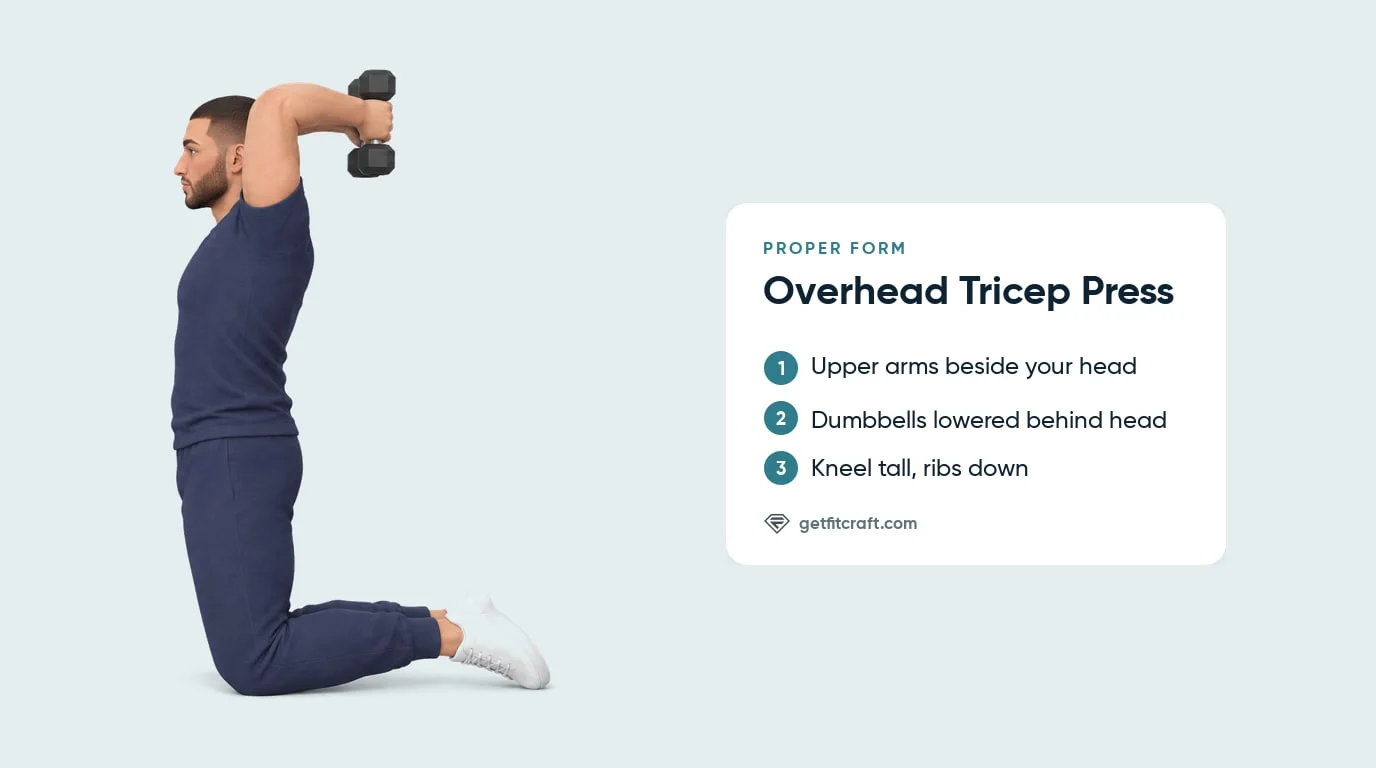
Variations: Kneeling, Seated, Standing and Single-Arm
Tall-Kneeling Overhead Tricep Press (Beginner in the FitCraft App)
The version described in the step-by-step above: kneeling tall on a mat with a dumbbell in each hand, palms facing each other. It is the one the FitCraft app teaches and rates Beginner.
Seated Overhead Tricep Press (Easier)
Sit on a bench or sturdy chair with back support and perform the same movement. The back support helps keep your lower back from arching, so start here if your back arches when you kneel. Lighter dumbbells, or stopping before your elbows reach a right angle, also make the exercise easier.
Standing Overhead Tricep Press
Stand with your feet in a split stance, one foot a little ahead of the other, brace your abs, and perform the same movement. Keep your ribs down so your lower back does not arch.
One Dumbbell in Both Hands
Hold one dumbbell in both hands, cupping the top weight with your palms, and lower it behind your head the same way. Keep your elbows pointing forward rather than out.
Single-Arm Overhead Tricep Press
Hold a dumbbell in one hand, press it overhead, and perform the same lowering and pressing motion one arm at a time, keeping your upper arm pointing up beside your head. Then switch sides.
Harder Options
Use heavier dumbbells only as long as you control them behind your head, or lower more slowly, over about three seconds, with your upper arms still. Skull crushers, done lying on the floor and rated Intermediate in the FitCraft app, are a harder triceps exercise to move on to.
When to Avoid or Modify Overhead Tricep Press
The overhead tricep press is safe for most healthy adults. A stretch or burn in the backs of your arms is normal; any pain in your elbows, shoulders, wrists, knees, lower back or neck means stop. Always consult a qualified healthcare provider or physical therapist before starting or returning to any exercise program, especially if any of the conditions below apply to you.
- Active shoulder pain, impingement, or rotator cuff issues. Holding the weights overhead can bother an irritated shoulder. Have it assessed by a physician or physical therapist before any overhead exercise, and ask them which triceps exercises are safe for you and when to return. Any shoulder pain during a set means stop.
- Elbow tendinopathy or recent elbow strain. The stretch at the bottom of every rep loads the triceps tendon at the elbow. Have it assessed by a physician or physical therapist before you do this exercise, and ask them when and how to return. Any elbow pain during a set means stop right away.
- Lower back pain or recent disc injury. Any lower-back pain during a set means stop. Have it checked by a physician or physical therapist before you do this exercise, and ask them when and how to return.
- Knee pain. The FitCraft app's version is done kneeling. Have your knee checked by a physician or physical therapist before you kneel for this exercise, and ask them when and how to return. Any knee pain during a set means stop.
- Limited shoulder mobility (cannot reach arms fully overhead without arching). If you can't get your arms overhead with your ribs down and no arch in your lower back, use the seated version with back support and stop the dumbbells a little higher, before your elbows reach a right angle. Any shoulder pain means stop and have it checked by a physician or physical therapist.
- Pregnancy, especially second and third trimester. Get cleared by your doctor or a physical therapist before overhead dumbbell work, and follow their guidance on whether and how to do it.
- Recent shoulder or elbow surgery. Get clearance from your surgeon before any overhead or loaded arm work, and ask them or your physical therapist when and how to return.
Related Exercises
- Same target muscle (lying down): Skull crushers, a lying triceps exercise that lowers the dumbbells toward your forehead.
- Same target muscle (standing): Tricep extensions, a band pushdown with your elbows at your sides.
- Same target muscle (bent forward): Tricep kickbacks (a bent-forward dumbbell triceps exercise; a complement to overhead work, not a substitute).
- Compound that includes the triceps: Close-grip push-ups, diamond push-ups, bench dips, and chest press all involve elbow extension under load.
- Antagonist isolation: Pair tricep work with biceps isolation like bicep curls or hammer curls for balanced arm development.
- Vertical pressing partner: Shoulder press shares the overhead arm position and trains the shoulders.
- Practice for a still lower back: Deadbugs and bird-dogs are floor exercises that practice holding your lower back still while your arms or legs move.
How to Program Overhead Tricep Press
Programming guidance follows the ACSM Position Stand on Resistance Training (Ratamess et al., 2009), adapted to single-joint isolation work for the triceps.
| Training status | Sets × Reps | Rest between sets | Frequency |
|---|---|---|---|
| New to strength training (the app's Beginner version, light dumbbells) | 2-3 × 10-15 | 45-60s | 2 sessions/week |
| Some training experience | 3-4 × 8-15 | 60-90s | 2-3 sessions/week |
| Experienced (heavier dumbbells or a slower lowering) | 3-4 × 6-15 (intensity-dependent) | 60-120s | 2-4 sessions/week |
Where in your workout. Place overhead tricep press late in the session, after your main compound pressing work like push-ups, chest press, or shoulder press. Isolation work is an accessory. If you put it first, your triceps may tire before the bigger lifts that need them. A common pairing is supersetting overhead tricep press with biceps isolation like hammer curls for efficient arm training.
Good form matters more than rep targets. If your elbows start flaring, your back starts arching, or you can't lower the dumbbells slowly, end the set.
In the FitCraft app, the overhead tricep press is done kneeling tall with a dumbbell in each hand and is rated Beginner, with a 3D demonstration.
Frequently Asked Questions
Can I do overhead tricep press with shoulder pain or impingement?
Not without a clinician's go-ahead. Holding the weights overhead can bother an irritated shoulder, and any shoulder pain during a set means stop. Have your shoulder checked by a doctor or physical therapist, and ask them which triceps exercises are safe for you and when you can return to overhead work.
What is the difference between overhead tricep press and tricep extension?
An overhead tricep extension is another name for the same exercise: you hold the weight overhead and bend your elbows to lower it behind your head. "Tricep extension" on its own covers any exercise that straightens the elbow against resistance, such as the band pushdown, where your elbows stay at your sides.
Is the overhead tricep press good for beginners?
Yes. The FitCraft app rates the overhead tricep press Beginner. Start with light dumbbells, one in each hand, kneeling tall on a mat. If your lower back arches, sit on a bench or sturdy chair with back support instead. Keep your upper arms beside your head with your elbows pointing forward, and lower slowly.
What muscles does the overhead tricep press work?
The overhead tricep press works the triceps, the muscle on the back of the upper arm. The triceps straighten your elbows to press the dumbbells back overhead and control them as they lower behind your head. With your arms overhead, the long head, the one part of the triceps that crosses the shoulder, is stretched at the bottom of each rep. It is an isolation exercise: the triceps are the one muscle it trains.
How heavy should I go on overhead tricep press?
Lighter than you might expect. Use dumbbells you can control behind your head: if your elbows flare out, your lower back arches, or you can't lower slowly, over about a second or two, the weight is too heavy. Start light and add weight only while you keep full control.
Can I do overhead tricep press every day?
Not recommended. Two or three sessions a week, with at least a day of rest between them, suits most people; experienced lifters may use up to four, as the programming table on this page shows. That table follows the ACSM's resistance training guidelines. Your triceps also work in pressing exercises like push-ups, shoulder press, and chest press.