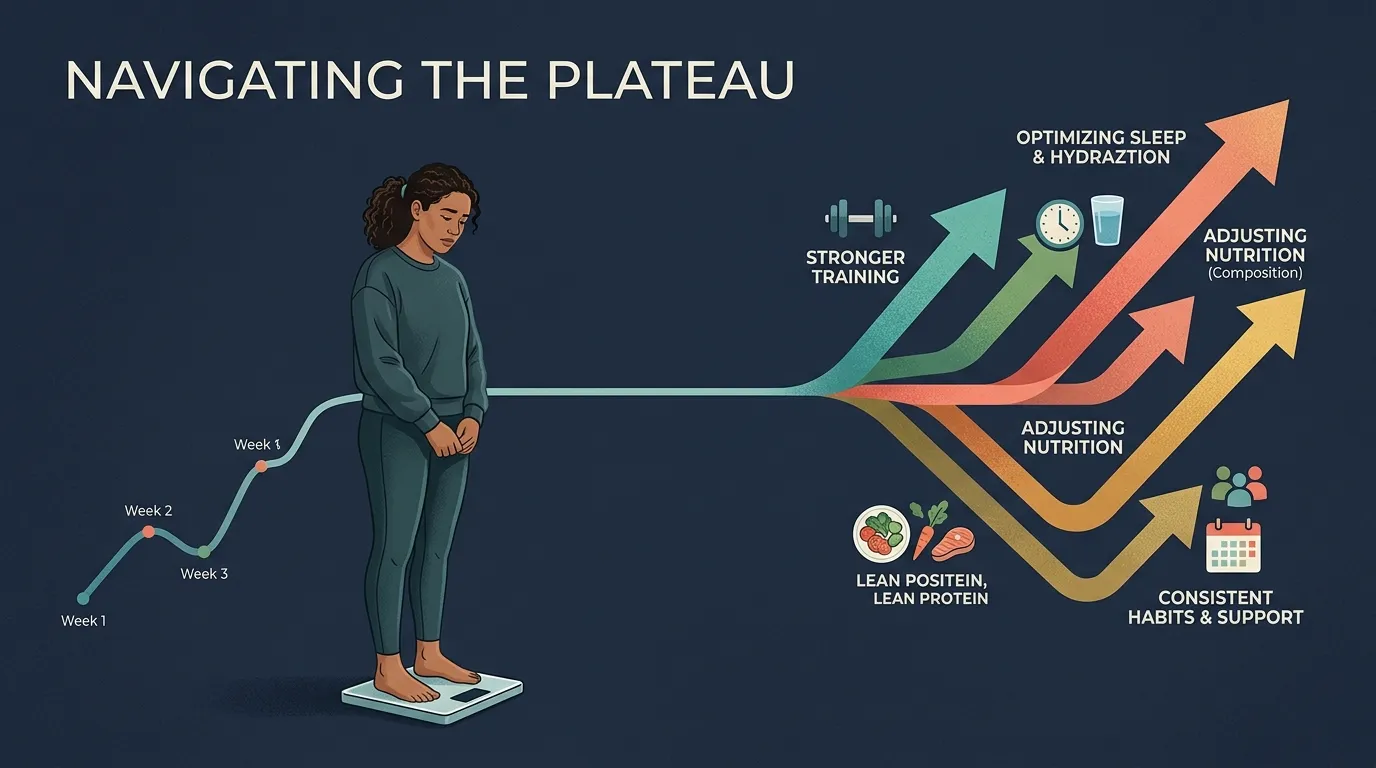
You were doing everything right. The workouts were consistent. The meals were dialed in. The scale was moving. And then, nothing. For a week. Then two. Then three.
So you Googled "why did I stop losing weight" at 11pm, and now you're here. Good. Because the answer isn't what you think.
You didn't break anything. You didn't fail. Your body is doing exactly what it evolved to do. And the instinct you're fighting right now (to eat less, train more, push harder) is the exact wrong move. Here's why, and what to do instead.
What Actually Causes a Weight Loss Plateau
When you eat fewer calories than you burn, you lose weight. Everyone knows that part. What most people don't know is that your body fights back, hard.
This phenomenon is called metabolic adaptation (sometimes called "adaptive thermogenesis"), and it's one of the most well-documented responses in human physiology. When you consistently eat in a caloric deficit, your body interprets the energy gap as a potential threat and activates a cascade of compensatory mechanisms to close that gap.
A landmark review published in the Journal of the International Society of Sports Nutrition by Trexler et al. (2014), "Metabolic adaptation to weight loss: implications for the athlete", found that metabolic adaptation involves multiple overlapping systems: your resting metabolic rate decreases, your non-exercise activity thermogenesis (NEAT) drops (you fidget less, move less throughout the day without realizing it), hunger hormones like ghrelin increase, and satiety hormones like leptin decrease. Your body is literally fighting to restore the energy balance you disrupted.
The result? The caloric deficit that was producing steady weight loss three weeks ago no longer creates the same gap. Your metabolism has adjusted. The scale stalls, not because you're doing something wrong, but because your body is functioning exactly as designed.
This isn't a theory. A follow-up study on The Biggest Loser contestants by Fothergill et al. (2016), published in Obesity, tracked metabolic adaptation six years after the show. Researchers found that contestants' metabolic rates had slowed by an average of approximately 500 calories per day beyond what would be expected for their body size, and this suppression persisted years later. The more aggressively they had dieted, the more severe the metabolic slowdown.
That study changed how exercise scientists think about weight loss. And it should change how you think about your plateau.
Why the Scale Lies to You
Here's something that makes plateaus even more frustrating: the scale doesn't measure what you think it measures.
Your body weight is a composite number. It includes fat mass, muscle mass, water, glycogen stores, food in your digestive tract, and inflammation. On any given day, these variables can swing your weight by 2 to 5 pounds, completely independent of whether you gained or lost any fat. And if you're not sure the number you saw this month was ever realistic, our breakdown of how much weight you can lose in a month sets the expected range by starting body weight. If workouts are not part of your week right now, our guide to how to lose weight without exercise covers the four levers that still move the scale.
Three common scenarios where the scale lies:
- Body recomposition. If you're strength training while eating in a moderate deficit, especially if you're relatively new to resistance training, you can simultaneously lose fat and gain muscle. Since muscle is denser than fat, you can look visibly leaner while the number on the scale doesn't move. This is one of the most common causes of "phantom plateaus" and it's actually the best possible outcome.
- Water retention from new exercise. When you start a new training program or increase intensity, your muscles retain extra water to support repair and glycogen storage. This can mask fat loss on the scale for 2 to 4 weeks. It's temporary, but it's maddening if you're only watching the number.
- Cortisol and stress response. Under-eating combined with over-training spikes cortisol, which causes water retention. Ironically, the harder you try to "push through" a plateau by eating less and training more, the more your body holds water, making the scale stall even longer.
This is why experienced coaches track measurements, progress photos, and performance metrics, not just body weight. The scale is one data point. It's a noisy, unreliable, emotionally loaded data point. And making decisions based on it alone is how people spiral. A stall can also mean the phase has simply run long enough, and our bulking vs cutting guide covers how long a cut should last before a stretch at maintenance buys more than another month of grinding. Those same measures are how you tell fat loss from muscle loss, which our guide on how to lose fat without losing muscle walks through in detail. That matters most for the lower body, where a tape measure can sit still for months: our guide to how to lose thigh fat covers why the thighs are last in the queue.
The Danger of Cutting Calories Further
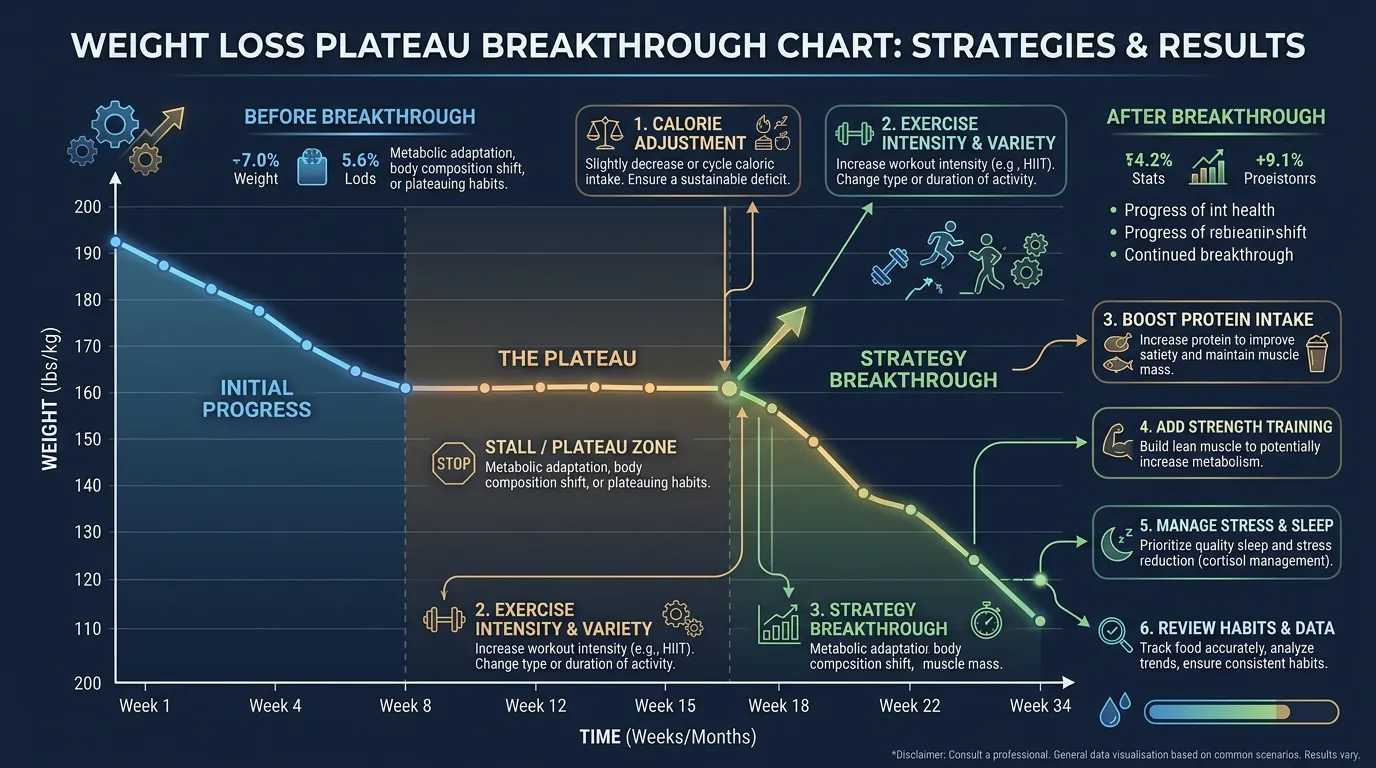
When the scale stalls, the gut reaction is to eat less. It feels logical. If the deficit stopped working, make the deficit bigger. Simple math, right?
This is the single most counterproductive response to a plateau.
Here's why. Your body is already in metabolic adaptation mode. It's already slowing your metabolism to match your reduced intake. If you cut calories further, you accomplish three things, all of them bad:
- You amplify the adaptation. A steeper deficit triggers a stronger compensatory response. Your resting metabolic rate drops further. Your NEAT drops further. Hunger hormones surge. You're burning less and craving more.
- You lose muscle. In a severe deficit, your body breaks down muscle tissue for energy, especially if protein intake is inadequate. Less muscle means a lower metabolic rate, which makes future weight loss even harder. You're eating into the engine that burns calories at rest.
- You set up the rebound. The deeper the deficit, the more aggressive the body's recovery response when you eventually return to normal eating. This is how yo-yo dieting works: extreme restriction followed by metabolic rebound, each cycle leaving you with less muscle and a slower metabolism than before.
The Fothergill study on Biggest Loser contestants is the most vivid illustration of this cycle. Contestants who lost weight through extreme caloric restriction experienced metabolic suppression that persisted for at least six years. Their bodies never fully recalibrated. The aggressive approach that produced dramatic short-term results created long-term metabolic damage.
The plateau isn't the problem. Your response to the plateau is the problem.
What Actually Works: Progressive Overload
If cutting calories further is the wrong lever to pull, what's the right one? Build more muscle.
Progressive overload (gradually increasing the weight, reps, or intensity of your training over time) is the most effective long-term strategy for breaking through plateaus and maintaining weight loss. Here's the mechanism:
- Muscle is metabolically active tissue. Every pound of muscle you carry burns roughly 6 to 7 calories per day at rest, compared to about 2 calories per pound of fat. That doesn't sound like much, but over months and years, the compound effect is significant. Gaining 5 pounds of muscle effectively raises your resting metabolic rate by 25 to 35 calories per day, working in your favor around the clock, including while you sleep.
- Resistance training has an elevated afterburn effect. High-intensity resistance training increases excess post-exercise oxygen consumption (EPOC), meaning you continue burning calories at an elevated rate for hours after your workout, far more than steady-state cardio.
- Progressive overload counteracts metabolic adaptation. While your body adapts to caloric deficit by slowing metabolism, it also adapts to increasing training stimulus by building more metabolic tissue. You're fighting adaptation with adaptation, but in your favor.
A study by Hunter et al. (2008), published in Obesity, randomized 94 women to resistance training, aerobic training or no training through a supervised weight loss to a BMI under 25. Resistance training preserved both fat-free mass and resting energy expenditure, while the aerobic-only and no-exercise groups saw both decline. The strength training group maintained both their metabolism and their weight loss, while the cardio-only group hit a wall.
The takeaway is clear: the way through a plateau isn't eating less. It's training smarter. If you want a tool for the training half of that, we ranked the best workout apps for weight loss.
Find out what's really holding you back
Take the free 2-minute assessment. FitCraft's AI coach will analyze your current patterns and build a plan designed to keep you progressing, not stuck.
Take the Free Assessment Free · 2 minutes · No credit card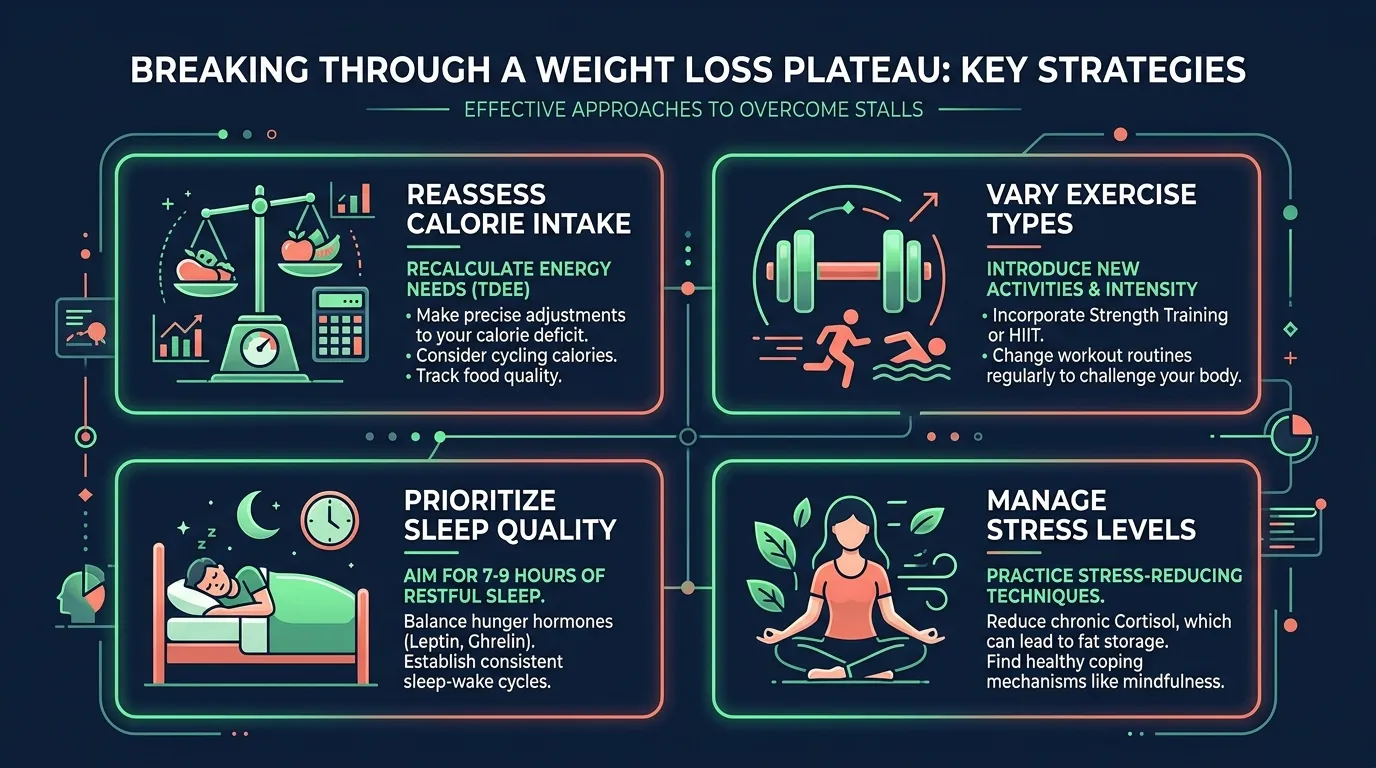
How to Break a Weight Loss Plateau
Everything above explains why the scale stopped. This is what to do about it, in order, and the order is the useful part: the first two steps resolve most stalls and cost you nothing, while the later ones cost you time, food or patience you would rather not spend before you have to.
- Confirm it is actually a plateau. Day-to-day swings of 2 to 5 pounds will hide a week of genuine progress. Compare a seven-day rolling average against the same average three weeks ago, not today's number against last Tuesday's. Weight loss is also supposed to decelerate: the energy-balance model published by Hall and colleagues (2011) in The Lancet shows that a lighter body burns less, so a fixed intake produces a shrinking gap and a curve that flattens on its own. Three flat weeks on a rolling average is a plateau. Nine flat days is noise.
- Re-measure what you are actually eating. This is the uncomfortable step, and it is usually the answer. Ten adults who reported being unable to lose weight on what they described as fewer than 1,200 calories a day were measured with doubly labeled water, the reference standard for energy expenditure. They under-reported their intake by an average of 47 percent and over-reported their physical activity by 51 percent (Lichtman et al., 1992). Nobody in that study was lying. Portions drift, handfuls go uncounted, and weekends quietly undo weekdays. Weigh everything for seven days before you change one other thing. Our breakdown of why you might not be losing weight in a calorie deficit ranks the other culprits by how often each turns out to be the real one.
- Raise protein before you lower calories. A review in the American Journal of Clinical Nutrition concluded that intakes around 1.2 to 1.6 grams per kilogram of body weight per day, spread across meals at roughly 25 to 30 grams each, improve appetite control and help preserve lean mass during energy restriction (Leidy et al., 2015). More protein at the same calories is a free move: it makes the deficit easier to hold, and it protects the tissue that keeps your resting metabolic rate up. Our protein calculator gives you the number for your body weight.
- Add training stimulus rather than a deeper deficit. The Hunter trial above is the reason: resistance training preserved fat-free mass and resting energy expenditure through weight loss where cardio alone did not. The practical version is progressive overload on paper rather than in spirit. The ACSM progression position stand recommends raising load by roughly 2 to 10 percent once you can complete one to two repetitions above your target on two consecutive sessions, with the smaller increments on upper-body movements (Ratamess et al., 2009). Two to four sessions a week is enough, and a pair of dumbbells at home counts.
- Put back the movement that adaptation removed. Non-exercise activity thermogenesis is the first thing a dieting body trims, and it does it below the level of awareness: fewer steps, less fidgeting, more sitting on the stairs you used to take two at a time. Trexler's review lists it as one of the main channels of metabolic adaptation, and unlike resting metabolic rate you can simply put it back. A daily step target you can hold for months, in the region of 7,000 to 9,000 rather than a heroic number you abandon in a fortnight, is worth roughly one to two hundred calories a day without touching your intake or your training.
- Fix sleep before you cut food. Ten overweight adults completed two 14-day blocks of the same moderate calorie restriction in a randomized crossover, one with 8.5 hours in bed and one with 5.5. On the short-sleep block, fat loss fell from 1.4 kg to 0.6 kg and loss of fat-free mass rose from 1.5 kg to 2.4 kg, with higher ghrelin and more reported hunger (Nedeltcheva et al., 2010). Identical diet, and most of the weight came off the wrong tissue. If the scale has been flat during a bad month of sleep, that is the variable to move first.
- Only then, take a planned break at maintenance. In the MATADOR trial, 51 men with obesity were randomized to 16 weeks at a 33 percent energy deficit, taken either continuously or split into two-week blocks separated by two weeks of eating at maintenance, which stretched the whole thing over 30 weeks. The intermittent group lost more fat, 12.3 kg against 8.0 kg, with a smaller fall in resting energy expenditure, and was still further ahead six months later (Byrne et al., 2018). Two weeks at maintenance is not quitting. In that trial it was the treatment.
Notice what is not on that list: a bigger deficit, a cleanse, an extra hour of cardio, or a brand new program. Every one of those is a way of doing more of the thing that stopped working. And notice what step seven implies. If the stall has run past eight weeks with the first six steps genuinely in place, the honest answer is usually that this cut has run long enough, and our review of what a calorie deficit actually is covers the arithmetic that decides how long yours should be.
Why Consistency Through the Plateau Matters More Than Any Tactic
Here's the part nobody wants to hear: the single best predictor of long-term weight loss success is whether you keep going when the scale stops moving.
Most people don't fail because they chose the wrong diet or the wrong program. They fail because they interpret a plateau as evidence that "this isn't working," and they quit. Or they make a drastic change (slash calories, add hours of cardio, switch programs entirely) that disrupts the very consistency that was producing results.
Plateaus are temporary. Metabolic adaptation is a real physiological response, but it's not permanent: your body eventually recalibrates. The stall typically lasts 2 to 8 weeks. If you maintain your training, keep your protein high, and resist the urge to panic, the scale will start moving again. Your body needs to catch up. Give it time. If the stall has lasted a month and your training hasn't changed in weeks, our guide to cardio for fat loss has an eight-item checklist for auditing the weekly dose before you touch a single calorie.
The people who achieve lasting body composition changes aren't the ones with the perfect plan. They're the ones who didn't quit during the messy middle. They showed up on the days it felt pointless. They trusted the process when they couldn't see the progress.
That's the real skill. Not dieting. Not training. Staying.
How FitCraft Adapts When You Plateau
This is where most fitness apps fall apart. They give you a static plan, and when you stop progressing, you're on your own, guessing what to change, Googling "how to break a plateau," spiraling into information overload.
FitCraft was designed by an Ivy League-trained exercise scientist, NSCA-certified strength coach to handle exactly this moment.
FitCraft's AI coach Ty monitors your training data and automatically adjusts your programming when progress stalls. Instead of guessing what variable to change, the app applies progressive overload strategically, modifying volume, intensity, and exercise selection based on your real performance data. If you're stalling on a movement, Ty adjusts. If your overall progression has plateaued, Ty recalibrates the entire program.
This isn't generic advice. It's adaptive programming, the same approach a high-end personal trainer would use, built into an app that costs a fraction of the price.
And because FitCraft uses gamification (streaks, quests, collectible cards, and avatar progression), it solves the other plateau problem: the motivation one. When the scale stalls and the excitement fades, most people lose the will to keep training. FitCraft's reward systems give you reasons to show up that have nothing to do with the number on the scale. Your streak is alive. Your quest is half-finished. Your avatar is one workout away from leveling up.
The plateau doesn't end your progress. It tests your system. And FitCraft was built to pass that test.
Real Results from Real People
What FitCraft Users Are Saying
Jim, 26: "Down 24 lbs in 3 months. The app kept me going when I would've normally quit."
Barry, 42: "Lost 28 lbs in 4 months. Lost weight during breakfast while kids ate. Worked around my life, not the other way around."
Jim and Barry didn't have some secret advantage. They hit plateaus like everyone else. The difference was they had a system that adapted with them and kept them showing up when the scale went quiet.
Frequently Asked Questions
How do you break a weight loss plateau?
Work through it in order. Confirm it is a real plateau by comparing seven-day rolling averages three weeks apart rather than today's number against last Tuesday's. Then weigh your food for a week, because adults in one doubly labeled water study under-reported their intake by an average of 47 percent. Raise protein toward 1.2 to 1.6 grams per kilogram of body weight, add progressive resistance training instead of a deeper deficit, put your daily step count back where it sat before the diet quietly trimmed it, and fix your sleep, since 5.5 hours in bed rather than 8.5 cut fat loss by more than half on an identical deficit. Only if all of that is already in place and eight weeks have passed should you take two weeks at maintenance calories, which outperformed continuous dieting in a randomized trial.
How long do weight loss plateaus last?
Most weight loss plateaus last 2 to 8 weeks. Your body needs time to adjust to its new baseline. The worst thing you can do during a plateau is panic and slash calories further, because that amplifies the metabolic adaptation that caused the stall in the first place. Consistent training and adequate protein intake help your body recalibrate faster.
Should I eat less if my weight loss stalls?
Usually not. Cutting calories further during a plateau can backfire by increasing metabolic adaptation: your body down-regulates energy expenditure even more. A better strategy is to increase training intensity through progressive overload, maintain adequate protein intake (0.7 to 1g per pound of bodyweight), and give your metabolism time to catch up.
Can I be losing fat but not losing weight?
Absolutely. Body recomposition (losing fat while gaining muscle) is common, especially in beginners or people returning to exercise. Since muscle is denser than fat, the scale can stay flat or even go up while your body is genuinely changing. Waist measurements, how clothes fit, and progress photos are more reliable indicators than the scale alone.
Does progressive overload help break a weight loss plateau?
Yes. Progressive overload (gradually increasing weight, reps, or intensity) builds lean muscle, which raises your resting metabolic rate. More muscle means your body burns more calories at rest, which directly counteracts the metabolic slowdown that causes plateaus. This is why strength training is one of the most effective tools for long-term weight management.
How does FitCraft help when I hit a weight loss plateau?
FitCraft's AI coach Ty monitors your training data and automatically adjusts your programming when progress stalls. Instead of guessing what to change, the app applies progressive overload strategically, modifying volume, intensity, and exercise selection based on your real performance data. Every program is designed by an Ivy League-trained exercise scientist, NSCA-certified strength coach, so the adjustments follow evidence-based training principles.