You don't need a gym membership or fancy equipment to build real upper body strength. The push-up works your chest, triceps, and shoulders in a single movement, and you can do it anywhere.
The problem? Most people learn push-ups wrong and never get corrected. Flared elbows, sagging hips, rushed reps. That leads to shoulder pain and the assumption that push-ups "aren't for them."
They are. Get the basics right and you've got one of the best upper-body exercises ever invented.
Quick Facts: Push-Up
- Equipment needed: None
- Difficulty: Beginner (incline) to Intermediate (floor)
- Modality: Strength
- Body region: Upper body
- FitCraft quest category: Strength
Muscles Worked
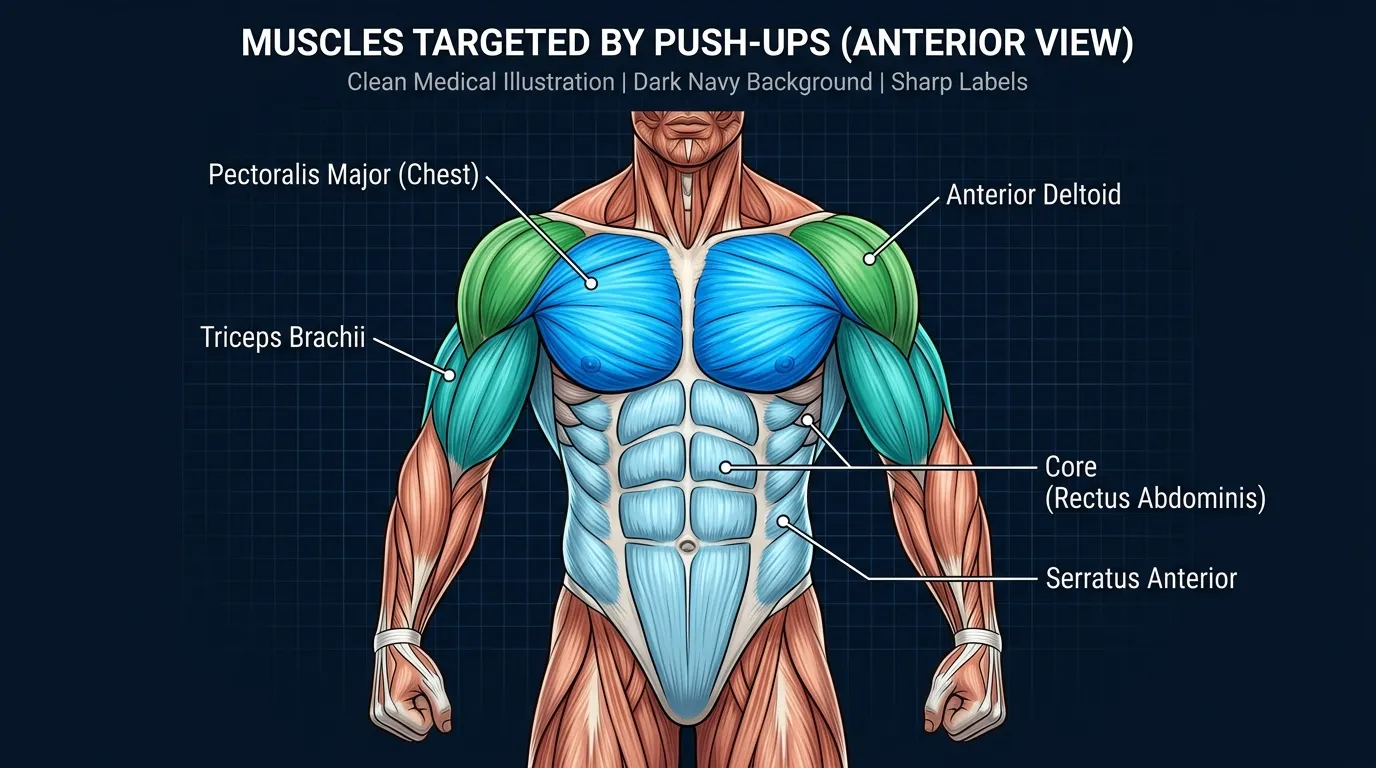
Primary movers: the pectoralis major (chest), triceps brachii, and anterior deltoids. These drive the pressing motion. They shorten on the way up (concentric phase) and lengthen under tension on the way down (eccentric phase), which is what produces the strength and hypertrophy stimulus.
Secondary movers: the serratus anterior (the muscle along the side of your ribcage that protracts the shoulder blade at the top of every rep) and the long head of the biceps brachii (a minor stabilizer at the elbow joint).
Stabilizers: the entire anterior core (rectus abdominis, transverse abdominis, obliques), the glutes, and the posterior deltoids and rotator cuff. All of these work isometrically to hold the rigid plank position throughout every rep, which is why a clean push-up demands whole-body engagement to execute well.
How hand position changes which muscle you bias: Cogley et al. (2005) measured pectoral and triceps EMG across wide, shoulder-width, and narrow push-up hand positions and found greater activation in both muscles with the narrow base than the wide base. Moving the hands in makes the push-up a harder, more complete arm-and-chest exercise. Moving them out shortens the range of motion and shifts the demand toward the shoulders. Hand position is a real programming lever, just not the "wide equals more chest" lever gym folklore describes.
Step-by-Step: How to Perform a Push-Up
Whether you're starting with incline push-ups or going straight to the floor, the movement pattern is the same. The cues below apply to both.
Step 1: Set Your Starting Position
Place your hands on the floor (or a bench for incline) slightly wider than shoulder-width apart. Extend your legs behind you so your body forms a straight line from head to heels.
Coach Ty's cue: "Make sure your hands are under your shoulders, but slightly wider than shoulder-width apart."
Step 2: Brace Your Entire Body
Before you move, lock everything in. Tighten your core. Squeeze your glutes. Your whole body holds position throughout the rep, from your shoulders down through your heels.
Ty's cue: "Keep your body as straight as a plank. Your body should rise and fall as one unit."
Step 3: Lower Yourself with Control
Inhale as you bend your elbows and lower your chest toward the surface. Control the descent and lower until your chest nearly touches.
Ty's key cue: "Keep your elbows close to your body, don't let them flare out to the sides." Elbow flare is the number one cause of push-up shoulder pain. Aim for a 45-degree angle between your upper arms and torso.
Step 4: Push Back Up
Exhale as you press through your palms back to the start. As Ty coaches it: "Imagine pushing the floor away from you as you rise, this helps activate your chest." Keep a slight bend in your elbows at the top to maintain tension.
Step 5: Repeat with Control
Every rep should look the same: same tempo, same depth, same body position. If form breaks down, stop the set.
Ty's reminder: "Aim for a controlled and smooth motion, don't rush through your pushups."
Get this exercise in a personalized workout
FitCraft, our mobile fitness app, uses its AI coach Ty to program pressing exercises like this into your plan at the right volume and intensity, based on your level, goals, and equipment. Ty was designed and trained by Domenic Angelino, MPH (Brown University) and NSCA-CSCS, with research published in the Journal of Strength and Conditioning Research and Medicine & Science in Sports & Exercise.
Take the Free Assessment Free · 2 minutes · No credit card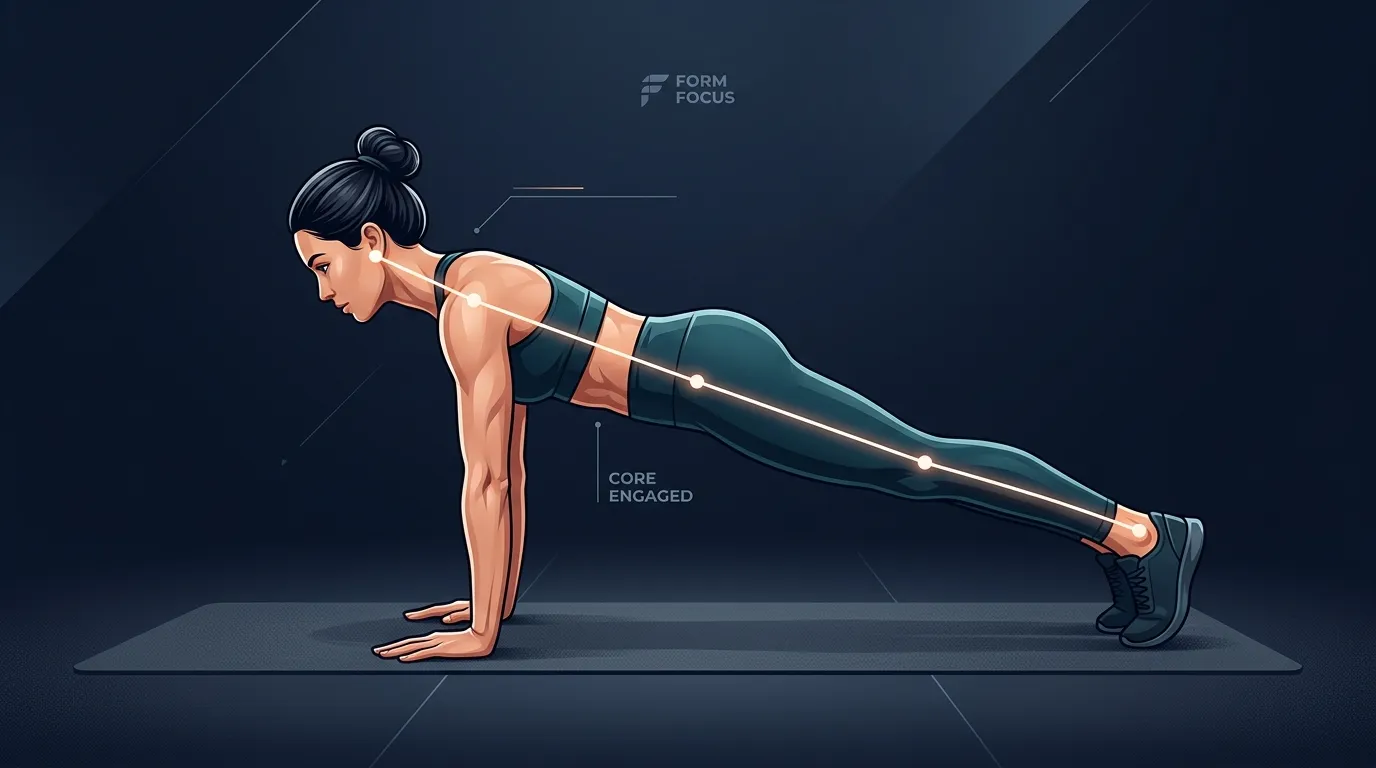
Common Mistakes (and How to Fix Them)
Here are the mistakes Ty corrects most often.
- Elbow flare. Elbows splaying out to a T-shape dumps stress on your shoulders. Fix: keep elbows at 45 degrees. Think "arrow shape," not "T shape."
- Sagging hips. Your lower back drops when your core disengages. Fix: squeeze glutes and brace abs before every rep.
- Pike hips (butt too high). Hiking your hips turns it into a shoulder press. Fix: straight plank from head to heels.
- Half reps. Stopping halfway robs you of the range of motion where growth happens. Fix: lower until your chest nearly touches. Can't get that deep? Regress to incline.
- Head craning forward. Strains your neck and pulls your spine out of alignment. Fix: neutral head, eyes on the floor past your fingertips.
- Rushing reps. Speed hides bad form. Fix: two seconds down, one second up.
Push-Up Variations: Regressions and Progressions
Start where you are and progress when your form is solid at the current level.
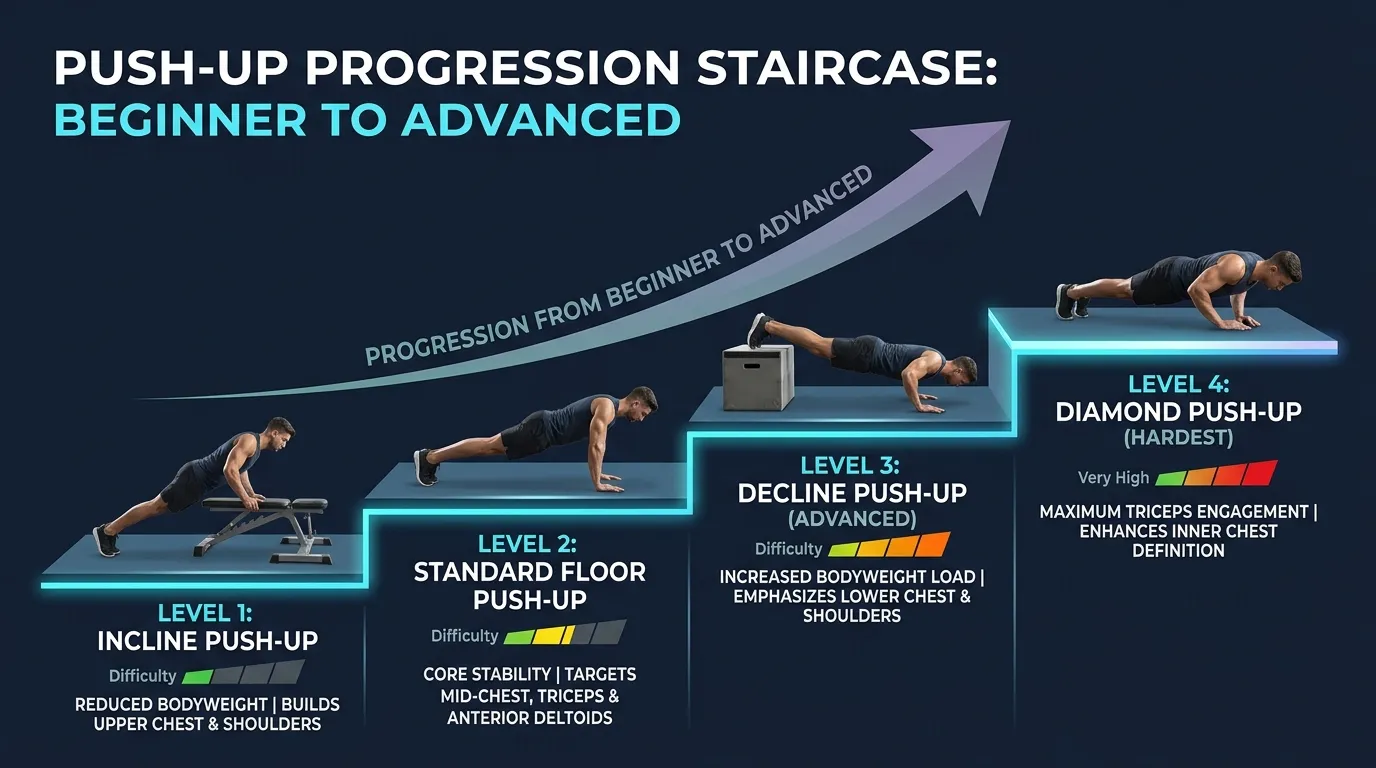
Incline Push-Up (Beginner Regression)
Place your hands on a bench, countertop, or wall. The higher the surface, the easier the movement. Same muscles, same movement pattern, less load. Master it here before moving to the floor.
Floor Push-Up (Standard)
Hands on the ground, body in a straight line, full range of motion. Once you can do 3 sets of 10-12 with controlled form, you're ready for harder variations.
Diamond Push-Up (Advanced Progression)
Hands together under your chest in a diamond shape. Shifts emphasis to the triceps and inner chest. Significantly harder. Don't rush here until floor push-ups feel comfortable.
Pike Push-Up (Shoulder-Focused Progression)
Start in a downward-dog position with hips high. Lower your head toward the floor between your hands. Shifts load to the anterior deltoids and works as a stepping stone toward handstand push-ups.
When to Avoid or Modify Push-Ups
Push-ups are safe for most healthy adults, but a few conditions call for modification or temporarily swapping floor variations for easier ones. None of these are permanent restrictions. They're starting points. Always consult your physician or physical therapist for personalized guidance.
- Wrist pain or carpal tunnel. Floor push-ups load the wrists at roughly 90 degrees of extension, which can aggravate carpal tunnel, wrist strain, or arthritic wrists. Modify with push-up handles, dumbbell grips, or fist push-ups to keep the wrist neutral. High-incline push-ups against a bench or counter also dramatically reduce wrist load.
- Acute shoulder impingement or rotator cuff irritation. Full-range floor push-ups can compress the supraspinatus tendon at the bottom of the rep. Stay with high-incline push-ups, keep elbows at 45 degrees (not flared), and work only within a pain-free range. If symptoms persist for more than a week or two, see a physical therapist before progressing.
- Recent shoulder, wrist, or elbow surgery. Get clearance from your surgeon before any pressing exercise. Most post-surgical protocols start with isometric scapular work, then wall push-ups, before introducing inclined or floor variations on a controlled timeline.
- First 6–8 weeks postpartum or active diastasis recti. The plank position demands real deep-core engagement. If the core can't hold a neutral spine, the lumbar will sag and intra-abdominal pressure can worsen abdominal separation. Start with wall push-ups, prioritize diaphragmatic breathing and transverse abdominis activation with deadbugs and bird-dogs, and progress only when you can hold a flat plank without doming or coning.
- Lower-back pain that worsens when bracing. If your hips visibly sag and cueing doesn't fix it, the floor variation is loading the lumbar spine. Drop to incline push-ups and rebuild bracing strength with forearm planks, deadbugs, and bird-dogs first.
Related Exercises
If push-ups are part of your routine, these movements complement or extend the same training pattern:
- Same muscle group (push): Chest Press and Chest Fly load the same pectoral and tricep pattern with dumbbells, useful when you've outgrown bodyweight or want isolated chest work.
- Tricep-focused progression: Diamond Push-Ups and Bench Dips shift more load to the triceps once standard push-ups feel easy.
- Shoulder-focused progression: Pike Push-Ups, a stepping stone toward handstand push-ups that biases the anterior deltoid and upper chest.
- Core foundation for the plank position: Hand Planks and Forearm Planks isolate the bracing pattern push-ups rely on, useful if your hips sag during sets.
- Advanced chest and front-delt variation: Pseudo Planche Push-Up shifts hand position forward to dramatically increase chest and anterior deltoid demand.
How to Program Push-Ups
Push-up programming follows the same evidence-based ranges as any pressing exercise. The American College of Sports Medicine (ACSM) Position Stand on resistance training recommends roughly 8–12 reps per set for strength and 12–20 for muscular endurance, with at least 48 hours between sessions training the same muscle group (Ratamess et al., 2009).
| Level | Sets × Reps | Rest between sets | Frequency |
|---|---|---|---|
| Beginner (incline) | 2–3 × 5–10 | 60–90 seconds | 2–3 sessions/week |
| Intermediate (floor) | 3–4 × 8–15 | 60–90 seconds | 2–4 sessions/week |
| Advanced (decline, diamond, plyometric) | 3–5 × 6–12 | 90–120 seconds | 3–4 sessions/week |
Where in your workout: Push-ups belong early in an upper-body session, when you're fresh. They're a compound movement that needs maximum motor unit recruitment, so don't push them to the end of a fatigued workout. If you're combining push-ups with weighted pressing (bench press, dumbbell press), do those first and use push-ups as an accessory finisher or burnout set. In a full-body or circuit context, push-ups work well at the start of a "push" block.
Form floor over rep targets: if your last 2 reps of a set break form (elbow flare, sagging hips, half range), stop the set there. Hitting a target rep count with broken form is worse than hitting fewer reps cleanly.
How FitCraft Programs This Exercise
Knowing how to do a push-up is step one. Knowing when to do it, how many reps, and when to progress is where most people get stuck.
FitCraft's AI coach Ty handles that. During your personalized diagnostic assessment, Ty maps your fitness level, goals, and available equipment. Then Ty builds a personalized program that slots push-ups into a balanced training plan at the right variation for your level.
As you get stronger, Ty adjusts the variation and volume to match your level. Incline becomes floor. Floor gets paired with harder variations. Volume adjusts based on your recovery and consistency. Every program is designed by an Ivy League-trained exercise scientist and NSCA-certified strength coach using evidence-based periodization, then adapted to you by the AI.
Frequently Asked Questions
How many push-ups should a beginner do?
Start with whatever you can do with proper form, even 3 to 5 reps. Begin with incline push-ups, then progress to floor push-ups as you build strength. Consistency matters more than volume.
What muscles do push-ups work?
Primarily the chest, triceps, and front shoulders. They also engage the core and serratus anterior as stabilizers, which makes them one of the most efficient bodyweight upper-body exercises.
Are incline push-ups effective or just a shortcut?
They're absolutely effective. Same muscles, reduced load, ideal for building foundational strength and motor patterns before progressing to the floor.
Why do my shoulders hurt during push-ups?
Usually elbow flare. Elbows splaying out instead of staying at a 45-degree angle puts the shoulder in a vulnerable position. Hands placed too high (near your head) instead of at mid-chest can cause the same problem. Fix those two things and most shoulder pain resolves.
Can I do push-ups if I have wrist pain?
Floor push-ups load the wrists at roughly 90 degrees of extension, which can aggravate carpal tunnel, wrist strain, or arthritic wrists. Modify with push-up handles, dumbbell grips, or fist push-ups to keep the wrist neutral. Or use high-incline push-ups against a bench or counter. The higher the surface, the less wrist load. If pain persists after these modifications, see a physical therapist or occupational therapist for an assessment.