The forearm plank is one of those exercises that looks like nothing is happening and feels like everything is happening. You're not moving. You're just holding a position. And yet, done right, your entire midsection is working hard to keep you in that line.
What makes the forearm plank especially versatile is the built-in progression path. Beginners start on their knees and build foundational core strength. From there, you graduate to the standard hold on your toes, then to harder variations that add anti-rotation or load. No equipment needed, no complex technique to learn. Just you and the floor.
Quick Facts: Forearm Plank
- Equipment needed: None (mat optional)
- Difficulty: Beginner (knees) to Intermediate (standard) to Advanced (shoulder taps, weighted)
- Modality: Strength (isometric)
- Body region: Core (anterior dominant) and full-body stabilizers
- FitCraft quest category: Core
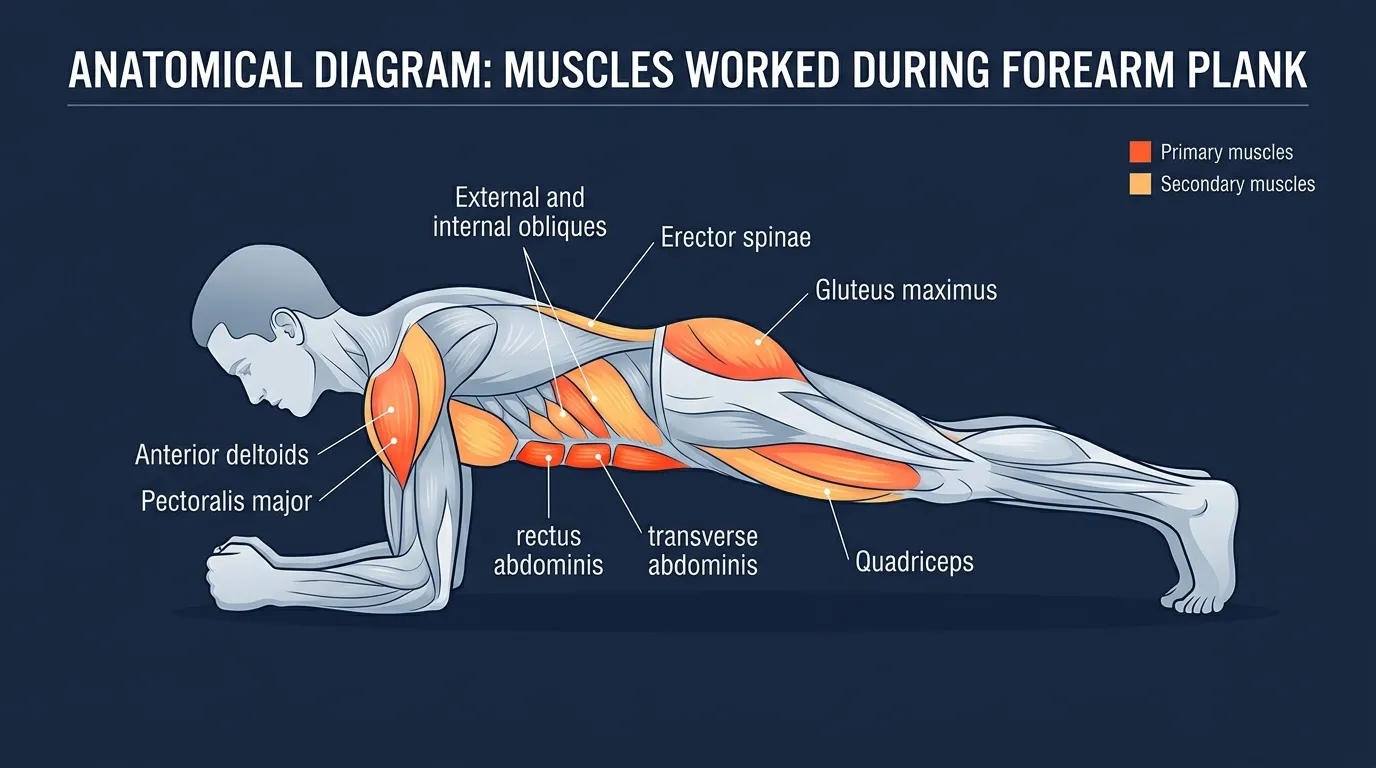
Muscles Worked
Primary movers: the rectus abdominis (the visible "six-pack" muscle), transverse abdominis (the deep core layer that wraps around the trunk like a corset), and the internal and external obliques. In an isometric hold like the plank, these muscles don't shorten and lengthen the way they would in a crunch. They contract and stay contracted, generating just enough tension to keep your pelvis neutral against gravity's constant pull toward lumbar extension.
Secondary movers: the gluteus maximus (squeezing the glutes posteriorly tilts the pelvis and unloads the lumbar spine), the spinal erectors (working isometrically to hold a neutral spine), and the long head of the triceps and anterior deltoids holding the shoulder girdle in position.
Stabilizers: the diaphragm and pelvic floor (the deep core canister that creates intra-abdominal pressure), the rotator cuff and serratus anterior (keeping the shoulder blades flat against the ribcage), and the hip flexors and quadriceps holding the lower body in alignment. The breath itself is a key stabilizer here: exhaling steadily reinforces transverse abdominis activation, while breath-holding spikes intra-abdominal pressure and blood pressure unnecessarily.
Mechanism: gravity is constantly trying to pull your hips toward the floor and arch your lower back. The forearm plank trains your anterior core to resist that pull. This is the same bracing skill you need under load during a squat, deadlift, or overhead press, which is why planks transfer so well to nearly every compound lift. The isometric format also builds core endurance, which matters more than peak strength for postural carryover during long days on your feet or at a desk.
Step-by-Step: How to Hold a Forearm Plank
Whether you're starting with the knee variation or holding the standard plank on your toes, the bracing pattern is the same. The cues below apply to both.
Step 1: Get Into Position
Lie face down on the floor. Place your forearms on the ground with elbows directly beneath your shoulders. Your forearms should be parallel to each other, palms flat or hands clasped lightly together.
Coach Ty's cue: "Set your elbows directly under your shoulders, not in front of them. Forward elbows shift the work to your upper traps."
Step 2: Lift Your Body
Push up off the floor, raising your body onto your forearms and toes. For the beginner variation, keep your knees on the ground instead. Your body should form a straight line from head to heels, or from head to knees in the regression.
Ty's cue: "Keep your body as straight as a plank of wood, from head to heels. If someone laid a broomstick along your back, it should touch your head, upper back, and glutes at the same time."
Step 3: Brace Your Core and Squeeze Your Glutes
Tighten your abdominal muscles by drawing your belly button toward your spine. Squeeze your glutes and tilt your pelvis slightly toward your ribcage. This posterior pelvic tilt is the single best fix for sagging hips.
Ty's key cue: "Focus on engaging your core, imagine pulling your belly button into your spine. Then squeeze your glutes like you're trying to crack a walnut." The glute squeeze is the most underused plank cue. It stabilizes the hips and prevents the lumbar spine from taking over.
Step 4: Hold the Position with Steady Breathing
Maintain the plank for the prescribed duration. Breathe steadily, in through the nose and out through the mouth. Keep your neck neutral by looking at the floor slightly ahead of your hands.
Ty's reminder: "Breathe steadily. Holding your breath is the most common beginner mistake. Steady breathing keeps your muscles oxygenated and lets you hold longer."
Step 5: Lower and Rest
Gently lower your body back to the floor by dropping the knees first, then the chest. Rest 45 to 60 seconds before your next set.
Ty's quality-over-quantity rule: "End the hold the moment your form breaks. A 20-second plank with perfect alignment beats a 90-second plank where your hips are sagging."
Get this exercise in a personalized workout
FitCraft, our mobile fitness app, uses its AI coach Ty to program core stability work like this into your plan at the right hold time and frequency, based on your level, goals, and equipment. Ty was designed and trained by Domenic Angelino, MPH (Brown University) and NSCA-CSCS, with research published in the Journal of Strength and Conditioning Research and Medicine & Science in Sports & Exercise.
Take the Free Assessment Free · 2 minutes · No credit card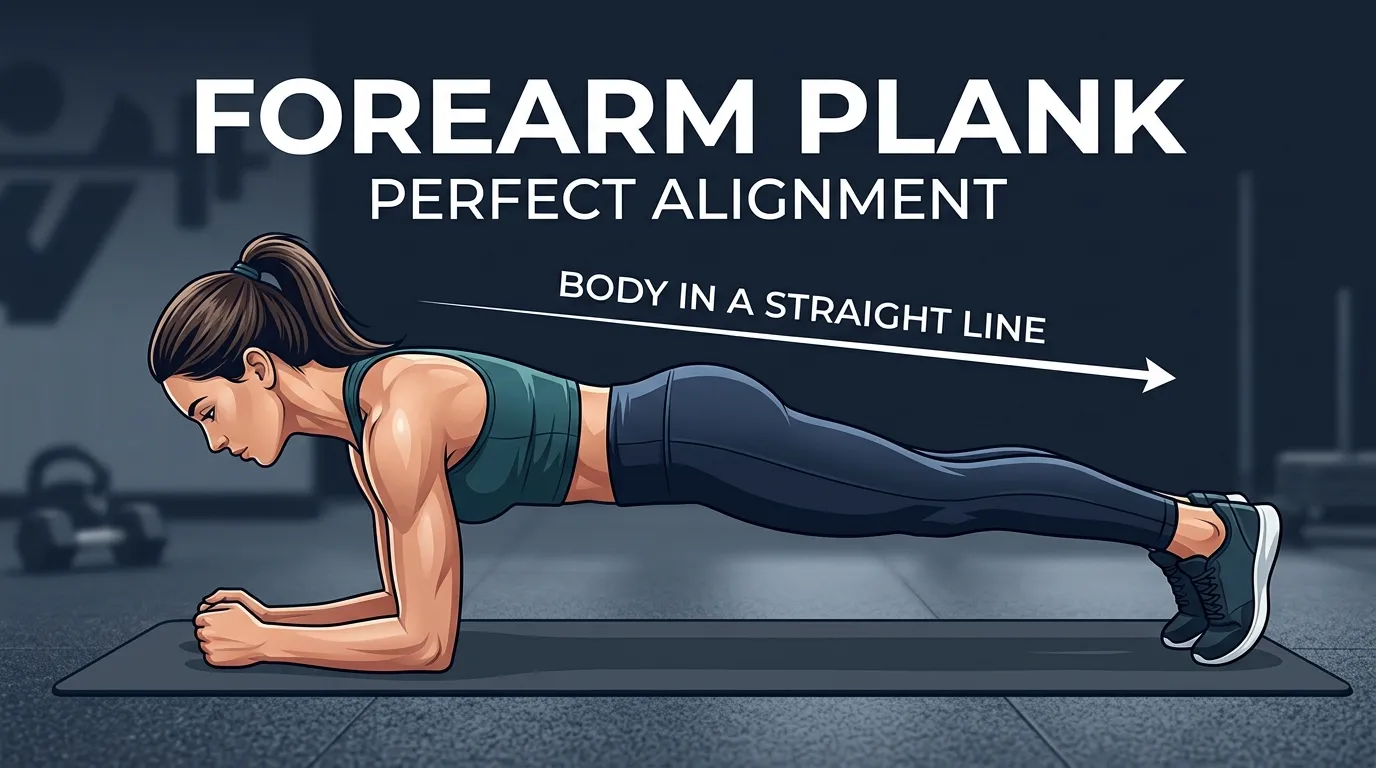
Common Mistakes (and How to Fix Them)
Here are the mistakes Ty corrects most often.
- Hips sagging toward the floor. This is the number one plank mistake. When your hips drop, the stress shifts from your core to your lumbar spine and the exercise stops training what it should. Fix: squeeze your glutes harder, draw your belly button toward your spine, and tilt your pelvis slightly under. If you still can't hold the line, drop to the knee variation.
- Hips piking up too high. The opposite problem. Pushing your hips toward the ceiling shortens the lever arm and makes the plank easier, so your core gets less work. Fix: lower your hips until your body is in one line and your eyes look at the floor slightly ahead of your hands.
- Elbows in front of your shoulders. Forward elbows force the upper traps and shoulders to do the holding work the core should be doing, which is why your shoulders fatigue first. Fix: stack the elbows directly under the shoulders. If you've been here a while and your elbows have drifted forward, walk them back without bending your knees.
- Holding your breath. Breath-holding spikes intra-abdominal pressure and blood pressure unnecessarily, and shortens how long you can hold. Fix: breathe in through the nose, out through the mouth, on a steady cadence. If you can't talk, the load is too high (drop to knees or shorten the hold).
- Head craning up or hanging down. Either extreme pulls the cervical spine out of neutral. Fix: keep your gaze at the floor slightly ahead of your hands. Your ears should stay in line with your shoulders.
- Chasing the timer instead of the form. Holding a sagging plank for 90 seconds trains lumbar compensation, not core strength. Fix: end the hold the moment your form breaks. Do an extra set instead of a longer one.
Forearm Plank Variations: Regressions and Progressions
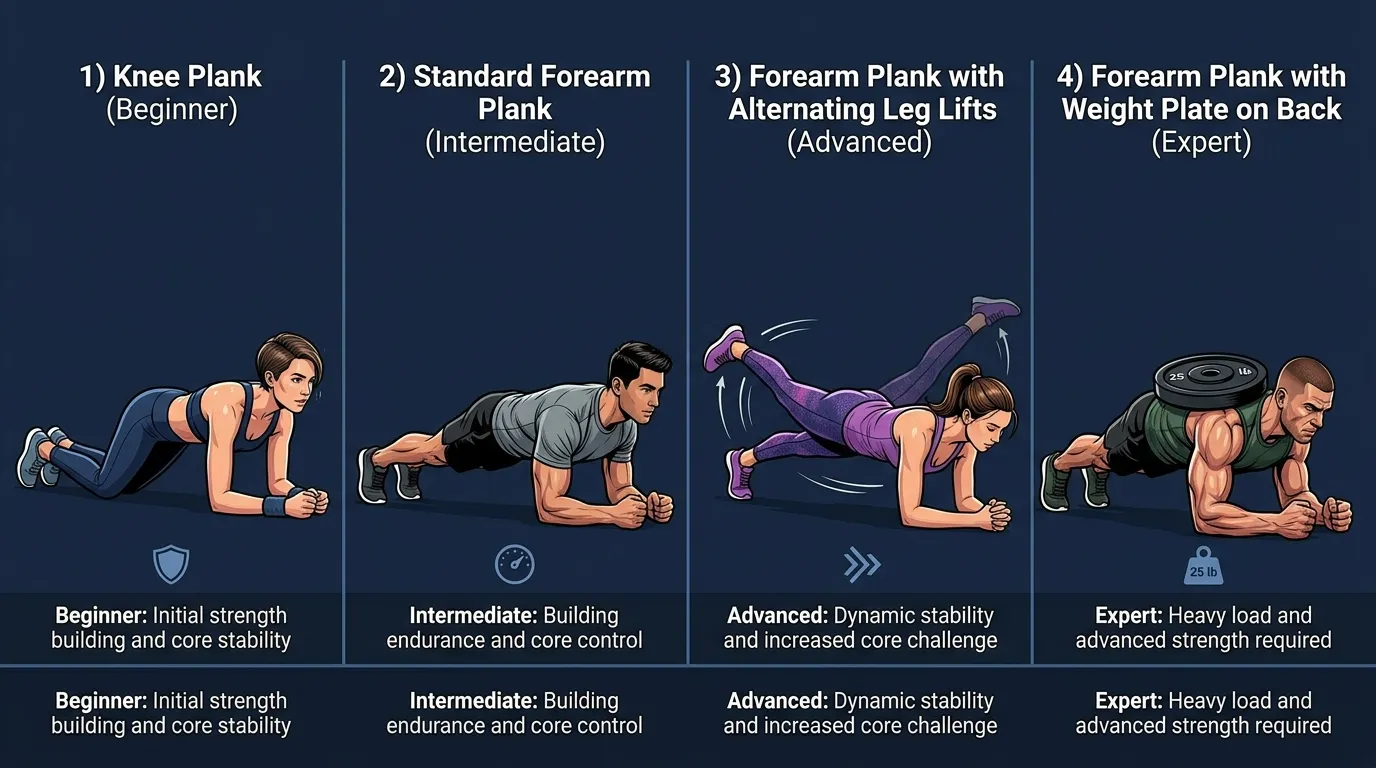
Start where you can hold solid form for at least 20 seconds, then progress.
Knee Forearm Plank (Beginner Regression)
Perform the plank with knees on the ground instead of toes. This shortens the lever arm and reduces the load on your core by roughly half. Same bracing pattern, same cues, just less weight to hold. Master this for 30 to 45 seconds with perfect form before moving to the standard variation.
Standard Forearm Plank (Intermediate)
The classic version on forearms and toes. Aim for 30 to 60 seconds with perfect form. Once 60 seconds feels comfortable and your form stays clean throughout, you're ready for harder variations.
Forearm Plank with Shoulder Tap (Advanced)
From the standard position, lift one hand to tap the opposite shoulder, alternating sides. This adds an anti-rotation challenge because your hips want to twist when one arm leaves the floor. Keep them level. Tempo: 1 to 2 seconds per tap. Start with 6 to 10 taps per side.
Plank Twists (Advanced Dynamic)
Drop one hip toward the floor, then the other, rotating through the thoracic spine while keeping the elbows planted. Builds rotational core control on top of the anti-extension base.
Side Plank (Lateral Variation)
Rotate onto one forearm to target the obliques and the quadratus lumborum. Hold for equal time on each side. The side plank trains anti-lateral-flexion, which complements the forearm plank's anti-extension training.
Hand Plank (High Plank Variation)
Same position but on extended arms instead of forearms. Shifts more load to the shoulders and demands wrist extension. Useful as a bridge toward push-ups and shoulder-tap variations.
When to Avoid or Modify Forearm Planks
Forearm planks are one of the safer core exercises because they avoid loaded spinal flexion, but a few conditions still call for modification or a temporary swap. Always consult your physician or physical therapist for personalized guidance.
- Acute lower-back pain that worsens during the hold. Planks generally help back pain because they train anti-extension, but only if the core actually holds the position. If your hips sag and you can't fix it with the glute squeeze, the load is going to your lumbar spine. Drop to the knee variation or substitute deadbugs and bird-dogs until you can hold a flat plank without sagging. Persistent pain warrants a PT assessment.
- First 6 to 8 weeks postpartum or active diastasis recti. The plank position demands real deep-core engagement to hold a neutral spine. If the abdominal wall can't generate enough tension, the lumbar will sag and intra-abdominal pressure can widen abdominal separation. Restore deep-core function first with diaphragmatic breathing, transverse abdominis activation, and deadbugs and bird-dogs. Reintroduce planks at the knee variation only when you can maintain a flat (non-coning, non-doming) abdominal wall.
- Recent abdominal surgery (C-section, hernia repair, appendectomy). Get clearance from your surgeon before any plank-position work. Most post-surgical protocols start with diaphragmatic breathing, progress to gentle bracing in supine positions, and only reintroduce planks weeks to months later on a controlled timeline.
- Hernia (umbilical, inguinal, ventral). Planks generate intra-abdominal pressure that can worsen some hernias. Consult your physician about safe options, often starting with bird-dogs and deadbugs while the hernia is monitored or managed.
- Pregnancy (second and third trimesters). The standard plank loads the abdominal wall in a way that can encourage coning or doming as the baby grows. Many obstetricians and pelvic-floor PTs recommend switching to upright variations (incline plank against a wall or counter) or to side-lying core work in the second and third trimesters. Always consult your provider for trimester-specific guidance.
- Wrist, elbow, or shoulder injury. While forearm planks are easier on the wrists than hand planks, they still demand significant shoulder stability. Acute shoulder pain or recent surgery means working at the knee variation, shortening the hold, or substituting deadbugs until cleared by a physical therapist.
Related Exercises
If forearm planks are part of your routine, these movements complement or extend the same training pattern:
- Same plane (anti-extension): Hand Planks train the same bracing pattern on extended arms. Deadbugs train anti-extension supine, with less shoulder demand and more bandwidth to focus on the lumbar position.
- Same plane (anti-rotation and anti-lateral): Bird-Dogs add an anti-rotation component on hands and knees. Side Planks train anti-lateral-flexion and round out the "Big 3" McGill core stability set with forearm planks and bird-dogs.
- Dynamic plank progressions: Plank Twists, Plank Walks, Spider Planks, and Side Plank Raises add motion on top of the plank base. Build all of these on a solid 60-second static plank first.
- Posterior chain foundation: Superman Holds train the spinal erectors and glutes isometrically, balancing the anterior bias of plank work. Glute Bridges isolate the hip-extension pattern that locks your pelvis during planks.
- Compounds that demand strong planks: Squats, deadlifts, and overhead presses all rely on the same anti-extension bracing pattern the forearm plank trains. The plank isolates the skill in an unloaded position so you can train it without the stakes of a barbell.
How to Program Forearm Planks
Isometric core endurance follows different programming rules than dynamic strength work, but the ACSM Position Stand on resistance training still provides the framework for frequency and progression principles (Ratamess et al., 2009). For planks specifically, hold time, total time-under-tension, and form-floor cutoff matter more than rep count.
| Level | Hold time × Sets | Rest between sets | Frequency |
|---|---|---|---|
| Beginner (knee variation) | 15 to 30 seconds × 2 to 3 | 45 to 60 seconds | 2 to 4 sessions/week |
| Intermediate (standard) | 30 to 60 seconds × 3 | 60 seconds | 3 to 5 sessions/week |
| Advanced (shoulder taps, weighted, plank twists) | 60 to 120 seconds × 3 to 5 | 60 to 90 seconds | 4 to 6 sessions/week |
Where in your workout: planks belong at the end of a resistance-training session, not the beginning. Pre-fatiguing the core before compound lifts compromises spinal stability under load, which is the opposite of what you want. Standalone core days or "core finisher" blocks also work well. As a warm-up activation, use the lighter cousin (a 10 to 20 second knee plank or a few deadbugs) to wake up the deep core before compound work, but save the long holds for after.
Form floor over hold time: if your form breaks at 35 seconds, end the set at 35 seconds. Don't grind out another 25 seconds with sagging hips just to hit a number. Do an extra set instead. Total weekly time-under-tension with clean form is what drives the adaptation, not the longest single hold.
How FitCraft Programs This Exercise
Knowing how to hold a plank is step one. Knowing which variation, how long, and how often is where most people get stuck.
FitCraft's AI coach Ty handles that. During your personalized diagnostic assessment, Ty maps your fitness level, core stability baseline, and goals. Then Ty builds a program that slots forearm planks into a balanced training plan at the right variation and hold time for your level, paired with complementary anti-rotation and posterior-chain work so the core gets balanced training rather than just anterior dominance.
As you get stronger, Ty adjusts the variation and hold time to match your level. The knee plank graduates to standard. The standard plank extends in duration, then evolves into shoulder taps or weighted variations once a clean 60-second hold is automatic. Volume adjusts based on your recovery and overall training load.
Frequently Asked Questions
Can I do forearm planks if I have lower-back pain?
The forearm plank is generally one of the safer core exercises for lower-back pain because it trains anti-extension (resisting lumbar arch) rather than spinal flexion. The catch is that if your core can't hold the position, your hips sag and the load shifts to your lumbar spine, which makes back pain worse. Start with the knee variation and short holds (10 to 20 seconds), keep your hips level and glutes squeezed, and stop the set the moment your hips drop. If pain persists or worsens during the hold, switch to deadbugs and bird-dogs instead and consult a physical therapist.
How long should a beginner hold a forearm plank?
Beginners should start with 15 to 30 seconds using the knee variation, focusing on maintaining proper form. As your core strengthens, gradually increase hold time by 5 to 10 seconds per week. Quality always trumps duration. A 20-second plank with perfect form beats a 60-second plank with sagging hips. End the hold when your form breaks, not when the timer runs out.
What is the difference between a forearm plank and a high plank?
A forearm plank is performed on your forearms with elbows beneath your shoulders, while a hand plank (or high plank) is performed on your hands with arms fully extended. Forearm planks place more emphasis on core stability and are generally easier on the wrists, while hand planks engage the shoulders and arms more and demand wrist extension under load.
Should I do forearm planks every day?
You can do forearm planks daily since they are a low-impact isometric exercise, but your core still benefits from rest like any other muscle. Most programs include planks 3 to 5 times per week as part of a balanced core routine. Daily plank challenges tend to chase hold-time records at the expense of form, which trains compensation patterns rather than core strength.
Why do my shoulders or upper traps hurt during forearm planks?
Two common causes. First, elbow position: elbows should sit directly beneath your shoulders, not forward of them. Forward elbows force the upper traps to take over the holding work. Second, scapular position: actively press the forearms into the floor and gently spread the shoulder blades apart (protraction). Shrugging into the ears is a sign you're letting the shoulders bear what the core should be doing.