Running in place is a cardio exercise you can do in a small room. You stand where you are, build a jogging rhythm, and use knee lift plus arm swing to raise your heart rate without a treadmill, track, or sidewalk.
Watch for heavy landings. If your feet slap the floor, slow down and land lighter on the balls of your feet, right under your hips. Done well, run in place is light, upright, and repeatable.
Quick Facts: Running in Place
- Equipment needed: None
- Difficulty: Beginner (as rated in the FitCraft app)
- Modality: Cardio conditioning
- Body region: Lower body (hips, calves, thighs and glutes), with the shoulders helping as your arms swing
Muscles & Systems Worked
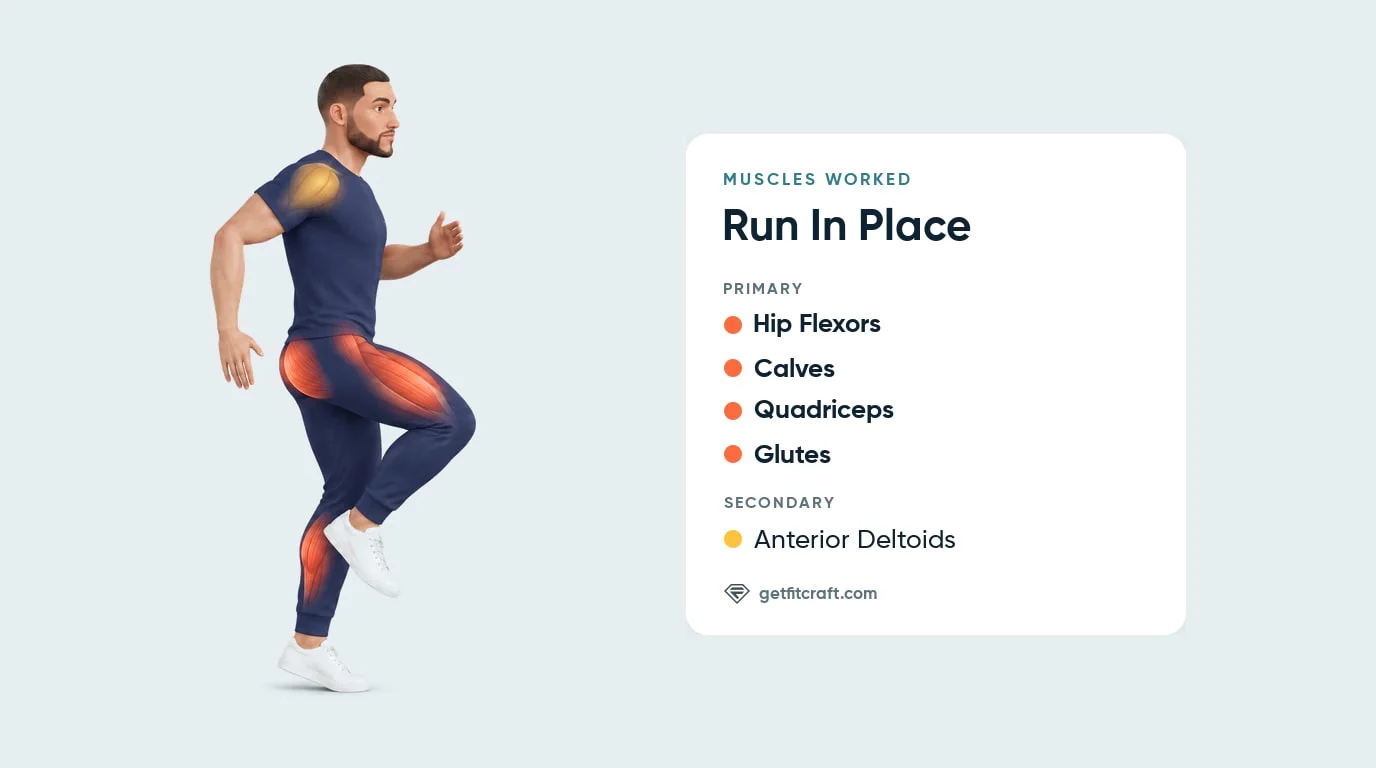
Primary movers: the hip flexors, at the fronts of your hips, lift each knee. The calves push off and cushion each landing on the ball of your foot. The quadriceps, at the fronts of your thighs, hold the landing knee and straighten it into the next step, and the glutes drive the leg back down toward the floor and steady your hip.
Secondary movers: the anterior deltoids, at the fronts of your shoulders, swing each arm forward with the opposite leg.
Pace and effort: in a study that compared stationary running in water and on dry land, Alberton et al. (2015) found the thigh muscles more active at maximal speed than at a slow pace, so a faster pace makes running in place harder work. The 2024 Adult Compendium of Physical Activities lists jogging in place at 4.8 METs. So the same drill can be a warm-up, a cardio block or a finisher, depending on how fast and how long you go.
Step-by-Step: How to Do Running in Place
Step 1: Stand Tall With Feet Hip-Width Apart
Start with your feet about hip-width apart under your hips, chest lifted, eyes forward, and elbows bent at about a right angle. Keep your shoulders relaxed so your arms can swing freely. Use a clear, non-slip floor and supportive shoes.
Tip: run tall, with your head up, chest up and shoulders relaxed and level.
Step 2: Lift One Knee to a Natural Running Height
Lift one knee to a comfortable running height, about halfway or a bit more toward hip level, with that heel drawn up under you. You do not need the hip-height knee drive of high knees, though a little higher is fine while you stay tall, and a lower lift is fine too.
Tip: drive each foot down under your hips, quick and light.
Step 3: Switch Legs in a Steady Jogging Rhythm
Switch legs with a small, light hop, landing on the ball of the other foot right under your hips with your knee a little bent. Your heel can touch down lightly. Keep the landings quiet at a steady jog of about two or three steps a second.
Tip: your heels can touch down lightly or stay just above the floor; both are fine.
Step 4: Swing Your Arms in Opposition
Swing the opposite arm and leg together: right knee with left arm, left knee with right arm. Keep the hands relaxed and the elbows bent at about a right angle, a little more or less is fine. A small natural turn of the shoulders as your arms swing is fine too.
Tip: swing your arms in rhythm with your legs, elbows bent.
Step 5: Breathe and Stop Before Form Breaks
Use a pace you can keep while running tall, upright or with a slight forward lean. Breathe in a steady, relaxed rhythm and never hold your breath. If your feet start to slap, you hunch forward, or you lean back, slow to a march until you recover.
Tip: when you finish, walk around slowly for a minute while your breathing settles.
Get this exercise in a personalized workout
FitCraft, our mobile fitness app, uses its AI coach Ty to program conditioning work like this into your plan at the right volume and intensity, based on your level, goals, and equipment. Ty was designed and trained by Domenic Angelino, MPH (Brown University) and NSCA-CSCS, with research published in the Journal of Strength and Conditioning Research and Medicine & Science in Sports & Exercise.
Take the Free Assessment Free · 2 minutes · No credit card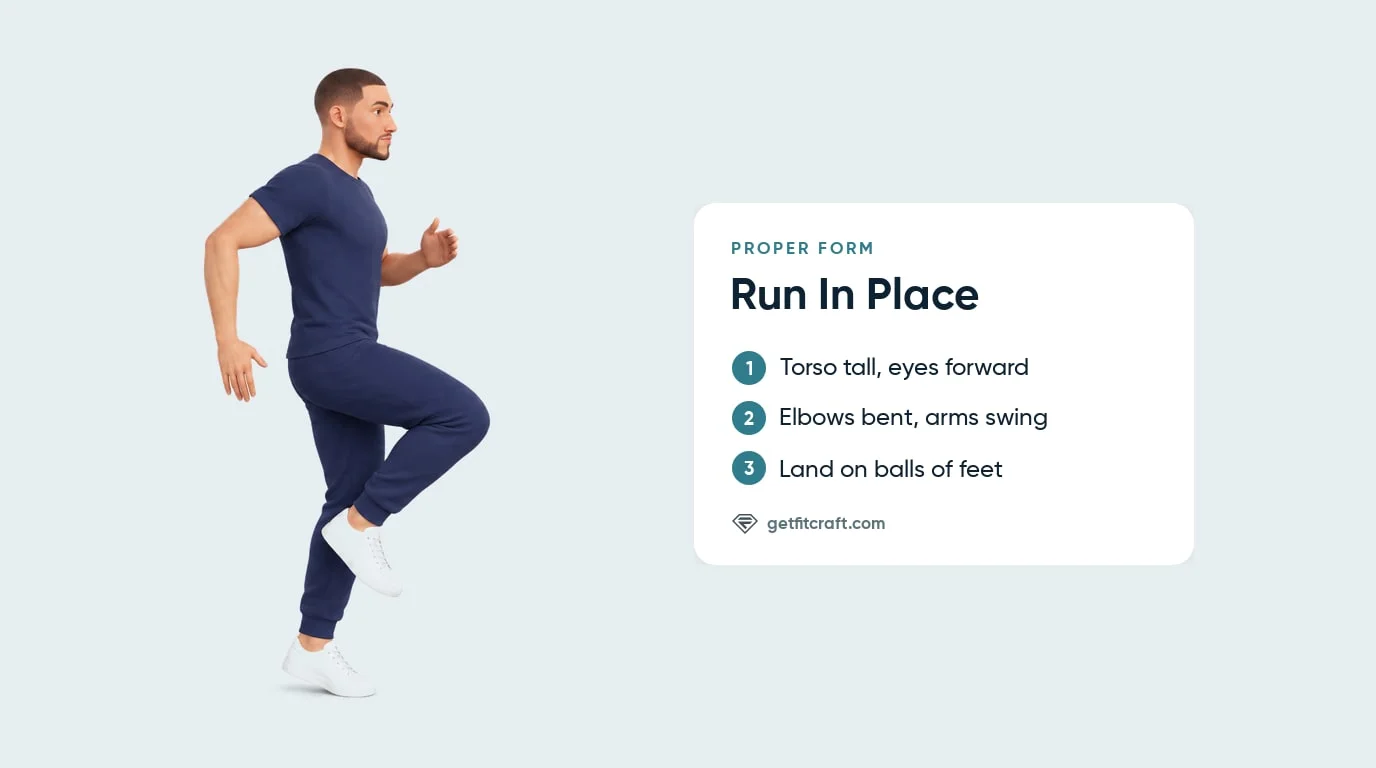
Common Mistakes (and How to Fix Them)
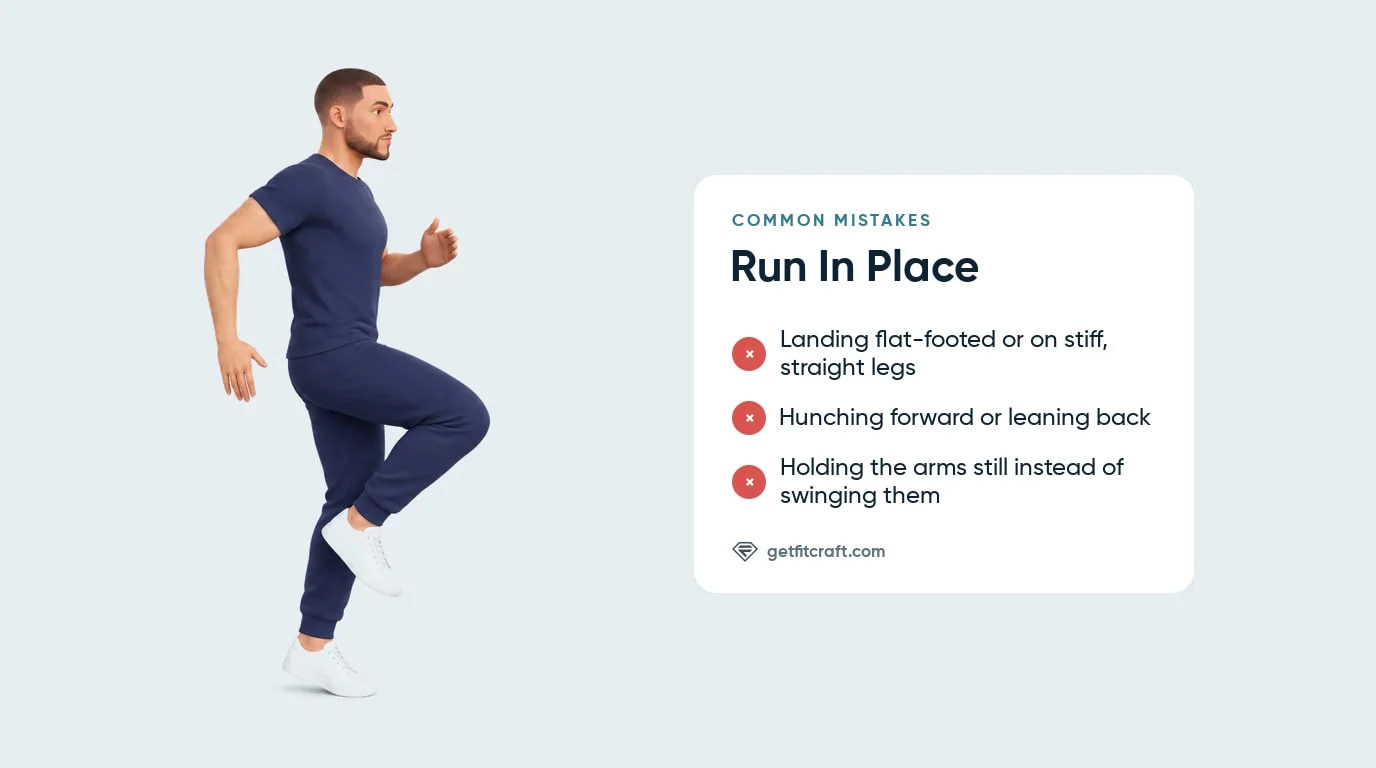
- Landing flat-footed or on stiff, straight legs. Stiff, flat-footed landings land harder. Fix it by landing softly on the balls of your feet with your knees a little bent, and let your heels touch down lightly.
- Hunching forward or leaning back. Run tall, upright or with a slight forward lean, and slow down if you start to fold over.
- Freezing the arms. Keep your arms swinging: swing each arm forward and back with the opposite leg, elbows bent.
- Speeding up until the landings get sloppy. Go only as fast as your landings stay light and quiet, and add faster intervals only once they do.
- Holding your breath. Breathe in a steady, relaxed rhythm and never hold your breath.
- Ignoring pain signals. Burning legs and hard breathing during a planned interval are expected. Any pain in your feet, shins, knees, hips or back is a stop sign: stop the exercise right away.
Running in Place Variations: Regressions and Progressions
Choose the version that lets you keep a quiet landing and tall posture. Progress when that version feels controlled for the full work interval.
Marching in Place (Easier, No Hop)
March in place with no hop, swinging your arms. Use it when you want to keep moving with less bounce, or to catch your breath between faster rounds.
Walking in Place (Easier)
Walk in place at an easy pace. Use it between harder intervals, during warm-ups, or on days when you want movement without the hop.
Run in Place (Standard, Beginner in the App)
A light jog in place: each knee to a comfortable running height, a small hop between steps, and light landings under your hips. FitCraft's version jogs at about two and a half steps a second. This is the base version to master before you make it harder.
High Knees (Harder)
Drive each knee up to hip height and keep the same light landings.
Faster Pace (Harder)
Pick up the pace, keeping every landing light and quiet, and slow down as soon as your landings get heavy.
When to Avoid Running in Place or See a Doctor First
Run in place is safe for most healthy adults. A burn in your legs is normal; any pain in a joint, your shins, your lower back or your neck means stop the exercise. If any of the following apply, talk to a doctor or physical therapist before you run in place.
- Known cardiovascular disease or uncontrolled hypertension. Fast intervals can raise heart rate and blood pressure quickly. Get medical clearance first and stay within the heart-rate zones your doctor gives you.
- Knee, ankle, foot, shin, or plantar fascia pain. Repeated landings load all of these. Any pain in them means stop; see a doctor or physical therapist and start again only once they clear you.
- Pregnancy or early postpartum recovery. Ask your doctor or midwife whether running in place suits you at each stage, and after giving birth get clearance from your doctor or a pelvic floor physical therapist before you hop again.
- Stress incontinence or pelvic-floor symptoms. Running in place can bring on leakage for some people. See a doctor or pelvic floor physical therapist before you run in place.
- Vertigo, balance disorders, or vestibular symptoms. Fast alternating steps can raise the risk of a fall. Ask your doctor before running in place, and stop right away if you feel dizzy or unsteady.
- Asthma or exercise-induced bronchoconstriction. Check with your doctor before you start, and follow their advice on intensity and any prescribed medication. Stop right away if you feel dizzy, lightheaded or can't catch your breath.
Related Exercises
If running in place fits your workout, try these exercises too:
- The easier options: Marching in Place and Walking in Place keep you moving with no hop.
- The harder options: High Knees and High Knee Running, with the knees driven higher.
- Another jog in place: Butt Kicks, kicking the heels up behind you.
- Core exercises to pair with your cardio: Forearm Planks and Deadbugs.
- For your calves: Calf Raises and Calf Hops.
How to Program Running in Place
For conditioning work, treat run in place as an interval tool or a short, steady cardio block. No study gives work or rest times for running in place, so treat the table below as a practical starting point.
| Version | Work | Rest between sets | Frequency |
|---|---|---|---|
| Easier (marching in place or shorter intervals) | 20-30 sec | 60-90 sec | 2-3 sessions/week |
| Run in place (Beginner in the app) | 30-45 sec | 45-60 sec | 3-4 sessions/week |
| Harder (faster pace or high knees) | 45-60 sec | 30-45 sec | 3-5 sessions/week |
Where in your workout: use run in place as a 3 to 5 minute warm-up, a standalone interval block, or a short finisher after strength work. If lower-body strength is the main goal for the day, do heavy strength work first and save faster intervals for the end.
Form first: end the interval when your feet get loud or you start to hunch, and stop the exercise for any pain. A shorter round with light landings is better than a longer one with heavy landings.
How FitCraft Programs This Exercise
Run in place is useful when you need cardio without equipment or much space. FitCraft maps your level, goals, and equipment during the diagnostic and builds a plan around them. The app has one run in place exercise, rated Beginner, and can include it in your plan.
Its 3D demonstration jogs at about two and a half steps a second, with each thigh lifted to a comfortable running height, a small hop between steps, and the feet landing under the hips. The app also has marching in place, walking in place, high knees and butt kicks.
Frequently Asked Questions
Is run in place a good exercise?
Yes. Running in place raises your heart rate in a small space with no equipment, as long as you keep a steady pace and light landings under your hips. It works well for warm-ups, low-space cardio, and interval circuits.
What muscles does run in place work?
Run in place works the hip flexors, calves, quadriceps and glutes, with the anterior deltoids helping. The fronts of your hips lift each knee, your calves push off and cushion each landing, the fronts of your thighs hold the landing knee and straighten it into the next step, and your glutes drive each leg back down toward the floor and steady your hip. The fronts of your shoulders swing your arms forward.
Is run in place as good as running outside?
Running in place raises your heart rate in a small space, but you stay in one spot instead of moving forward, so it is not the same as running outside. It is a good choice when space, weather or equipment limits you.
How long should I run in place for a workout?
Start with 3 to 5 minutes at an easy pace if you are new. For conditioning, use work intervals of 20 to 60 seconds with planned rest, starting short and building up while your landings stay light.
Can I run in place with knee, ankle, or shin pain?
No. Any pain in your knees, ankles, feet or shins while you run in place means stop the exercise; a burn in your leg muscles is normal. See a doctor or physical therapist, and start again only once they clear you.