Your back does more than help you stand tall. It keeps your trunk from collapsing forward when you carry groceries, sit at a desk, hinge to pick something up, or brace during harder strength work.
Superman holds train that back-body endurance with no equipment. You lie face down, lift the arms and legs slightly, and hold a long position while the spinal erectors and glutes work isometrically.
The exercise is useful, but it is not a contest to lift as high as possible. Small range, steady breath, and clean tension beat a dramatic arch every time.
Quick Facts: Superman Holds
- Equipment needed: None
- Difficulty: Beginner to Intermediate
- Modality: Core strength
- Body region: Posterior chain and core
- FitCraft quest category: Core
Muscles Worked
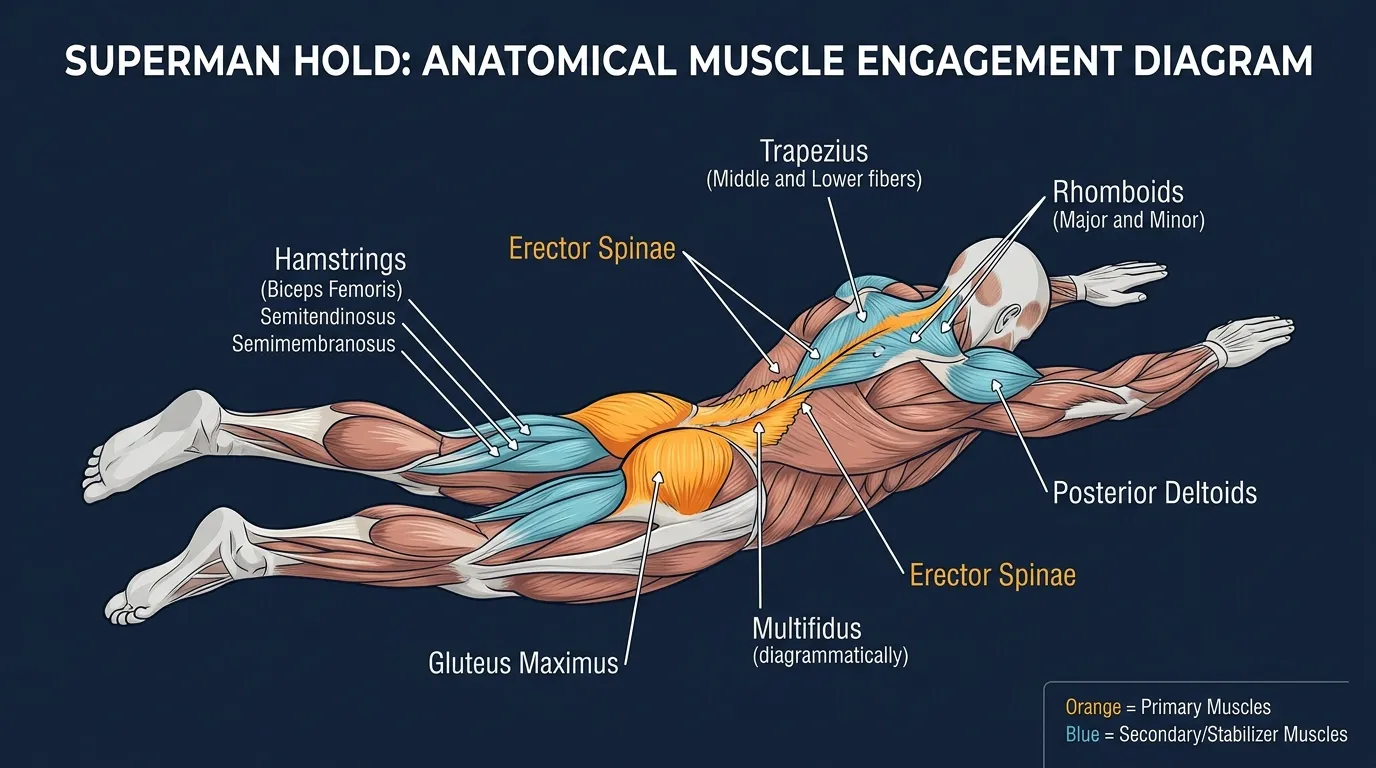
Primary movers: the spinal erectors and gluteus maximus. They hold the trunk and hips in extension while you hover above the floor. Because this is an isometric hold, the main training stimulus comes from sustained tension rather than a large concentric and eccentric phase.
Secondary movers: the hamstrings assist the glutes with hip extension, while the posterior deltoids, lower trapezius, rhomboids, and lats help keep the arms long and the shoulder blades controlled.
Stabilizers: the diaphragm, pelvic floor, transverse abdominis, obliques, and deep spinal stabilizers keep the ribs and pelvis from flaring apart. The breath matters here. Quiet exhales help maintain trunk pressure without turning the hold into a breath-holding strain.
Mechanism: superman holds are useful because they load prone spinal extension with a long lever. Reaching the arms and legs away from the torso increases the demand on the erectors and glutes even when the lift height is small. A lower, longer hold usually trains the target muscles better than a high arch that shifts stress into the lumbar joints.
Step-by-Step: How to Perform Superman Holds
Use the smallest range of motion that lets you feel your glutes, lower back, and upper back working without pinching.
Step 1: Set Your Starting Position
Lie face down on a mat or flat surface. Reach your arms forward with palms down and extend your legs behind you. Keep your forehead or gaze angled toward the floor so your neck starts in line with your spine.
Step 2: Brace and Squeeze Your Glutes
Before you lift, create light tension through your trunk and hips. Squeeze your glutes, draw your ribs down slightly, and keep your belly from fully relaxing into the floor.
Coach Ty's cue: "Engage your glutes and lower back as you raise your legs and chest off the floor."
Step 3: Lift Arms and Legs Together
Exhale and lift your chest, arms, and legs a few inches from the floor at the same time. Reach forward through your fingertips and backward through your toes. Height is secondary.
Ty's cue: "Point your toes and extend your arms forward to create a long line from fingertips to toes."
Step 4: Hold with Steady Breathing
Hold the raised position while breathing normally. Keep your glutes active, your ribs controlled, and your gaze down. If you feel your lower back pinch, lower your chest and legs slightly.
Ty's cue: "Hold the pose, but don't hold your breath. Keep breathing steadily."
Ty's neck cue: "Keep your neck neutral. Gaze down at the floor to avoid straining it."
Step 5: Lower with Control and Reset
Lower your chest, arms, and legs slowly to the floor. Rest long enough to reset your breath, then repeat. End the set when the hold turns into a forced arch or your breathing stops.
Get this exercise in a personalized workout
FitCraft, our mobile fitness app, uses its AI coach Ty to program core stability work like this into your plan at the right volume and intensity, based on your level, goals, and equipment. Ty was designed and trained by Domenic Angelino, MPH (Brown University) and NSCA-CSCS, with research published in the Journal of Strength and Conditioning Research and Medicine & Science in Sports & Exercise.
Take the Free Assessment Free · 2 minutes · No credit card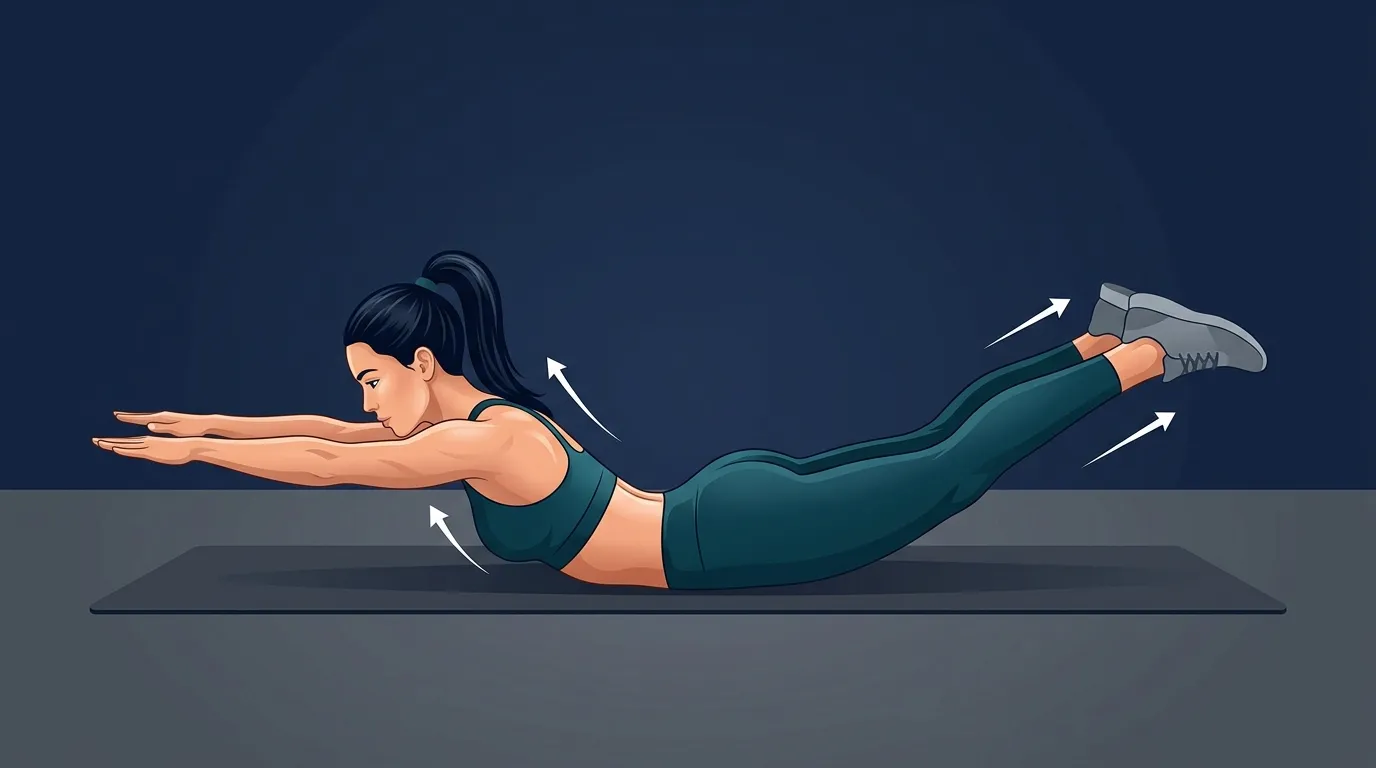
Common Mistakes (and How to Fix Them)
Most superman hold mistakes come from chasing height instead of tension.
- Cranking your neck upward. Looking forward turns the hold into cervical extension. Fix: keep your gaze on the floor and your neck in line with your spine.
- Lifting too high. A dramatic arch can compress the lower back. Fix: lift only a few inches and reach longer through the arms and legs.
- Holding your breath. Breath-holding increases pressure and makes the hold harder to control. Fix: use slow exhales through the full hold.
- Letting the glutes switch off. If the glutes relax, the lower back takes more of the load. Fix: squeeze the glutes before you lift and keep that squeeze through the hold.
- Using momentum to pop up. Jerking off the floor hides weak control. Fix: lift slowly, pause, and lower slowly.
- Holding past form failure. When the ribs flare, knees bend, or one side drops, the set is done. Short clean holds build better endurance than long strained ones.
Superman Hold Variations
Pick the variation that lets you feel the target muscles without lower-back irritation.
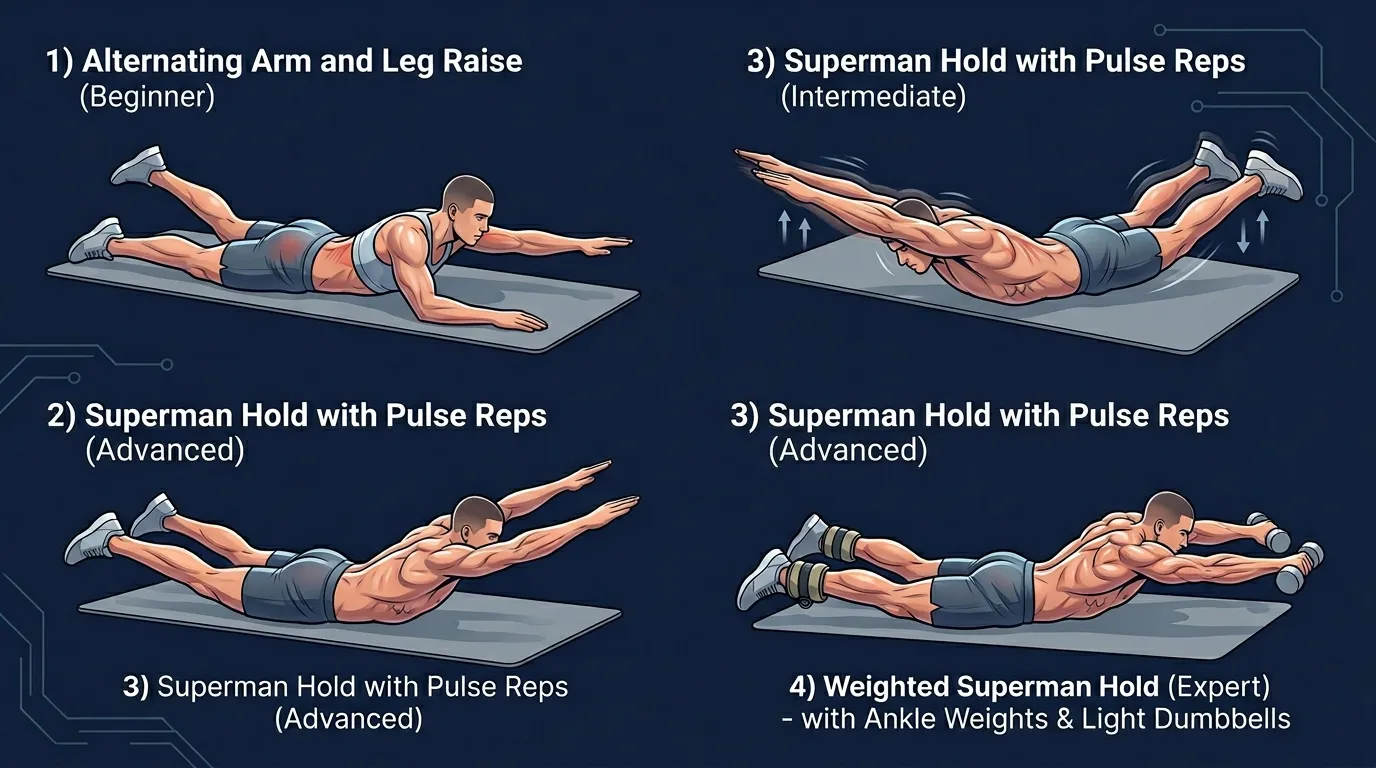
Alternating Superman (Beginner Regression)
Lift the right arm and left leg, lower, then switch sides. This reduces the spinal-extension demand while teaching the same cross-body control.
Low Superman Hold (Back-Friendly Regression)
Lift only the chest or only the legs, or keep the arms bent by your sides. Use this if the full long-lever version feels too intense.
Superman Hold (Standard)
Lift both arms and both legs a few inches and hold for time. Progress when you can complete 3 sets of 20-30 seconds with steady breathing and no pinching.
Superman Pulses (Advanced Progression)
From the raised position, pulse up and down one inch with control. Keep the pulse small so the movement stays muscular instead of bouncy.
Weighted Superman Hold (Advanced)
Hold a very light object in your hands or wear light ankle weights. Add load only after standard holds feel smooth and symptom-free.
When to Avoid or Modify Superman Holds
Superman holds are safe for many healthy adults, but spinal-extension work deserves respect. Always consult your physician or physical therapist for personalized guidance, especially if back extension reproduces pain.
- Acute lower-back pain or known disc pathology. Full prone extension can aggravate symptoms. Substitute bird-dogs, deadbugs, or a chest-only low lift until a clinician clears more range.
- Lower-back pinching during the hold. Reduce the lift height, bend your elbows, squeeze your glutes harder, or switch to glute bridges for hip-extension work without spinal extension.
- First 6-8 weeks postpartum or active diastasis recti. Prone extension can increase abdominal pressure if bracing is not restored. Rebuild with diaphragmatic breathing, deadbugs, and bird-dogs first.
- Recent abdominal surgery, hernia, or pelvic-floor dysfunction. Get medical clearance before loaded or long-duration trunk holds. Start with gentle breathing and low-pressure core drills.
- Pregnancy after the first trimester. Prolonged prone positions are not appropriate. Use side-lying, quadruped, or standing alternatives prescribed by a qualified professional.
- Neck pain that flares with extension. Keep the gaze down and the lift small. If symptoms continue, use cobra pose only within a comfortable range or choose bird-dogs instead.
Related Exercises
Use these exercises to build the same posterior-chain and core-control qualities from different angles:
- Same prone extension pattern: Back Extensions use a similar back-body pattern with more adjustable range and loading.
- Easier spinal-control regression: Bird-Dogs train the back, glutes, and deep core from hands and knees with less extension stress.
- Anterior core balance: Deadbugs, Forearm Planks, and Hollow Holds build the anti-extension strength that balances prone back work.
- Glute foundation: Glute Bridges strengthen hip extension without asking the lower back to arch.
- Loaded hinge progression: Romanian Deadlifts and Good Mornings train posterior-chain strength with external load once bracing is solid.
How to Program Superman Holds
Use superman holds as a trunk-endurance drill instead of a max-effort backbend. The American College of Sports Medicine's resistance-training progression model supports matching sets, hold duration, rest, and weekly frequency to the trainee's level (Ratamess et al., 2009).
| Level | Sets × Reps | Rest between sets | Frequency |
|---|---|---|---|
| Beginner | 2-3 × 5-15 second holds | 45-60 seconds | 2-4 sessions/week |
| Intermediate | 3 × 15-30 second holds | 60 seconds | 3-5 sessions/week |
| Advanced | 3-5 × 30-60 second holds or controlled pulses | 60-90 seconds | 4-6 sessions/week |
Where in your workout: Put superman holds near the end of a resistance-training session, in a dedicated core block, or as low-volume activation before hinge work. Avoid fatiguing your spinal erectors before heavy deadlifts, squats, or rows.
Form floor over time targets: stop the hold when your neck reaches, your breath locks, your lower back pinches, or one side drops. A crisp 10-second hold is better than a strained 45-second hold.
How FitCraft Programs This Exercise
Knowing how to do superman holds is step one. Knowing when to use them, how long to hold, and when to progress is where most people get stuck.
FitCraft's AI coach Ty handles that. During your personalized diagnostic assessment, Ty maps your fitness level, goals, and available equipment. Then Ty builds a personalized program that slots core and posterior-chain work into a balanced training plan.
As you get stronger, Ty adjusts the variation and volume to match your level. Short holds become longer holds. Regressions become standard holds. Standard holds can progress to pulses or light load when your form stays clean. Every program is designed by an Ivy League-trained exercise scientist and NSCA-certified strength coach using evidence-based periodization, then adapted to you by the AI.
Frequently Asked Questions
What muscles do superman holds work?
Superman holds primarily work the spinal erectors, glutes, and posterior deltoids. The hamstrings, upper-back muscles, deep abdominals, diaphragm, and pelvic floor help stabilize the position while you hold your arms and legs off the floor.
How long should a beginner hold a superman hold?
Start with 5 to 10 second holds or alternating arm-and-leg lifts. Build toward 15 to 30 seconds only when you can keep your neck neutral, breathe steadily, and lift without pinching your lower back.
Can I do superman holds with lower-back pain?
Avoid full superman holds during acute lower-back pain, radiating symptoms, or known disc pathology unless a clinician has cleared them. Try bird-dogs, deadbugs, or a smaller chest-only lift first, and stop if extension increases symptoms.
Should my legs lift high during superman holds?
No. A small lift is enough. Reaching long through the toes and squeezing the glutes matters more than lifting high. If your lower back pinches or your knees bend, lower the height.
Are superman holds better than bird-dogs?
They train related muscles, but they are not interchangeable. Superman holds are prone spinal-extension holds with more back-body demand. Bird-dogs are usually easier to control because they train anti-rotation from hands and knees.