The prone W raise is a light, body-weight shoulder-blade exercise done lying face down, holding both arms a few inches off the floor in a W with the elbows bent. It works the middle trapezius, lower trapezius, rhomboids, posterior deltoids, and rotator cuff. The defining cue is simple: keep your forehead and chest on the floor, draw your shoulder blades back and down, and lift only your arms, without shrugging. The FitCraft app rates it Beginner and plays it as a hold for the time your workout sets. To make it easier, lift your arms only an inch or two and hold for less time; to make it harder, hold longer or move on to the T raise or Y raise.
The prone W raise trains the muscles that pull your shoulder blades back and down and keep your arms turned out, with body weight only. It works well as a warmup before pressing or overhead work, or as an accessory exercise.
Quick Facts: Prone W Raises
- Equipment needed: None; exercise mat optional
- Difficulty: Beginner (as rated in the FitCraft app)
- Modality: Strength and shoulder stability
- Body region: Upper back and shoulders
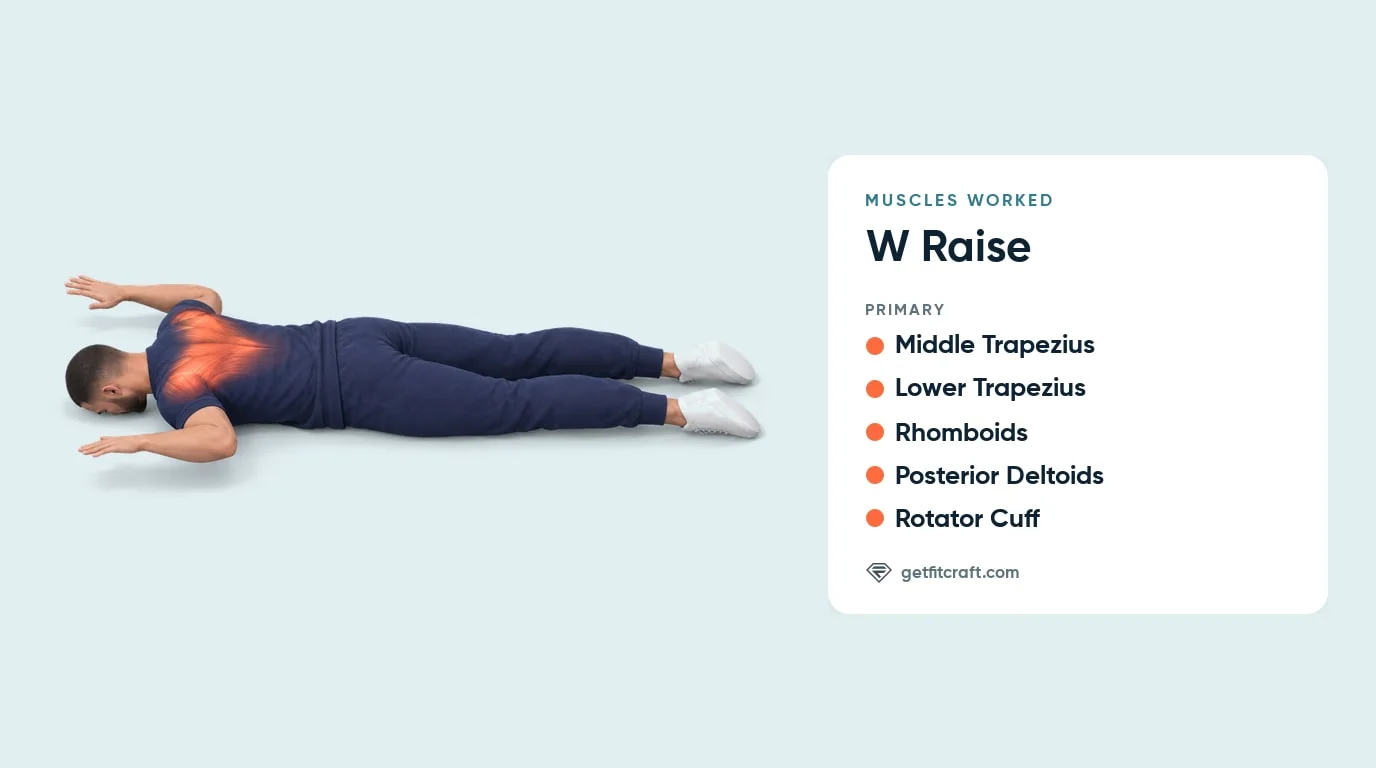
Muscles Worked
Primary movers: five muscles work together for the whole hold: the middle trapezius, lower trapezius, rhomboids, posterior (rear) deltoids, and rotator cuff. The middle trapezius and rhomboids, between your shoulder blades, squeeze the shoulder blades together. The lower trapezius, below them, draws the shoulder blades down so your shoulders stay away from your ears. The posterior deltoids, at the backs of your shoulders, hold your upper arms up and back off the floor. The rotator cuff, the small muscles on your shoulder blades, holds your arms turned out so your forearms and hands stay up off the floor.
Why the elbows bend: Bending your elbows shortens the lever compared with the straight-arm T raise, so you can focus on drawing your shoulder blades back and down and keeping your arms turned out instead of chasing height.
Step-by-Step: How to Do a Prone W Raise
- Lie face down and set your arms. Lie face down on a mat with your legs long and the tops of your feet on the floor. Set your arms out to the sides in a W: upper arms about 45 to 60 degrees out from your body, elbows bent so your hands sit about level with your head, palms facing the floor.
Tip: Keep your upper arms below shoulder height. Palms facing the floor or thumbs turned up are both fine.
- Set your head and brace gently. Rest your forehead on the floor or a folded towel so your neck stays long. Brace your abs gently and keep your chest and hips on the floor.
Tip: Do not lift your head to look forward. Keep your eyes on the floor.
- Lift your arms off the floor. Draw your shoulder blades back and down, then lift both arms a few inches off the floor in the W, elbows and hands at the same time, with the elbows still bent.
Tip: Lift only as high as you can without your back arching. Your chest stays on the floor.
- Hold the W. Hold the position for the time your workout sets, breathing slowly and steadily. You should feel it between and below your shoulder blades and in the backs of your shoulders, with no pain in your shoulders, neck, or lower back.
Tip: Keep your shoulder blades drawn back and down, toward your back pockets, and your shoulders away from your ears.
- Lower with control. When the hold ends, lower your arms slowly to the floor. A few shorter holds with a short rest between are fine too.
Tip: If your hands start to drop or the W slips during the hold, lower your arms, rest a moment, and lift again.
Get this exercise in a personalized workout
FitCraft, our mobile fitness app, uses its AI coach Ty to program isolation exercises like this into your plan at the right volume and intensity, based on your level, goals, and equipment. Ty was designed and trained by Domenic Angelino, MPH (Brown University) and NSCA-CSCS, with research published in the Journal of Strength and Conditioning Research and Medicine & Science in Sports & Exercise.
Take the Free Assessment Free • 2 minutes • No credit card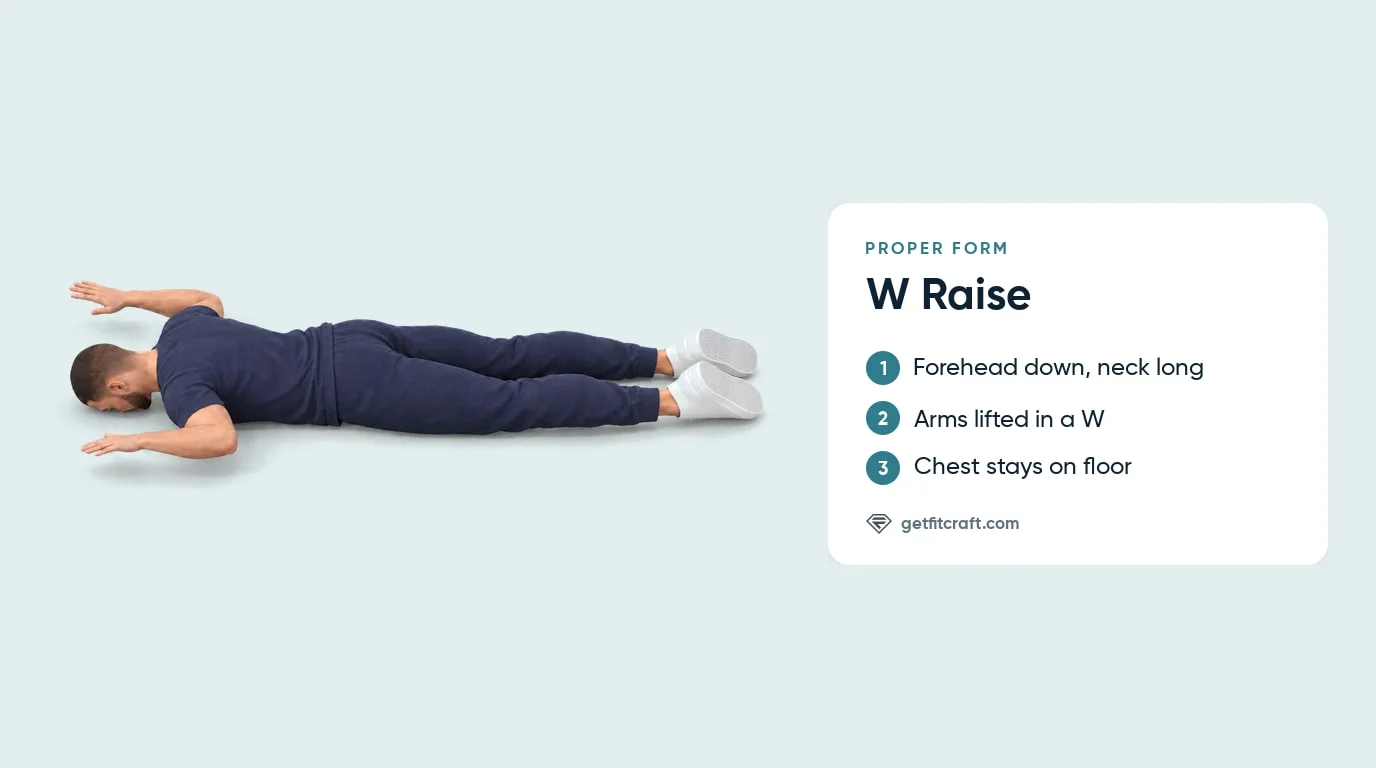
Common Mistakes and How to Fix Them
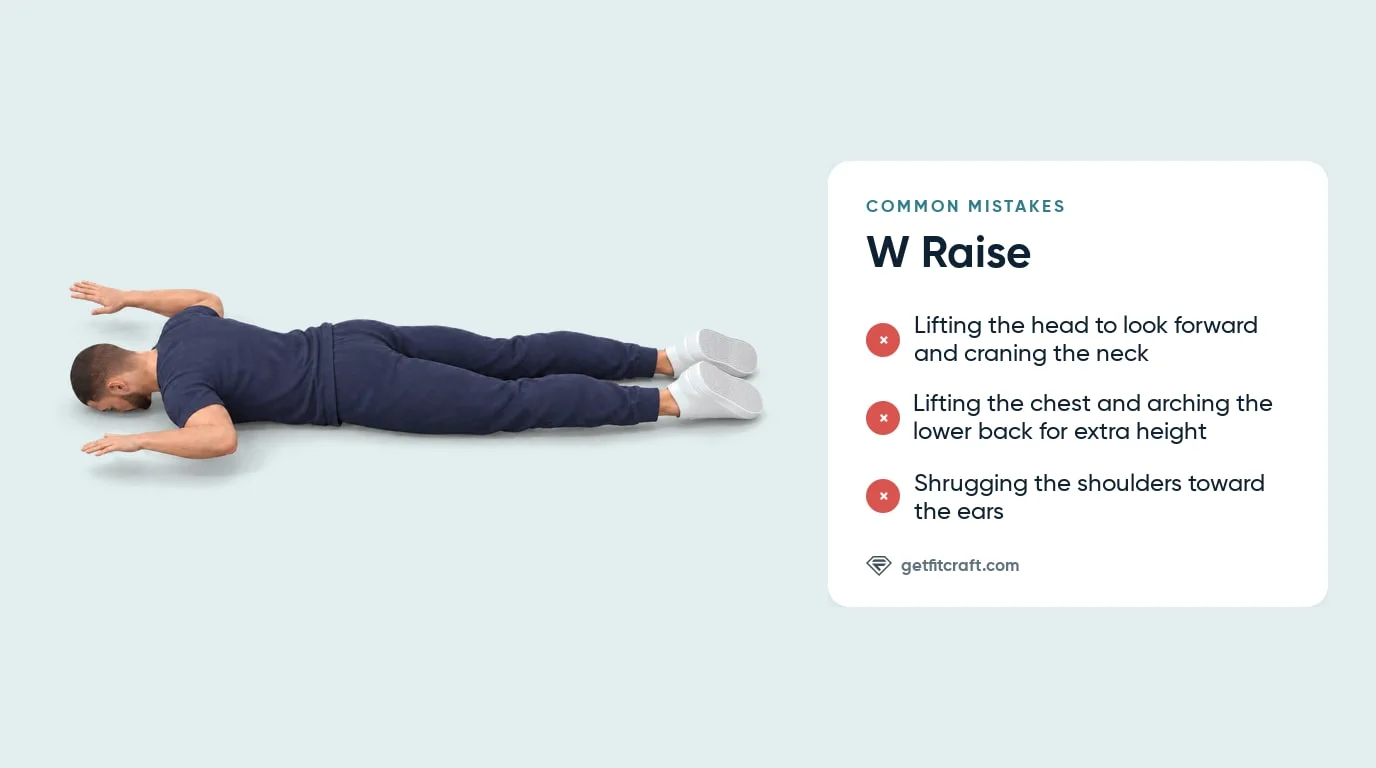
Shrugging the Shoulders Up
What it looks like: The shoulders hike toward the ears as the arms leave the floor.
Why it's a problem: Shrugging shifts the work into your neck, and the muscles between your shoulder blades do less of the work.
The fix: Pull your shoulders away from your ears before you lift. If the shrug returns, lift your arms a little lower and make the hold shorter. If your neck feels tense, check that your forehead is down, your eyes are on the floor, and your shoulders are away from your ears.
Losing the W Shape
What it looks like: The elbows drift in toward your sides, or the arms straighten toward a T raise.
Why it's a problem: The W raise depends on a bent-elbow position. When that shape changes, your arms stop being held turned out, and the exercise changes.
The fix: Set the W before you lift, with your elbows bent and your hands about level with your head. If the shape slips during the hold, lower your arms and reset it.
Lifting the Chest Off the Floor
What it looks like: The rib cage peels away from the mat and the lower back arches to create extra height.
Why it's a problem: The low back starts helping, and the shoulder muscles no longer have to control the whole movement.
The fix: Keep the forehead down, squeeze the glutes lightly, and accept a smaller range. Height matters less than a clean shoulder-blade squeeze.
Lifting Your Head
What it looks like: You raise your head to look forward, bending your neck back.
Why it's a problem: Your neck leaves its long, neutral line, and the chest often lifts with it.
The fix: Rest your forehead on the floor or a folded towel, or hover it just above with your eyes on the floor.
Hands Dropping Mid-Hold
What it looks like: Your hands sink back to the floor partway through the hold.
Why it's a problem: Once the hands drop, the muscles around your shoulder blades stop holding the W.
The fix: Lower your arms, rest a moment, and lift again with a shorter hold.
Holding Your Breath
What it looks like: You stop breathing to keep your arms up.
Why it's a problem: The hold gets harder to keep steady, and tension creeps into your neck.
The fix: Keep breathing slowly and steadily the whole time you hold the W.
Prone W Raise Variations: Regressions and Progressions
Shorter Holds (Easier)
Lift your arms just an inch or two off the floor and hold for less time, then lower, rest a moment, and lift again. The American Council on Exercise describes the prone W with holds of 5 to 10 seconds, repeated 2 to 4 times.
W Raise Hold (Beginner)
The standard version described above: lift into the W and hold it for the time your workout sets, breathing the whole way. The FitCraft app plays it as a hold and rates it Beginner.
Longer Holds (Harder)
Hold the W a little longer each time, but only while your forehead and chest stay down and your hands stay up.
T Raise and Y Raise (Harder)
The T raise holds straight arms out to the sides and the Y raise reaches straight arms overhead in a Y, both from the same face-down position. The straight arms make a longer lever, so both are harder than the bent-elbow W, although the FitCraft app rates all three Beginner. You can also do them one after another with I raises as a shoulder-blade sequence.
When to Avoid or Modify Prone W Raises
Stop at any pain in a joint, your lower back or your neck; a burn between and below your shoulder blades is normal. With any of the conditions below, see a doctor or physical therapist before you do W raises.
- Shoulder pain or pinching. Any shoulder pain or pinching during the lift means stop. See a doctor or physical therapist before you do W raises again.
- Recent shoulder surgery or acute rotator cuff injury. Get clearance from your surgeon or physical therapist before you do W raises; they decide how you return.
- Neck pain. Any neck pain means stop; see a doctor or physical therapist before you do W raises again.
- Lower-back pain. Any lower back pain means stop. See a doctor or physical therapist before you do W raises again.
- Pregnancy. This exercise is done lying face down. Ask your doctor or midwife before you do W raises while pregnant.
- Loss of arm position under fatigue. End the hold when the W shape disappears or your hands drop. Quality matters more than a longer hold for this drill.
Related Exercises
- Same face-down series: Y raises, T raises, and I raises train nearby shoulder-blade patterns.
- Shoulder-blade health: Pull-aparts add band resistance for rear delts and mid-back control.
- Deltoid isolation: Lateral raises and front raises train other deltoid fibers with external load.
- Mobility pairing: Seated rear delt stretches help open the back of the shoulder after upper-body training.
- Shoulder extension pattern: Overhead pullovers train shoulder control through a larger range with external load.
How to Program Prone W Raises
Ratamess et al., 2009 outlines progression models for resistance training based on training status, volume, intensity, rest, and frequency. W raises use light load, so clean holds matter more than resistance. The paper gives no set or hold ranges for the W raise itself, so treat the table below as a practical starting point.
| Level | Holds | Rest between holds | Frequency |
|---|---|---|---|
| Easier (arms an inch or two up) | 2-4 short holds, lowering as soon as the W slips | 45-60 seconds | 2-3 sessions/week |
| Beginner (the W raise hold, as rated in the app) | 2-4 holds of 5-10 seconds, or the time your workout sets | 60-90 seconds | 2-4 sessions/week |
| Harder (longer holds) | 2-4 longer holds, only while the W stays clean | 60-120 seconds | 2-4 sessions/week |
Place prone W raises early as shoulder prep before pressing, rows, pull-ups, or overhead work. If you are using them as an accessory exercise, place them late in the session after larger upper-body lifts.
Put good form ahead of hold time. End the hold when your neck takes over, your head or chest lifts, your hands drop, or the W shape drifts.
Frequently Asked Questions
What muscles do prone W raises work?
Prone W raises work five muscles together: the middle trapezius, lower trapezius, rhomboids, posterior deltoids, and rotator cuff. The middle trapezius and rhomboids squeeze your shoulder blades together, the lower trapezius draws them down, the posterior deltoids hold your upper arms up and back, and the rotator cuff holds your arms turned out so your forearms and hands stay up off the floor.
Can I do prone W raises with shoulder pain?
Not while your shoulder hurts. A burn between and below your shoulder blades is normal, but any pain in your shoulder, neck, or lower back means stop. If your shoulder hurts, see a doctor or physical therapist before you do W raises again.
Why do prone W raises lying down instead of standing?
Lying face down makes your arms lift against gravity, so the muscles between and below your shoulder blades and at the backs of your shoulders have to hold them up.
Do I need weights for prone W raises?
No. The FitCraft app does the W raise with body weight only. When the hold gets easy, hold the W a little longer, or move on to the T raise or the Y raise, whose straight arms make them harder.
How do W raises compare with Y raises and T raises?
All three are done lying face down. The Y raise reaches straight arms overhead in a Y, the T raise holds straight arms out to the sides, and the W raise bends the elbows so the hands sit about level with the head, with the rotator cuff holding the arms turned out. The bent elbows shorten the lever, so the W is the easiest of the three, although the FitCraft app rates all three Beginner.