Side planks train the part of core strength most people miss: resisting side bending. That matters any time you carry a bag in one hand, cut sideways in sport, climb stairs, or keep your pelvis level while walking.
They look simple, but they expose weak links fast. If your shoulder is unstable, your hips sag. If your gluteus medius is undertrained, your pelvis rolls. If you hold your breath, the position falls apart before your obliques get useful work.
Use side planks as a clean lateral core drill. Short, controlled holds beat long, collapsed holds every time.
Quick Facts: Side Planks
- Equipment needed: None
- Difficulty: Beginner (knee-supported) to Advanced (full hold and dynamic variations)
- Modality: Core strength
- Body region: Core, hips, and shoulder girdle
- FitCraft quest category: Strength
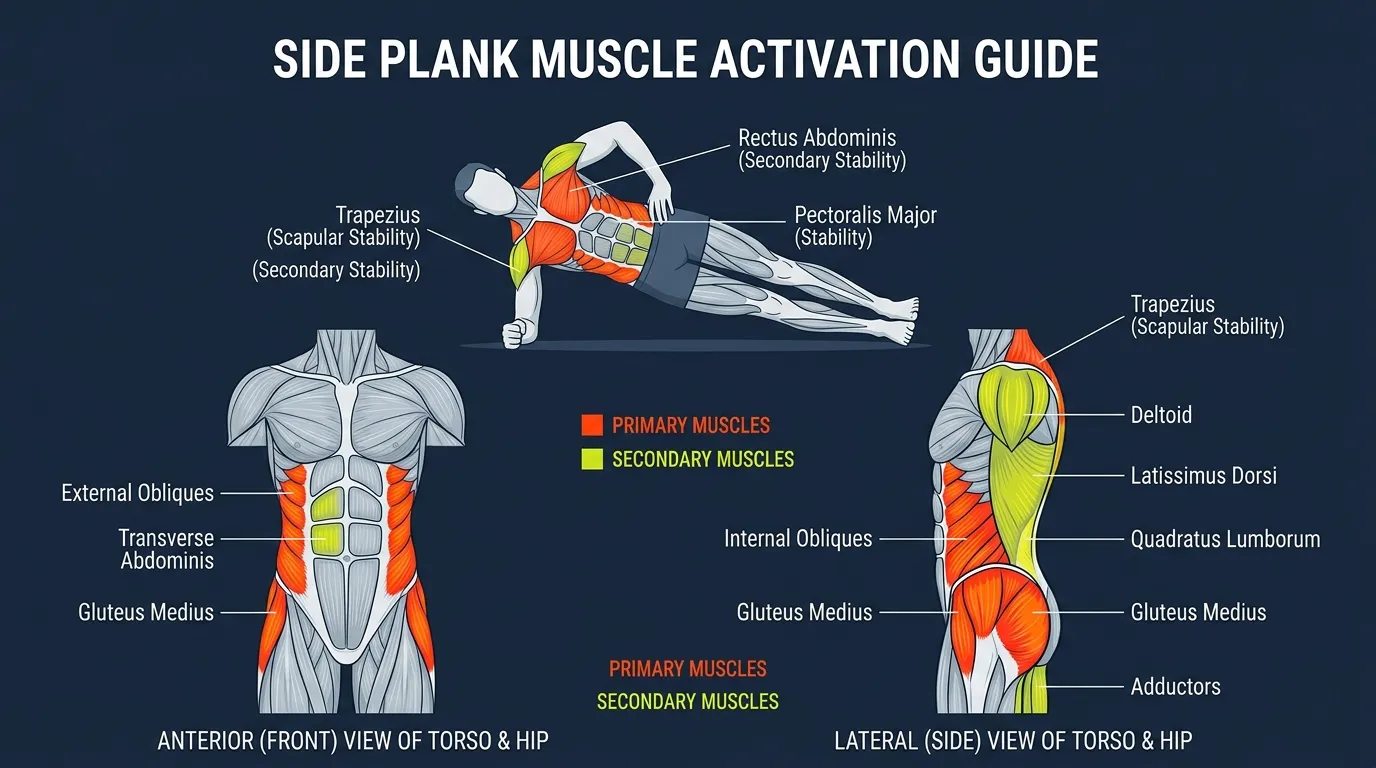
Muscles Worked
Primary movers: the internal and external obliques, quadratus lumborum, and gluteus medius. In a side plank, these muscles work mostly isometrically. They don't shorten and lengthen through a big range. They create force to keep the rib cage, pelvis, and hips from dropping toward the floor.
Secondary movers: the transverse abdominis, rectus abdominis, hip abductors, gluteus maximus, and adductors. These muscles help lock the pelvis in place, keep the legs stacked, and stop the torso from rotating forward or backward as fatigue builds.
Stabilizers: the supporting shoulder complex does real work here. The deltoids, rotator cuff, serratus anterior, lower trapezius, and forearm muscles hold the elbow-under-shoulder base. The diaphragm and pelvic floor help regulate pressure, and steady exhaling helps the deep core stay braced without breath-holding.
Mechanism: side planks are an anti-lateral-flexion exercise. Instead of bending the spine, you resist bending. That makes them useful for training trunk stiffness, side-to-side symmetry, and hip control without repeated spinal flexion. No exercise-specific PubMed, PMC, or DOI citation is included for side planks in the verified FitCraft citation library, so this section uses mechanism-based biomechanics instead of a proxy citation.
Step-by-Step: How to Perform Side Planks
The side plank is a position drill. Set the stack first, then hold only as long as the stack stays clean.
Step 1: Set Up on Your Side
Lie on your side with your forearm flat on the floor and your elbow directly beneath your shoulder. Your forearm should point forward, perpendicular to your torso. Stack your feet for the full version, or place the top foot slightly in front for more balance.
Coach Ty's cue: "Make sure your elbow is directly underneath your shoulder."
Step 2: Brace Your Core and Glutes
Before you lift, tighten your core and squeeze your glutes. Think ribs down, pelvis stacked, and hips ready to rise as one unit. This makes the hold feel stronger before the timer even starts.
Ty's cue: "Squeeze your glutes to help maintain your balance."
Ty's cue: "Tighten your core to maintain a straight line from head to heels."
Step 3: Lift Your Hips
Press through your forearm and the side of your bottom foot to lift your hips off the floor. Stop when your body forms a straight line from the crown of your head through your heels. Keep the shoulder away from your ear.
Ty's cue: "Don't let your hips sag. Keep them high to engage your core and side muscles."
Step 4: Hold With Steady Breathing
Keep your head in line with your spine, your ribs stacked over your pelvis, and your top shoulder directly above the bottom shoulder. Put your free hand on your hip, or raise it toward the ceiling if that helps you stay open through the chest.
Ty's cue: "Remember to breathe! Don't hold your breath while holding this position."
Ty's cue: "Don't let your head drop. Keep it in line with your spine."
Ty's cue: "Keep your free hand on your hip, or raise it towards the sky for an extra challenge."
Step 5: Lower and Switch Sides
Lower your hips with control instead of collapsing to the floor. Rest briefly, then repeat on the other side for the same hold time. Train the weaker side first if one side is clearly harder.
Ty's cue: "Stack your feet one on top of the other for more challenge, or place one in front for more balance."
Get this exercise in a personalized workout
FitCraft, our mobile fitness app, uses its AI coach Ty to program core stability work like this into your plan at the right volume and intensity, based on your level, goals, and equipment. Ty was designed and trained by Domenic Angelino, MPH (Brown University) and NSCA-CSCS, with research published in the Journal of Strength and Conditioning Research and Medicine & Science in Sports & Exercise.
Take the Free Assessment Free · 2 minutes · No credit card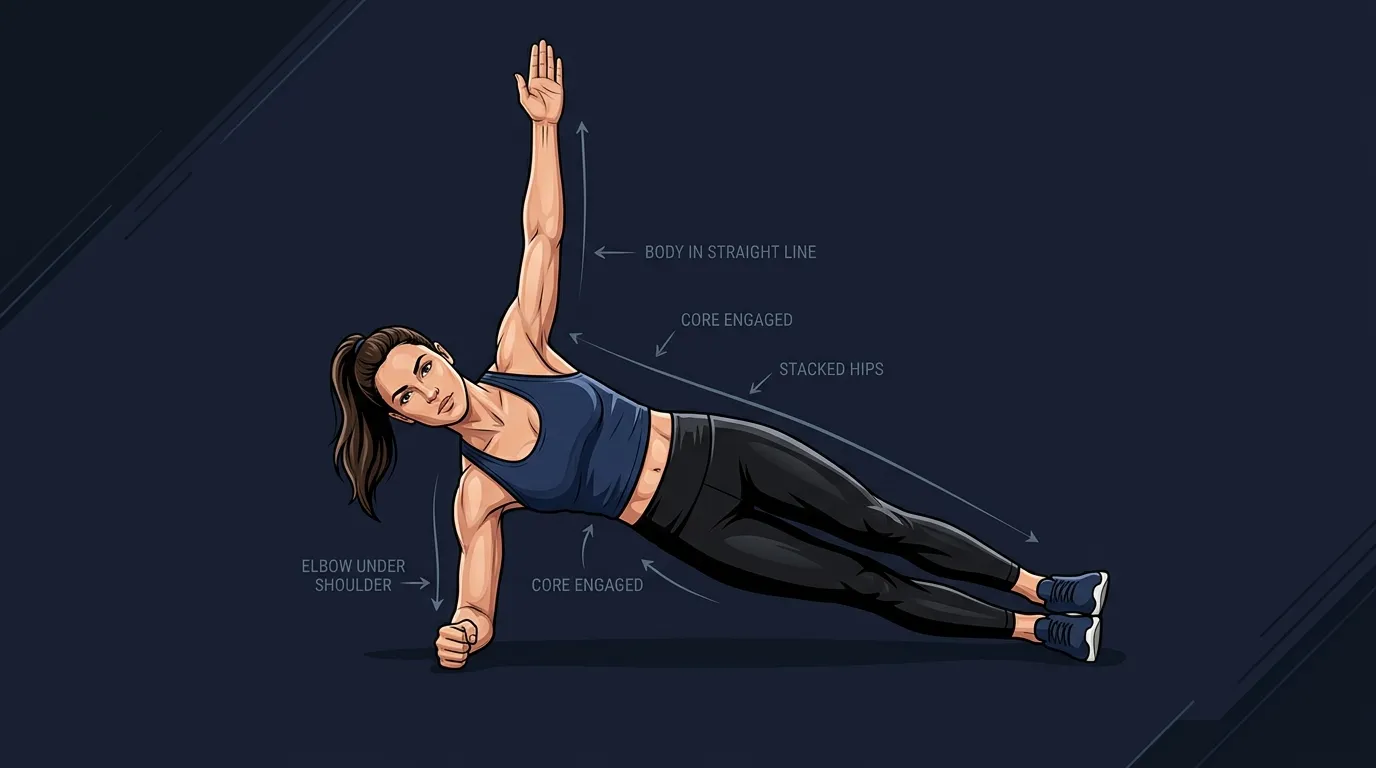
Common Mistakes (and How to Fix Them)
Most side plank errors show up as soon as fatigue starts. End the hold when these appear.
- Sagging hips. Your obliques and hip stabilizers stop holding the line, so your pelvis drops. Fix: drive the bottom hip away from the floor. If it drops again, stop the set.
- Elbow too far from the shoulder. A long or short base makes the shoulder work in a weaker position. Fix: reset with the elbow directly under the shoulder before every hold.
- Shoulder shrugging. The supporting shoulder creeps toward your ear as the arm fatigues. Fix: press the floor away and keep the neck long.
- Rolling forward or backward. Your torso should stay stacked, with the top shoulder over the bottom shoulder. Fix: imagine your back is against a wall and keep both hip bones facing forward.
- Holding your breath. Breath-holding can spike pressure and shorten the hold. Fix: exhale slowly through the hard part and keep the ribs from flaring.
- Chasing time after form breaks. Long holds with dropped hips train compensation. Fix: use shorter holds, knee-supported holds, or staggered feet until every second looks the same.
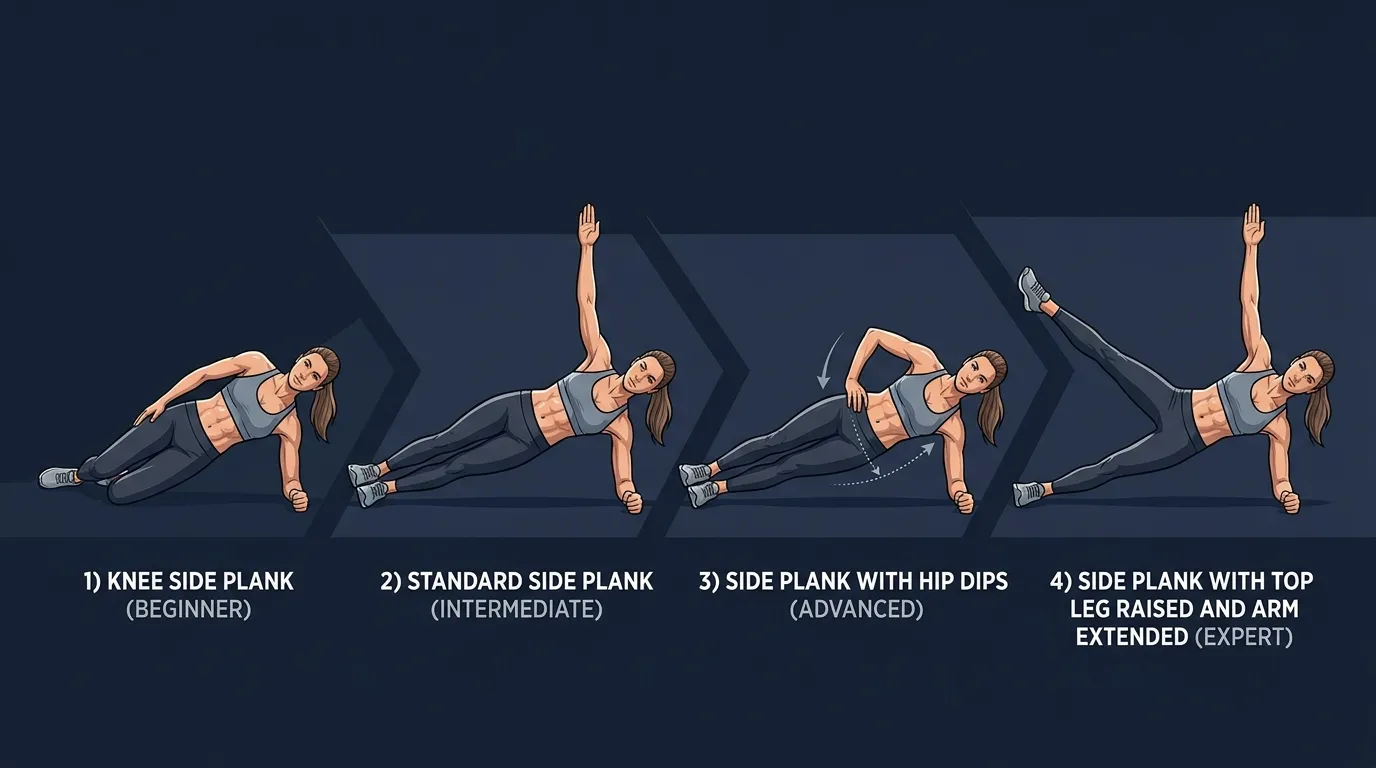
Side Plank Variations: Regressions and Progressions
Pick the version that lets you keep a straight line and breathe. Progress when both sides look the same.
Knee Side Plank (Beginner Regression)
Bend your bottom knee to about 90 degrees and support yourself from the knee and forearm. This shortens the lever arm, lowers the load on the obliques and shoulder, and makes it easier to learn the stacked position.
Standard Side Plank
Use the full setup from the steps above: elbow under shoulder, legs straight, feet stacked or staggered, and hips lifted. Build to 30 to 60 clean seconds per side before adding motion.
Side Plank Raise (Dynamic Progression)
Lower your hips a few inches, then drive them back to the starting line. Keep the movement slow. This adds controlled reps while keeping the same anti-lateral-flexion demand.
Side Plank Reach Through (Rotation Progression)
Reach your top arm under your torso, then rotate it back toward the ceiling. This adds thoracic rotation while the hips and trunk resist collapsing.
When to Avoid or Modify Side Planks
Side planks are safe for most healthy adults, but a few situations call for a regression, a different core drill, or medical guidance. Always consult your physician or physical therapist for personalized guidance.
- Current shoulder pain or recent shoulder surgery. Side planks load the supporting shoulder directly. Use knee-supported side planks, shorten the hold, or rebuild with deadbugs and bird-dogs until the shoulder tolerates weight-bearing.
- Acute lower-back pain or known disc pathology. If bracing increases pain or the pelvis keeps dropping, swap to lower-pressure anti-extension drills like deadbugs or forearm planks and consult a physical therapist.
- First 6-8 weeks postpartum or active diastasis recti. Side planks can be useful later, but the hold still creates trunk pressure. Start with breathing, transverse abdominis activation, deadbugs, and bird-dogs before returning to full side planks.
- Recent abdominal surgery or hernia. Get clearance from your surgeon or physician before loaded bracing work. Most returns start with diaphragmatic breathing, gentle bracing, and short supported holds.
- Pregnancy, pelvic-floor dysfunction, or pelvic-organ prolapse. High-pressure core work may need modification. Use shorter holds, knee support, or clinician-guided alternatives that let you breathe and manage pressure.
- Forearm or elbow irritation. The forearm base can be uncomfortable on hard floors. Use a mat, shorten the hold, or move to lower-pressure bracing work until the contact point calms down.
Related Exercises
If side planks are in your program, these exercises build the same lateral-core system or support the bracing pattern around it:
- Same plane, harder: Side Plank Raise and Side Plank Reach Through add motion once static holds are clean.
- Anti-extension foundation: Forearm Planks and Hand Planks train the straight-body brace from a different direction.
- Lower-pressure core foundations: Deadbugs and Bird-Dogs build trunk control with less shoulder load.
- Hip stability pairing: Glute Bridges strengthen the glutes that help keep the pelvis from rolling or dropping.
- Advanced core progression: Hollow Holds and Plank Twists challenge the trunk after you can hold clean side planks on both sides.
How to Program Side Planks
Side plank programming works best as timed isometric training. Use the broader progression principles from the American College of Sports Medicine position stand on resistance training: increase difficulty gradually, match volume to training status, and let form quality set the ceiling (Ratamess et al., 2009).
| Level | Sets × Reps | Rest between sets | Frequency |
|---|---|---|---|
| Beginner (knee-supported or staggered feet) | 2-3 × 15-30 second holds per side | 45-60 seconds | 2-4 sessions/week |
| Intermediate (standard side plank) | 3 × 30-60 second holds per side | 60 seconds | 3-5 sessions/week |
| Advanced (long holds or dynamic variations) | 3-5 × 60-120 second holds, or 8-15 controlled reps per side | 60-90 seconds | 4-6 sessions/week |
Where in your workout: put side planks near the end of a strength session, in a dedicated core block, or as a short core finisher. They can also work as low-volume activation before lower-body training, but avoid fatiguing your trunk before heavy squats, deadlifts, or overhead pressing.
Form floor over time targets: stop the set when your hips sag, your supporting shoulder shrugs, your torso rolls, or your breathing gets stuck. A clean 20-second hold is more useful than a collapsed 60-second hold.
How FitCraft Programs This Exercise
Knowing how to do a side plank is step one. Knowing when to use it, which variation fits your level, and how long to hold each side is where most people get stuck.
FitCraft's AI coach Ty handles that. During your personalized diagnostic assessment, Ty maps your fitness level, goals, and available equipment. Then Ty builds a personalized program that slots core stability work into a balanced plan at the right level for you.
As you get stronger, Ty adjusts the variation and volume to match your level. Knee-supported holds can become full side planks. Full holds can progress toward dynamic raises or reach-throughs. Every program is designed by an Ivy League-trained exercise scientist and NSCA-certified strength coach using evidence-based periodization, then adapted to you by the AI.
Frequently Asked Questions
What muscles do side planks work?
Side planks primarily work the obliques, quadratus lumborum, and gluteus medius. They also train the transverse abdominis, shoulder stabilizers, hip abductors, glutes, and deep spinal stabilizers that keep the trunk from bending sideways.
How long should I hold a side plank?
Start with 15 to 30 seconds per side if you're new to the movement. Build toward 30 to 60 seconds with clean alignment before adding harder variations. Stop each set when your hips sag, your shoulder shrugs, or your breathing turns strained.
Should I do side planks on both sides?
Yes. Train both sides for equal time. If one side is weaker, match the stronger side to the weaker side's clean hold time until the gap closes.
Are knee side planks effective?
Yes. Knee side planks shorten the lever arm, reduce shoulder and oblique demand, and let you learn the same bracing pattern with better control. They are the right regression when full side planks make your hips drop.
Can I do side planks with shoulder pain?
Use caution. Side planks place bodyweight through the supporting shoulder. Modify with a knee-supported side plank, shorten the hold, or swap to lower-pressure core work like deadbugs and bird-dogs. If shoulder pain is sharp, recent, or persists after modification, get assessed by a qualified clinician before progressing.