The iso ham raise is a hamstring and glute exercise in which you lie on your back with both heels on a sturdy box or bench and lift your hips into a bridge. Your knees stay bent at about a right angle the whole time. The hamstrings and glutes do the lifting, and the erector spinae, the muscles along your spine, hold your back in line while your hips are up. The defining cue is to press through your heels and stop at one straight line from your knees to your shoulders, so your lower back does not arch. The FitCraft app rates the partial lift, with the hips about two-thirds of the way up, Beginner and the full lift Advanced. You need only a sturdy box, bench or chair seat about 12 to 20 inches high. A floor glute bridge is the easier option, and the single-leg and weighted versions are harder.
Most people who want to build their hamstrings jump straight to Romanian deadlifts or machine curls. Both are great. Both also need equipment, a hinge pattern, and some technique you might not have yet. The iso ham raise skips all of that. You lie down, put your heels on a bench, and drive your hips up. That's the whole thing.
Quick Facts: Iso Ham Raise
- Equipment needed: A sturdy box, bench or chair seat about 12 to 20 inches (30 to 50 cm) high that cannot slide
- Difficulty: Beginner (partial lift) to Advanced (full lift), as the FitCraft app rates its two versions
- Modality: Strength (reps with a short hold at the top)
- Body region: Lower body, posterior chain
Muscles Worked
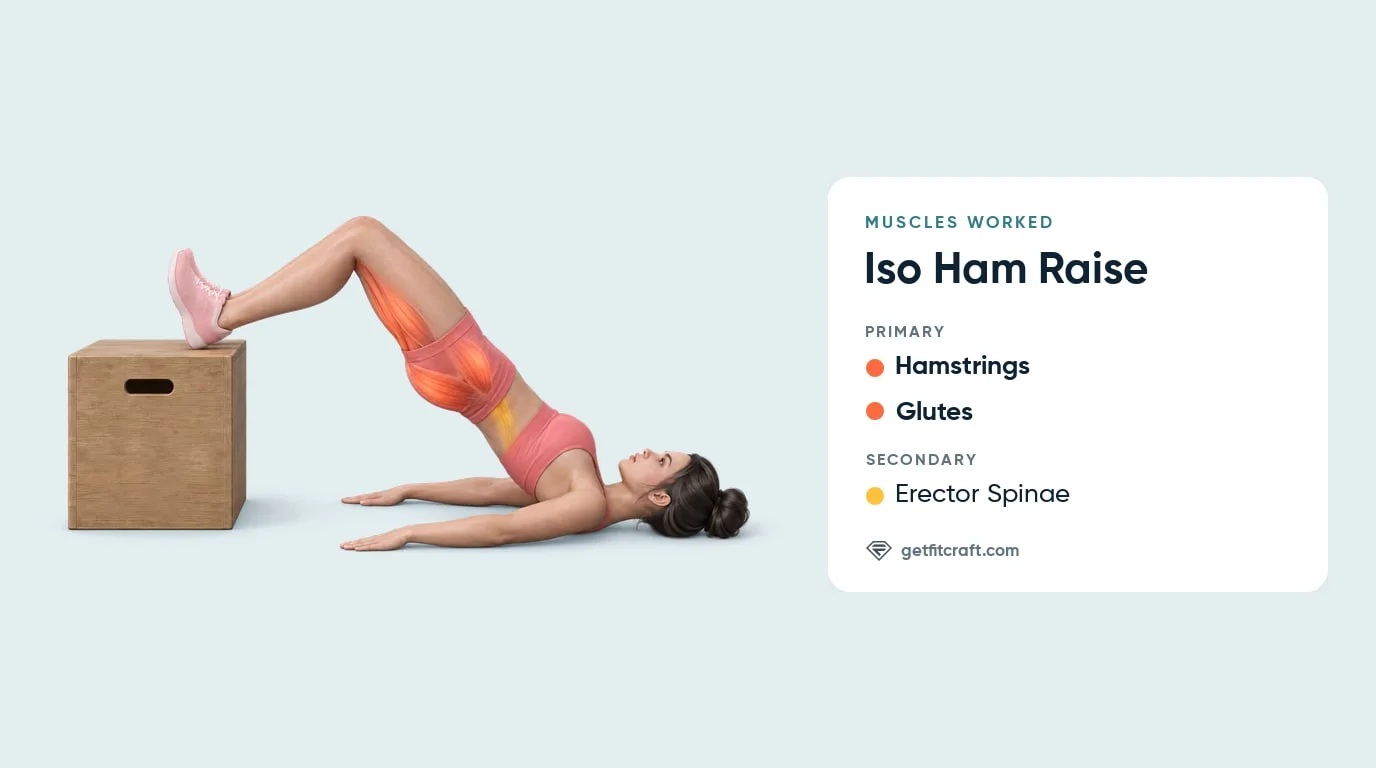
Primary movers. The hamstrings (semitendinosus, semimembranosus, and biceps femoris) and the glutes drive the hips upward. Your hamstrings press your heels down into the box and help straighten your hips, and your glutes lift your hips and finish the rep at the top, where the squeeze holds your hips straight. Both lower your hips under control on the way down.
Secondary muscle. The erector spinae, the muscles that run along your spine, hold your back in line with your thighs while your hips are up. They keep your back steady but should not do the lifting, which is why you stop at a straight line instead of arching higher.
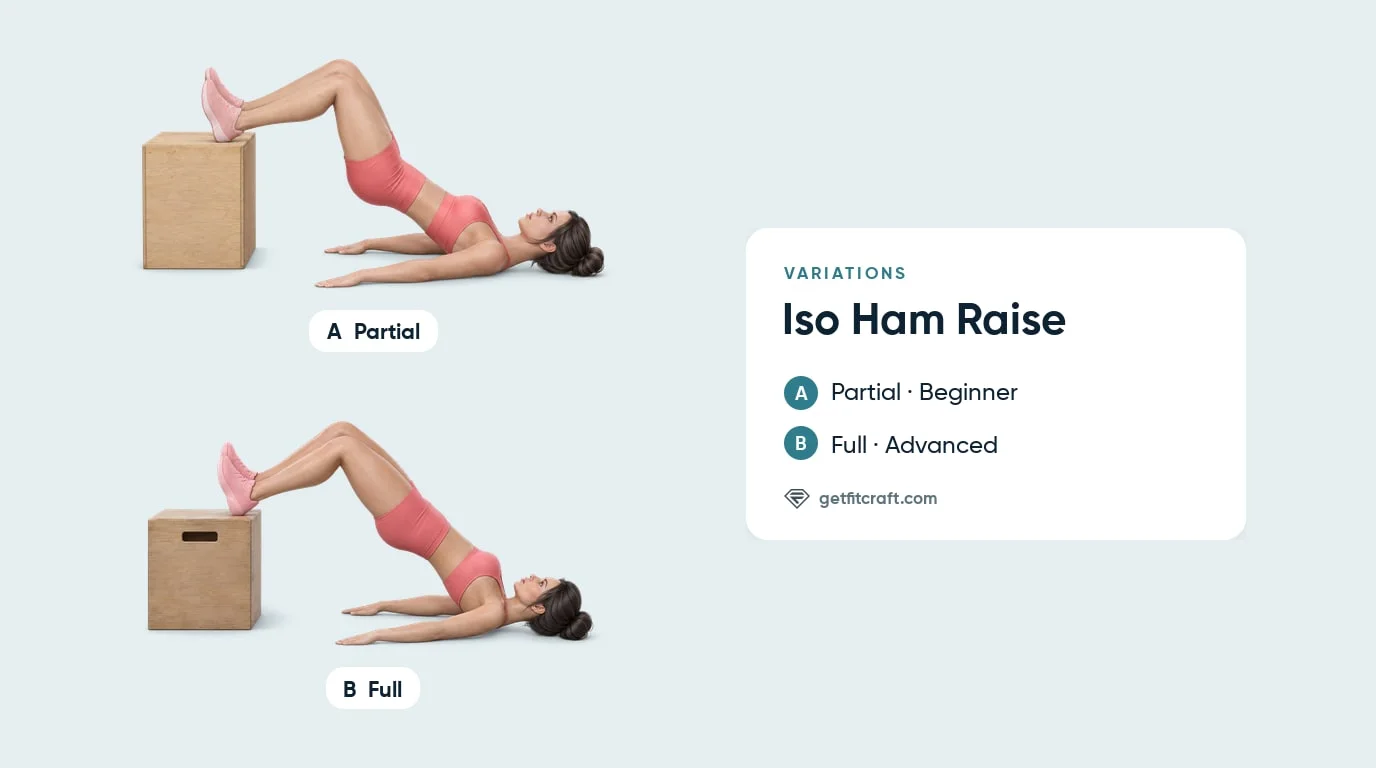
Mechanism. The iso ham raise is a hip-extension exercise: with your heels on the box and your knees bent at about a right angle through the whole rep, your hips go from just above the floor to straight. On the full version they finish in one straight line from your knees to your shoulders; on the partial version they stop about two-thirds of the way up. Each rep ends with a short squeeze at the top, about one to two seconds, before you lower under control.
Step-by-Step: How to Do an Iso Ham Raise
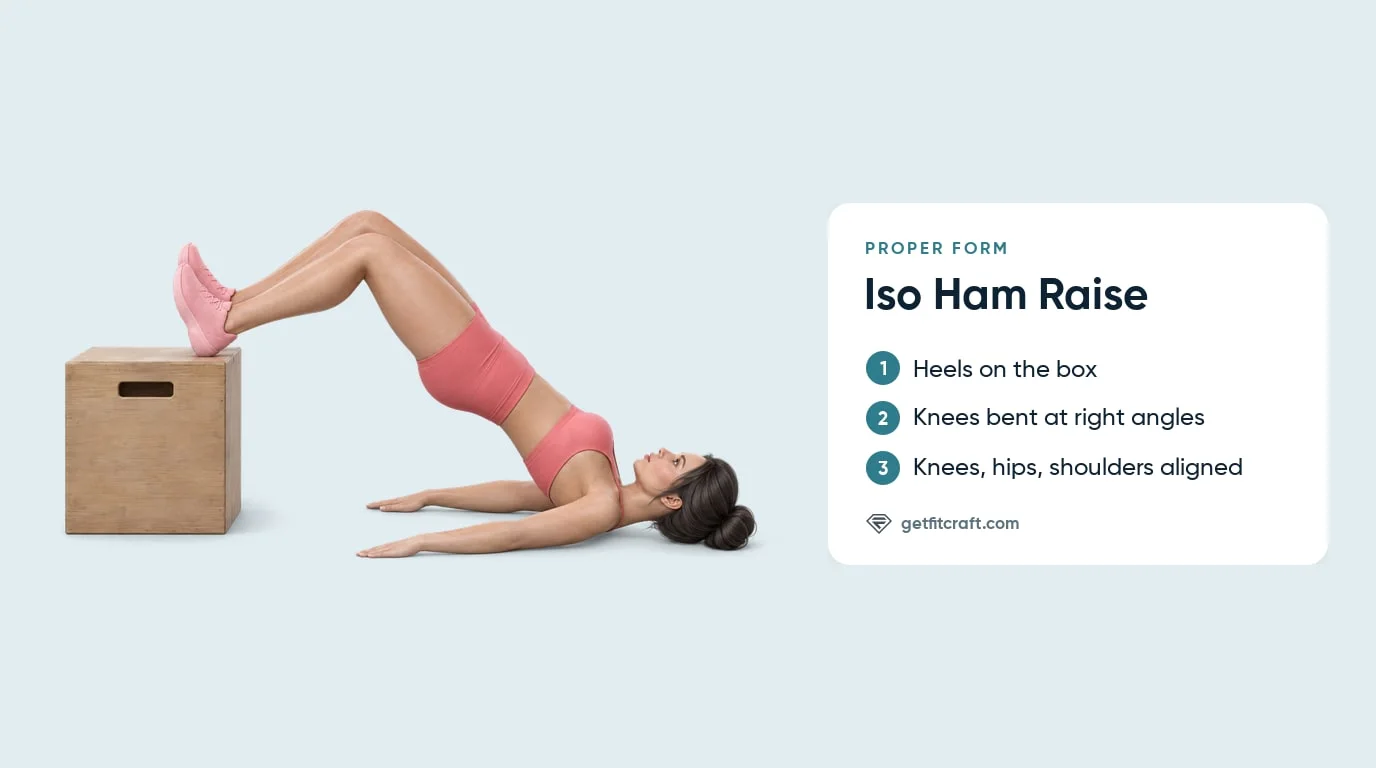
- Lie down on your back. Find a sturdy box, bench or chair seat about 12 to 20 inches (30 to 50 cm) high and set it where it cannot slide or tip. Lie on your back in front of it and rest both heels on top, about hip-width apart with your toes pointing up. Move closer or farther until your knees bend to about a right angle.
- Plant the heels. Press your heels down into the box, not your toes. This is not optional. It creates the stable base your glutes and hamstrings will push off from. If the box or bench wobbles or slides, fix it before your first rep.
- Relax the arms. Keep your arms flat on the floor beside you, angled out a little with the palms down. They're there for balance, not lifting. Don't push through your hands.
- Brace the core. Take a short breath into your belly and lightly tense your abs. Keep the back of your head, your shoulders and your upper back on the floor, and rest your weight on your shoulders and upper back, not your head, with your neck relaxed.
- Drive the hips up. Breathe out, push through your heels and squeeze your glutes to lift your hips toward the ceiling. On the full version, stop when your body forms a straight line from your knees down through your hips to your shoulders, no higher, so your lower back does not arch. On the partial version, lift only about two-thirds of the way. Both hips should rise together and stay level.
- Squeeze and hold. At the top, squeeze your glutes and keep your heels pressing down. Hold for 1 to 2 seconds with both hips level, and keep breathing.
- Lower slowly. Breathe in and lower your hips under control, over about 1 to 3 seconds, until they hover just above the floor or lightly touch it. Never drop them. Then lift again, breathing out on the way up.
Common Mistakes (And How to Fix Them)
One Hip Drops Lower
What it looks like: At the top of the rep, one side of the pelvis sits lower than the other, so your bridge is uneven.
Why it's a problem: It shifts the load onto one side, so the two sides do not work evenly.
The fix: Think about your hip bones as the two ends of a broomstick. They should rise together, stop together, and lower together. If one side keeps dropping, lift a little less high, as in the partial version, until both sides rise level. Save the single-leg version for when the two-leg full lift is clean.
Overextending the Lower Back
What it looks like: You push so high that your lower back arches dramatically and your ribs flare up.
Why it's a problem: The glutes and hamstrings stop doing the work. Your lower back takes over, and that's a fast route to soreness in all the wrong places.
The fix: Stop when your body forms a straight line from knees to shoulders, not a banana shape. Before you lift, exhale and tuck your ribs toward your pelvis. That locks the spine in neutral.
Pushing Through the Toes
What it looks like: Heels lift off the bench as you drive up, and you end up pressing through the balls of your feet.
Why it's a problem: Your heels lose their pressure on the box, so your hamstrings and glutes lose their job. You lose most of the point of this exercise.
The fix: Rest your heels, not your whole feet, on top of the box with your toes pointing up, and press your heels down before your hips move. It makes the heel drive automatic.
Using Momentum
What it looks like: Rapid, bouncy reps where the hips barely pause at the top or bottom.
Why it's a problem: Momentum steals the tension. You get to call it a workout, but your hamstrings and glutes barely work.
The fix: Slow everything down: about a second up, a 1 to 2 second squeeze at the top, and a smooth lowering over 1 to 3 seconds. No bouncing at the top or the bottom.
Get this exercise in a personalized workout
FitCraft, our mobile fitness app, uses its AI coach Ty to program core stability work like this into your plan at the right volume and intensity, based on your level, goals, and equipment. Ty was designed and trained by Domenic Angelino, MPH (Brown University) and NSCA-CSCS, with research published in the Journal of Strength and Conditioning Research and Medicine & Science in Sports & Exercise.
Take the Free Assessment Free • 2 minutes • No credit cardVariations
Easier (Regression)
- Partial Iso Ham Raise. Keep your heels on the box but lift your hips only about two-thirds of the way, stopping before the straight line, then lower. The FitCraft app rates this version Beginner and the full lift Advanced.
- Standard Glute Bridge. Feet flat on the floor instead of up on a box or bench. It is the easier place to start if you're brand new to hip extension work.
- Partial Glute Bridge. Lift only halfway. Builds confidence and lets you focus on the squeeze before adding full range.
Harder (Progression)
- Single-Leg Iso Ham Raise. Keep one heel on the box, point the other leg toward the ceiling, and drive up using only one side. It puts all the work on one leg at a time, so master the two-leg full lift first.
- Weighted Iso Ham Raise. Lay a dumbbell, plate, or loaded backpack across the front of your hips at the hip crease and hold it with both hands so it cannot roll. Start light.
- Longer Hold, Slower Lowering. Hold the top a few seconds longer and take about three seconds to lower, keeping both hips level.
Alternative Exercises
- Romanian Deadlift. Trains the same muscles through a different pattern (hip hinge instead of supine bridge). Better for carrying strength into real-world movements like picking things up.
- Single-Leg Deadlift. Loads the hamstrings and glutes while also training balance. Progressive next step once iso ham raises feel too easy.
When to Avoid or Modify Iso Ham Raises
If any of the situations below applies to you, check with a doctor or physical therapist before you do iso ham raises. A burn in the backs of your thighs or your glutes is normal; stop any rep that causes pain in a joint, your lower back or your neck. Always consult a qualified healthcare provider or physical therapist before starting or returning to any exercise program, especially if you have acute lower-back pain or known disc pathology, are within 6 to 8 weeks postpartum, have active diastasis recti, are recovering from abdominal or hip surgery, have a hamstring strain or recent hamstring tear, have a hernia, are pregnant, or have pelvic-floor dysfunction or pelvic-organ prolapse.
- Acute lower-back pain or known disc pathology. See a doctor or physical therapist before you do iso ham raises, and do them only once they clear you. During a set, any pain in your lower back means stop.
- Acute hamstring strain or recent tear. Do not do iso ham raises until a doctor or physical therapist clears you. Any pain in the back of your thigh, behind your knee or at your sitting bone means stop.
- Postpartum (first 6 to 8 weeks) or active diastasis recti. Check with your doctor, midwife or a pelvic-floor physical therapist first, and do iso ham raises only with their go-ahead. Stop if you feel pelvic pressure or any pain.
- Recent hip or lower-back surgery. Wait until your surgeon or physical therapist clears you before you do iso ham raises, and stop if you feel any pain in your hip or lower back.
- Pregnancy (second and third trimesters). Lying flat on your back for long periods is usually avoided from this point. Check with your doctor or midwife before you do iso ham raises, do them only with their go-ahead, and stop if you feel dizzy or lightheaded or feel any pain.
- Pelvic-organ prolapse or pelvic-floor dysfunction. Check with a pelvic-floor physical therapist before you do iso ham raises, and do them only with their go-ahead. Stop if you feel pelvic pressure or any pain.
Related Exercises
- Same muscle group: Glute Bridges, Partial Glute Bridge, Donkey Kicks.
- Hip hinge progression: Romanian Deadlift, Single-Leg Deadlift.
- Posterior-chain foundation: Bird-Dogs, Deadbugs.
- Advanced single-leg variation: Single-Leg Iso Ham Raise.
- Compound that benefits from strong hamstrings: Squats, Rear Lunges.
How to Program Iso Ham Raises
The ACSM Position Stand on Resistance Training (Ratamess et al., 2009) gives general guidance on matching sets, reps and progression to your training level; it sets no ranges for the iso ham raise, so treat the table below as a practical starting point. Each rep is a lift with a short squeeze at the top, and the FitCraft app rates the partial lift Beginner and the full lift Advanced.
| Version | Sets × Reps | Rest Between Sets | Frequency |
|---|---|---|---|
| Beginner: partial lift (hips about two-thirds of the way up) | 2 to 3 × 10 to 12 (with 1 to 2 sec hold at top) | 45 to 60 seconds | 2 sessions per week |
| Advanced: full lift (knees, hips and shoulders in one line) | 3 × 12 to 15 (with 1 to 2 sec hold at top) | 60 seconds | 2 to 3 sessions per week |
| Harder: single-leg, weighted or a longer hold | 3 to 4 × 8 to 10 single-leg (per side) or weighted, or hold the top a few seconds longer | 60 to 90 seconds | 3 sessions per week |
Where in your workout. Two natural spots. As a posterior-chain activation primer before heavy lower-body work (2 sets of 8 to 10 slow reps before squats or deadlifts wakes up the glutes and hamstrings without fatiguing them). Or as an accessory finisher after the main compound work, where the higher rep ranges add extra work for the hamstrings and glutes.
Form floor over rep targets. If you can't hold a straight line from knees to shoulders for a full one-to-two-second squeeze at the top, drop the rep target. Five clean reps with a real hold beat fifteen sloppy ones every time. The squeeze at the top is part of every rep, and momentum skips it.
The FitCraft app includes the iso ham raise in two versions, the partial lift rated Beginner and the full lift rated Advanced, each with a 3D demonstration so you can dial in the setup before your first rep.
Frequently Asked Questions
Can I do iso ham raises if I have lower-back pain?
See a doctor or physical therapist before you do iso ham raises with lower-back pain, and do them only once they clear you. During a set, any pain in your lower back means stop right away. A burn in the backs of your thighs or your glutes is normal. To keep your lower back out of the lift, stop at one straight line from your knees to your shoulders and never arch your back to push your hips higher.
What muscles does the iso ham raise work?
The iso ham raise works the hamstrings (semitendinosus, semimembranosus and biceps femoris) and the glutes as its main muscles, with the erector spinae, the muscles along your spine, as the secondary muscle. Your hamstrings press your heels down into the box and help straighten your hips, your glutes lift your hips and squeeze at the top, and the erector spinae hold your back in line while your hips are up.
Why elevate the feet on a bench?
Putting your heels up on a box or bench is what makes this an iso ham raise rather than a floor glute bridge. Your knees stay bent at about a right angle through the whole rep, your hamstrings press your heels down into the box and help straighten your hips, and your glutes lift your hips and squeeze at the top. Any sturdy box, bench or chair seat about 12 to 20 inches (30 to 50 cm) high works, as long as it cannot slide.
Is the iso ham raise a good hamstring exercise for beginners?
Yes, in its partial form. The FitCraft app rates the partial iso ham raise, with the hips lifted about two-thirds of the way, Beginner, and the full lift to a straight line Advanced. It needs nothing beyond a sturdy box, bench or chair seat, and it trains hip extension without the hip hinge a Romanian deadlift needs. If the partial version is still too hard, start with glute bridges with your feet flat on the floor.
How many iso ham raises should I do?
On the partial lift (Beginner in the FitCraft app), start with 2 to 3 sets of 10 to 12 reps with a one-to-two-second squeeze at the top. On the full lift (Advanced in the app), work up to 3 sets of 12 to 15 reps. For more, add a dumbbell or plate across the hips or move to the single-leg version for 3 to 4 sets of 8 to 10 reps per side. Rest 60 to 90 seconds between sets. Train 2 to 3 times per week on lower-body or posterior-chain days.
Can the iso ham raise replace the Romanian deadlift?
Not entirely. The iso ham raise builds hamstring and glute strength through hip extension, but it doesn't train the hip hinge pattern the same way a Romanian deadlift does. The hinge is a foundational pattern for picking things up, sprinting, and most posterior-chain athletic movements. Use the iso ham raise as a warm-up, accessory, or beginner substitute. Once you can hinge safely with load, add the Romanian deadlift back in.