The square walk is simple on purpose. You hold your fists up in a loose guard, stand with your feet wider than your shoulders, and walk three low steps forward and three back, turning your hips and shoulders together from one side to the other and sinking into a shallow squat on each step, rising between. The drill feels more like a moving footwork pattern than plain marching in place. A box-step pattern done standing tall, with the feet meeting at each corner, is a different stepping drill.
Quick Facts: Square Walk
- Equipment needed: None
- Difficulty: Beginner (as rated in the FitCraft app)
- Modality: Low-impact cardio and footwork
- Body region: Lower body (thighs, glutes, outer hips and inner thighs), with the sides of the waist helping as you turn
Muscles & Systems Worked
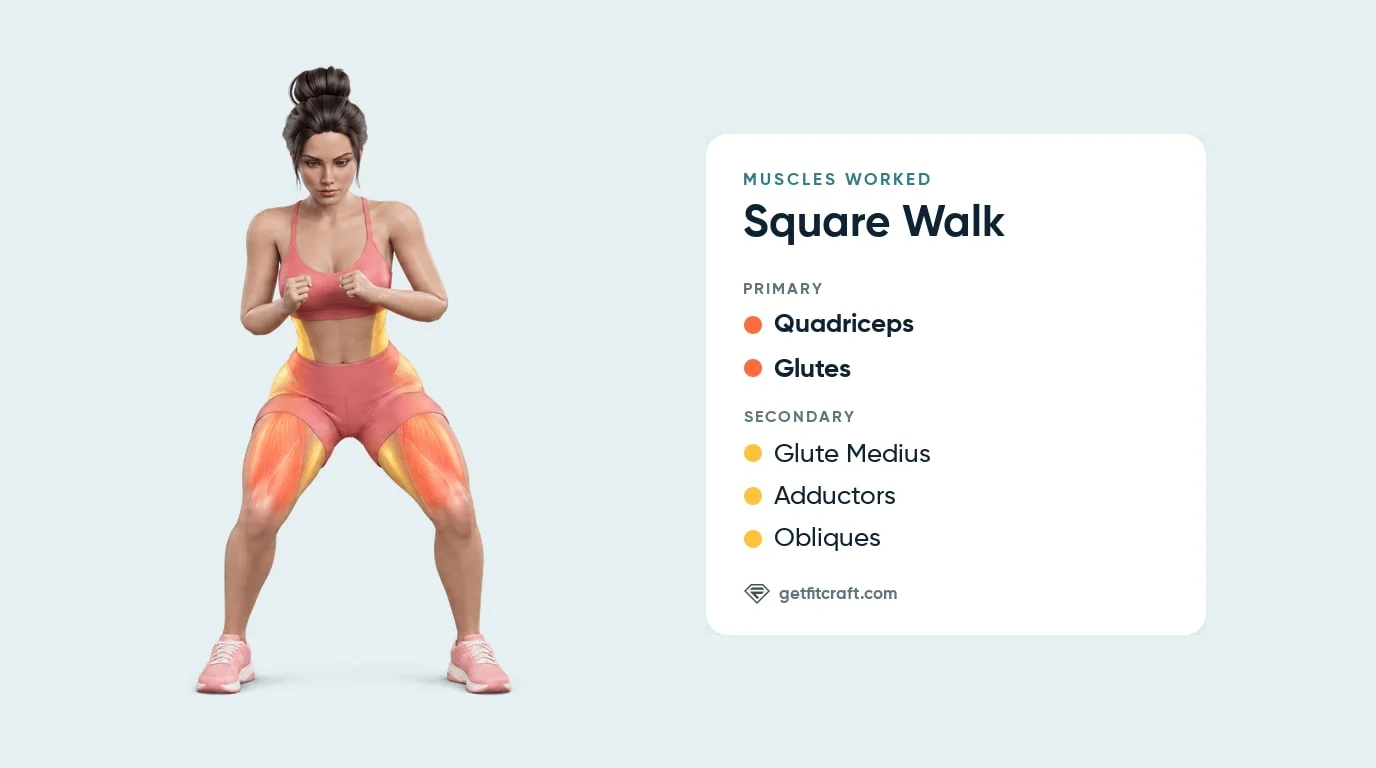
Primary movers: The quadriceps, at the fronts of your thighs, and the glutes lower you into the shallow squat on each turn and lift you back up.
Secondary movers: The glute medius, on the outside of your hip, steadies your pelvis as your weight shifts and your legs move out wide. The adductors, on your inner thighs, steady the wide stance and draw your legs back in. The obliques, at the sides of your waist, turn your trunk with your hips and keep it steady through each turn.
Heart rate: The steady rhythm of steps, turns and shallow squats gets your heart rate up with low impact and trains smooth footwork.
Step-by-Step: How to Do the Square Walk
- Set a wide stance with your guard up. Stand with your feet wider than your shoulders and slightly staggered, knees soft, weight toward the balls of your feet and chest up. Bring your hands up in a loose guard, fists in front of your chest or chin, elbows bent and close to your body.
Tip: go only as wide as you can stay steady with your knees in line with your toes.
- Step, turn and sink. Step one foot forward, keeping it low so it just clears the floor, and land it wide of your other foot and a little ahead of it. As it lands, turn your hips and shoulders together partway to the side, up to about halfway to facing sideways, so the hip of your front leg comes forward. Let your heels lift and your feet pivot so your knees stay in line with your toes, and sink into a shallow squat with your feet wide.
Tip: turn your hips and shoulders together, letting your feet pivot with you.
- Rise and turn back. Rise a little taller as your back foot moves through, then land it wide and a little ahead and turn toward the other side, sinking again as you turn.
Tip: sink only as low as you can stay balanced with your chest up and your back straight.
- Walk three steps forward, then three back. After three steps forward, take three steps back the way you came, landing each foot wide and turning as before, then repeat. Keep the balls of your feet close to the floor and your feet wide so they never come together. You need a clear strip of floor about 2 m (7 ft) long and 1 m (3 ft) wide; in a smaller space, take shorter steps. Your eyes can look forward or slightly down.
Tip: glide back the way you came, feet wide, turning with every step.
- Keep a steady rhythm. Keep your guard up and a steady, unhurried rhythm of a step and turn every second or two. Breathe steadily and never hold your breath, and speed up only while you stay balanced and your knees stay over your toes.
Tip: keep your turns smooth and controlled.
Get this exercise in a personalized workout
FitCraft, our mobile fitness app, uses its AI coach Ty to program conditioning work like this into your plan at the right volume and intensity, based on your level, goals, and equipment. Ty was designed and trained by Domenic Angelino, MPH (Brown University) and NSCA-CSCS, with research published in the Journal of Strength and Conditioning Research and Medicine & Science in Sports & Exercise.
Take the Free Assessment Free • 2 minutes • No credit card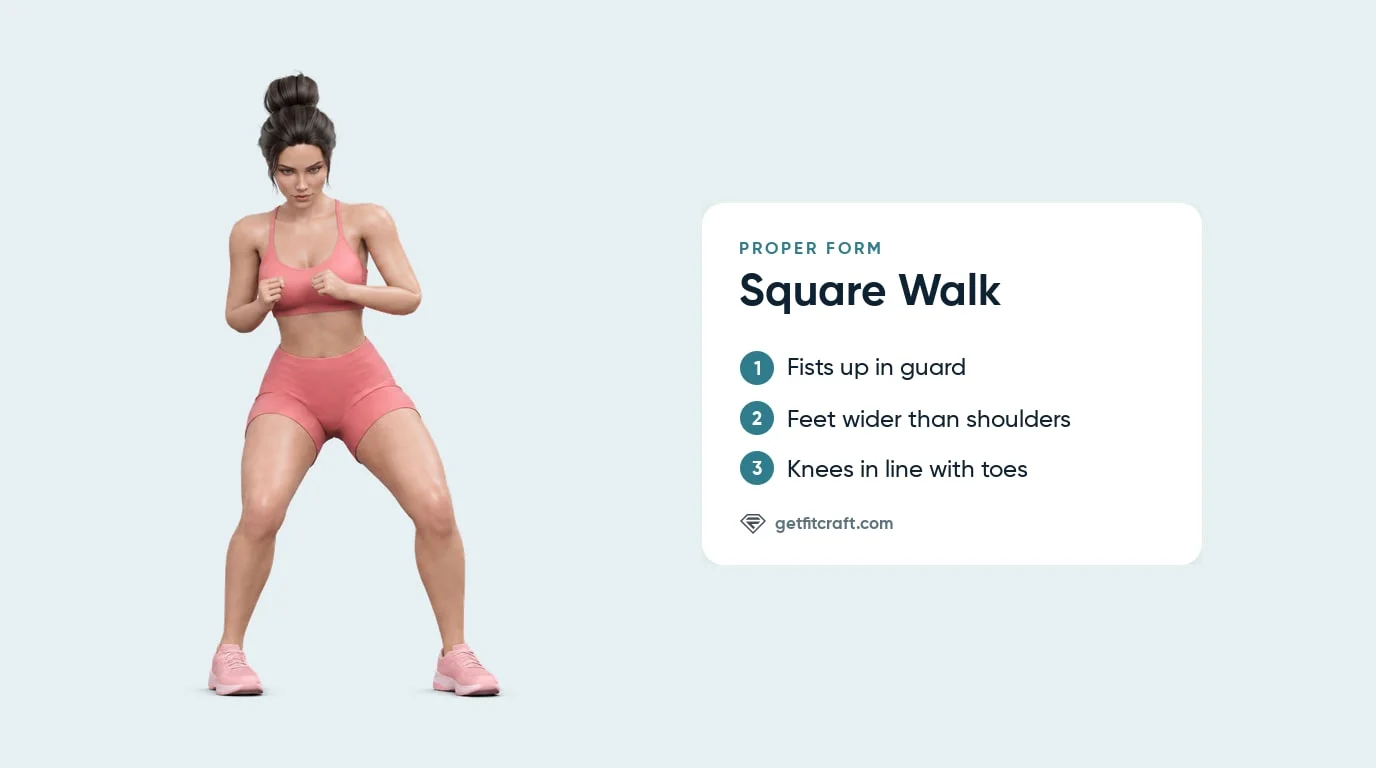
Common Mistakes
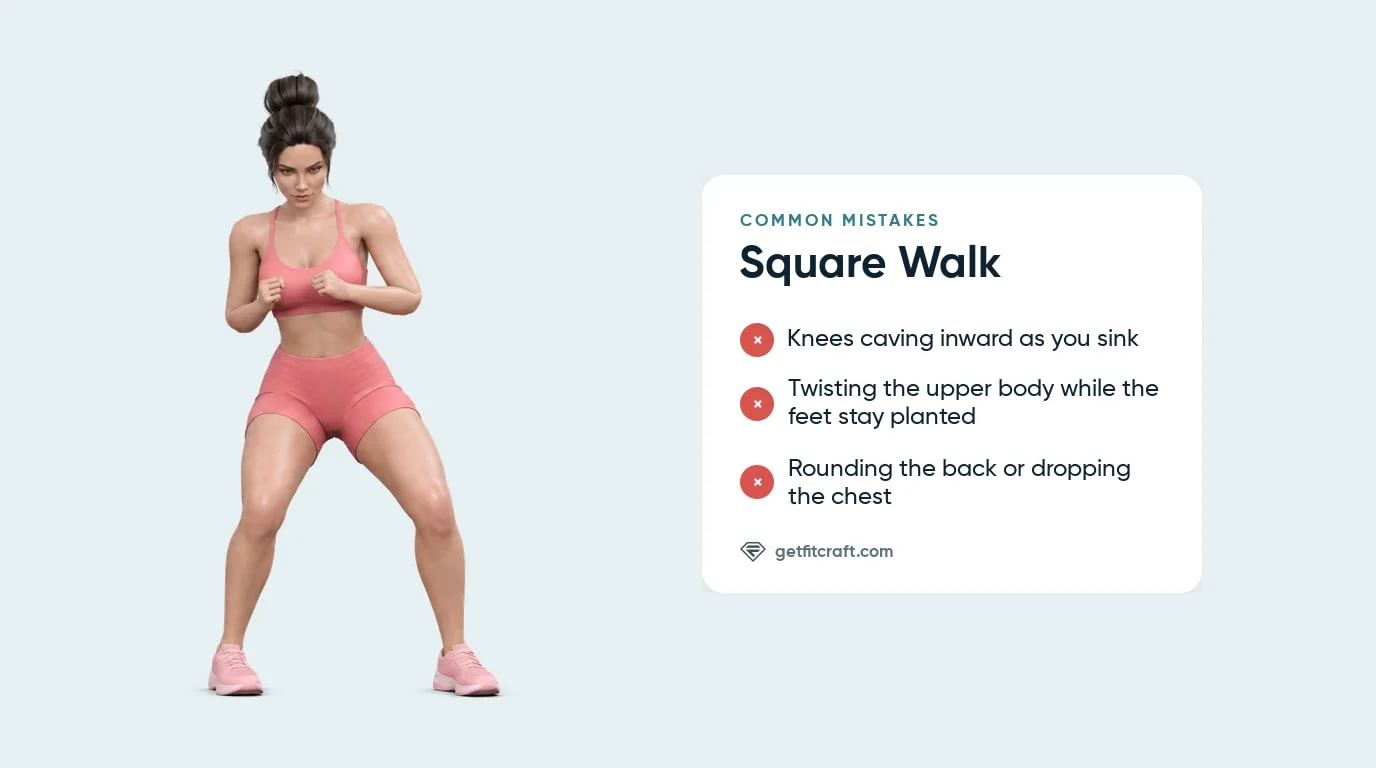
Knees Caving Inward
What it looks like: As you sink into a turn, your knees drift inward instead of following your toes.
Why it matters: Knees that cave in put more load on the knee.
The fix: Let your feet pivot as you turn so your knees stay in line with your toes, and sink only as low as you can keep them there.
Twisting Over Planted Feet
What it looks like: Your upper body turns while your feet stay flat and fixed on the floor.
Why it matters: With your feet fixed, the turn twists your knees and waist instead of coming from your hips and feet.
The fix: Turn your hips and shoulders together and let your heels lift and your feet pivot with you.
Rounding the Back or Dropping the Chest
What it looks like: Your chest drops and your upper back rounds as you sink, often because you are watching your feet.
Why it matters: A rounded back makes the shallow squat and the turn harder to control.
The fix: Keep your chest up and your back straight, with your eyes forward or slightly down. Sink only as low as you can keep that posture.
Rushing the Turns
What it looks like: You speed up until your feet get tangled or your balance slips.
Why it matters: A tangled step or a slipped balance can turn into a fall.
The fix: Keep a steady rhythm of a step and turn every second or two, and speed up only while you stay balanced with your knees over your toes.
Holding Your Breath
What it looks like: You hold your breath as you sink and turn.
Why it matters: The square walk is meant to be steady, unhurried cardio, so your breathing should stay steady too.
The fix: Keep breathing in a steady, easy rhythm as you step and turn.
Square Walk Variations: Regressions and Progressions
Taller, Smaller Turns (Easier)
Stay a little taller and make your turns smaller and slower. Staying a bit taller is never a mistake, and it is a good way to learn the movement.
Walking in Place (Easier)
Walk in place at an easy pace when you want to keep moving with less work, or to catch your breath between rounds.
Lower Sink, Brisker Rhythm (Harder)
Sink a little lower on each turn and keep a brisker rhythm, as long as you stay balanced, your chest stays up and your knees stay over your toes.
Quick Shuffles (Harder)
For faster footwork, try quick shuffles: quick, light steps from foot to foot in a wide, low stance with your arms out in front.
When to Avoid Square Walks or See a Doctor First
Square walks are safe for most healthy adults. A burn in your thighs is normal; any pain in a joint, your lower back or your neck means stop the exercise. If any of the following apply, talk to a doctor or physical therapist before you do square walks.
- Knee, ankle, hip, shin, or foot pain. The turns and shallow squats load all of these. Any pain in them means stop; see a doctor or physical therapist and start again only once they clear you.
- Known cardiovascular disease or uncontrolled hypertension. Get medical clearance first and stay inside the heart-rate range your doctor prescribes.
- Vertigo, balance disorders, vestibular symptoms, or feeling unsteady on your feet. The turns and shallow squats can throw off your balance and risk a fall. Ask your doctor or physical therapist before doing square walks, and stop right away if you feel dizzy, lightheaded or off balance.
- Pregnancy or early postpartum recovery. Ask your doctor or midwife whether square walks suit you, and after giving birth get clearance from your doctor or a pelvic floor physical therapist first, especially if you have pelvic-floor symptoms. Stop if you feel pelvic pressure, dizziness or any pain.
- Asthma or exercise-induced bronchoconstriction. Check with your doctor before you start, and follow their advice on intensity and any prescribed medication. Stop right away if your breathing feels tight instead of simply elevated.
Related Exercises
- Another standing cardio move: Step-N-Clap adds an arm pattern.
- An easier option: Walking in Place, when the turns feel awkward.
- Another easy, low-space option: Marching in Place, with more knee lift.
- A higher-impact bodyweight cardio move: Jumping Jacks.
- Faster footwork: Quick Shuffles keep you in one spot with quick, light steps from foot to foot.
- Core exercise to pair with your cardio: Deadbugs.
How to Program Square Walks
The square walk is a FitCraft movement, and no study gives work or rest times for it, so treat the table below as a practical starting point. Progress by lengthening the intervals, keeping a brisker rhythm, and sinking a little lower on each turn while you stay balanced and your knees stay over your toes.
| Version | Work | Rest between sets | Frequency |
|---|---|---|---|
| Easier (taller stance, smaller and slower turns) | 20-30 seconds | 60-90 seconds | 2-3 sessions/week |
| Square walk (Beginner in the app) | 30-45 seconds | 45-60 seconds | 3-4 sessions/week |
| Harder (lower sink, brisker rhythm) | 45-60 seconds | 30-45 seconds | 3-5 sessions/week |
Where in your workout: Use square walks as a warm-up, low-impact cardio block, circuit station, or short finisher after strength training. If you are doing hard strength work, place faster conditioning after the lifting so your legs and balance are fresh for loaded exercises.
Form first: Stop the interval when your knees start caving in or twisting as you turn, your balance slips, or your breathing feels uncontrolled instead of elevated.
How FitCraft Programs This Exercise
FitCraft can include low-impact cardio movements like the square walk in a plan that fits your level. The app has one square walk exercise, rated Beginner; its 3D demonstration keeps the guard up and walks three steps forward and three back, turning from side to side and sinking into a shallow squat on each step.
Frequently Asked Questions
What is the square walk exercise?
The square walk is a low-impact FitCraft cardio movement. With your fists up in a loose guard and your feet wider than your shoulders, you walk three low steps forward and three back, turning your hips and shoulders together from side to side and sinking into a shallow squat on each step, rising between. It gets your heart rate up without jumping and trains smooth footwork.
What muscles does the square walk work?
The square walk works the quadriceps and glutes, with the glute medius, adductors and obliques helping. The fronts of your thighs and your glutes lower you into the shallow squat on each turn and lift you back up. The glute medius, on the outside of your hip, steadies your pelvis as your weight shifts, the adductors, on your inner thighs, steady the wide stance and draw your legs back in, and the obliques, at the sides of your waist, turn your trunk with your hips.
Can I do square walks with knee pain?
No. Any knee pain during square walks means stop the exercise; a burn in your thighs is normal. See a doctor or physical therapist, and start again only once they clear you.
How long should I do square walks?
Start with 20 to 30 seconds of work, rest 60 to 90 seconds, and repeat for about 5 minutes. Build toward 30 to 45 second intervals, then 45 to 60 second intervals as your rhythm and breathing improve.
Can I do the square walk in a small space?
Yes, with shorter steps. The standard square walk takes three steps forward and three back, so it needs a clear strip of floor about 2 m (7 ft) long and 1 m (3 ft) wide. In a smaller space, take shorter steps or turn from side to side in place. Clear the floor around you and use a non-slip surface.