You don't need a gym membership or fancy equipment to build serious work capacity. The burpee trains your entire body in one movement and drives your heart rate up faster than almost anything else you can do without gear.
The problem? Most people either butcher the form (which leads to wrist and knee pain) or avoid burpees entirely (which means missing out on one of the best conditioning tools available). This guide covers how to perform a burpee correctly, from the Level 1 walkout through the explosive Level 2 jump version.
Quick Facts: Burpee
- Equipment needed: None
- Difficulty: Advanced (Level 1 walkout) to Expert (Level 2 jump)
- Modality: Cardio / Conditioning
- Body region: Full body
- FitCraft quest category: Cardio
Muscles & Systems Worked
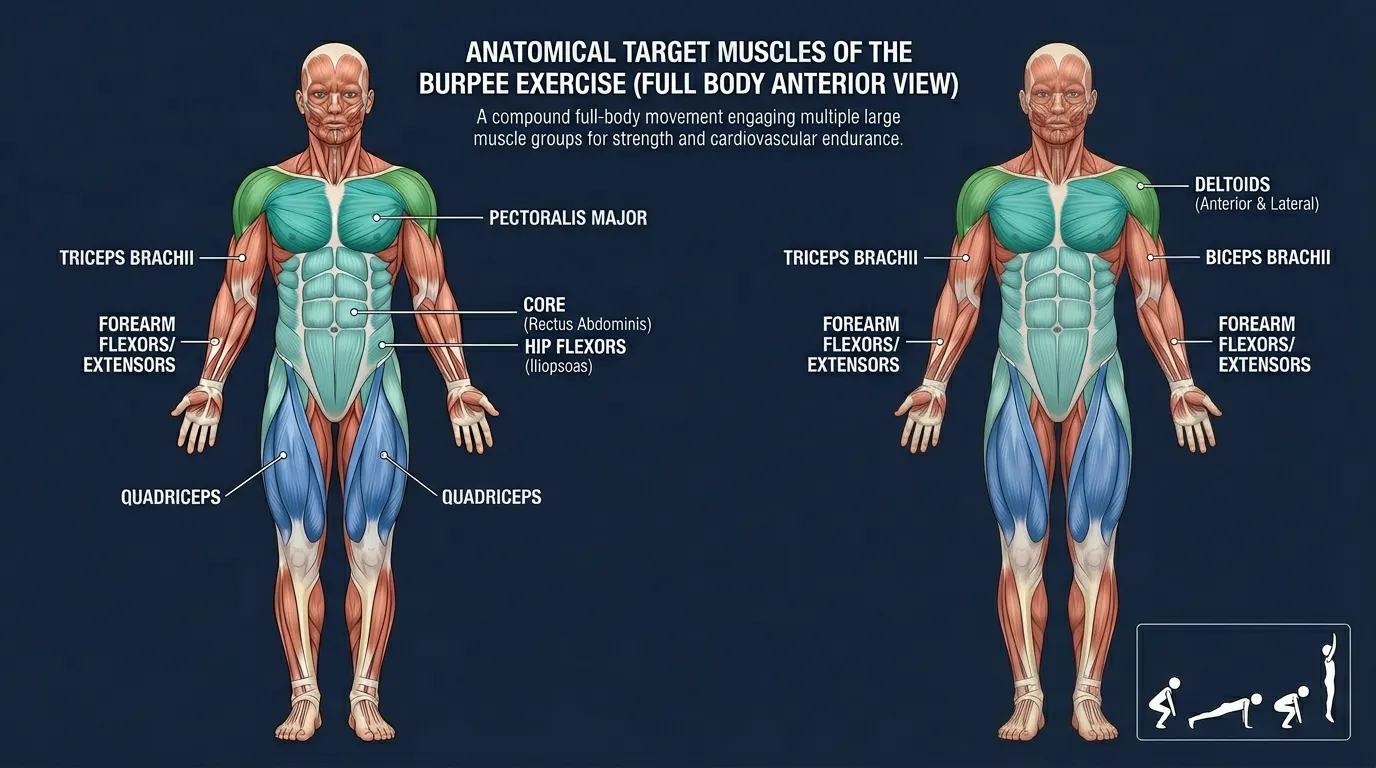
Primary movers: the quadriceps, gluteus maximus, and hamstrings drive the squat descent (eccentric loading) and the stand or jump (concentric extension at the hip and knee). On Level 2, these same muscles produce the vertical jump through rapid triple extension at the ankle, knee, and hip. The pectoralis major, anterior deltoids, and triceps brachii hold the plank position when your hands hit the floor and your feet move back.
Secondary movers: the hip flexors (psoas major and iliacus) pull the knees up when you bring your feet forward to the squat, the calves (gastrocnemius and soleus) drive ankle extension on the jump and absorb landing force, and the latissimus dorsi assists shoulder stability during the plank phase.
Stabilizers: the entire core works isometrically. Rectus abdominis, transverse abdominis, and obliques brace the trunk during the rapid plank transitions to prevent the hips from sagging. Ankle stabilizers (peroneals, tibialis anterior and posterior) control foot strike on landing. The spinal erectors hold the lumbar spine neutral through the hinge phase.
Energy systems and cardiovascular load: burpees elevate heart rate faster than almost any other bodyweight movement because they recruit large lower-body muscles, demand whole-body coordination, and chain multiple high-output positions back to back. Short, all-out work intervals (10 to 20 seconds) draw mostly on the phosphocreatine system. Sustained work (30 to 60 seconds) shifts into the glycolytic system, which is why burpees produce that distinctive lactate-burn at the 40-second mark. Repeated rounds with short rest tax the oxidative system. The exercise is a programming lever for whichever energy system you want to train, depending on the work-to-rest ratio you pick.
Step-by-Step: How to Do a Burpee
These steps cover the full movement pattern shared by both Level 1 and Level 2 variations. Differences between levels are noted at each step.
Step 1: Start Standing
Stand with your feet between shoulder and hip-width apart, arms relaxed at your sides. Brace your core lightly.
Coach Ty's cue: "Keep your feet between hip and shoulder-width apart. Too narrow and you lose balance; too wide and you lose power."
Step 2: Squat Down and Place Your Hands
Bend your knees and hinge at the hips to lower into a squat. Place both hands flat on the floor, directly under your shoulders. Keep your chest up as long as possible during the descent.
Ty's cue: "Hands directly under your shoulders. This distributes your weight evenly and protects your wrists."
Step 3: Move to a Plank
Level 1: step your feet back one at a time into a high plank. Level 2: jump both feet back simultaneously. In either case, your body should form a straight line from head to heels. No sagging hips, no piking up.
Ty's key cue: "Watch your hips in the plank. A sagging plank puts unnecessary stress on your lower back." Squeeze your glutes and brace your abs as you hit the plank position.
Step 4: Return to the Squat
Level 1: step your feet forward one at a time. Level 2: jump both feet forward to the outside of your hands, landing in a low squat position.
Step 5: Finish the Rep
Level 1: drive through your heels and stand up tall. Don't start lowering back down until you're fully upright. As Ty puts it: "Stand all the way up before starting the next rep, that's how you get the full range of motion every rep."
Level 2: explode upward from the squat into a vertical jump, extending your arms overhead and reaching as high as you can. Land softly and immediately begin the next rep. Ty's spring cue: "Think like a spring, loading up as you squat and releasing as you explode into the jump. The jump should come from your legs, not from yanking your upper body upward." Land on the balls of your feet and immediately let your heels kiss the ground to distribute force through your whole foot.
Get this exercise in a personalized workout
FitCraft, our mobile fitness app, uses its AI coach Ty to program conditioning work like this into your plan at the right volume and intensity, based on your level, goals, and equipment. Ty was designed and trained by Domenic Angelino, MPH (Brown University) and NSCA-CSCS, with research published in the Journal of Strength and Conditioning Research and Medicine & Science in Sports & Exercise.
Take the Free Assessment Free · 2 minutes · No credit card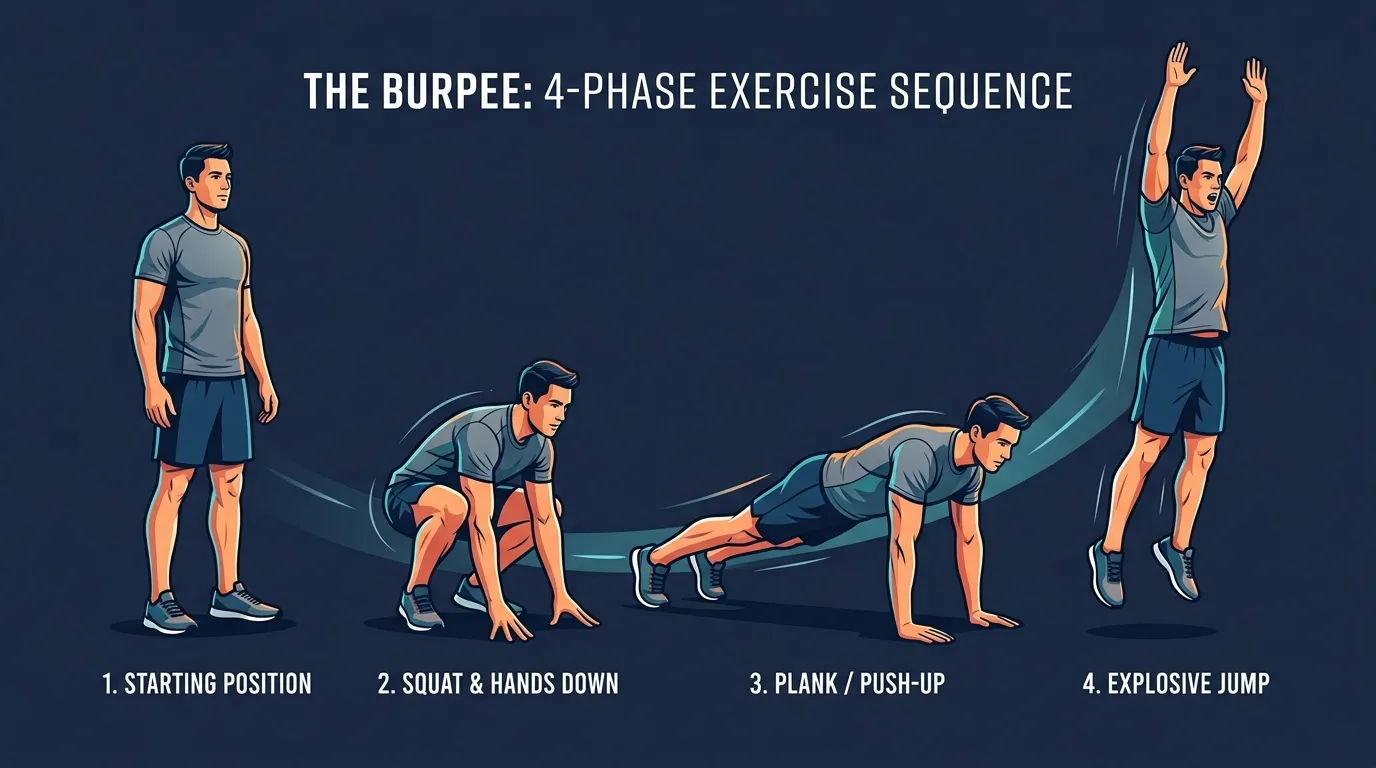
Common Mistakes (and How to Fix Them)
Burpees are straightforward in concept and easy to butcher in practice. Here are the mistakes Ty corrects most often.
- Sagging hips in the plank. The most common error. When your hips drop toward the floor, your lower back takes the load instead of your core. Fix: squeeze your glutes and brace your abs as you hit the plank position. If you can't hold a clean plank for 20 seconds, your core isn't ready for high-rep burpees yet. Build the foundation with forearm planks and deadbugs first.
- Not standing fully upright. Rushing reps means you never fully extend at the top. This shortchanges the movement and reduces the work your glutes and hip flexors do. Stand tall (or jump tall) before starting the next rep.
- Hands too far forward in the plank. Placing hands ahead of your shoulders shifts excess load onto your wrists and shoulders. Plant your hands directly below your shoulders every time.
- Toe-only landings after the jump (Level 2). Toe-heavy landings send impact straight into your knees and calves. Land on the balls of your feet and immediately let your heels kiss the ground to distribute force through your whole foot.
- Knees caving inward. During the squat phase or the landing, knees that collapse toward each other put rotational stress on the knee joint. Fix: actively push your knees out so they track over your toes. The cue "knees out" should run on a loop in your head.
- Holding your breath. Breathe out as you stand or jump up; breathe in as you lower down. Holding your breath spikes blood pressure and kills your endurance, which is the opposite of what you want in a conditioning exercise.
Burpee Variations: Regressions and Progressions
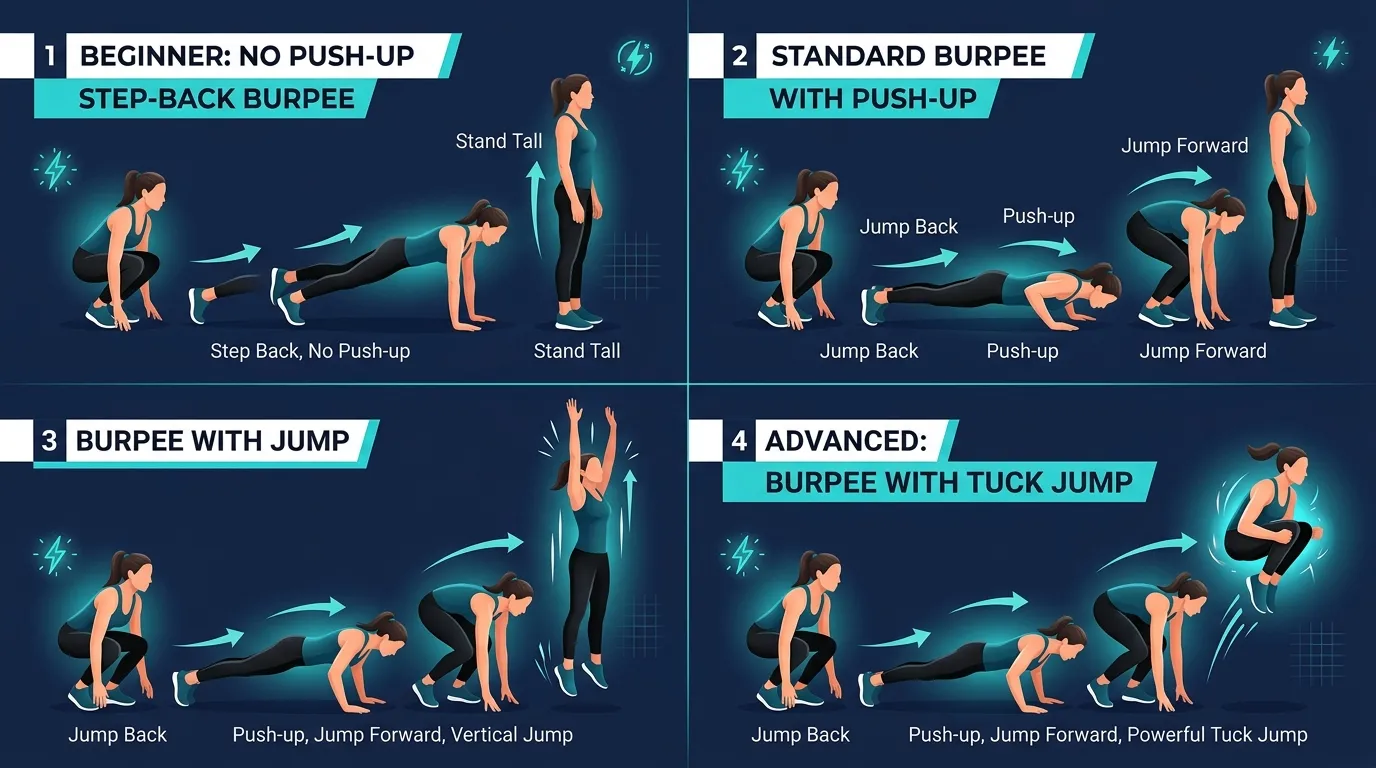
FitCraft programs two burpee variations as a clear progression path. A low-impact regression is also available for anyone managing joint sensitivity or pelvic-floor recovery.
Low-Impact Step-Back Burpee (Beginner Regression)
Remove both jumps. Squat down, step one foot back, then the other, into a plank. Step the feet forward one at a time and stand up. No jumps at any point. Use this if you're brand new to conditioning, returning from injury, or in early postpartum recovery. It builds the squat-to-plank coordination without any landing impact.
Level 1: Walkout Burpee (Advanced)
The Level 1 burpee removes the jump entirely. You step your feet back to the plank, step them forward to the squat, and stand up. This variation is categorized as advanced. It still demands coordination, mobility, and conditioning. Treat it as the foundation you build before adding explosive power.
Use Level 1 when: you're building your cardio base, working on squat-to-plank transitions, or managing joint sensitivity. Master this before moving to Level 2.
Level 2: Jump Burpee (Expert)
The Level 2 burpee adds a jump back to the plank and an explosive vertical jump at the finish. This dramatically increases cardiovascular demand and the power output required from your legs. It's categorized as expert-level for good reason. Sloppy jump burpees are a fast track to knee and lower-back problems.
Progress to Level 2 when: you can complete 3 sets of 10 Level 1 burpees with clean form and controlled breathing. If you're gasping or your plank collapses by rep 6, stay at Level 1.
When to Avoid or Modify Burpees
Burpees are safe for most healthy adults, but several conditions warrant modification or temporarily swapping the Level 2 jump variation for easier alternatives. None of these are permanent restrictions. They're starting points. Always consult your physician or physical therapist for personalized guidance.
- Known cardiovascular disease or uncontrolled hypertension. Burpees spike heart rate and blood pressure rapidly. Get your cardiologist's approval first and stay within their prescribed heart-rate zones. Lower-intensity substitutions like marching in place or step-n-clap let you build a base before adding plyometric load.
- Acute lower-extremity injury (knee, ankle, hip, shin splints, plantar fasciitis). The jump phase aggravates these. Drop to the low-impact step-back regression or substitute marching in place while you rehab. Reintroduce jumps only when you can do a pain-free 30-second walkout burpee set.
- First trimester (for some movements) and second or third trimester of pregnancy. Joint laxity increases injury risk and the prone plank position becomes uncomfortable as the belly grows. Substitute the low-impact step-back regression in the first trimester and switch entirely to standing alternatives (jumping jacks at modified intensity, marching in place) in later trimesters.
- First 6 to 12 weeks postpartum. Pelvic-floor recovery is a prerequisite for jumping movements. Get clearance from a pelvic-floor PT. Until cleared, rebuild deep-core control with deadbugs and bird-dogs, then phase in low-impact step-back burpees before any jumping.
- Stress incontinence. Jumping movements often trigger leakage. Substitute the low-impact step-back burpee or squat walks, and strengthen the pelvic floor first under the guidance of a pelvic-floor PT.
- Wrist pain or carpal tunnel. The plank phase loads the wrists at roughly 90 degrees of extension, which can aggravate carpal tunnel or wrist strain. Use push-up handles or dumbbells under the hands to keep the wrist neutral, or substitute a non-plank conditioning movement like jumping jacks until the wrist tolerates loaded extension.
- Vertigo, balance disorders, or vestibular conditions. The rapid up-down position changes risk falls. Stay with steady-state, non-plyometric conditioning until cleared by a physician.
- Asthma or exercise-induced bronchoconstriction. Have an inhaler accessible, lengthen your warm-up, and consider longer rest intervals between sets. Consult your physician before adding high-intensity intervals.
Related Exercises
If burpees are part of your conditioning, these movements complement, extend, or scale back the same training pattern:
- Lower-impact alternative in the same pattern: Step-n-Clap and Marching in Place drive heart rate up without the landing impact, useful when joints need a break or during recovery from injury.
- Same conditioning family: Jumping Jacks, Mountain Climbers, and Jump Squats hit similar energy systems and are great rotation options inside a HIIT circuit.
- Core stability foundation: Forearm Planks, Hand Planks, and Deadbugs isolate the bracing pattern burpees rely on, useful if your hips sag during the plank phase.
- Lower-body strength foundation: Squats build the eccentric squat strength that protects the knees during repeated burpee landings.
- Ankle and calf conditioning: Calf Raises and Calf Hops graduate impact tolerance, useful before progressing from Level 1 walkouts to Level 2 jumps.
How to Program Burpees
Burpee programming is time-based or work-to-rest-interval-based rather than fixed sets and reps. The American College of Sports Medicine (ACSM) Position Stand on resistance training, which also informs interval-based conditioning, recommends matching work intensity, rest duration, and frequency to your current conditioning level (Ratamess et al., 2009).
| Level | Work interval | Rest between rounds | Total session | Frequency |
|---|---|---|---|---|
| Beginner (low-impact step-back) | 20 to 30 seconds | 60 to 90 seconds | 10 to 15 minutes | 2 to 3 sessions/week |
| Intermediate (Level 1 walkout) | 30 to 45 seconds | 45 to 60 seconds | 15 to 25 minutes | 3 to 4 sessions/week |
| Advanced (Level 2 jump) | 45 to 60 seconds | 30 to 45 seconds | 20 to 30 minutes | 3 to 5 sessions/week |
Where in your workout: burpees belong in a standalone HIIT session, after resistance training (never before, because they deplete the glycogen your strength work needs), or as a metabolic finisher in the last 5 to 10 minutes of a session. They also pair well at the start of a circuit. Don't program burpees before heavy lower-body lifts; the leg fatigue will compromise squat or deadlift mechanics. Common formats include a 4-minute Tabata (20 seconds on, 10 seconds off, 8 rounds), a 15-minute EMOM (every minute on the minute), or a circuit of 5 movements at 30 seconds each with 60 seconds rest between rounds.
Form floor over rep targets: if your plank starts sagging, your landings get loud, or your knees cave inward, stop the work interval there. Hitting a target rep count or work duration with broken form is worse than hitting fewer reps cleanly. Burpees punish form breakdown more than most exercises because every rep includes a landing.
How FitCraft Programs This Exercise
Knowing how to do a burpee is step one. Knowing when to do it, at what work-to-rest ratio, and when to progress from Level 1 to Level 2 is where most people get stuck.
FitCraft's AI coach Ty handles that. During your personalized diagnostic assessment, Ty maps your fitness level, goals, and any joint or pelvic-floor considerations. Then Ty builds a personalized program that slots burpees into a balanced training plan at the right variation for your level.
As your conditioning improves, Ty adjusts the variation and the work-to-rest interval to match your level. The low-impact step-back becomes Level 1. Level 1 becomes Level 2. Work duration extends and rest shortens as your aerobic and lactate-tolerance capacities grow. Every program is designed by an Ivy League-trained exercise scientist and NSCA-certified strength coach using evidence-based periodization, then adapted to you by the AI.
Frequently Asked Questions
Can I do burpees if I have knee pain?
The Level 2 jump burpee is the part that most often aggravates knees, because of the landing impact and the rapid squat-to-jump transition. Drop to the Level 1 walkout variation, which removes both jumps entirely (you step back to plank, step forward to the squat, and stand up). Keep your knees tracking over your toes during the squat phase and avoid letting them collapse inward. If walkout burpees still produce pain, replace them with step-n-clap or marching-in-place for cardiovascular work while you rehab the knee, and see a physical therapist if symptoms persist beyond a week or two.
How many burpees should a beginner do?
Start with 5 to 8 reps per set using the Level 1 walkout variation, aiming for 2 to 3 sets with 60 to 90 seconds of rest between sets. Focus on maintaining proper form rather than speed. As your conditioning improves over several weeks, gradually increase reps or shorten rest before progressing to the Level 2 jump variation. Most people benefit from training burpees as a 20- to 30-second work interval with 60 to 90 seconds of rest, repeated 4 to 6 rounds, rather than chasing a fixed rep count.
What muscles do burpees work?
Burpees are a full-body movement that engages the quadriceps, glutes, and hamstrings to drive the squat and the jump, the pectorals, anterior deltoids, and triceps to support the plank position, and the entire core to stabilize the body during the rapid transitions. Beyond the muscles, burpees train the cardiovascular system and tap all three energy systems (phosphocreatine, glycolytic, and oxidative) depending on how long you sustain the work interval.
What is the difference between a Level 1 and Level 2 burpee?
A Level 1 burpee uses a walkout to plank and a standing finish: you step your feet back one at a time, step them forward, and simply stand up at the top. A Level 2 burpee adds a jump back to plank and an explosive vertical jump at the top with arms overhead. Level 1 is an advanced bodyweight movement; Level 2 is expert-level and significantly more demanding on your cardiovascular system, your knees, and your shoulders. Master Level 1 with clean form before progressing.
Can I do burpees every day?
You can do burpees daily in small volumes (a few sets of 5 to 8 reps), but most people benefit from including them 2 to 4 times per week as part of a structured program. Daily high-volume burpees lead to overuse fatigue, breakdown in landing mechanics, and compromised form, which raises injury risk on the knees, wrists, and lower back. FitCraft's AI coach Ty programs burpees at the right frequency and volume based on your fitness level and recovery capacity.