Quarter squats use the top portion of a squat: a small knee bend, a slight hip shift back, and a controlled return to standing. They are not the same as cutting a normal squat short because you got tired. The point is to control a shallow squat and keep your knees, hips and feet lined up.
That makes the quarter squat useful before squats, jump squats or any workout where you need a small, quick knee bend instead of a deep squat. Treat it as a strength exercise: slow, controlled reps.
The benefits: quarter squats train your quadriceps and glutes while keeping the forces on your knees low, build strength in the top part of the squat and make a good warm-up before jumps.
Quick Facts: Quarter Squats
- Equipment needed: None
- Difficulty: Beginner (shallower than the partial squat, which the FitCraft app rates Beginner)
- Modality: Bodyweight strength (a shallow squat)
- Body region: Lower body
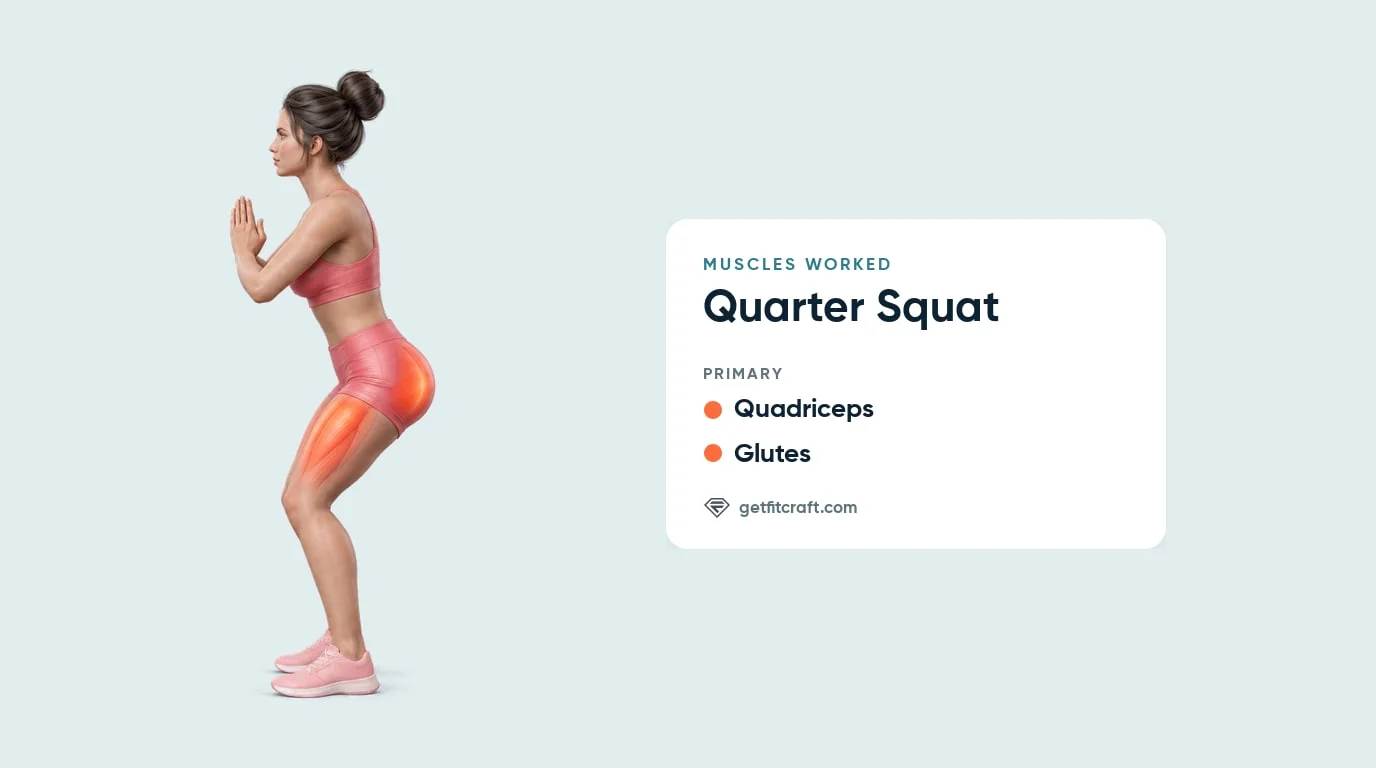
Muscles Worked
The quadriceps, at the front of your thighs, are a primary muscle. On the way down they control the shallow knee bend; on the way up they straighten your knees to stand you tall again.
The glutes are the other primary muscle. They control your hips as they push back a little, then drive your hips forward as you stand. You should feel the work in the fronts of your thighs and in your glutes, a bit lighter than in a deeper squat.
In a study of squat depth, glute activity rose as the squat got deeper (Caterisano et al., 2002), which is why the glutes do less here than in a full squat. A review of squat knee mechanics found knee forces lowest from standing to about 50 degrees of knee bend (Escamilla, 2001), so the shallow range keeps the load on your knees low. In a training study, shallow-squat training built strength in the shallow squat, while deep-squat training grew the front of the thigh more (Bloomquist et al., 2013). That is why the quarter squat works as a starting point or a warm-up, not a replacement for deeper squats.
Step-by-Step: How to Do a Quarter Squat
- Set your stance. Stand with your feet about shoulder-width apart, toes pointing forward or turned out a little. Spread your weight over your whole foot.
Tip: keep your heels and toes on the floor the whole time.
- Brace and stack your torso. Press your hands together in front of your chest or rest them on your hips. Stand tall, brace your core and keep your chest up without arching your lower back.
Tip: breathe in as you lower and out as you stand; never hold your breath.
- Lower into a shallow squat. Push your hips back a little and bend your knees to roughly 45 degrees, so your hips drop only a few inches and your thighs still slope steeply down. Stop well before halfway down.
Tip: anywhere from about 30 to 60 degrees of knee bend still counts as a quarter squat.
- Track knees over toes. Keep each knee pointing in the same direction as your toes, your heels down and your back flat. Your knees may move a little forward. If the knees cave inward, slow down and make the bend smaller.
Tip: knees follow your toes all the way.
- Stand tall with control. Pause briefly, then breathe out and push the floor away to stand tall. Lower in about a second and stand up smoothly, then repeat.
Tip: keep every rep smooth and controlled.
Get this exercise in a personalized workout
FitCraft, our mobile fitness app, uses its AI coach Ty to program mobility work like this into your plan at the right volume and intensity, based on your level, goals, and equipment. Ty was designed and trained by Domenic Angelino, MPH (Brown University) and NSCA-CSCS, with research published in the Journal of Strength and Conditioning Research and Medicine & Science in Sports & Exercise.
Take the Free Assessment Free • 2 minutes • No credit card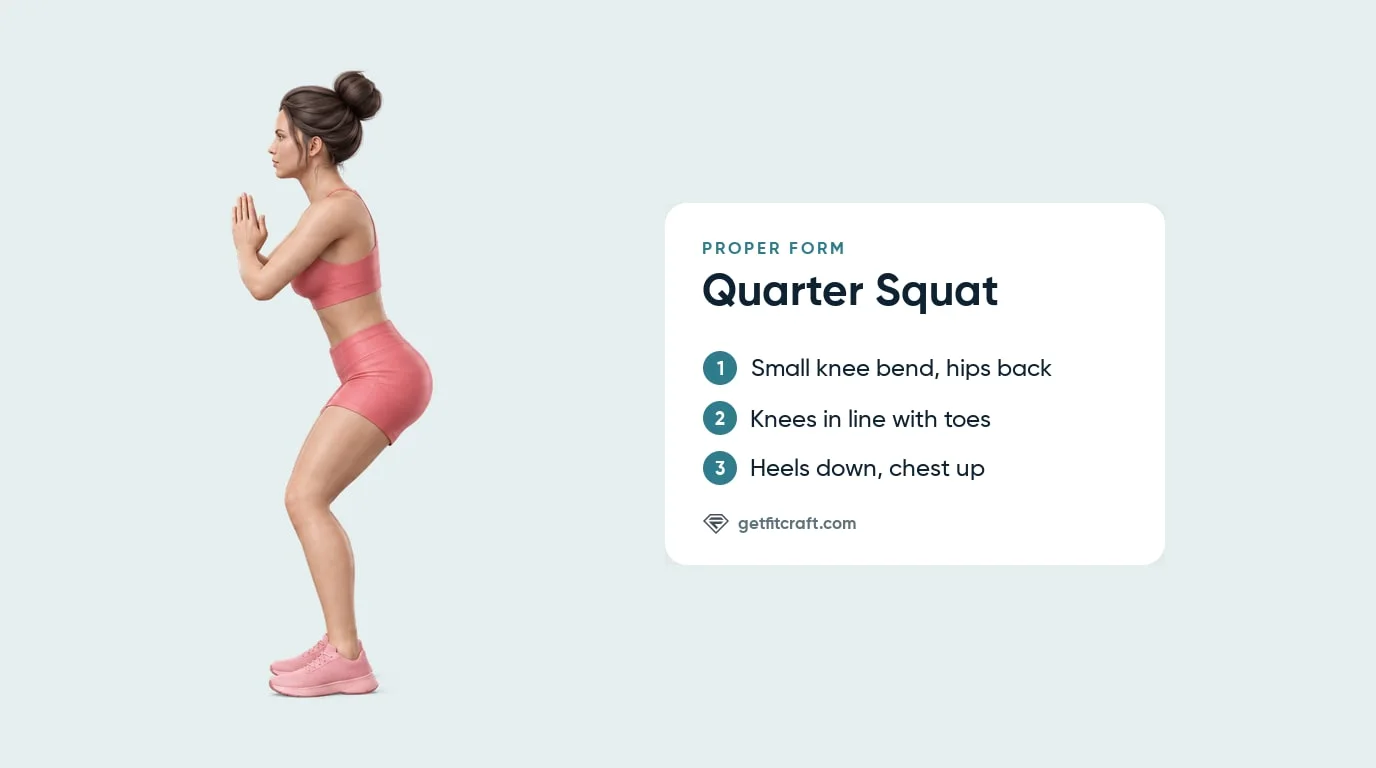
Common Mistakes
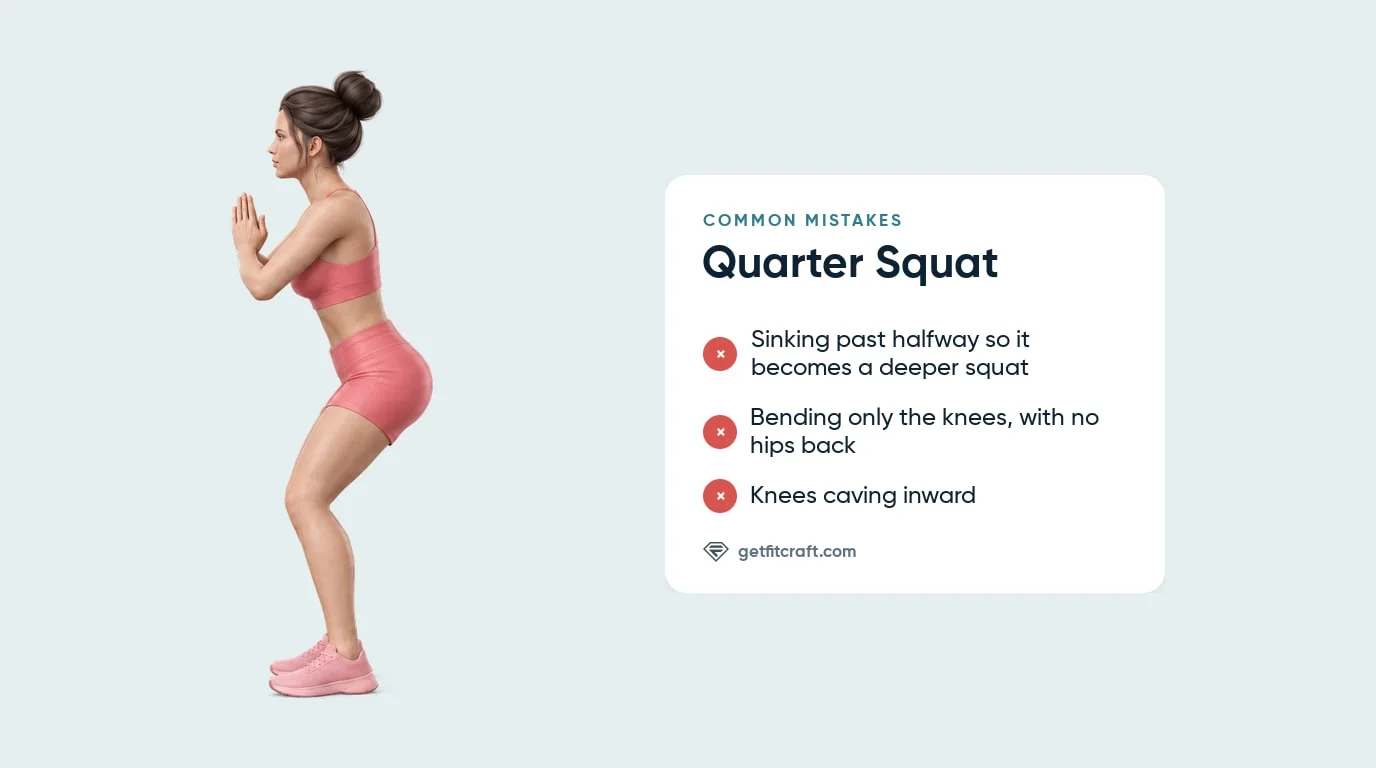
Turning it into a half squat
What it looks like: You keep lowering until the movement is closer to a half squat than a quarter squat.
Why it matters: The drill loses its purpose. The shallow range is there so you can practice stance and knee control through the top of the squat.
The fix: Film from the side to check your depth. Stop while your thighs still slope steeply down, with your knees bent roughly 45 degrees.
Letting the knees cave inward
What it looks like: One or both knees drift toward the midline as you lower or stand.
Why it matters: Inward knee collapse teaches a pattern you don't want to carry into deeper squats, landings, or loaded training.
The fix: Slow the rep down. Keep the kneecaps pointing over the second and third toes.
Rocking onto the toes
What it looks like: The heels get light and the body tips forward.
Why it matters: Your weight tips forward onto your toes and your knees take more of the load.
The fix: Keep your whole foot on the floor, heels and toes down, and push your hips back a little as your knees bend.
Bending only at the knees
What it looks like: Your knees bend but your hips stay where they are, so the rep turns into a knee dip.
Why it matters: The quarter squat is a small squat, not a knee bend. Pushing your hips back a little is what brings your glutes into the move.
The fix: Push your hips back a little as your knees bend, and keep your chest up.
Bouncing through fast, sloppy reps
What it looks like: You bounce through quick, sloppy reps because the movement feels easy.
Why it matters: Bouncing lets your depth and knee position change from rep to rep, so you stop practicing control.
The fix: Lower in about a second, pause briefly at the bottom and stand up smoothly. To make it harder, go deeper or lower more slowly, never faster.
Quarter Squat Variations: Regressions and Progressions
Smaller Quarter Squat (Easier)
Make the bend smaller, just an inch or two, and do fewer reps with a short rest between sets. Build up to the full quarter-squat depth while your knees stay in line with your toes.
Bodyweight Quarter Squat
The standard version: knees bent roughly 45 degrees, hips a few inches lower, then stand. Keep the range small and the feet quiet.
Partial and Full Squats (Harder)
Go deeper once quarter squats feel easy. Partial squats lower about halfway (rated Beginner in the FitCraft app), and full squats lower until your thighs are about level with the floor (rated Intermediate). A slow three-second lowering with a pause at the bottom also makes the quarter squat harder.
Wall Sit
Hold a squat against a wall when you want to work the quadriceps and glutes without moving. Use a comfortable knee angle. The FitCraft app has a partial version, rated Beginner, and a full version, rated Intermediate.
Jump Squat
A jump often starts with a quick dip into a quarter or half squat, so quarter squats make a good warm-up before jumps. Jump squats add impact and speed, and the FitCraft app rates them Advanced and Expert, so build up with partial and full squats first, land softly and stop before form fades.
When to Avoid or Modify Quarter Squats
Quarter squats are safe for most healthy adults, but if any of the situations below applies to you, check with a doctor or physical therapist before you do them. A burn in your thighs or glutes is normal; stop any rep that causes pain in a joint, your lower back or your neck.
- Acute knee, hip, or ankle injury. See a doctor or physical therapist first, and do quarter squats only once they clear you. Any pain in a joint during a set means stop.
- Recent lower-body surgery. Even shallow bending loads healing tissue. Wait until your surgeon or physical therapist clears you, and stop at any pain.
- Hypermobility or connective tissue disorders. Check with your doctor or physical therapist first. Move slowly and with control, never bouncing, and stop at any joint pain.
- Acute muscle strain. Don't load a fresh strain. See a doctor or physical therapist, and do quarter squats only once they clear you.
- Pregnancy. Check with your doctor or midwife first, and do quarter squats only with their go-ahead. Stop if you feel pelvic pressure, dizziness, or any pain.
- Low-back pain, disc symptoms, or active sciatica. See a doctor or physical therapist before you do quarter squats, and do them only once they clear you. Any pain in your lower back, or pain that travels down your leg, means stop.
Related Exercises
- Squat foundation: Squats take the same movement deeper; move on to them once quarter squats feel easy.
- Same muscles, no movement: Wall sits work the quadriceps and glutes as a hold against a wall.
- Inner-thigh stretch: Cross-legged ankle stretch is a gentle seated stretch for the adductors on the inner thighs.
- Hip stretch: Hip abductor stretch stretches the glute medius and glutes on the side and back of the hip.
- Power progression: Jump squats add speed and impact; quarter squats make a good warm-up before them.
- Lower-leg work: Calf raises work the calves, which the quarter squat does not target.
How to Program Quarter Squats
Use quarter squats as a starting point, a warm-up, or a short dip to practice before jumps. The ACSM position stand on resistance training says to make training harder gradually, for example with more reps, a different rep speed or more total work (Ratamess et al., 2009). Start with a dose you can do cleanly, and add more reps, a slower lowering or more depth only when the movement stays controlled. The table below is a practical starting point, not figures from the position stand.
| Goal | Reps | Sets | Frequency |
|---|---|---|---|
| Starting out | 6-8 slow reps | 1-2 | 5-7 sessions/week as warm-up practice |
| Building up | 8-12 controlled reps | 2-3 | 3-5 sessions/week |
| Warm-up before jumps | 5-10 controlled reps | 2-4 | 2-4 sessions/week before lower-body training |
Place quarter squats early in the session after easy movement prep and before deeper squats, lunges, or jumps.
Good form matters more than hitting the rep target. If your heels lift, knees cave, back arches, or the depth changes from rep to rep, end the set there.
The quarter squat is not in the FitCraft app. The app does include the partial squat, rated Beginner, and the full squat, rated Intermediate, both with 3D demonstrations.
Frequently Asked Questions
What muscles do quarter squats work?
Quarter squats work two muscles, both primary: the quadriceps and the glutes. The quadriceps, at the front of your thighs, straighten your knees to stand you up, and the glutes drive your hips forward. The glutes work less in a shallow squat than in a deep one, but they still share the work, so the quarter squat is a bodyweight strength exercise for both.
Are quarter squats good for beginners?
Yes. Quarter squats are a good starting point: they teach stance, knee tracking and foot pressure through a small range. Deeper squats build more thigh and glute muscle, so move on to partial squats, then full squats, once the quarter squat feels easy.
Can I do quarter squats with knee pain?
Not until a doctor or physical therapist clears you. See them first, and do quarter squats only once they say it is fine. During a set, a burn in your thighs or glutes is normal, but any pain in your knees means stop right away.
How deep should a quarter squat be?
Only a few inches. Push your hips back a little and bend your knees to roughly 45 degrees (anywhere from about 30 to 60 still counts), so your thighs still slope steeply down. If you reach halfway, you have gone deeper than a quarter squat needs.
Are quarter squats better than full squats?
No, they do different jobs. A shallow range keeps the forces on your knees low and builds strength in the top part of the squat, but deeper squats build more thigh and glute muscle. Use quarter squats as a starting point or a warm-up before jumps, not as a replacement for deeper squats.