Wall sits look almost too simple. You lean against a wall, slide down, and hold.
The work shows up fast. Your quads have to keep producing force without movement, your hips keep the knees from collapsing inward, and your trunk keeps the ribs and pelvis stacked while fatigue builds.
That makes wall sits useful when you want lower-body endurance without jumping, running, or heavy equipment. The tradeoff is depth. A good wall sit is controlled and aligned. A deeper wall sit is only better if your knees, hips, and back stay calm.
Quick Facts: Wall Sits
- Equipment needed: A flat wall
- Difficulty: Beginner (partial) to Intermediate (full)
- Modality: Strength and muscular endurance
- Body region: Lower body and core
- FitCraft quest category: Strength
Muscles Worked
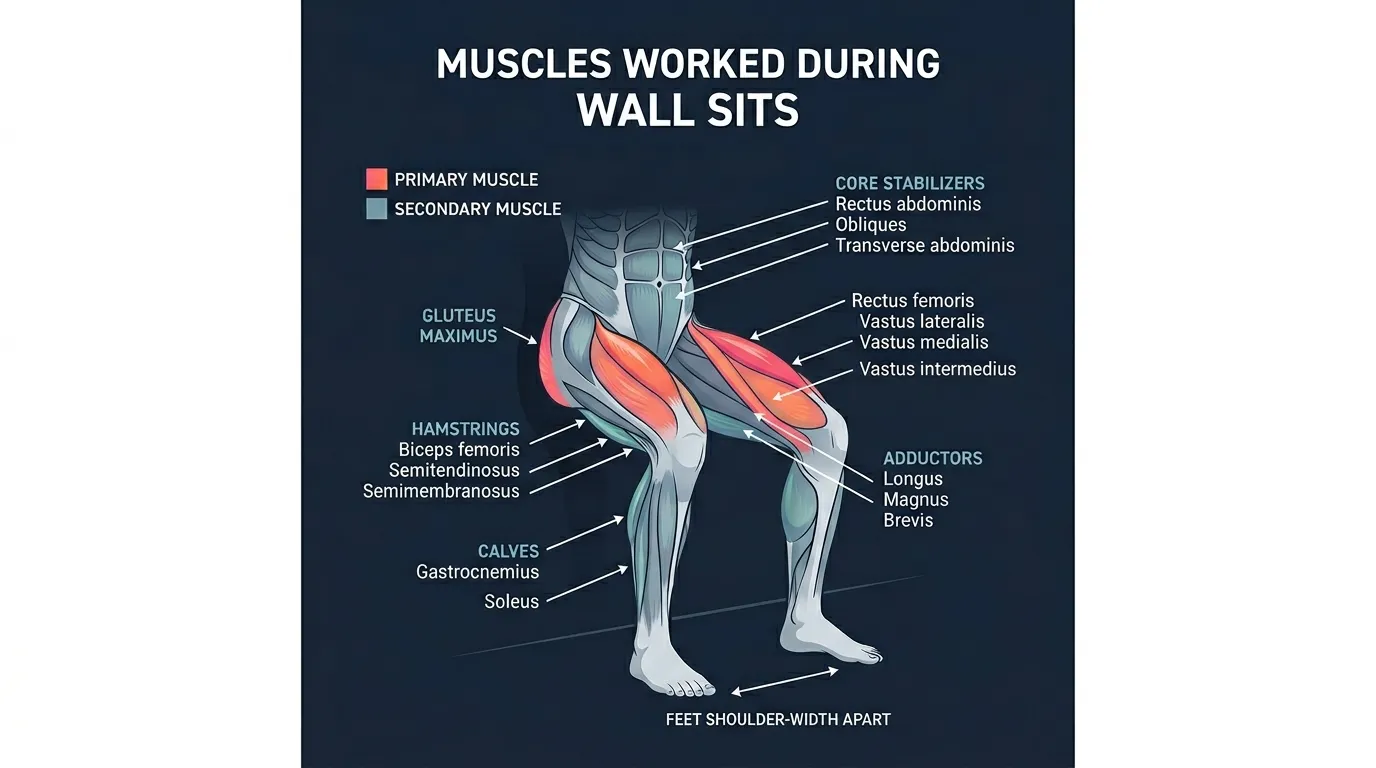
Primary movers: the quadriceps are the main working muscles. Because the wall sit is isometric, the quads produce force at a fixed knee angle instead of shortening and lengthening through a rep. The deeper the knee angle, the more demanding the hold becomes.
Secondary movers: the gluteus maximus helps support hip position, while the hamstrings and calves assist by keeping the lower leg steady. The adductors and gluteus medius help keep the knees from collapsing inward as fatigue builds.
Stabilizers: the abdominal wall, obliques, spinal erectors, diaphragm, and pelvic floor help keep the ribs stacked over the pelvis. Your upper back also works lightly to maintain contact with the wall. Steady breathing matters because holding your breath can raise pressure and make the hold feel harder.
Why the wall changes the exercise: the wall gives your torso external support, so the limiting factor is usually local leg endurance rather than balance. A shallow partial wall sit reduces knee flexion and quad demand. A full wall sit near parallel increases the lever arm at the knee and makes the quadriceps work much harder without adding impact.
Step-by-Step: How to Do Wall Sits
Step 1: Set Your Stance
Stand with your back flat against a smooth wall. Walk your feet about two feet forward and set them shoulder-width apart.
Coach Ty's cue: "Start with your feet far enough out that your shins can stay almost vertical."
Step 2: Slide Down with Control
Bend your knees and slide your back down the wall. Stop at a partial depth if you're new, or lower until your thighs are close to parallel if you can hold that position cleanly.
Coach Ty's cue: "Lower only as far as you can control. Depth comes after alignment."
Step 3: Stack Knees Over Ankles
Your knees should track over your middle toes, with your ankles under or slightly behind your knees. If your knees drift far past your toes, step your feet farther from the wall.
Coach Ty's cue: "Knees point the same direction as your toes for the whole hold."
Step 4: Brace and Breathe
Keep your ribs down, core gently braced, and back in contact with the wall. Breathe in a steady rhythm instead of clenching your jaw or holding your breath.
Coach Ty's cue: "Breathe through the burn. Don't let the burn change your position."
Step 5: Stand Up Cleanly
Press through your heels and slide up the wall under control. Rest before the next hold, and end the set as soon as knee tracking, back contact, or breathing falls apart.
Get this exercise in a personalized workout
FitCraft, our mobile fitness app, uses its AI coach Ty to program core stability work like this into your plan at the right volume and intensity, based on your level, goals, and equipment. Ty was designed and trained by Domenic Angelino, MPH (Brown University) and NSCA-CSCS, with research published in the Journal of Strength and Conditioning Research and Medicine & Science in Sports & Exercise.
Take the Free Assessment Free · 2 minutes · No credit card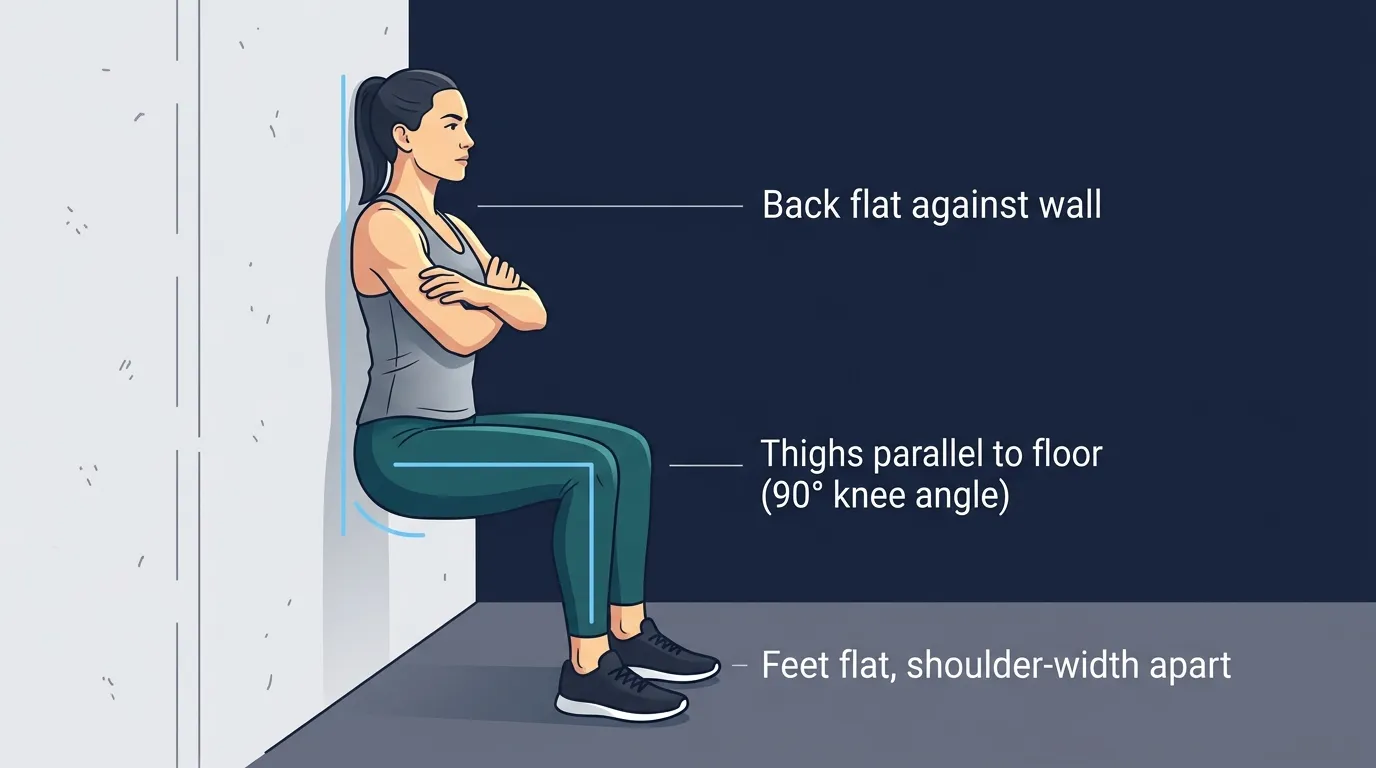
Common Mistakes (and How to Fix Them)
- Knees drifting inward. Fatigue can pull the knees toward each other. Fix it by spreading the floor gently with your feet and keeping each knee pointed over the middle toes.
- Feet too close to the wall. If the knees shoot forward, the position can feel pinchy. Walk the feet out until your shins are close to vertical.
- Sitting too low too soon. A full 90-degree wall sit is much harder than it looks. Start higher and earn more depth once you can hold still without joint pain.
- Hands pushing on thighs. Pressing your hands into your legs offloads the quads. Keep your hands at your sides, across your chest, or extended forward.
- Holding your breath. Breath-holding makes the effort spike and can cause dizziness. Use slow, steady breathing from the first second of the hold.
- Sliding up as fatigue builds. The body tries to escape the hardest angle. Pick a depth you can honestly hold, then stop when you can no longer stay there.
Wall Sit Variations: Regressions and Progressions
Use the variation that lets you hold a clean knee position and steady breath. Progress depth before you progress load.
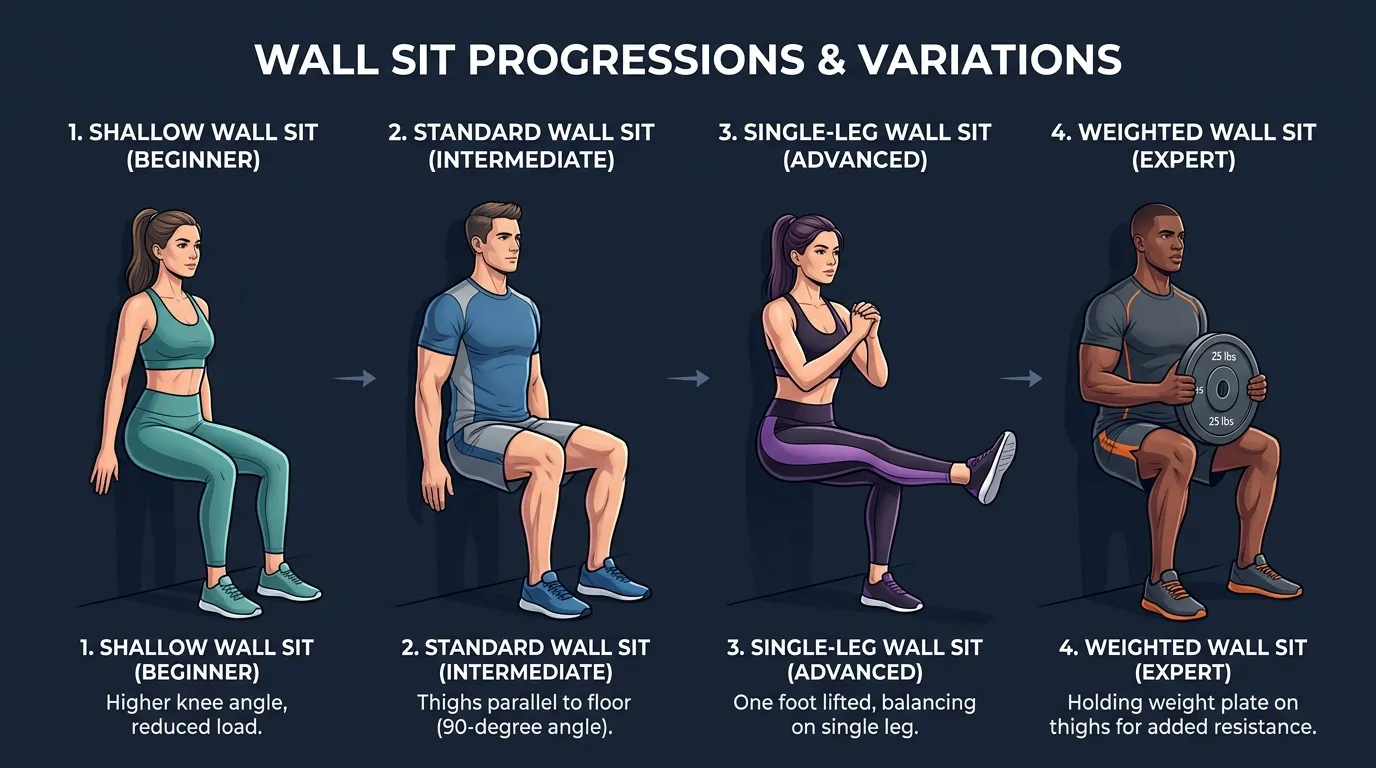
Partial Wall Sit (Beginner Regression)
Slide down only partway, usually around a 45-degree knee bend. This reduces quad demand and gives you room to practice alignment.
Full Wall Sit (Standard)
Lower until your thighs are near parallel and your knees are around 90 degrees. This is the standard version most people mean when they say wall sit.
Loaded Wall Sit (Strength Progression)
Hold a dumbbell, kettlebell, or weight plate at your chest. Add load only after you can hold the full bodyweight version with calm breathing and clean knee tracking.
Single-Leg Wall Sit (Advanced Progression)
From the full position, extend one leg forward and hold with the other leg. Use short holds at first because the working leg takes a much larger share of the load.
When to Avoid or Modify Wall Sits
Wall sits are safe for most healthy adults, but deep knee flexion and sustained bracing can bother certain conditions. Use a shallower angle, shorter hold, or different exercise when symptoms show up. Always consult your physician or physical therapist for personalized guidance.
- Patellofemoral knee pain or recent knee surgery. Deep holds can irritate the front of the knee. Use a partial wall sit, stay above the painful depth, or choose quarter squats until cleared to progress.
- Acute lower-back pain or known disc pathology. The wall reduces balance demand, but bracing still matters. If the back feels worse during the hold, rebuild control with deadbugs, bird-dogs, or forearm planks.
- Pregnancy, especially second or third trimester. Use a shallow angle, avoid breath-holding, and stop if you feel pelvic pressure, dizziness, or pain. Medical guidance matters here.
- First 6-8 weeks postpartum or active diastasis recti. Sustained bracing can raise intra-abdominal pressure. Start with breathing, gentle core work, glute bridges, and short partial holds only after clearance.
- Hernia, pelvic-floor dysfunction, or pelvic-organ prolapse. Long isometric holds can increase pressure. Keep holds short, breathe continuously, and work with a qualified clinician if symptoms are present.
- Dizziness or uncontrolled blood pressure. Isometric holds can make breath-holding tempting. Stop if you feel lightheaded, and use lower-intensity strength work until medically cleared.
Related Exercises
If wall sits fit your training, these exercises build the same lower-body and bracing qualities from different angles:
- Same squat pattern: Squats and Quarter Squat train the same knee and hip pattern with movement instead of a static hold.
- Loaded squat progression: Goblet Squats and Front Squats add external load once bodyweight control is solid.
- Single-leg progression: Split Squats and Bulgarian Split Squats challenge each leg separately and demand more hip control.
- Core foundation: Deadbugs, Bird-Dogs, and Forearm Planks build the bracing pattern that keeps the wall sit calm.
- Glute and lower-leg support: Glute Bridges and Calf Raises strengthen the support muscles that help the knees track well.
How to Program Wall Sits
Wall sits are best programmed as timed isometric holds. The American College of Sports Medicine position stand on resistance training supports progressive overload through volume, intensity, rest, and frequency, which applies cleanly to hold time and depth here (Ratamess et al., 2009).
| Level | Sets × Reps | Rest between sets | Frequency |
|---|---|---|---|
| Beginner (partial hold) | 2-3 × 15-30 seconds | 45-60 seconds | 2-4 sessions/week |
| Intermediate (full hold) | 3 × 30-60 seconds | 60 seconds | 3-5 sessions/week |
| Advanced (loaded or single-leg) | 3-5 × 60-120 seconds | 60-90 seconds | 4-6 sessions/week |
Where in your workout: Use wall sits near the end of a lower-body session, as a bodyweight finisher, or in a short at-home strength circuit. If heavy squats, lunges, or jumps are in the same workout, do those first while your legs are fresh.
Form floor over time targets: stop the set when your knees cave inward, your back peels from the wall, your feet shift, or your breathing locks. A clean 25-second hold beats a sloppy 60-second hold.
How FitCraft Programs This Exercise
Wall sits are useful because the dose is easy to control. Hold time, depth, rest, and variation tell the whole story.
FitCraft's AI coach Ty uses your personalized diagnostic assessment to place core stability work and lower-body strength work into a balanced program. Wall sits may show up as a beginner-friendly lower-body endurance hold, a finisher after squat patterns, or a low-equipment option when you need strength work without jumping.
As your capacity improves, Ty adjusts the variation and volume to match your level. Partial holds can become full holds. Full holds can become longer, loaded, or single-leg work. The goal is steady progress without turning every set into a form breakdown contest.
Frequently Asked Questions
How long should you hold a wall sit?
Beginners usually start with 15 to 30 seconds at a partial depth. Intermediate users can hold 30 to 60 seconds near parallel. Advanced users may use 60 to 120 seconds, added load, or single-leg variations. Stop when your position changes, even if the timer has time left.
What muscles do wall sits work?
Wall sits primarily work the quadriceps. The gluteus maximus, hamstrings, calves, hip stabilizers, and trunk muscles support the position while you hold the squat angle against the wall.
Are wall sits good for beginners?
Yes. Beginners can use a shallower partial wall sit and short holds to learn knee tracking, upright posture, and steady breathing before progressing to a deeper 90-degree position.
Why do my quads burn during wall sits?
The burn comes from sustained isometric tension. Your quadriceps keep producing force without changing length, so local fatigue builds quickly. That is normal, but sharp joint pain is a reason to stop.
Can I do wall sits with knee pain?
Use caution. Wall sits can be comfortable for some knees because there is no impact, but deep knee flexion can aggravate patellofemoral pain or recent knee injuries. Start higher on the wall, keep shins close to vertical, and stop if pain increases. Get medical or physical therapy guidance if knee pain is persistent, sharp, or post-surgical.