Sideways flutters train the glute medius on the side of your hip, the muscle that keeps your pelvis level when you walk, run or stand on one leg.
The setup is simple. Lie on your side propped on your forearm, stack your hips, and lift the top leg with control. The challenge is keeping the rest of your body still while the leg works.
Quick Facts: Sideways Flutters
- Equipment needed: None (exercise mat optional)
- Difficulty: Intermediate (as rated in the FitCraft app); easier lying all the way down
- Modality: Hip strength (side-lying leg raise)
- Body region: Hips and glutes (glute medius, with the rest of the glutes helping)
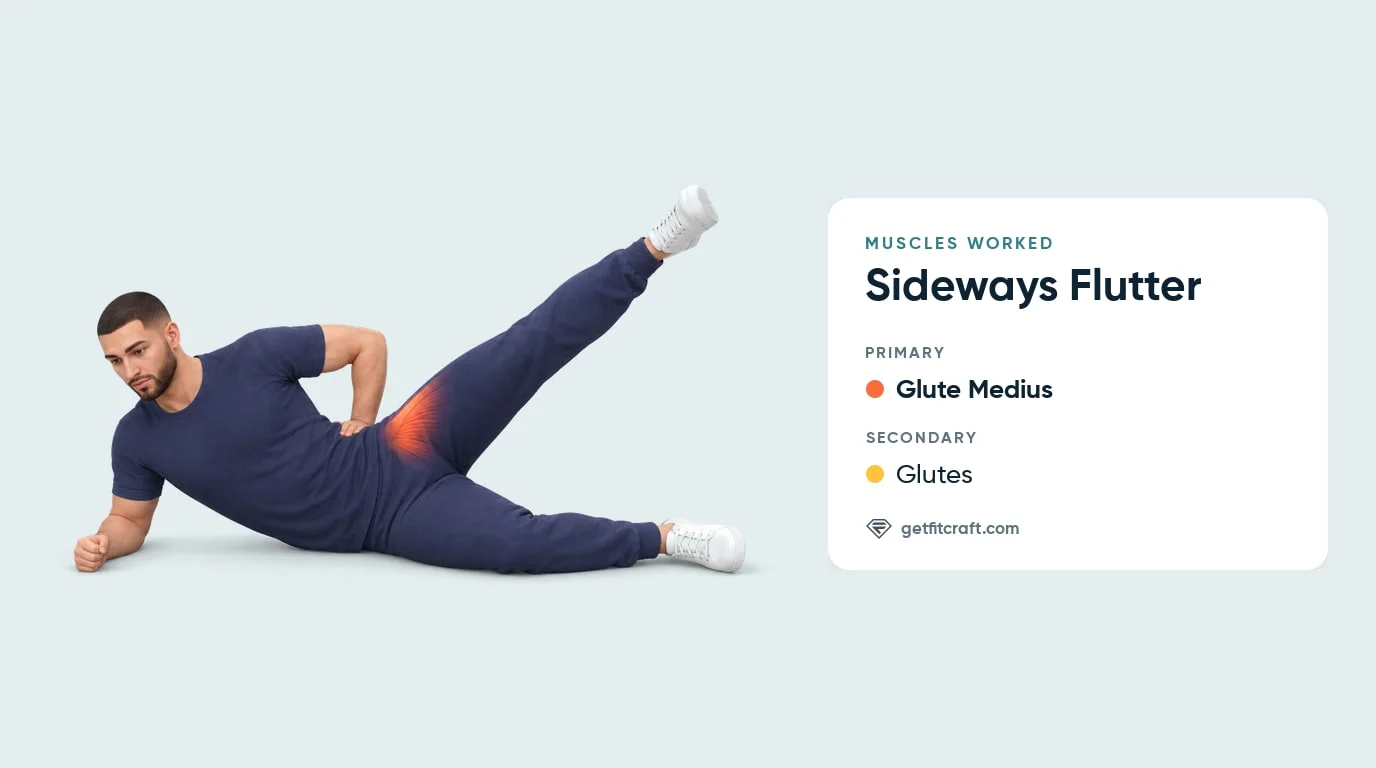
Muscles Worked
Primary mover: the glute medius, the muscle high on the side of your hip. It abducts the hip, which means it lifts the top leg away from the middle of your body, and it controls the leg as it lowers. It is also the muscle that keeps your pelvis level when you walk, run or stand on one leg. In a study of 12 common therapeutic exercises, side-lying hip abduction, the same move as the sideways flutter, produced the highest glute medius activity (Distefano et al., 2009).
Secondary mover: the rest of your glutes help the glute medius lift the leg. Keeping your knee and toes facing forward and your hips stacked keeps the work in the side of your hip rather than the front of it.
Why the movement works: lying on your side means your top leg lifts against gravity, and a straight top leg is a long lever, so even your own leg is enough to work the side of your hip hard. Lifting higher than about 45 degrees does not add more: the pelvis tips and the side of the hip stops doing the work.
Step-by-Step: How to Do a Sideways Flutter
Step 1: Set Your Side-Lying Position
Lie on one side on a mat, propped on your bottom forearm with your elbow under your shoulder, and rest your top hand on your hip. Bend your bottom knee for balance and keep your top leg straight and in line with your body. For an easier setup, lie all the way down with your head resting on your bottom arm; your bottom leg can be straight or bent.
Tip: keep your elbow right under your shoulder so your upper body doesn't sag toward the floor.
Step 2: Stack Your Hips and Brace
Stack your top hip directly over your bottom hip, with your top knee and toes facing forward. Lightly tighten your abs so your hips don't roll backward before the first rep starts. This keeps the work in the side of the hip instead of the lower back.
Tip: only the top leg moves. Your trunk and hips stay still.
Step 3: Lift the Top Leg
Breathe out and lift your top leg up toward the ceiling, in line with your body. Keep the leg straight, with your knee and toes facing forward. Stop when you feel the side of your hip working or your hips start to tip, at about 30 to 45 degrees.
Tip: turning your knee and toes up toward the ceiling moves the work to the front of your hip. Keep them facing forward.
Step 4: Pause, Then Lower Slowly
Pause briefly at the top, then breathe in and lower your leg slowly until it is back in line with your body. Take about a second each way, with a short pause at the bottom before the next lift.
Tip: lower slowly, pause, then lift. No fast kicks.
Step 5: Keep the Rhythm Even and Switch Sides
Repeat with a steady, controlled tempo instead of fast kicks. Finish every planned rep on one side, then roll over and work the other leg the same way.
Tip: use the same range and the same pace on both sides.
Get this exercise in a personalized workout
FitCraft, our mobile fitness app, uses its AI coach Ty to program core stability work like this into your plan at the right volume and intensity, based on your level, goals, and equipment. Ty was designed and trained by Domenic Angelino, MPH (Brown University) and NSCA-CSCS, with research published in the Journal of Strength and Conditioning Research and Medicine & Science in Sports & Exercise.
Take the Free Assessment Free • 2 minutes • No credit card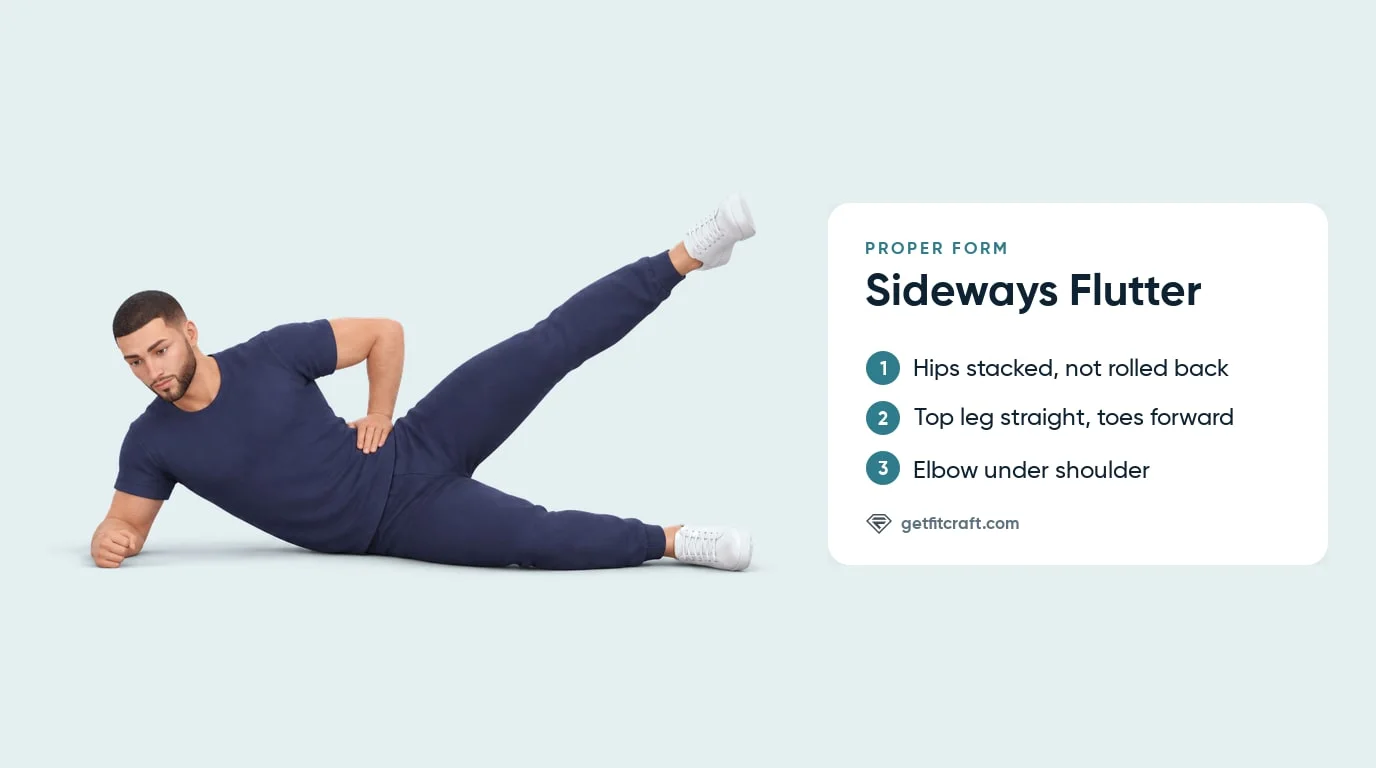
Common Mistakes (and How to Fix Them)
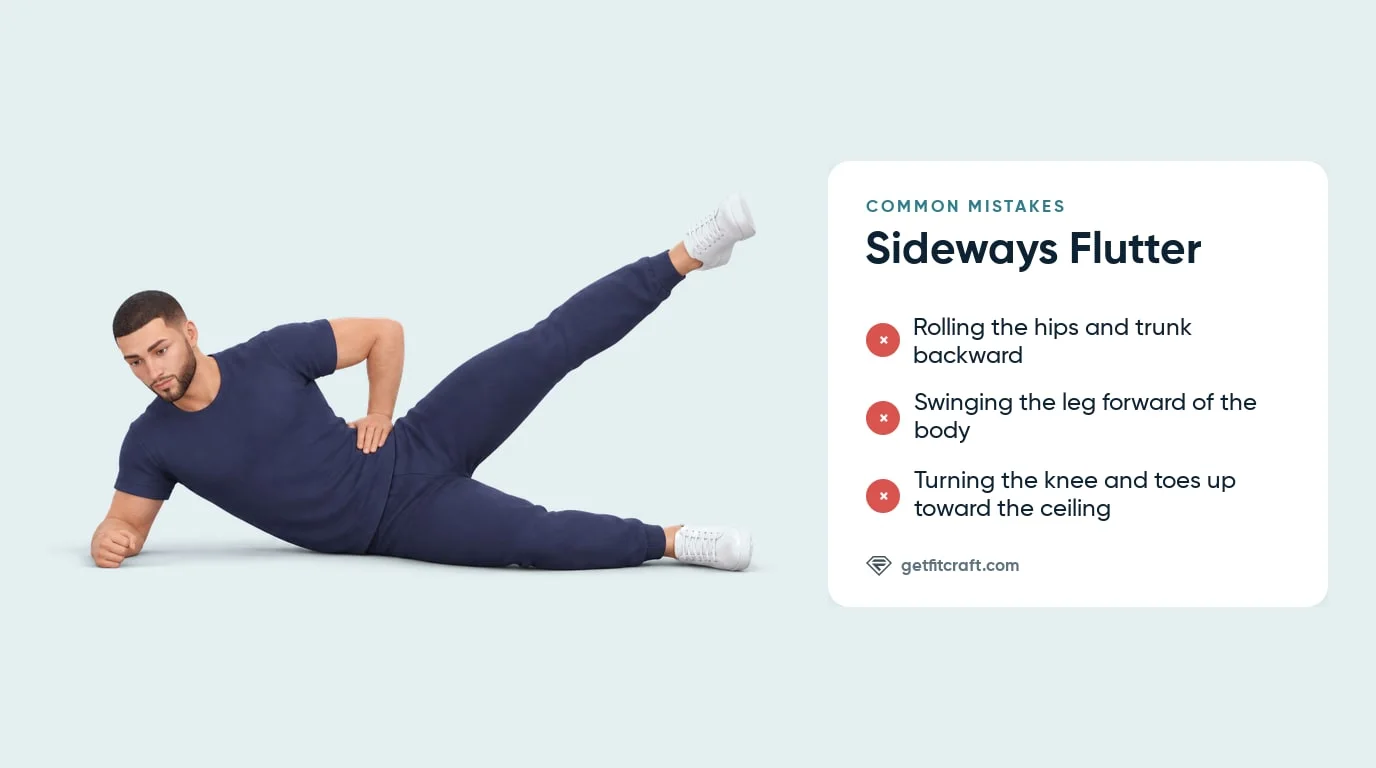
- Rolling the hips and trunk backward. This moves the work toward the front of the hip. Fix it by stacking your top hip right over your bottom hip and lifting a little less.
- Swinging the leg forward. Lift straight up, in line with your body, not forward of it. A leg that drifts forward also moves the work toward the front of the hip.
- Bending the top knee to finish reps. A bent knee shortens the lever and makes the exercise easier. Use fewer reps, or bend it slightly on purpose as the easier version.
- Turning the knee and toes toward the ceiling. That position shifts work toward the front of the hip. Keep your knee and toes facing forward.
- Lifting too high. Higher is not better. Lift to about 30 to 45 degrees and stop when your hips start to tip.
- Rushing the lift. Fast kicks let momentum and other muscles do the work. Take about a second up and a second down, with a short pause at the top and bottom.
- Sinking into the bottom shoulder. Keep your elbow right under your shoulder and hold your upper body up instead of letting it sag toward the floor.
Sideways Flutter Variations: Regressions and Progressions
Use the version that lets you keep your hips stacked and lift your leg in line with your body. A burn on the outside of your hip is normal; any pinching or pain at the front of your hip, or any pain in your lower back, means stop the exercise.
Easier Sideways Flutter
Lie all the way down with your head resting on your bottom arm instead of propping up, lift a little less, or bend your top knee slightly to shorten the leg. Each keeps the same side-lying lift but makes it easier to keep your hips stacked.
Standard Sideways Flutter (Intermediate in the FitCraft App)
Propped on your forearm with your bottom knee bent and your top leg straight, lift the top leg to about 30 to 45 degrees with a short pause at the top and bottom. This is the version the app teaches.
Harder Sideways Flutter
Slow down to about two seconds up, a pause at the top, and two seconds down. For the hardest version, lift into a side plank on your forearm and raise your top leg from there.
When to Avoid or Modify Sideways Flutters
Sideways flutters need no equipment, but if any of the situations below applies to you, check with a doctor or physical therapist before you do them. A burn on the side of your hip is normal; any pain in a joint, your lower back or your neck means stop the exercise.
- Hip pinching or pain on the side of your hip. Pain in the hip is pain in a joint, so stop the exercise. See a doctor or physical therapist before you do sideways flutters again, and do them only once they clear you.
- Lower-back pain or a known disc problem. Rolling backward or lifting too high can load your lower back. See a doctor or physical therapist before you do sideways flutters, and do them only once they clear you. During a set, any pain in your lower back means stop the exercise.
- Shoulder or elbow pain. Propping on your forearm puts weight through your bottom shoulder and elbow. See a doctor or physical therapist before you do sideways flutters, and stop if you feel any pain in your shoulder or elbow.
- After giving birth, or with diastasis recti. Check with your doctor, midwife or a women's health physical therapist first, and do sideways flutters only with their go-ahead. Stop if you feel any pain.
- Recent abdominal surgery, hernia repair, or C-section. Wait until your surgeon clears you before you do sideways flutters, and stop if you feel any pain.
- Pregnancy. Check with your doctor or midwife before you do sideways flutters, and do them only with their go-ahead. Stop if you feel pelvic pressure, dizziness or any pain.
- Pelvic-floor dysfunction or pelvic-organ prolapse. See a pelvic-floor physical therapist before you do sideways flutters, and do them only with their go-ahead. Stop if you feel pelvic pressure, heaviness or any pain.
Related Exercises
If sideways flutters fit your plan, these exercises pair well with them:
- Same muscles: Fire Hydrants, rated Beginner in the FitCraft app, work the glute medius from your forearms and knees, with the rest of the glutes helping, and Clamshells work the glute medius and glutes lying on your side.
- Side plank: Side Planks hold you up on your forearm from your side without moving the legs, the same support the harder sideways flutter starts from.
- A flat back and level hips while a leg moves: Bird-Dogs train the glutes from your hands and knees.
- Glute foundation: Glute Bridges work the glutes from your back and pair well with work for the side of your hip.
- Core: Forearm Planks train your abs to hold your body still.
- A lower-body exercise to pair with them: Squats.
How to Program Sideways Flutters
Sideways flutters are a rep-based hip strength exercise. The American College of Sports Medicine position stand on resistance training says your training has to progress for you to keep improving. It also says the right amount depends on your goals, your physical capacity and how trained you are (Ratamess et al., 2009). It gives no set and rep ranges for sideways flutters, so the table below is a practical starting point, not figures from the position stand.
| Level | Sets x Reps | Rest between sets | Frequency |
|---|---|---|---|
| Easier (lying down or a smaller lift) | 2-3 x 8-12 per side | 45-60 seconds | 2-3 sessions/week |
| Intermediate (the standard sideways flutter, as rated in the FitCraft app) | 2-3 x 10-20 per side | 45-60 seconds | 2-4 sessions/week |
| Harder (slow tempo with a pause, or from a side plank) | 3-4 x 15-30 per side, slow tempo | 60 seconds | 3-4 sessions/week |
Where in your workout: use sideways flutters near the end of a lower-body or core session, after squats or lunges, or as a light warm-up before a workout. If tired hips change how your squats or lunges move, do the flutters at the end instead.
Good form comes before the rep target: stop when your hips roll, your knee bends without meaning to, or you feel it in the front of your hip.
How FitCraft Programs This Exercise
FitCraft maps your level, goals and equipment during the free assessment and builds a plan around them. The app's sideways flutter, rated Intermediate, works one leg at a time, and the app can include it in your plan.
Its 3D demonstration shows the forearm prop, the top hand on the hip, the bent bottom knee and the slow lift of the straight top leg. Keep your hips stacked as this guide describes.
Frequently Asked Questions
What muscles do sideways flutters work?
Sideways flutters mainly work the glute medius, the muscle high on the side of your hip that lifts your leg out to the side and keeps your pelvis level when you walk, run or stand on one leg. The rest of your glutes help with the lift.
How are sideways flutters different from side leg raises?
They are the same exercise. Sideways flutter is FitCraft's name for a side-lying leg raise, also called side-lying hip abduction. The app's version is a full, slow lift of the straight top leg to about 30 to 45 degrees, with a short pause at the top and at the bottom, not small hovering pulses.
Can I do sideways flutters with hip or lower-back pain?
If you have hip or lower-back pain, see a doctor or physical therapist before you do sideways flutters, and do them only once they clear you. A burn on the side of your hip is normal, but any pain in your hip, another joint or your lower back means stop the exercise.
How many sideways flutters should I do per set?
A good starting point is 2 to 3 sets of 10 to 20 controlled reps per side. Stop the set when your hips start rolling back, your toes turn up or your leg bends to chase extra reps.
Should I point my toes up or forward during sideways flutters?
Point your knee and toes forward, the same way your belly faces. Turning them up toward the ceiling moves the work toward the front of your hip. Lift your leg straight up, in line with your body, while your hips stay stacked.