Swing-N-Lunges are built for low-impact conditioning with no jump. Each rep starts standing with your arms overhead: you step back into a reverse lunge as your arms swing down past your front knee, then stand tall as your arms swing back up overhead, and repeat on the other side. Your legs do the heavy work, but your shoulders and breathing have to keep up.
The move looks simple until fatigue shows up. Then the front knee starts drifting inward, the ribs flare as the arms reach up, the back rounds as they swing down, and the lunge shrinks into a tiny dip. Learn the form slowly before you speed up, and stop the set when your form slips.
Quick Facts: Swing-N-Lunges
- Equipment needed: None
- Difficulty: Expert (as rated in the FitCraft app); plain reverse lunges or marching in place are easier
- Modality: Cardio / conditioning
- Body region: Lower body and shoulders
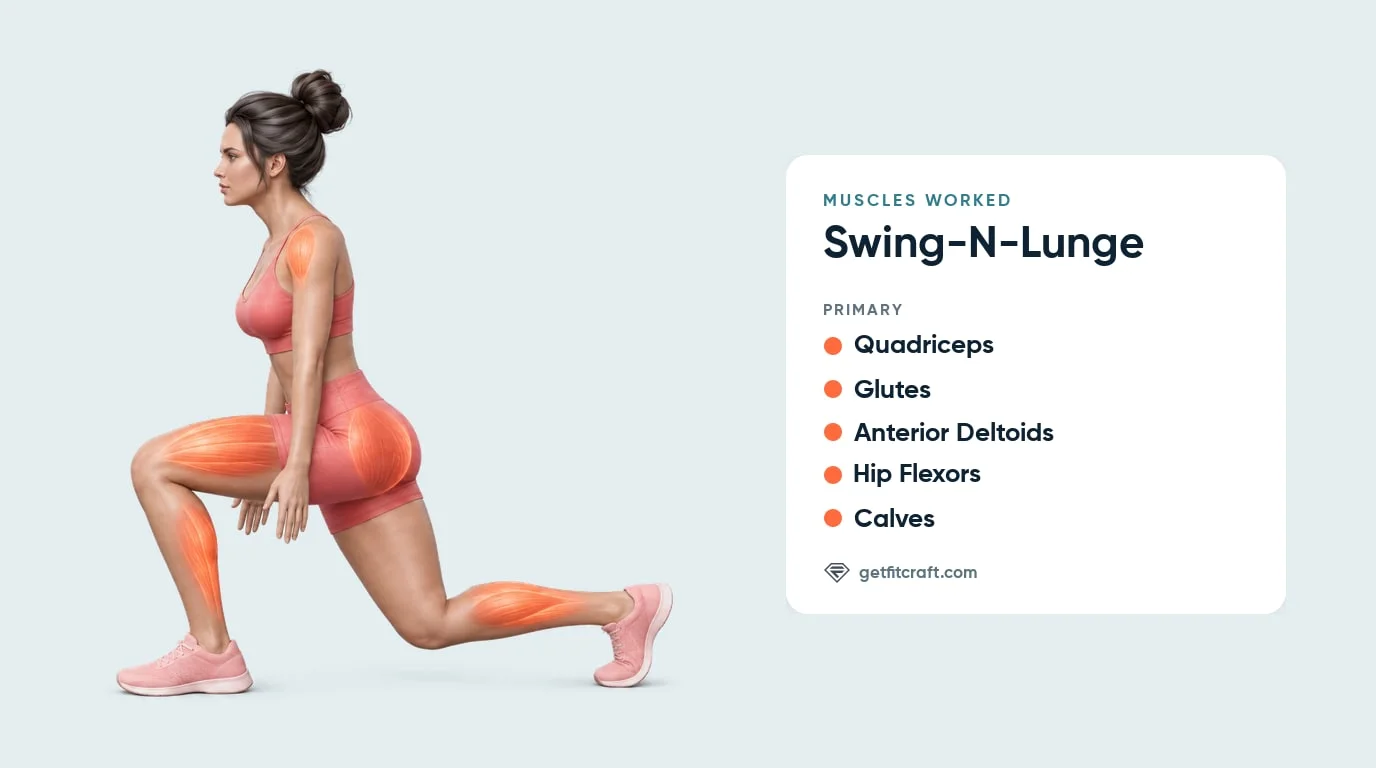
Muscles & Systems Worked
Primary muscles: all five muscles this exercise works are primary. The quadriceps and glutes lower you into each reverse lunge and drive you back up to standing. The hip flexors swing the back leg forward as you stand. The calves hold the back heel up in the lunge and push off the ball of the back foot. The anterior deltoids, the fronts of the shoulders, lift the arms forward and up overhead as you rise.
Why it feels like cardio: Swing-N-Lunges use large lower-body muscles, alternate sides every rep, and keep the arms moving, so they raise your heart rate quickly. No published study has tested the Swing-N-Lunge itself, so this guide cites none for it; the muscle roles above describe what each muscle does in the move.
Step-by-Step: How to Do the Swing-N-Lunge
- Set your stance. Stand tall with your feet about hip-width apart, chest up and abs braced. Reach both arms straight up overhead, elbows straight or softly bent, and keep your ribs down so your lower back does not arch.
- Step back into a reverse lunge. Step one foot straight back onto the ball of that foot and lower until your back knee hovers just above the floor and your front thigh is about parallel, or as low as you can control. Keep your front foot flat and your front knee pointing the same way as your toes.
- Swing your arms down as you lower. As you step back and lower, swing both arms forward and down in a smooth arc until your hands pass beside your front knee. Keep your chest up and your back flat; a slight forward lean from the hips is fine, rounding is not.
- Stand and reach overhead. Push through your whole front foot to stand tall, bringing the back foot forward beside the front one, and swing your arms forward and back up overhead as you rise. Keep your ribs down so your lower back does not arch at the top.
- Switch sides and keep a smooth rhythm. Alternate legs every rep at about two seconds per leg; slower is fine. Breathe in as you step back and swing your arms down, and out as you stand and reach up. Never bounce out of the bottom, and stop the set when your lunge depth, knee tracking or overhead reach starts to break down.
Get this exercise in a personalized workout
FitCraft, our mobile fitness app, uses its AI coach Ty to program conditioning work like this into your plan at the right volume and intensity, based on your level, goals, and equipment. Ty was designed and trained by Domenic Angelino, MPH (Brown University) and NSCA-CSCS, with research published in the Journal of Strength and Conditioning Research and Medicine & Science in Sports & Exercise.
Take the Free Assessment Free · 2 minutes · No credit card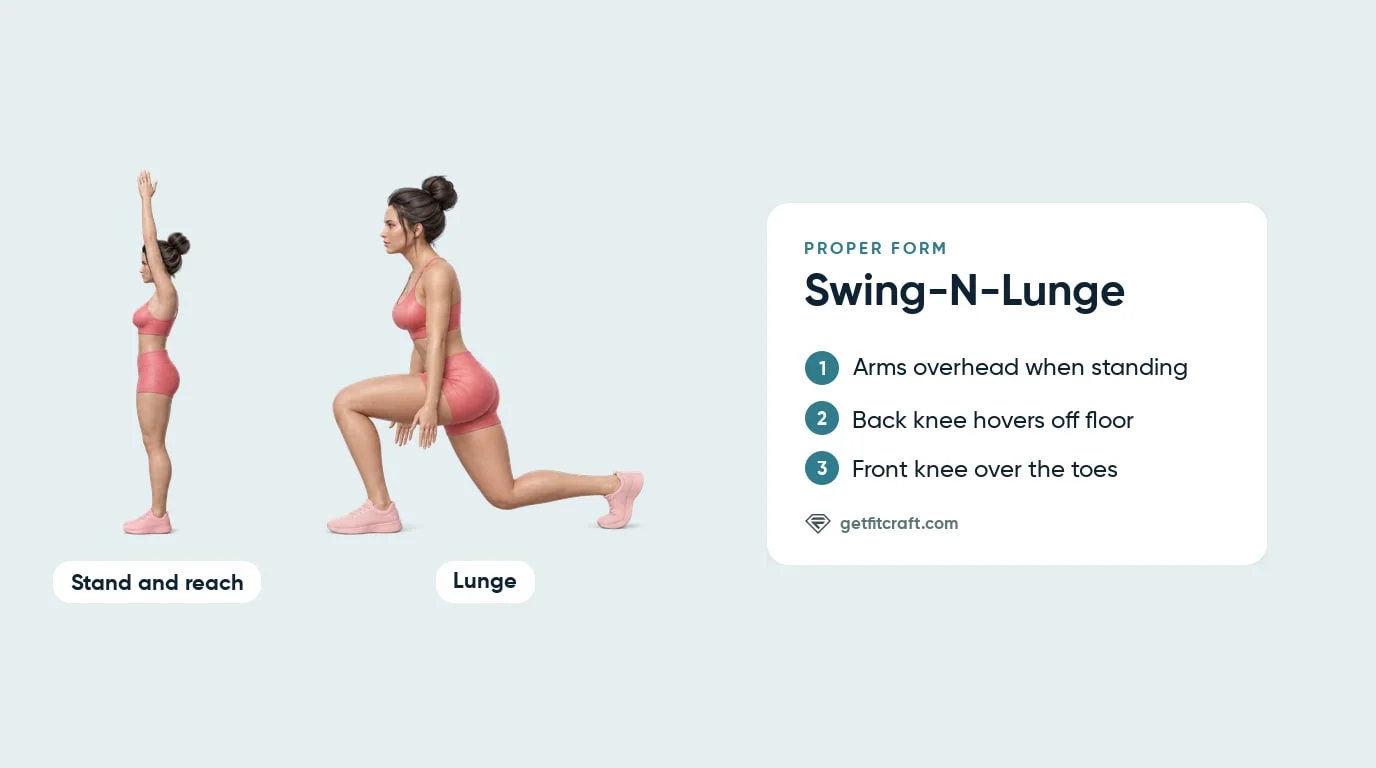
Common Mistakes (and How to Fix Them)
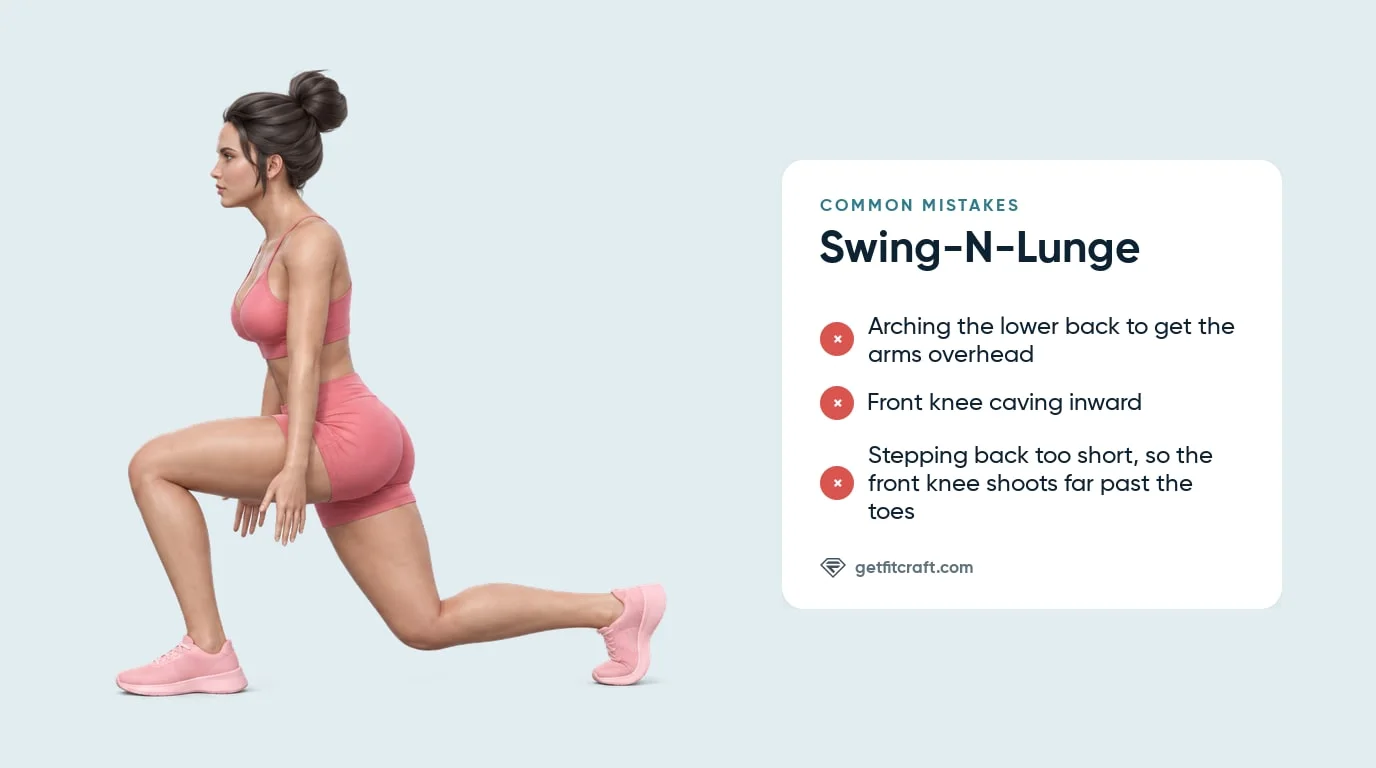
- Letting the front knee cave inward. The knee drifts inward as you lower or stand. Slow down and keep the front knee pointing the same way as your toes.
- Taking too short a step. A short step drives the front knee far past your toes and makes depth feel cramped. Step back far enough that the back knee lowers mostly straight down and your front knee stays about over your toes.
- Arching to reach overhead. If your ribs flare and your lower back arches as you reach, keep your ribs down and reach only as high as your shoulders comfortably allow, down to shoulder height if needed.
- Rounding the back as the arms swing down. A slight forward lean from the hips is fine at the bottom, but keep your chest up and your back flat as your hands pass your front knee.
- Letting speed shrink the lunge. Fast reps turn the lunge into a tiny dip. Keep the depth you can control, even if that means fewer reps.
- Dropping the back knee onto the floor. Lower under control until the back knee hovers just above the floor. Never let it touch down or bounce out of the bottom, and stop the set if you can no longer lower with control.
- Holding your breath. Keep breathing through every rep: breathe in as you step back and swing your arms down, and out as you stand and reach up.
Swing-N-Lunge Variations: Regressions and Progressions
Pick the version that lets you keep balance, lunge depth, and overhead reach under control.
Marching in Place (Easier)
Marching in place keeps your heart rate up and the rhythm going without the lunge. Use it when balance or fatigue makes the full move sloppy.
Reverse Lunge Without the Arm Swing (Easier)
Do plain reverse lunges, alternating legs with your arms bent at your sides like a runner's. A shallower lunge, or swinging your arms only to shoulder height, also makes the full move easier.
Standard Swing-N-Lunge
This is the version the FitCraft app uses, rated Expert. Start standing with your arms overhead, swing them forward and down past your front knee as you step back into the lunge, and swing them back up overhead as you stand, alternating legs every rep. Start slow enough that the front knee, rib position, and arm swing stay the same from the first rep to the last. Raising your arms overhead on the way down instead is a different exercise, a lunge with an overhead reach, not a Swing-N-Lunge.
Bottom-Pause Swing-N-Lunge (Harder)
Pause for one second at the bottom before you stand and reach. The pause removes momentum, so your front leg has to drive every rep.
Slow-Lowering Swing-N-Lunge (Harder)
Lower more slowly, over about two seconds, then stand and reach up smoothly.
When to Avoid or Modify Swing-N-Lunges
Swing-N-Lunges are safe for many healthy adults, but they combine single-leg balance, an overhead reach, and fast breathing. A burn in your legs, glutes, or shoulders is normal; any pain in a knee, hip, ankle, shoulder, your lower back, or your neck means stop right away, and so does feeling dizzy or lightheaded. Check with your doctor or physical therapist first if you have any of the conditions below.
- Known cardiovascular disease or uncontrolled hypertension. Conditioning intervals can spike heart rate and blood pressure. Get medical clearance, stay within the intensity your doctor sets, and keep breathing through every rep; never hold your breath.
- Active knee, hip, ankle, shin, or foot pain. Have it checked by a doctor or physical therapist before you do Swing-N-Lunges, and ask them which exercises suit you. Any joint pain during a set means stop right away.
- Shoulder pain or limited overhead range. If your shoulder hurts, stop and have it checked by a doctor or physical therapist before you do this exercise. If your arms simply cannot reach overhead without your ribs flaring or your lower back arching, swing them only to shoulder height instead.
- Pregnancy or early postpartum recovery. Ask your doctor, midwife, or a pelvic-floor physical therapist whether Swing-N-Lunges suit you and how hard to work. Stop for any pelvic pain or pressure.
- Stress incontinence or pelvic-floor symptoms. Work with a pelvic-floor physical therapist and ask them whether Swing-N-Lunges suit you. Stop if symptoms appear during a set.
- Vertigo, balance disorders, asthma, or exercise-induced bronchoconstriction. Ask your doctor or physical therapist before doing Swing-N-Lunges, since the alternating lunges challenge your balance and the intervals raise your breathing rate. Stop if you feel dizzy, lose your balance, or find it harder than normal to breathe.
Related Exercises
If Swing-N-Lunges fit your training, these exercises cover the same conditioning pattern, supporting strength, and movement prerequisites:
- Related cardio lunges: Step-N-Lunge is a side lunge with the arms reaching forward, and the Reach-N-Lunge holds the arms overhead and switches legs with a small hop each rep.
- Simple cardio substitute: Marching in Place and High Knees let you raise heart rate without the reverse-lunge depth.
- Lower-body strength foundation: Squats build the knee and hip extension strength that helps each lunge rep stay controlled.
- Core stability foundation: Forearm Planks teach the rib-and-pelvis control you need to reach overhead without arching.
- Higher-impact conditioning: Jump Squats add impact and power once your lower-body control and landing mechanics are ready.
How to Program Swing-N-Lunges
Swing-N-Lunges are timed in intervals rather than counted in reps. The broader progression model from the American College of Sports Medicine supports matching volume, rest, and frequency to training status (Ratamess et al., 2009). That paper gives no ranges for this exercise, so the table below is a practical starting point.
| Level | Work interval | Rest between sets | Frequency |
|---|---|---|---|
| Easier (reverse lunges without the swing, a shallower lunge, or marching in place) | 20-30 seconds of easier-version reps | 60-90 seconds | 2-3 sessions/week |
| Expert (the app's standard Swing-N-Lunge) | 30-45 seconds of alternating Swing-N-Lunges | 45-60 seconds | 3-4 sessions/week |
| Harder (a pause at the bottom or slower lowering) | 45-60 seconds of paused or slow-lowering reps | 30-45 seconds | 3-5 sessions/week |
Where in your workout: use Swing-N-Lunges in a standalone HIIT circuit, after resistance training, or as a 5 to 10 minute finisher at the end of a workout. Avoid placing them before heavy squats, deadlifts, or loaded lunges because they tire your legs and make balance harder.
Good form comes before time targets: end the interval when knee tracking, lunge depth, overhead reach, or breathing control breaks down. A shorter interval with good form is better than a longer one with sloppy reps.
How FitCraft Programs This Exercise
FitCraft maps your level, goals, and equipment during the free assessment and builds a plan around them. The app has one Swing-N-Lunge exercise, rated Expert, done with no equipment and alternating legs every rep, and can include it in your plan. Reverse lunges and marching in place are easier options in the app.
Its 3D demonstration shows the move: standing tall with the arms overhead, one foot steps straight back as the arms swing forward and down past the front knee, and the arms swing back up overhead on the way up.
Frequently Asked Questions
What muscles do Swing-N-Lunges work?
Swing-N-Lunges work five primary muscles: the quadriceps, glutes, anterior deltoids (the fronts of the shoulders), hip flexors, and calves. The quads and glutes lower you into each reverse lunge and drive you back up, the fronts of the shoulders lift your arms forward and up overhead, the hip flexors swing the back leg forward as you stand, and the calves hold the back heel up and push off the ball of the back foot. Because the move is continuous, it also raises your heart rate.
Are Swing-N-Lunges good for beginners?
The FitCraft app rates the Swing-N-Lunge Expert, so most beginners should build toward it. Start with an easier version: plain reverse lunges without the arm swing, a shallower lunge, or marching in place to keep your heart rate up without lunging. Once your lunges feel steady, add the arm swing at a slower pace, swinging only to shoulder height at first if you need to.
Can I do Swing-N-Lunges with knee pain?
Do not do Swing-N-Lunges through knee pain. Any knee pain, as you lower or as you stand, means stop right away. Have it checked by a doctor or physical therapist and ask them which exercises suit you.
Can Swing-N-Lunges replace cardio?
They can work as a short cardio interval or a finisher at the end of a workout because they use large lower-body muscles with continuous arm motion. For longer aerobic sessions, use them as one station in a circuit rather than your only cardio tool.
How many Swing-N-Lunges should I do?
Use time-based intervals instead of chasing a fixed rep count. Start with 20 to 30 seconds of work and 60 to 90 seconds of rest, using an easier version if you need one. For the standard move, which the FitCraft app rates Expert, use 30 to 45 seconds with 45 to 60 seconds of rest. For a harder set with a pause at the bottom or slower lowering, use 45 to 60 seconds with 30 to 45 seconds of rest, only while every rep stays clean.