The top chin hold is simple: get to the top of a chin-up and stay there with control. It teaches the top position of a chin-up, where the elbows tend to open and the shoulders creep toward the ears.
Quick Facts: Top Chin Hold
- Equipment needed: Pull-up bar that safely holds your full weight, plus a sturdy box or bench to step up
- Difficulty: Advanced, as rated in the FitCraft app (step up from a box and keep the holds short to make it easier)
- Modality: Bodyweight strength (a static hold)
- Body region: Upper body and grip
Muscles Worked
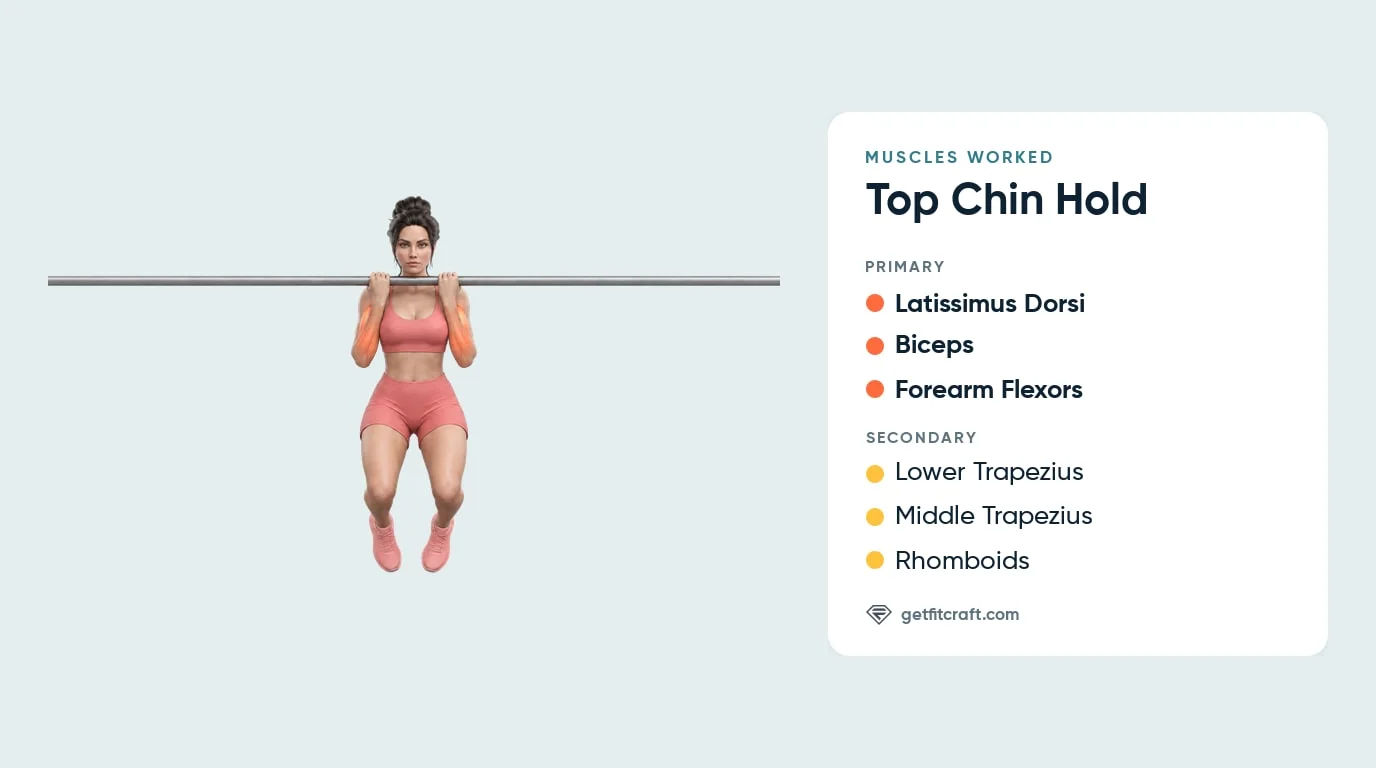
The latissimus dorsi, biceps and forearm flexors do most of the work. Because the exercise is a hold, they work to keep you still instead of lifting and lowering you. The lats keep your upper arms pulled down to your sides, the biceps keep your elbows bent, and the forearm flexors keep your grip closed around the bar. The hold leans hard on your grip.
The lower trapezius, middle trapezius and rhomboids help by holding your shoulder blades down and back, so your shoulders don't creep up toward your ears while you hold.
No study has measured this exact hold. The flexed-arm hang of fitness tests such as FitnessGram holds the same chin-above-the-bar position, usually with an overhand grip, and stops the clock when the chin touches or falls below the bar. That is the same point at which you end each hold here.
Step-by-Step: How to Do a Top Chin Hold
- Get into position. Set a sturdy box or bench under a pull-up bar that safely holds your full weight. Take an underhand grip, palms facing you, hands about shoulder-width apart or slightly closer, thumbs wrapped around the bar. Step up from the box or jump lightly until your chin is just above the bar. If you can do a chin-up, you can pull yourself up instead.
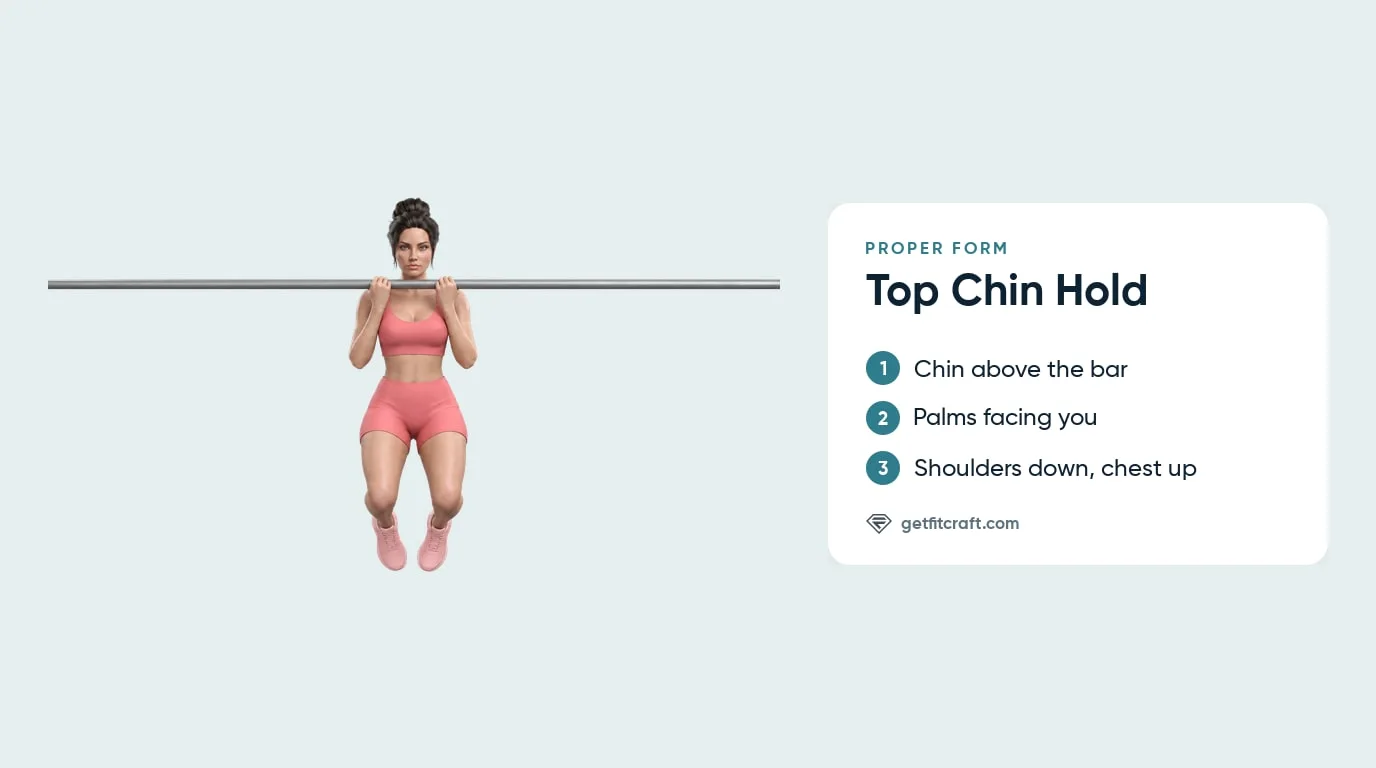
- Lock in the top. Keep your elbows bent sharply and pointing down in front of your body, and your chin just above the bar without resting it on the bar or tipping your head back. Lift the chest toward the bar and pull your shoulders down away from your ears.
- Grip the bar hard. Squeeze the bar hard. A loose grip usually ends the hold early.
- Lock the body. Brace your core and keep your legs still, straight or with the knees bent, ankles crossed or side by side, so your body doesn't swing.
- Hold and breathe. Keep breathing slowly and steadily while you stay above the bar; never hold your breath. End the hold when your chin sinks to the bar, your shoulders creep up or your grip starts to slip. Then lower yourself slowly to straight arms and step down onto the box or floor with control. Never let go and drop.
Common Mistakes and How to Fix Them
Chin Dropping Below the Bar
What it looks like: The chin slowly sinks to bar level or below, and the elbows start opening.
Why it's a problem: The drill trains the top position. Once your chin sinks, you are lowering instead of holding.
The fix: End the hold the moment your chin sinks to the bar. Don't rest your chin on the bar or tip your head back to keep it up. Lower yourself slowly, step down with control, rest, and start the next hold from a cleaner top position.
Swinging or Kipping
What it looks like: The legs swing, the hips drift, or the body rocks forward and back.
Why it's a problem: Momentum takes tension away from your lats and biceps and teaches a sloppy pulling pattern.
The fix: Brace your core and keep your legs still, straight or bent, ankles crossed or side by side. If you can't stop swinging, step up from the box and keep the holds shorter.
Shrugging the Shoulders
What it looks like: The shoulders ride up toward the ears and the neck disappears.
Why it's a problem: Shrugging lets go of the shoulder-blade position the lower trapezius, middle trapezius and rhomboids are there to hold, and makes the shoulder position less stable.
The fix: Pull your shoulder blades down and back before the clock starts. Think chest proud and neck long.
Holding the Breath
What it looks like: Your face goes red, your jaw locks and you gasp as soon as the set ends.
Why it's a problem: Holding your breath can spike your blood pressure.
The fix: Take small, steady breaths. If you can't breathe, the hold is too hard or too long.
Get this exercise in a personalized workout
FitCraft, our mobile fitness app, uses its AI coach Ty to program pulling exercises like this into your plan at the right volume and intensity, based on your level, goals, and equipment. Ty was designed and trained by Domenic Angelino, MPH (Brown University) and NSCA-CSCS, with research published in the Journal of Strength and Conditioning Research and Medicine & Science in Sports & Exercise.
Take the Free Assessment Free • 2 minutes • No credit cardTop Chin Hold Variations: Regressions and Progressions
Easier: Engaged Hang
The engaged hang, rated Beginner in the FitCraft app, builds your grip and shoulder position first. Hang from the bar with your shoulders pulled down away from your ears and your elbows soft, not locked straight.
Easier: Box-Assisted Top Chin Hold
Place a sturdy box or bench under the bar and step up to the top instead of pulling yourself up. Keep each hold short and end it as soon as your chin sinks to the bar.
Standard: Bodyweight Top Chin Hold
This is the version the FitCraft app teaches, rated Advanced: hold the top of the chin-up with no leg support. Start with shorter holds and end each one when your form slips.
Harder: Top Chin Hold to Chin Negative
After the hold, lower yourself slowly over about three to five seconds to straight arms, keeping your shoulders down. This is the chin negative, and it links top-position strength to the full chin-up range.
Harder: Longer Holds, Then Full Chin-Ups
Hold a little longer each time, as long as your chin stays above the bar and your shoulders stay down. When the hold and the slow lowering both feel solid, work toward full chin-ups, rated Expert in the FitCraft app.
When to Avoid Top Chin Holds
A few conditions call for a check with your doctor or physical therapist before you do top chin holds, because holding your body weight on a bar is demanding on the shoulders, elbows, wrists, grip and blood pressure. A burn in your lats, biceps or grip is normal; any pain in a joint, your lower back or your neck means stop, lower yourself slowly and step down. Always consult your physician or physical therapist for personalized guidance.
- Acute shoulder injury or rotator cuff irritation. Hanging from a bar loads your shoulders under your full body weight. Skip top chin holds until a doctor or physical therapist clears you, and ask them when and how to return to hanging. Any shoulder pain means stop.
- Recent shoulder or elbow surgery. Get clearance from your surgeon before any hanging or pulling work, and ask them or your physical therapist when and how to return.
- Tennis elbow or golfer's elbow. Skip top chin holds while your elbow hurts. Underhand gripping and holding your elbows bent under your body weight can aggravate both, so see a doctor or physical therapist, and ask them when and how to return. Any elbow pain means stop.
- Lower-back pain. If you have lower-back pain, see a doctor or physical therapist before doing top chin holds, and ask them when and how to return. Once they clear you, brace your core and keep your legs still so your body doesn't swing. Any lower-back pain means stop.
- Wrist pain or grip limitation. If your wrists hurt, see a doctor or physical therapist before doing top chin holds. Once they clear you, keep your wrists straight, in line with your forearms. Any wrist pain means stop. If your grip simply gives out first, end the hold, lower yourself slowly and build your grip with engaged hangs.
- Blood pressure concerns. Get your doctor's clearance first and follow their exercise guidance. Keep breathing slowly and steadily through every hold and never hold your breath. Stop if you feel dizzy or lightheaded.
Related Exercises
- Same muscle group: Chin-ups and bent-over rows train the same pulling pattern through a larger range of motion.
- Easier regression: Inverted rows, supported rows, corner rows, and reverse rows build pulling strength with less bodyweight.
- Slow lowering: Chin negatives teach control from the same top position into a slow descent.
- Grip and shoulder foundation: Engaged hangs build your grip and the shoulders-down position, and dead hangs mainly build grip.
- Core anti-swing foundation: Deadbugs, bird-dogs, and hollow holds help keep the body still under the bar.
How to Program Top Chin Holds
Ratamess et al., 2009, the ACSM resistance-training progression position stand, supports matching sets, rest, frequency, and progression to training level. For top chin holds, progress by stepping up less and holding a little longer, and let your form, not the clock, end each hold. The position stand gives no hold times for this exercise, so treat the table below as a practical starting point.
| Stage | Sets and holds | Rest between sets | Frequency |
|---|---|---|---|
| Building up | 2-3 short holds, stepping up from a box | 60-90 seconds | 2-3 sessions/week |
| Body-weight holds | 3-4 holds, each ended when your chin sinks or your shoulders creep up | 90-120 seconds | 2-3 sessions/week |
| Harder | 3-5 longer holds, or holds finished with a slow chin negative | 90-180 seconds | 2-4 sessions/week |
Where in your workout: place top chin holds early in an upper-body or pull session while your grip is fresh. If you do heavy carries or rows first, your grip may give out before your back does.
Form before time targets: stop when the chin drops, the shoulders shrug, the breath locks, or the body swings. A short, clean hold beats a long, shaky one.
How FitCraft Programs This Exercise
Knowing the drill is step one; fitting it into a plan is the next. FitCraft uses your level, goals, and available equipment to build your training plan. The app includes the top chin hold as its own exercise, rated Advanced, with a 3D demonstration that shows the shoulder and chin position before you train, alongside the engaged hang, the chin negative and the full chin-up.
Frequently Asked Questions
Can I do top chin holds with elbow pain?
Not while your elbow hurts. The hold keeps your elbows bent under your full body weight with an underhand grip, which loads the elbow and the gripping tendons. If you have tennis elbow, golfer's elbow or any elbow pain, stop and see a doctor or physical therapist, and ask them when and how to return. Any elbow pain means stop.
What muscles does the top chin hold work?
Top chin holds mainly work the latissimus dorsi, the biceps and the forearm flexors: the lats keep your upper arms pulled down to your sides, the biceps keep your elbows bent, and the forearm flexors keep your grip closed around the bar. The lower trapezius, middle trapezius and rhomboids help by holding your shoulder blades down and back.
How long should I hold the top chin position?
There is no set hold time; let your form decide. Hold for the time your workout sets, and end the hold early when your chin sinks to the bar, your shoulders creep up or your grip starts to slip. Then lower yourself slowly and step down. As you get stronger, hold a little longer each time.
Will top chin holds help me get my first chin-up?
They can. Top chin holds train the bent-arm top position of a chin-up. Pair them with chin negatives, engaged hangs and rows so you build strength through the full range, not only at the top.
Top chin hold vs dead hang: which is better?
They train different positions. A dead hang is a straight-arm hang with relaxed shoulders that mainly builds grip. A top chin hold works your lats, biceps and grip in the bent-arm top position of a chin-up. To build up to it, start with the engaged hang, where your shoulders stay pulled down and your elbows soft.