Everyone thinks they know how to do a crunch. Lie down, put your hands behind your head, and yank yourself up as fast as possible. Right? Wrong. That version strains your neck, barely works your abs, and is why so many people think crunches are useless or, worse, dangerous.
Done correctly, the crunch is a highly effective core isolation exercise that targets your rectus abdominis with minimal equipment and space. The key is technique: where you initiate the movement, how you control the tempo, and what you do at the top of each rep.
What follows is step-by-step instruction for both the partial crunch (beginner) and the standard crunch (intermediate), with coaching cues from Ty, FitCraft's AI coach. The same cues Ty delivers during your workouts in real time.
Quick Facts: Crunch
- Equipment needed: None (bodyweight)
- Difficulty: Beginner (partial crunch) to Intermediate (standard crunch)
- Modality: Strength
- Body region: Core
- FitCraft quest category: Strength
Muscles Worked
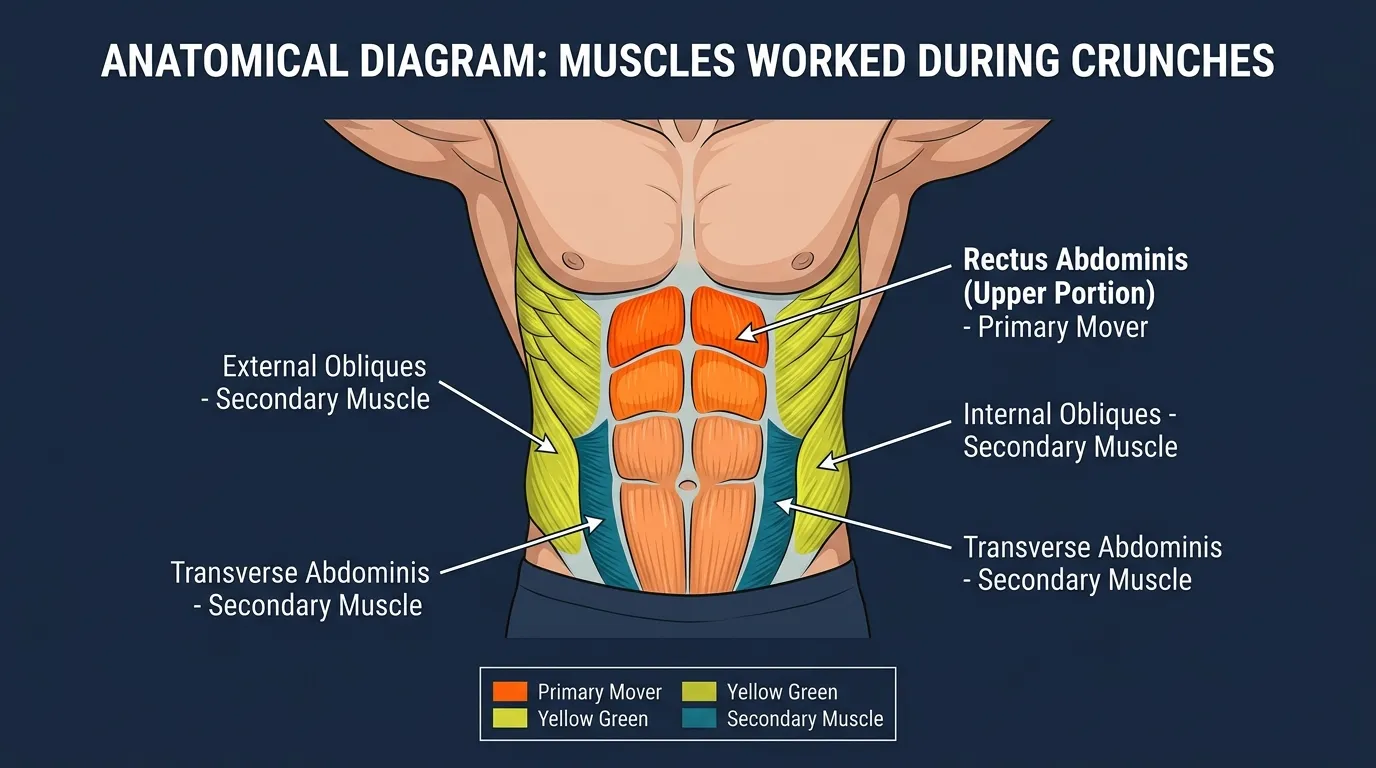
Primary movers. The rectus abdominis is the main muscle doing the work. It runs vertically along the front of the abdomen from the sternum and lower ribs down to the pubis, and its action is to flex the spine by bringing the ribcage closer to the pelvis. During a crunch, the rectus abdominis contracts concentrically as you curl up and eccentrically as you lower under control. The upper portion of the muscle bears most of the load because the movement lifts the upper trunk while the pelvis stays fixed.
Secondary movers. The obliques (internal and external) contribute to stabilizing the trunk and resisting any lateral sway as the rep happens. The hip flexors (psoas and rectus femoris) play a minor role here, though they activate much more in a full sit-up where the pelvis lifts. Keeping your lower back pressed into the floor throughout the rep is the cue that keeps the work in the abs and out of the hip flexors.
Stabilizers. The diaphragm and pelvic floor (the deep core canister) maintain intra-abdominal pressure throughout the rep. The spinal erectors lengthen eccentrically during the flexion phase, allowing controlled spinal curl rather than collapse. The breath is a key stabilizer here. Exhaling forcefully during the curl-up phase reinforces transverse abdominis activation and amplifies the contraction.
Mechanism note. The crunch is mechanically distinct from the sit-up despite the visual similarity. A crunch isolates spinal flexion through roughly 30 to 45 degrees of upper-trunk movement, with the lumbar spine staying neutral against the floor. A sit-up uses both spinal flexion and hip flexion, lifting the entire torso to vertical and recruiting the psoas and rectus femoris heavily. For pure rectus abdominis development, the crunch keeps tension on the target muscle without recruiting hip flexors as the primary movers. This is why crunches remain a fixture in most evidence-based core programs despite criticism of their spinal-loading profile.
Step-by-Step: How to Perform a Crunch
Whether you're starting with partial crunches or performing the standard version, the setup and movement cues are nearly identical. The difference is range of motion.
Step 1: Set Your Starting Position
Lie face up on a mat with your knees bent at roughly 90 degrees and your feet flat on the floor, hip-width apart. Place your fingertips lightly behind your ears, or cross your arms over your chest if you're tempted to pull on your neck. Never interlace your fingers behind your head.
Coach Ty's cue: "Keep your feet planted firmly on the ground."
Step 2: Brace Your Core
Before you move, engage your abdominal muscles. Draw your belly button toward your spine and press your lower back gently into the floor. This pre-activation is critical. It ensures your abs do the work, not your hip flexors or neck.
Step 3: Curl Your Shoulders Off the Floor
Exhale and lift your shoulder blades off the ground by contracting your abs. Think about curling your ribcage toward your pelvis rather than sitting up. For partial crunches, lift just a few inches. For standard crunches, curl until your shoulder blades are fully off the floor.
Ty's cue: "Imagine lifting your shoulder blades off the ground, not just your head." And: "Keep a small space between your chin and your chest, as though holding an orange under your chin."
Step 4: Squeeze at the Top
This is the step most people skip, and it's where the crunch becomes effective. At the top of the movement, squeeze your abs as hard as you can. Pause for one second. Feel the contraction.
Ty reminds: "Your focus here is on squeezing your abs as hard as you can at the top." And: "Try pausing for a second at the top of the movement."
Step 5: Lower with Control and Repeat
Slowly lower your shoulders back toward the floor. Don't just drop. Resist gravity on the way down. This eccentric phase is where a huge portion of the muscle work happens. Repeat with the same controlled tempo on every rep.
Ty's cue: "Make each repetition smooth and controlled, not quick and jerky." And: "It's about maintaining tension in your abs throughout the set."
Get this exercise in a personalized workout
FitCraft, our mobile fitness app, uses its AI coach Ty to program core stability work like this into your plan at the right volume and intensity, based on your level, goals, and equipment. Ty was designed and trained by Domenic Angelino, MPH (Brown University) and NSCA-CSCS, with research published in the Journal of Strength and Conditioning Research and Medicine & Science in Sports & Exercise.
Take the Free Assessment Free · 2 minutes · No credit card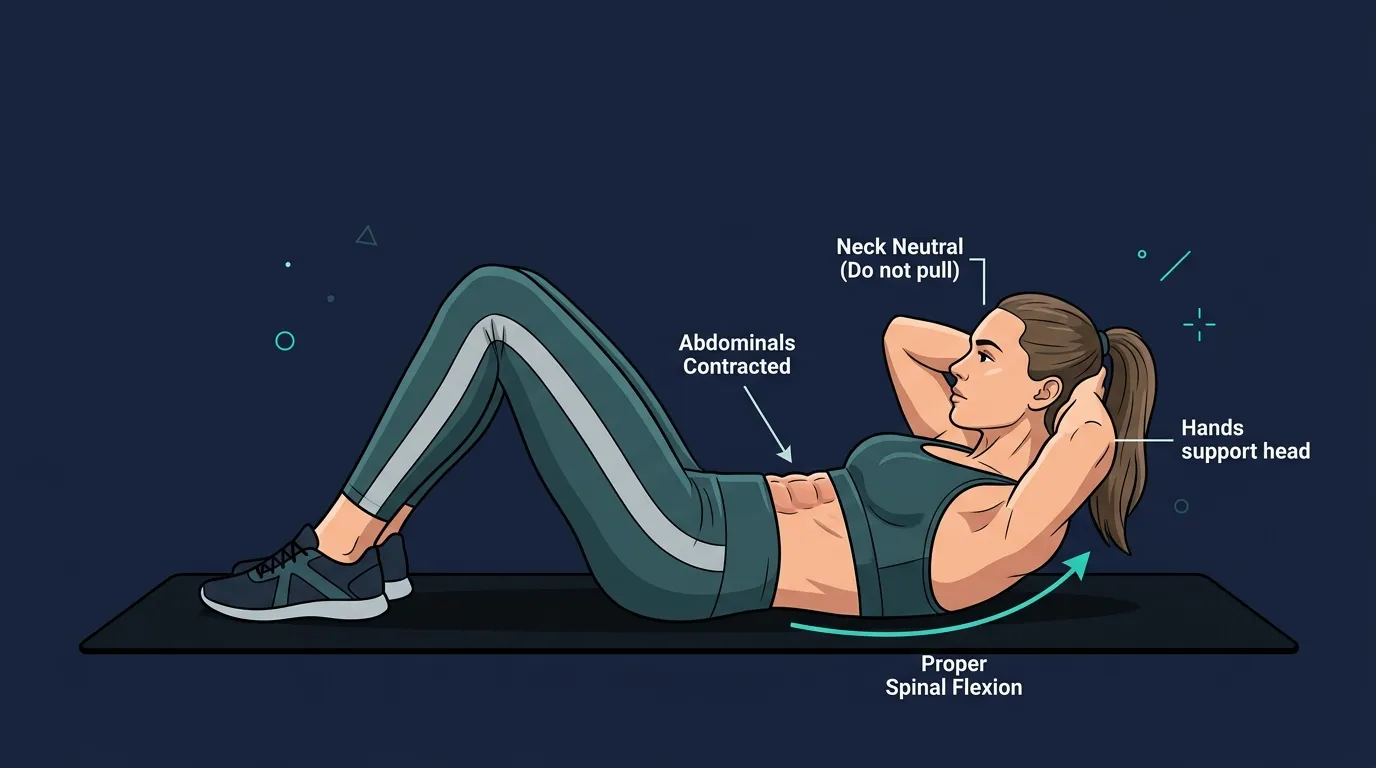
Common Mistakes (and How to Fix Them)
Crunches are deceptively simple. These are the errors Ty corrects most often, and the fix for each.
- Pulling on your neck. This is the most common crunch mistake by far. When your abs fatigue, your hands take over and yank your head forward, straining your cervical spine. Fix: place your fingertips lightly behind your ears or cross your arms over your chest. If you feel your neck working, you're doing it wrong.
- Using momentum. Rocking your body to generate speed bypasses the abdominal contraction entirely. Fix: slow down. Take 2 seconds up, pause 1 second, take 2 seconds down. If you can't do it slowly, reduce your rep count.
- Sitting all the way up. A crunch is not a sit-up. Going past the point where your shoulder blades leave the floor shifts the work to your hip flexors. Fix: stop once your shoulder blades are off the ground. That's the full range of motion for a crunch.
- Flattening your chin to your chest. Tucking your chin too aggressively compresses your neck. Fix: maintain a fist-sized gap between your chin and chest throughout the movement. The "orange under your chin" cue works perfectly.
- Letting your feet lift off the floor. When your feet come up, your hip flexors are taking over for your abs. Fix: press your feet firmly into the ground throughout the entire set.
- Holding your breath. Forgetting to breathe during core exercises is extremely common. Fix: exhale as you crunch up, inhale as you lower down. The exhale actually helps your abs contract harder.
Crunch Variations: Regressions and Progressions
The crunch is a progression-friendly exercise. Start where you are and level up when your form is solid.
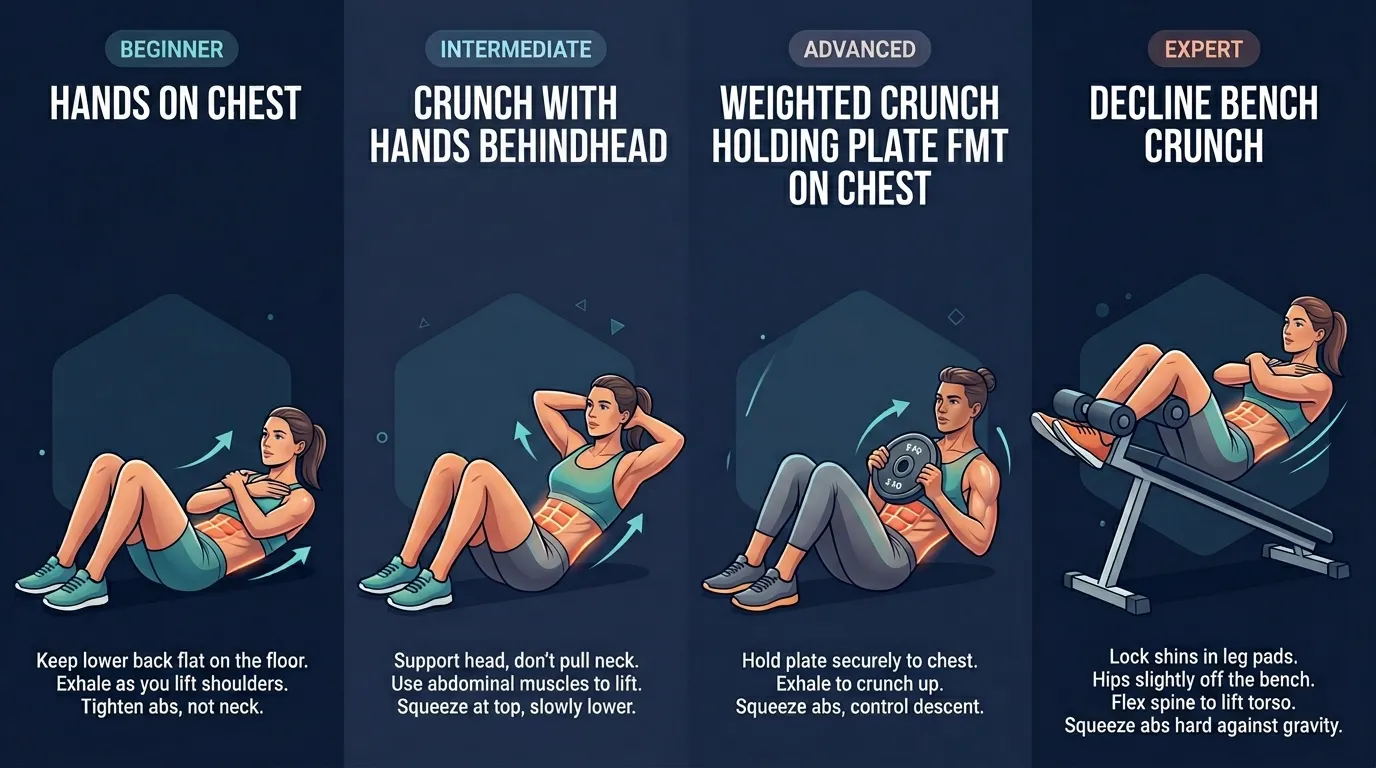
Partial Crunch (Beginner)
A smaller range of motion where your shoulder blades barely leave the floor. The focus is entirely on learning to contract your abs deliberately and maintaining tension throughout the set. This is where everyone should start until the mind-muscle connection is rock solid.
Standard Crunch (Intermediate)
Full shoulder blade lift with a controlled pause at the top. Once you can perform 3 sets of 20 reps with perfect form and a one-second squeeze at the top, you're ready for harder variations.
Bicycle Crunch (Advanced Progression)
Add a rotational component by bringing your opposite elbow toward your knee as you crunch. This targets the obliques alongside the rectus abdominis, making it a more complete core exercise. The key is to rotate from your torso, not just move your elbow.
Twist Crunch (Advanced Progression)
A static rotational variant where you crunch up and twist your torso toward one side, then return and alternate. Less dynamic than the bicycle crunch but excellent for building deliberate oblique control without the momentum risk.
Weighted Crunch (Advanced Progression)
Hold a weight plate or dumbbell against your chest while performing the standard crunch. Even 5 to 10 pounds significantly increases the challenge. Progress the weight gradually. Your abs respond to progressive overload like any other muscle.
When to Avoid or Modify Crunches
Crunches are safe for most healthy adults, but a handful of conditions warrant modification or substitution. The crunch loads the spine into repeated flexion under bodyweight resistance, which is the load profile most likely to aggravate disc-related and postpartum issues. Always consult a qualified healthcare provider or physical therapist before starting or returning to any exercise program, especially if any of the following apply.
- Acute lower-back pain or known disc pathology. Repeated spinal flexion can aggravate disc-related back pain. Substitute with anti-extension patterns like deadbugs, bird-dogs, and forearm planks, and consult a physical therapist before reintroducing loaded flexion.
- Active diastasis recti or first 6 to 8 weeks postpartum. Crunching can widen abdominal separation. Restore deep-core function first with diaphragmatic breathing, transverse abdominis activation, and gentle bird-dogs and deadbugs. Get clearance from a pelvic-floor specialist before adding loaded flexion.
- Recent abdominal surgery (C-section, hernia repair, appendectomy). Get clearance from your surgeon. Most post-surgical protocols start with diaphragmatic breathing, progress to gentle bracing, and only later reintroduce loaded flexion.
- Hernia (umbilical, inguinal, ventral). The intra-abdominal pressure spike during a crunch can worsen some hernias. Consult your physician about safe options before continuing.
- Pregnancy (second and third trimesters). Avoid supine positions for long durations (vena cava compression). Avoid high-flexion movements. Use upright or side-lying core alternatives such as standing pallof presses or side-lying leg lifts.
- Pelvic-organ prolapse or pelvic-floor dysfunction. The high intra-abdominal pressure of a crunch can worsen prolapse symptoms. Work with a pelvic-floor physical therapist on appropriate core progressions.
- Cervical (neck) pain or pinched nerve. Even with perfect form, the head-lifting component can flare cervical symptoms. Substitute with deadbugs and bird-dogs until symptoms resolve.
Related Exercises
- Easier regression (same plane): Partial Crunch. Shorter range of motion, ideal for learning the contraction pattern before adding range.
- Same plane, rotational: Bicycle Crunches and Twist Crunches. Add an oblique component to the spinal-flexion pattern.
- Same plane, reversed: Reverse Crunches. Pelvis moves to the ribcage instead of the ribcage to the pelvis, biasing the lower portion of the rectus abdominis.
- Foundation for spinal bracing (anti-extension): Deadbugs and Bird-Dogs. Universal foundations that build deep-core control without loading the spine into flexion.
- Isometric anti-extension: Forearm Planks and Hand Planks. Train the same musculature isometrically and balance the flexion load from crunches.
- Posterior chain pairing: Superman Holds and Glute Bridges. Train spinal extension and hip extension to balance the anterior emphasis of crunches.
- Hip-flexion alternative: Leg Raises. Bias the lower abs and hip flexors through a different movement pattern.
How to Program Crunches
Programming recommendations follow ACSM resistance-training guidance summarized in Ratamess et al., 2009. The ranges below match the targeted adaptation (motor learning at the beginner level, hypertrophy and endurance at intermediate, and advanced strength-endurance with slow tempos at the advanced level).
| Level | Sets × Reps | Rest between sets | Frequency |
|---|---|---|---|
| Beginner | 2-3 × 8-12 (partial range) | 45-60 seconds | 2-4 sessions/week |
| Intermediate | 3 × 10-20 (full range) | 45-60 seconds | 3-5 sessions/week |
| Advanced | 3-4 × 15-30 (slow tempo or weighted) | 60 seconds | 4-6 sessions/week |
Where in your workout. Place crunches at the end of a resistance-training session. Pre-fatiguing the core before compound lifts like squats or deadlifts compromises spinal stability under load. Crunches also work well as part of a dedicated core block or finisher, paired with anti-extension and anti-rotation patterns (planks, deadbugs, bird-dogs) for balanced trunk training. As a warm-up, swap to low-rep deadbugs or bird-dogs to wake up the deep core without fatiguing the flexors.
Form floor over rep targets. If your form breaks down at rep 12 but the program says 15, stop at 12. Quality reps drive adaptation. Sloppy reps recruit compensating muscles (hip flexors, neck) and reduce the stimulus to the rectus abdominis. Hit the form floor first, then chase the rep targets.
How FitCraft Programs This Exercise
Knowing how to do a crunch is step one. Knowing how many sets and reps to perform, which variation suits your level, and how crunches fit into a balanced core training program is where most people get stuck.
FitCraft's AI coach Ty handles that. During your personalized diagnostic assessment, Ty maps your current fitness level, available equipment, and goals. Ty then builds a personalized program that slots crunches, at the right variation, into a balanced training plan alongside other core, upper body, and lower body exercises.
As you get stronger, Ty adjusts the variation and volume to match your level. Partial crunches progress to standard crunches. Standard crunches get paired with more challenging variations or added resistance. Volume adjusts based on your recovery and consistency patterns.
Every program is designed by an Ivy League-trained exercise scientist and NSCA-certified strength coach using evidence-based periodization, and then adapted to you by the AI. It's expert programming that fits your life.
Frequently Asked Questions
Can I do crunches with lower-back pain?
Repeated spinal flexion under load can aggravate disc-related lower-back pain, so if you have acute back pain or a known disc issue, skip crunches for now. Substitute with anti-extension and anti-rotation patterns (deadbugs, bird-dogs, and forearm planks) that train the same deep core musculature without loading the spine into flexion. See a physical therapist for an assessment before adding loaded flexion back into your program.
What is the difference between a partial crunch and a standard crunch?
A partial crunch involves a smaller range of motion. You lift your shoulders just a few inches off the floor while focusing intensely on abdominal contraction. A standard crunch uses a fuller range of motion, curling your shoulder blades completely off the ground. Partial crunches are ideal for beginners building core activation patterns. Standard crunches add more challenge for intermediate exercisers.
Are crunches bad for your back?
Crunches involve repeated spinal flexion, which is a real concern for people with disc-related back pain. For healthy adults with no history of back issues, well-executed crunches are not harmful. Problems arise when people pull on their neck, use momentum, or perform excessive volume. The key is to lift from your abs (not your neck), maintain a controlled tempo, and stay within a pain-free range of motion. If you have any pre-existing back condition, consult a healthcare professional before adding crunches to your routine.
How many crunches should I do per workout?
Quality matters more than quantity. For beginners, 2 to 3 sets of 8 to 12 reps with proper form is a solid starting point. For intermediate exercisers, 3 sets of 10 to 20 reps works well. Advanced trainees can push to 3 to 4 sets of 15 to 30 reps with a slow tempo. FitCraft's AI coach Ty programs the right volume based on your fitness level, goals, and overall training plan so your core work complements your other exercises rather than competing with them.
Will crunches give me a six-pack?
Crunches build the rectus abdominis (the six-pack muscle), but visible abs require low body-fat levels (roughly 10 to 15 percent for men and 18 to 22 percent for women). You can have very strong abs that stay hidden under a layer of fat. Crunches develop the muscle. Diet, total training volume, and overall conditioning reveal it. A balanced program that pairs core training with full-body strength and a calorie strategy is what produces visible abs.