You don't need equipment, machines, or even much floor space. Bicycle crunches train your abs and obliques through a movement pattern most people learned as kids in gym class. The trouble is that most people kept doing them the playground way and never got coached on the details that turn them into a serious core exercise.
Common problem: pulling on the neck, swinging the elbows without rotating, letting the lower back arch off the floor, rushing the reps. Any of those and you're moving without loading the muscle you came to train.
Fix those four things and bicycle crunches earn their spot in your program.
Quick Facts: Bicycle Crunch
- Equipment needed: None (optional mat for comfort)
- Difficulty: Beginner (partial) to Advanced (full and slow-tempo)
- Modality: Strength
- Body region: Core
- FitCraft quest category: Strength
Muscles Worked
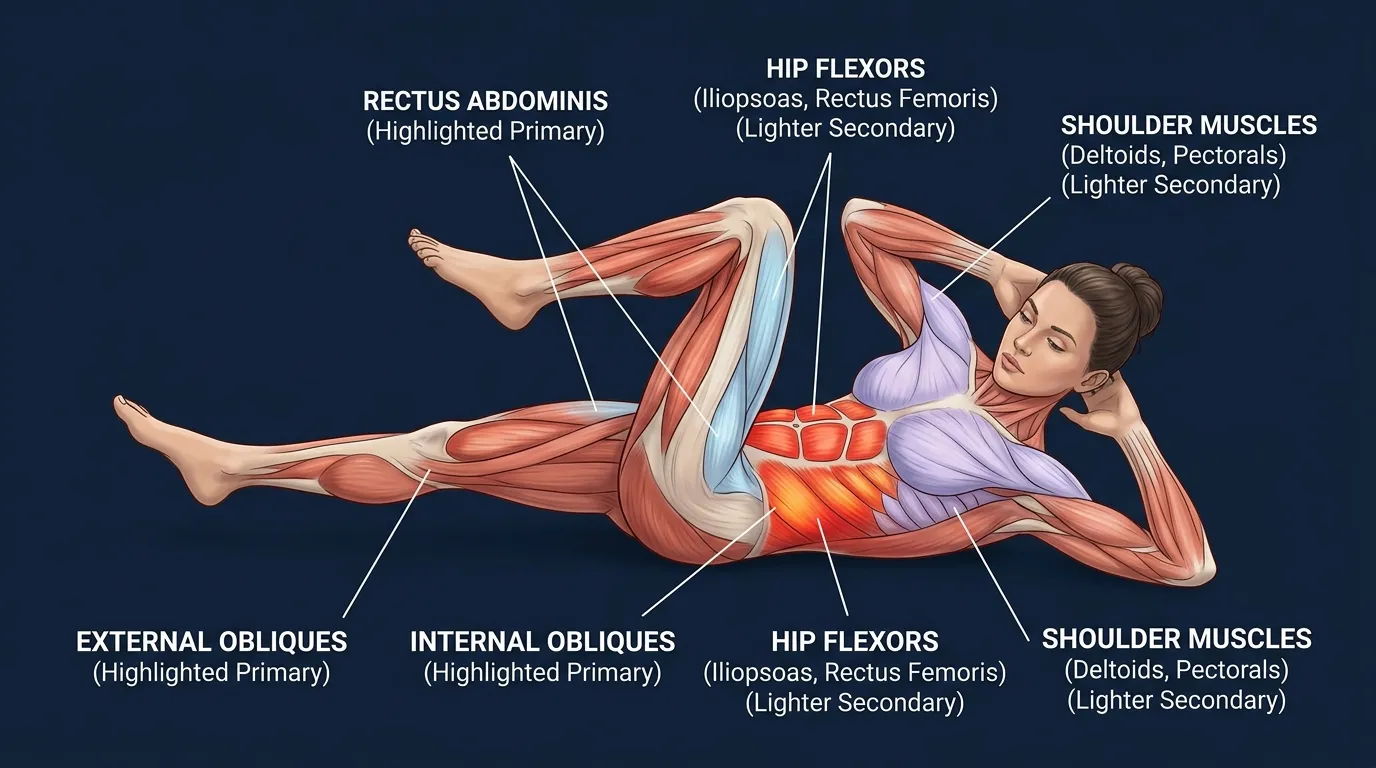
Primary movers: the rectus abdominis (the long sheet of muscle that runs from your sternum to your pelvis, the "six-pack") and the internal and external obliques (the side abs that wrap around your torso). The rectus abdominis shortens to lift your shoulders off the floor (concentric trunk flexion). The obliques shorten to rotate your torso so your elbow can travel across to the opposite knee. That rotation under load is what separates bicycle crunches from a plain crunch.
Secondary movers: the hip flexors (psoas major and iliacus) drive the knee toward the chest on each pedaling rep. The rectus femoris (one of the quad muscles that crosses the hip) assists with the hip-flexion side of the movement. The serratus anterior fires gently to stabilize the scapula as your shoulder lifts off the floor.
Stabilizers: the transverse abdominis (the deep corset-like muscle that compresses the abdominal wall) braces isometrically throughout every rep. The diaphragm and pelvic floor work with the transverse abdominis as the deep-core canister. Spinal stability comes from the multifidus along the lumbar spine. The breath is a key stabilizer here. Exhaling as you crunch reinforces transverse abdominis activation and increases the rectus and oblique contraction force.
Why the rotation matters: studies of abdominal muscle activation using surface EMG repeatedly show that combined trunk flexion plus rotation (bicycle crunches, captain's chair, vertical leg crunch) produces higher rectus abdominis and oblique activation than straight-plane crunches alone. The pedaling motion adds continuous hip flexion against the core's bracing demand, which is why a clean set of bicycle crunches feels harder than a comparable set of basic crunches. The full variant adds a constant isometric demand on top of the dynamic work because the extended leg never gets to rest on the floor.
Step-by-Step: How to Perform a Bicycle Crunch
The two variants share the same rotational pattern. The partial gives you a foot and an elbow on the ground for stability. The full keeps everything off the floor. Cues below apply to both unless noted.
Step 1: Lie Flat and Set Your Hand Position
Press your lower back firmly into the floor. Place your fingertips lightly behind your ears with elbows flared out to the sides. Don't interlock your hands behind your head.
Coach Ty's cue: "Your fingertips support your head's weight, your abs do the work. If you feel your hands pulling, ease the pressure off."
Step 2: Choose Your Starting Position
For the partial (beginner) variant, bend both knees and plant both feet flat on the floor at about a 90-degree angle. Keep one elbow resting on or near the floor throughout the set.
For the full (advanced) variant, lift both shoulders off the floor and extend both legs out at an angle, hovering them a few inches off the ground. Your shoulders and your extended leg never touch down for the entire set.
Ty's cue: "If you can't keep the extended leg hovering without your lower back arching, drop to the partial. The form floor wins."
Step 3: Crunch and Rotate to One Side
Engage your core, lift your shoulder blades off the floor (or higher, if doing the full), and pull your right knee toward your chest. At the same time, rotate your torso to drive your left elbow toward your right knee.
Ty's key cue: "Draw your elbow towards your opposite knee, while keeping the other elbow on the ground." For the full variant, both elbows are already off the ground, so the focus stays on rotating the torso instead of just throwing the elbow across.
Step 4: Exhale Through the Crunch
Breathe out as you rotate and crunch. Exhaling compresses the abdominal cavity and recruits the transverse abdominis, which adds force to the rectus and oblique contraction.
Ty's reminder: "Maintain a steady and controlled pace, crunching on the exhale."
Step 5: Switch Sides with Control
Reverse the motion in one smooth pedaling movement. Extend your right leg back out (hover for the full, plant for the partial) while drawing your left knee in. Rotate to bring your right elbow toward your left knee. Keep your lower back pressed flat throughout.
Ty's cue: "Keep your lower back flat on the floor to engage your abs and protect your spine." If your back arches off the floor, your hip flexors are dominating. Press that lower back down.
Get this exercise in a personalized workout
FitCraft, our mobile fitness app, uses its AI coach Ty to program core stability work like this into your plan at the right volume and intensity, based on your level, goals, and equipment. Ty was designed and trained by Domenic Angelino, MPH (Brown University) and NSCA-CSCS, with research published in the Journal of Strength and Conditioning Research and Medicine & Science in Sports & Exercise.
Take the Free Assessment Free · 2 minutes · No credit card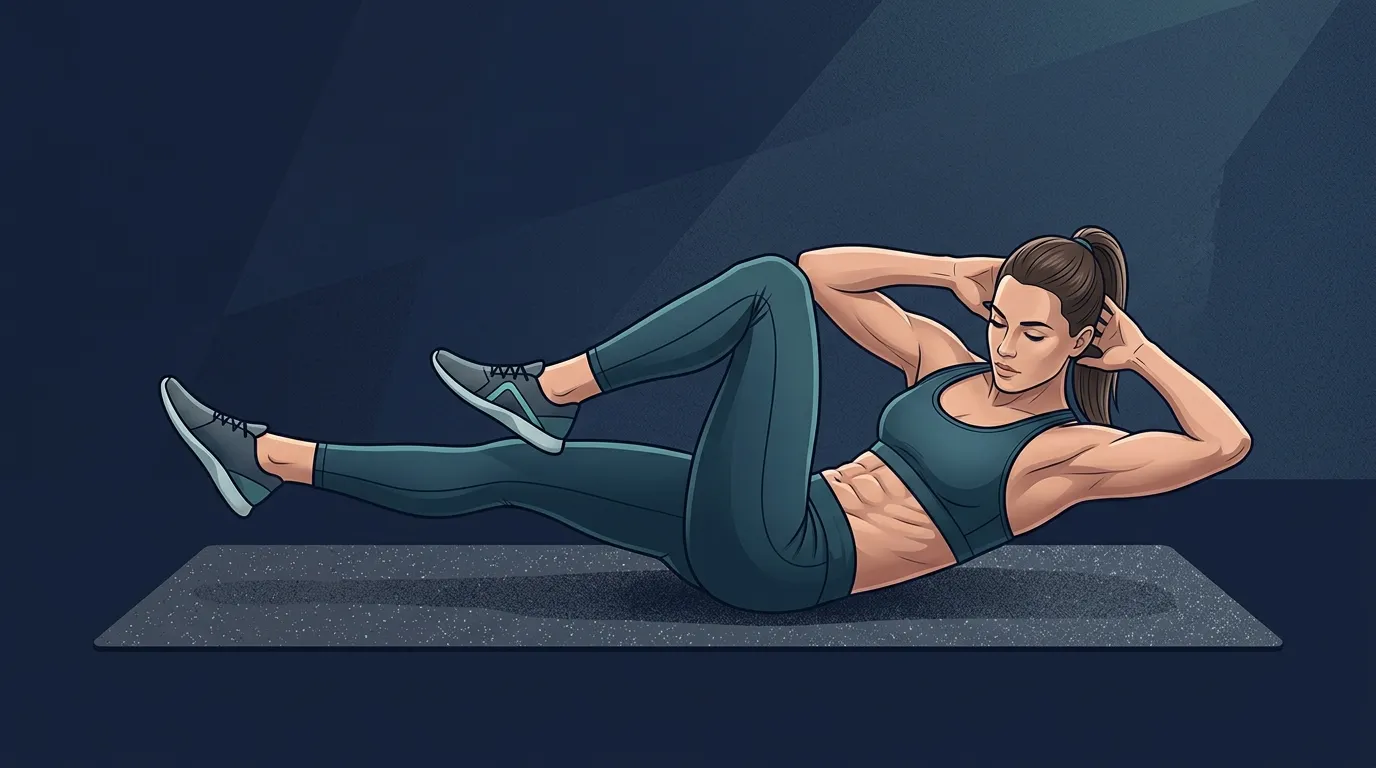
Common Mistakes (and How to Fix Them)
Here are the mistakes Ty corrects most often.
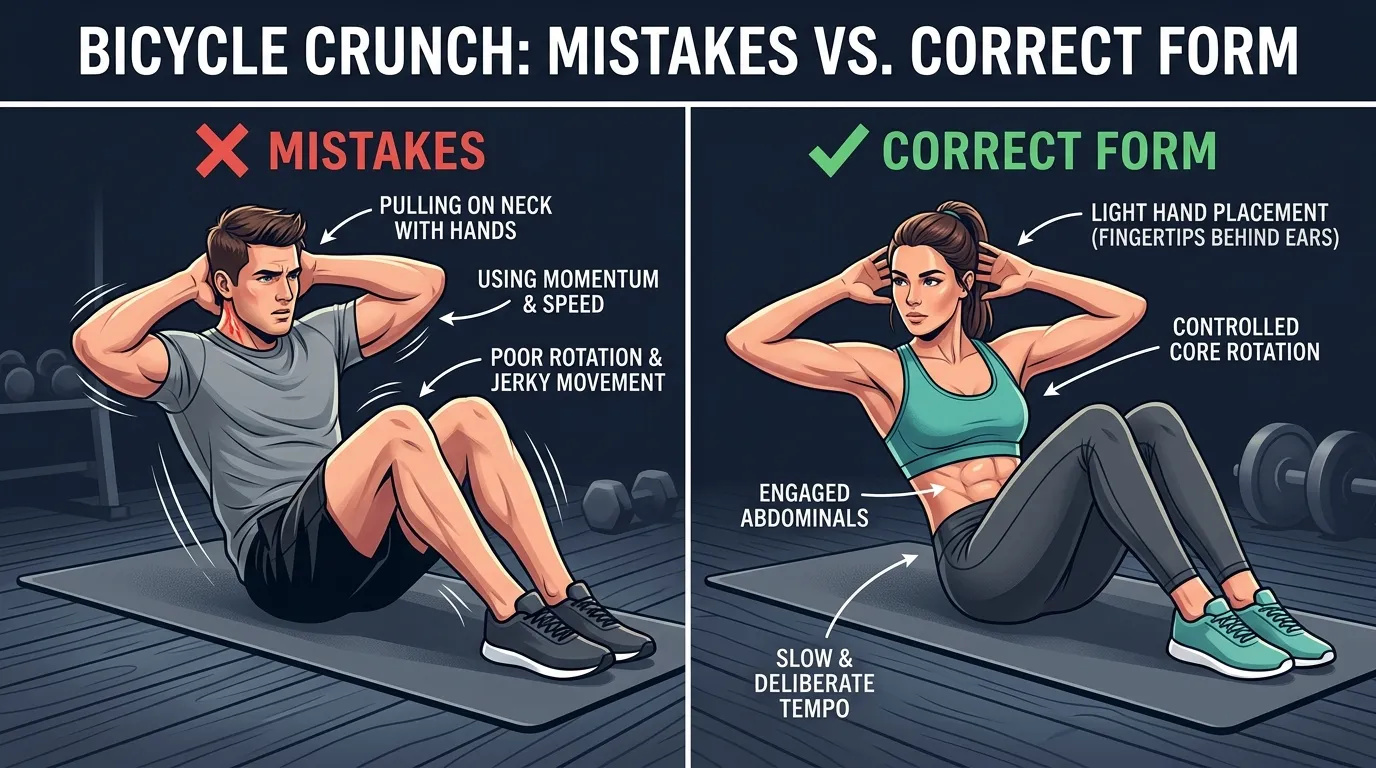
- Pulling on the neck. Number-one bicycle-crunch mistake. Your fingertips cradle your head, they don't yank it forward. Fix: place your fingertips lightly behind your ears (not interlocked behind your head) and let your abs do the lifting. If your neck still hurts, try resting your tongue against the roof of your mouth, which activates deep neck flexors that take strain off the surface muscles.
- Swinging elbows without rotating the torso. Throwing your elbow toward your knee without actually rotating your trunk misses the obliques entirely and turns the exercise into a flailing arm motion. Fix: lead with your shoulder, not your elbow. Think about driving your armpit toward the opposite hip.
- Lower back lifting off the floor. When your lumbar arches, the load shifts from your abs to your spine. The hip flexors take over and the core stops working. Fix: keep your lower back pressed flat against the ground throughout. If you can't, drop to the partial variant until you can.
- Rushing through reps. Momentum reduces muscle activation and turns a 30-second set into junk volume. Fix: aim for a 2-second crunch and 2-second return. A deliberate squeeze at peak contraction is worth more than three rushed reps.
- Extended leg dropping to the floor (full variant). The hovering extended leg is what creates continuous lower-ab tension. If it touches the floor between reps, you've lost the isometric demand. Fix: if you can't keep it hovering without your back arching, switch to the partial. Build the bracing strength first, then come back to the full.
Bicycle Crunch Variations: Regressions and Progressions
Start where your form holds. Progress when the current level feels controlled, not the moment you can grind through reps.
Alternating Partial (Beginner Regression)
One elbow stays on the ground for stability, non-working foot stays planted on the floor. This is the entry point for learning the rotation pattern without burning out your stabilizers before the working side gets to work. Stay here until you can do 2 to 3 sets of 12 reps per side without your lower back arching.
Alternating Full (Standard)
Shoulders stay elevated, both legs stay off the floor with one extended and hovering at all times. This is the version most people picture when they think "bicycle crunch." Continuous tension throughout the set. Once you can do 3 sets of 15 reps per side with clean form, you're ready to add tempo or load.
Slow-Tempo Bicycle Crunches (Advanced Progression)
Perform each rep with a 3-second crunch, 1-second hold at peak rotation, and 3-second return to neutral. Time under tension dramatically increases without any added equipment. This is the cleanest way to make bicycle crunches harder before adding load.
Weighted Bicycle Crunches (Advanced Progression)
Hold a light dumbbell or medicine ball at your chest while performing the movement. The added load increases the demand on the rectus abdominis and obliques. Use light weight, this is a core exercise, not a press. Form quality always wins over the weight on the floor next to you.
When to Avoid or Modify Bicycle Crunches
Bicycle crunches are safe for most healthy adults, but a handful of conditions call for modification or substitution. None of these are permanent restrictions. They're starting points. Always consult your physician or physical therapist for personalized guidance.
- Acute lower-back pain or known disc pathology. Bicycle crunches load the spine in combined flexion and rotation, the same plane in which lumbar discs are most vulnerable. If you have an active back flare-up or imaging-confirmed disc issues, skip the rotational crunches and rebuild with anti-rotation and anti-extension patterns first. Start with deadbugs and bird-dogs, then progress to forearm planks. Reload flexion patterns only when the pain has fully resolved and you have PT clearance.
- First 6-8 weeks postpartum or active diastasis recti. The combined flexion-plus-rotation pattern increases intra-abdominal pressure across the linea alba and can widen an active abdominal separation. Restore deep-core function first with diaphragmatic breathing, transverse abdominis activation, and bird-dogs and deadbugs. Add crunch-style movement back only after a women's-health PT confirms the gap has closed enough.
- Recent abdominal surgery (C-section, hernia repair, appendectomy). Get clearance from your surgeon before any spinal flexion exercise. Most post-surgical protocols start with diaphragmatic breathing, then gentle bracing, then progressive loading over weeks to months. Don't rush this one.
- Hernia (umbilical, inguinal, or ventral) or pelvic-organ prolapse. Both conditions can worsen with high intra-abdominal pressure movements like bicycle crunches. Work with your physician or a pelvic-floor physical therapist on safe alternatives. Anti-extension patterns like deadbugs are usually the safer starting point.
- Pregnancy (second and third trimesters). Avoid prolonged supine positions (which can compress the vena cava and reduce blood flow), and avoid the combined flexion-plus-rotation pattern that bicycle crunches load. Substitute with upright or side-lying core work, or with anti-rotation patterns from a kneeling or standing position.
- Persistent neck pain. If you keep getting neck strain even after cueing fingertips-only contact and lifting through the abs, the issue may be limited cervical flexor endurance or upper-trap dominance. Drop the bicycle crunch volume and add deadbugs (which don't require lifting the head) until the surface neck muscles let go.
Related Exercises
If bicycle crunches are part of your routine, these movements complement or extend the same training pattern:
- Same plane (flexion-rotation): Twist Crunches and Cross Toe Touches hit the rectus abdominis and obliques through similar rotational patterns from the same supine position.
- Easier regression (flexion only): Crunches and Partial Crunches isolate the rectus abdominis without the rotation demand, useful when learning the bracing pattern.
- Lower-ab and hip-flexor pairing: Reverse Crunches and Leg Raises bias the lower portion of the rectus abdominis through hip flexion, complementing bicycle crunch's upper-ab and rotational load.
- Foundation for spinal bracing: Deadbugs and Bird-Dogs teach the anti-extension and anti-rotation bracing patterns the lower back needs to stay flat during bicycle crunches. Run these as warm-ups before crunch work.
- Isometric core foundation: Forearm Planks and Side Planks build the static bracing endurance that supports dynamic core work. A strong plank usually means a clean bicycle crunch.
How to Program Bicycle Crunches
Bicycle crunch programming follows evidence-based core training ranges. The American College of Sports Medicine (ACSM) Position Stand on resistance training recommends progressing volume and intensity gradually, with adequate recovery between sessions training the same muscle group (Ratamess et al., 2009). Core exercises generally tolerate higher frequency than compound lifts because the loads are lower and recovery is faster.
| Level | Sets × Reps (per side) | Rest between sets | Frequency |
|---|---|---|---|
| Beginner (partial variant) | 2–3 × 8–12 | 45–60 seconds | 2–4 sessions/week |
| Intermediate (full variant) | 3 × 10–20 | 45–60 seconds | 3–5 sessions/week |
| Advanced (slow-tempo or weighted) | 3–4 × 15–30 | 60 seconds | 4–6 sessions/week |
Where in your workout: bicycle crunches work well at the end of a resistance-training session as a core finisher, or as part of a dedicated core circuit paired with a plank variation and a hip-hinge pattern like deadbugs. Don't program bicycle crunches as a warm-up before compound lifts that demand spinal stability (squats, deadlifts, presses). Fatiguing the core first compromises bracing under load.
Form floor over rep targets: if your last 2 reps of a set break form (lower back arches, neck pulls, rotation becomes a swing), stop the set there. Hitting a rep target with broken form is worse than hitting fewer reps cleanly. Core training compounds over sessions, not in any single set.
How FitCraft Programs This Exercise
Knowing how to do a bicycle crunch is step one. Knowing which variant fits your level, how many reps to chase, and when to add tempo or load is where most people get stuck.
FitCraft's AI coach Ty handles that. During your personalized diagnostic assessment, Ty maps your fitness level, goals, and how your core currently moves. Then Ty slots bicycle crunches into a balanced program at the right variant for your level: partial if you're building the bracing pattern, full if you can hold a flat lower back, slow-tempo or weighted if you're chasing a harder stimulus.
As your core gets stronger, Ty adjusts the variation, volume, and tempo. Partial becomes full. Full gets paired with anti-rotation work like bird-dogs. Volume and frequency tune to your recovery. Every program is designed by an Ivy League-trained exercise scientist and NSCA-certified strength coach using evidence-based periodization, then adapted to you by the AI.
Frequently Asked Questions
Can I do bicycle crunches if I have lower-back pain?
Bicycle crunches combine spinal flexion with rotation, which can aggravate disc-related lower-back pain or active flare-ups. If your back hurts during the movement, stop and switch to anti-rotation patterns like bird-dogs and deadbugs first. These build the deep-core bracing you need before reloading flexion patterns. If the pain persists for more than a week or two, see a physical therapist or physician for an assessment before returning to crunch-style movements.
Are bicycle crunches better than regular crunches?
Bicycle crunches engage more muscle groups than regular crunches. The rotation activates the obliques while the pedaling motion works the hip flexors and lower abs. A study by the American Council on Exercise ranked bicycle crunches as one of the most effective exercises for the rectus abdominis and obliques.
How many bicycle crunches should I do?
Beginners should aim for 2 to 3 sets of 8 to 12 reps per side with the partial variant. Intermediate exercisers can perform 3 sets of 10 to 20 reps per side with the full variant. Advanced lifters can push to 3 to 4 sets of 15 to 30 slow-tempo reps. Quality always matters more than quantity. Slow, controlled reps beat fast, sloppy ones.
Why does my neck hurt during bicycle crunches?
Neck pain during bicycle crunches usually means you're pulling on your head with your hands instead of using your abs to lift your shoulders. Place your fingertips lightly behind your ears (not interlocked behind your head) and focus on lifting with your core. Your hands should only support your head's weight, not drive the movement.
Do bicycle crunches give you a six-pack?
Bicycle crunches build and strengthen the rectus abdominis and obliques, which are the muscles that show as a six-pack. Visible abs require both muscle development and low enough body-fat to see the muscle through the skin. The body-fat side comes from your overall calorie balance and diet, not from any single exercise. Bicycle crunches do the muscle-building half of the equation.