Many people go straight to full crunches or bicycle crunches, then pull on their neck and swing up with momentum instead of curling with their abs. The partial crunch teaches the curl first.
Its short range, a few inches off the floor, keeps the work in your rectus abdominis and makes each rep easy to control.
Quick Facts: Partial Crunch
- Equipment needed: None (a mat is helpful but optional)
- Difficulty: Beginner (as rated in the FitCraft app)
- Modality: Strength (core endurance and motor control)
- Body region: Core (the rectus abdominis, down the front of your stomach)
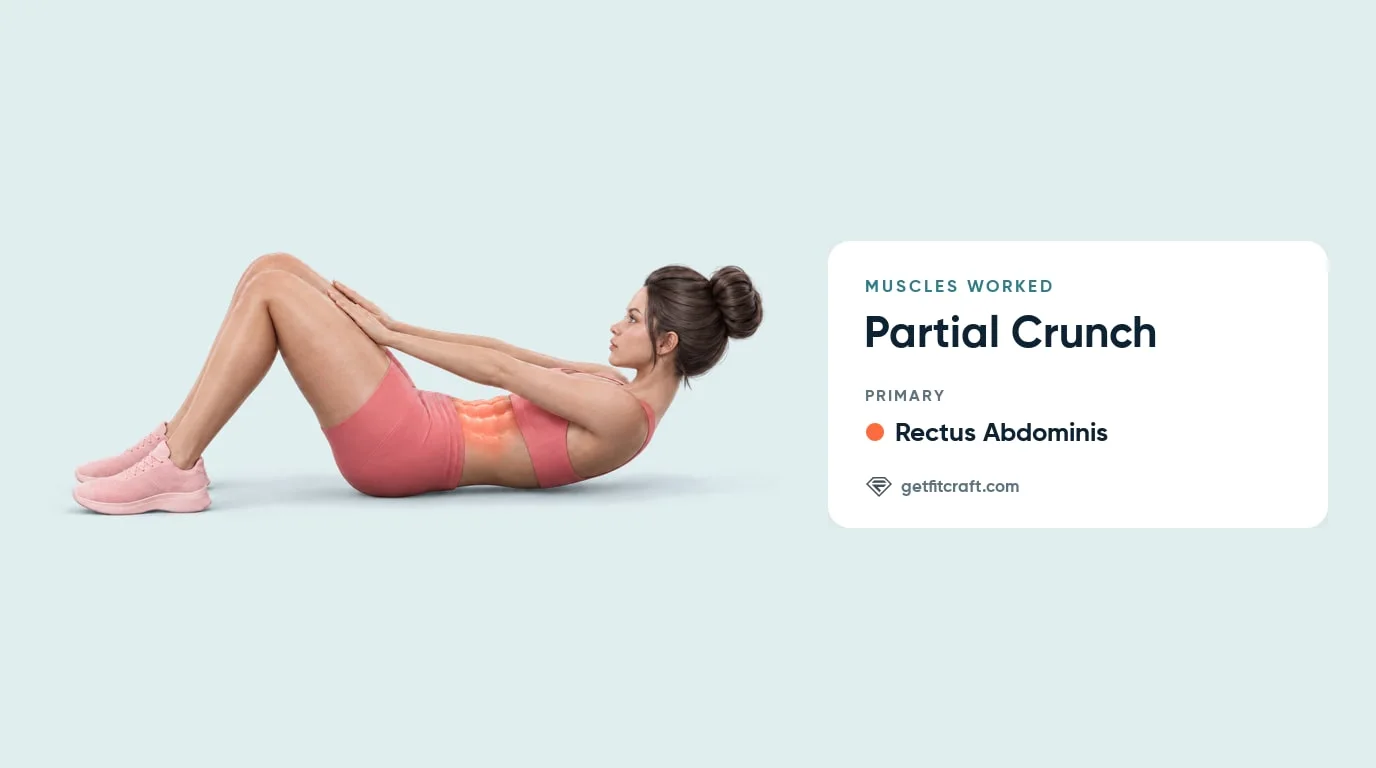
Muscles Worked
Primary muscle: the rectus abdominis, the long muscle that runs down the front of your stomach from your ribs to your pelvis (the "six-pack"). It shortens as you curl your head and shoulders off the floor, holds you briefly at the top, and lengthens under control as you lower.
Why the short range works: the partial crunch stops when your shoulders just clear the floor and your hands are about halfway up your thighs. Your lower back, hips, and feet stay down, so the curl comes from your abs, and the short range makes each rep easier to control than a full crunch. Curling further, until your hands reach your kneecaps, is the full crunch. Sitting all the way up, with your whole back off the floor, is a sit-up, a different exercise.
Step-by-Step: How to Perform a Partial Crunch
Here's the sequence, with form tips along the way.
Step 1: Set Your Starting Position
Lie face up on a mat with your knees bent and your feet flat on the floor, about hip-width apart, heels about 12 to 18 inches from your tailbone. Rest your hands on the fronts of your thighs with your arms straight. Keep a small gap between your chin and chest.
Form tip: with your hands on your thighs, nothing pulls on your head, so your abs have to do the lifting.
Step 2: Brace Your Core
Before anything moves, tighten your abs and let your lower back rest on the floor. Your lower back, hips, and feet stay down for the whole set.
Step 3: Curl Your Shoulders Up a Few Inches
Breathe out and curl your head and shoulders just off the floor. Think about bringing your ribs toward your hips while your hands slide about halfway up your thighs. Your lower back stays on the mat the entire time. If your lower back lifts, you've gone too far.
Form tip: stop when your shoulders just clear the floor. Sliding your hands all the way to your kneecaps is the full crunch.
Step 4: Hold Briefly at the Top
Hold the top for a moment with your abs tight. Keep your head in line with your upper back and a small gap between your chin and chest. Don't tip your head back or point your chin at the ceiling, and don't tuck your chin hard into your chest.
Step 5: Lower with Control
Breathe in and lower slowly until your shoulders touch the floor. Don't just drop. Your head can rest for a moment or stay just off the floor; keep your neck relaxed either way. Repeat for the prescribed number of reps.
Form tip: curl up and lower slowly, with no jerking or bouncing.
Get this exercise in a personalized workout
FitCraft, our mobile fitness app, uses its AI coach Ty to program core stability work like this into your plan at the right volume and intensity, based on your level, goals, and equipment. Ty was designed and trained by Domenic Angelino, MPH (Brown University) and NSCA-CSCS, with research published in the Journal of Strength and Conditioning Research and Medicine & Science in Sports & Exercise.
Take the Free Assessment Free · 2 minutes · No credit card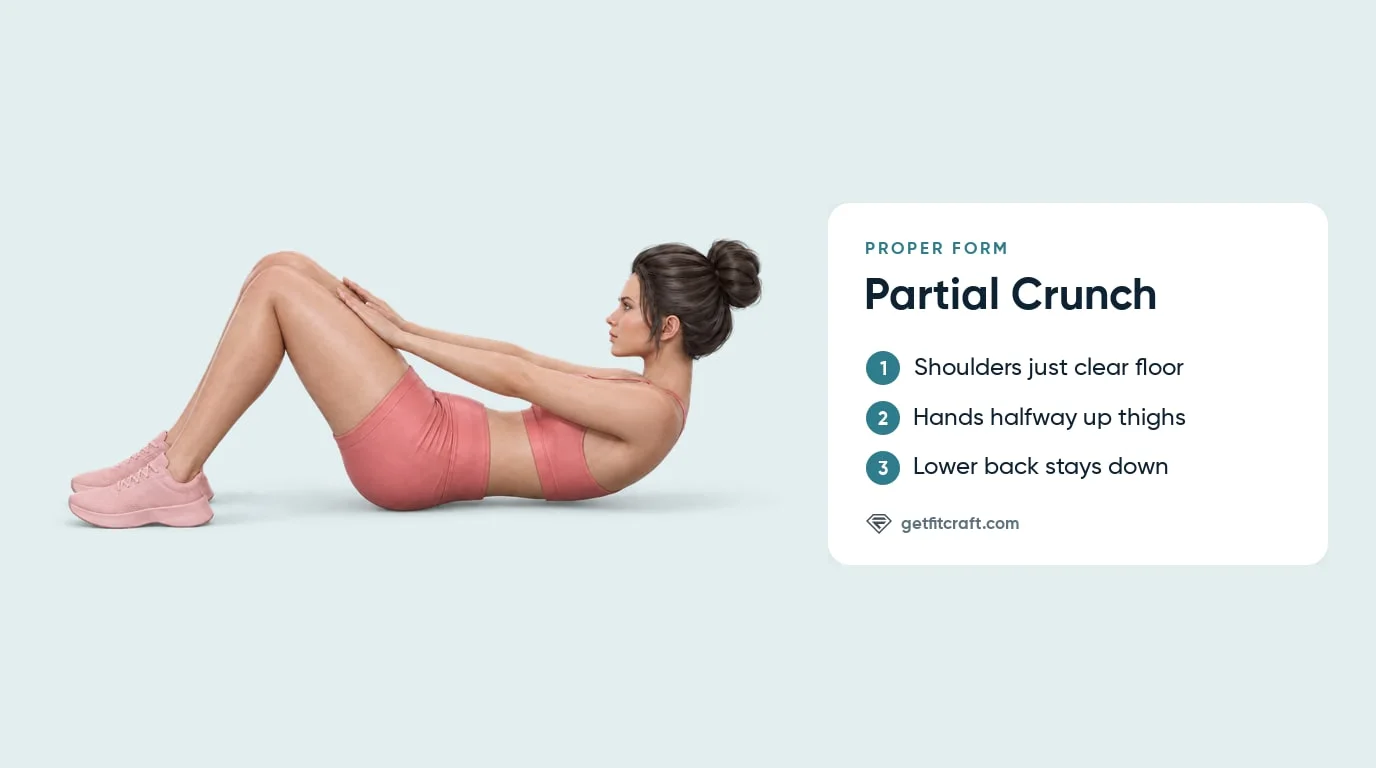
Common Mistakes (and How to Fix Them)
The partial crunch is forgiving, but these errors can still reduce its effectiveness or strain your neck.
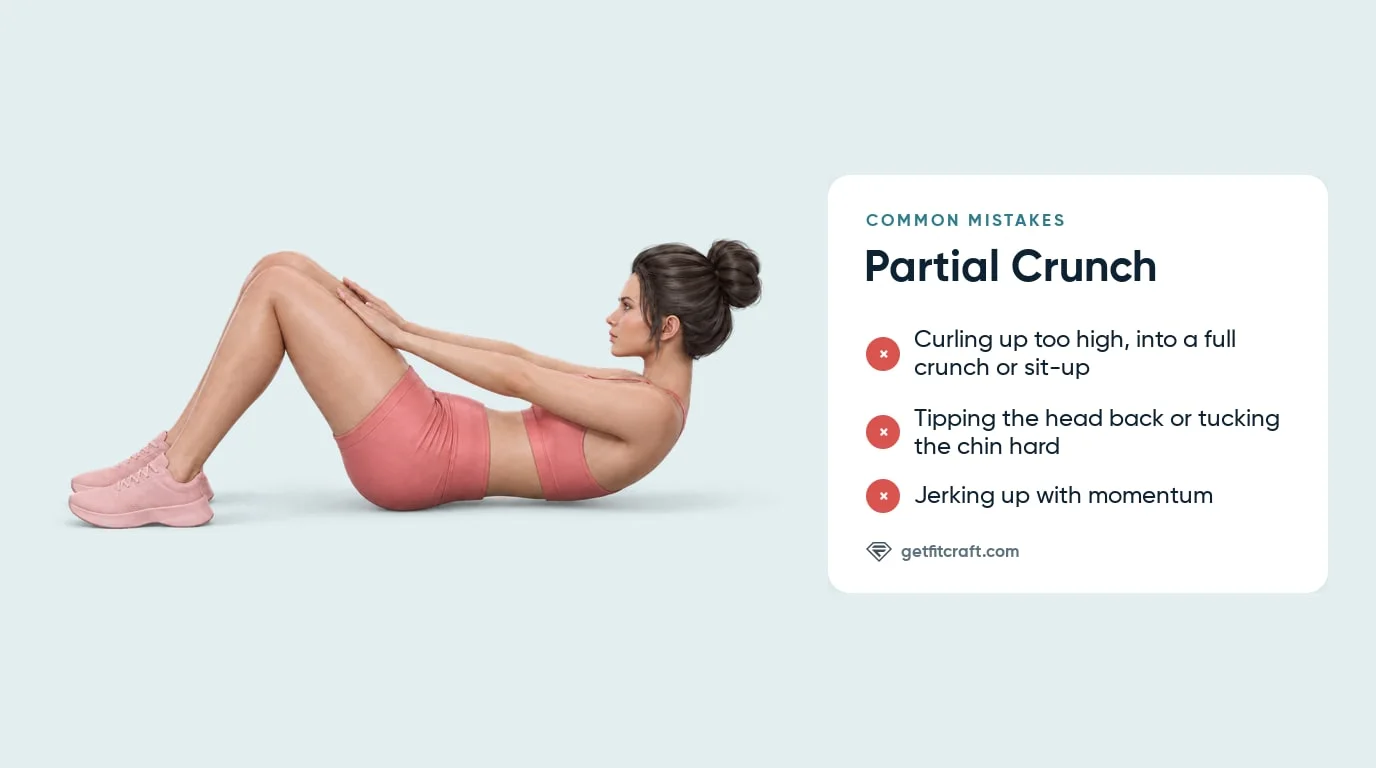
- Pulling on your neck or tucking your chin hard. Your head juts forward and your chin tucks into your chest as you fatigue. This strains your neck and means your abs aren't doing the work. Fix: keep your arms straight with your hands on your thighs. Imagine holding an orange between your chin and your chest, and keep that gap throughout every rep. Any pain in your neck means stop.
- Tipping your head back. Pointing your chin at the ceiling bends your neck back instead of keeping it in line with your upper back. Fix: keep your head in line with your upper back, with the same small gap between your chin and chest at the top and the bottom of every rep.
- Going too high. Curling until your hands reach your kneecaps turns the partial crunch into a full crunch, and lifting your lower back off the floor turns it into a sit-up. Fix: keep it small. Stop when your shoulders just clear the floor and your hands are about halfway up your thighs. If your lower back or hips lift, you've gone too far.
- Using momentum. Rocking up quickly, bouncing at the top and dropping back down hand the work to momentum, so your abs control very little of each rep. Fix: curl up smoothly, hold the top briefly, then lower slowly until your shoulders touch. If you can't keep that control, do fewer reps.
- Holding your breath. Holding your breath through the curl is a common habit. Fix: breathe out as you curl up and breathe in as you lower, on every rep.
Partial Crunch Variations: Regressions and Progressions
Start where your form holds, and progress when every rep in the set stays smooth and controlled.
Standard Partial Crunch (Beginner)
Arms straight, palms on the fronts of your thighs, sliding about halfway up as you curl until your shoulders just clear the floor. This is the version the FitCraft app teaches, rated Beginner, and the version the cues above describe. Your hands give you feedback on how far to go and keep you from pulling on your neck. Once you can complete 3 sets of 15 with smooth, controlled reps, you're ready to make it harder.
Partial Crunch with a Longer Pause (Harder)
Same range, but hold the top a little longer, about a second, with your abs tight before you lower slowly. Keep the small gap between your chin and chest, and keep your lower back down.
Arms Crossed, Then Hands Behind Your Head (Harder)
Moving your arms higher makes any crunch harder. First cross your arms on your chest instead of sliding your hands up your thighs. When that feels easy, rest your fingertips lightly behind your head with your elbows wide, never pulling on your head. Keep the same short range: shoulders just clear the floor.
Full Crunch (Range-of-Motion Progression)
Once partial crunches feel easy with good form, progress to the full crunch, which the FitCraft app rates Intermediate. The movement pattern is the same, but you keep curling until your hands reach your kneecaps, about 30 degrees of trunk lift, with your lower back and hips still on the floor.
When to Avoid or Modify Partial Crunches
Partial crunches are safe for most healthy adults, but they still curl your spine on every rep, so a few conditions call for a doctor's or physical therapist's advice first. During any set, a burn in your abs is normal, but any pain in a joint, your lower back, or your neck means stop. Always consult your physician or physical therapist for personalized guidance.
- Acute lower-back pain or known disc pathology. Partial crunches curl your spine on every rep, even at this short range. Skip them while your back hurts, or if you have been told to avoid bending your spine. See a doctor or physical therapist before you do them again, and ask them which exercises suit you. During any set, lower-back pain means stop.
- Recent childbirth or active diastasis recti. Get clearance from your doctor or a women's health physical therapist before you do partial crunches, and follow the plan they give you.
- Recent abdominal surgery (C-section, hernia repair, appendectomy). Get clearance from your surgeon before you do partial crunches, and follow the plan they give you.
- Hernia (umbilical, inguinal, or ventral). Ask your physician before you do partial crunches, and ask them which exercises suit you.
- Pregnancy. Partial crunches are done lying on your back with a curl of the spine. Ask your doctor or midwife before you do them, and ask which exercises suit your stage of pregnancy.
- Pelvic-organ prolapse or pelvic-floor dysfunction. Ask a pelvic-floor physical therapist before you do partial crunches. If you feel pressure, heaviness, or leaking during a set, stop and tell them.
- Neck pain or a pinched nerve in the neck. Any pain in your neck during partial crunches means stop. If you have neck pain, see a doctor or physical therapist before you do them, and ask them which exercises suit you.
Related Exercises
If partial crunches are part of your routine, these movements complement or extend the same core training pattern:
- Trunk control on the floor: Deadbugs and Bird-Dogs teach you to keep your trunk steady while your arms or legs move, without curling your spine.
- Same curl, bigger range: Full Crunches are the natural next step once partial crunches feel controlled. Reverse Crunches curl your pelvis up toward your ribs instead of lifting your shoulders.
- Adding a turn: Bicycle Crunches and Twist Crunches add a turn of the ribcage once you can curl up cleanly.
- Holding your trunk still: Forearm Planks train you to hold your trunk still, which pairs well with partial crunches in the same session.
- Glute pairing: Glute Bridges and Partial Glute Bridges work the back of your hips and pair well with crunches in a core session.
- Back-of-body pairing: Superman Holds work your back while you lie face down, the side of your trunk that crunches do not train.
How to Program Partial Crunches
The American College of Sports Medicine (ACSM) Position Stand on resistance training recommends progressing volume and intensity gradually as you adapt (Ratamess et al., 2009). It gives no set and rep ranges for the partial crunch itself, so treat the table below as a practical starting point.
| Version | Sets × Reps | Rest between sets | Frequency |
|---|---|---|---|
| Beginner: the standard partial crunch | 2-3 × 8-12 | 45-60 seconds | 2-4 sessions/week |
| Building up: the standard partial crunch | 3 × 10-20 | 45-60 seconds | 3-5 sessions/week |
| Harder: a longer pause at the top, arms crossed or hands behind your head | 3-4 × 15-30 | 60 seconds | 4-6 sessions/week |
Where in your workout: Partial crunches belong at the end of a resistance-training session, after compound lifts. Tiring your core before squats, deadlifts, or overhead pressing makes it harder to brace under load. They also work well as part of a standalone core finisher.
Form floor over rep targets: if your last 2 reps of a set break form (neck pulling, lower back lifting, jerking up), stop the set there. Hitting a target rep count with broken form is worse than hitting fewer reps cleanly.
How FitCraft Programs This Exercise
FitCraft maps your level, goals, and equipment during the diagnostic and builds a plan around them. The app has a partial crunch exercise, rated Beginner, and a full crunch, rated Intermediate, and can include them in your plan.
Its 3D demonstration shows the partial crunch: knees bent, feet flat, arms straight with the hands sliding about halfway up the thighs as the head and shoulders curl just off the floor.
Frequently Asked Questions
Can I do partial crunches with lower-back pain?
Not while your back hurts. Partial crunches curl your spine on every rep, even at this short range, and any pain in your lower back during the movement means stop. If you have lower-back pain or a disc problem, see a doctor or physical therapist before you do partial crunches, and ask them which exercises suit you.
What is the difference between a partial crunch and a regular crunch?
A partial crunch uses a smaller range of motion than a regular crunch. You curl only until your shoulders just clear the floor and your hands are about halfway up your thighs, and the FitCraft app rates it Beginner. A regular (full) crunch keeps curling until your hands reach your kneecaps, about 30 degrees of trunk lift, and the app rates it Intermediate. In both, your lower back, hips, and feet stay on the floor. Partial crunches are a good starting point for beginners learning to curl up with their abs.
Are partial crunches effective for building abs?
Yes. Partial crunches build strength in the rectus abdominis, the six-pack muscle down the front of your stomach, especially for beginners. The short, controlled curl keeps the work in your abs, with your lower back and hips on the floor and no momentum. When the partial crunch feels easy with good form, the full crunch takes the same curl further.
How many partial crunches should a beginner do?
Beginners should start with 2 to 3 sets of 8 to 12 reps, focusing on slow, controlled movement with a brief hold at the top. Quality matters far more than quantity. Rest 45 to 60 seconds between sets and start with 2 to 4 sessions a week.
When should I progress from partial crunches to full crunches?
When 3 sets of 15 feel easy with good form, make the partial crunch harder (a longer pause at the top, then arms crossed, then fingertips lightly behind your head) or move on to the full crunch, where your hands slide all the way up to your kneecaps. If your neck starts pulling forward or your lower back lifts off the floor before you finish a set, stay with the partial range.