Squat kicks make a basic bodyweight squat more athletic. You lower with control, stand back up, then kick one leg out to the side before you repeat with the other leg.
The payoff is cardio. Your thighs and glutes handle the squat, the front and outside of your hip lift the kicking leg, and your heart rate climbs as you repeat that big range of motion.
This exercise works best when the two pieces are already solid. Own your bodyweight squats first, kick only as high as you can control, and keep a steady pace of about five seconds per rep.
Quick Facts: Squat Kicks
- Equipment needed: None
- Difficulty: Expert in the FitCraft app (a partial squat, a lower kick or a pause before each kick makes it easier)
- Modality: Cardio / conditioning
- Body region: Lower body: thighs, glutes and hips
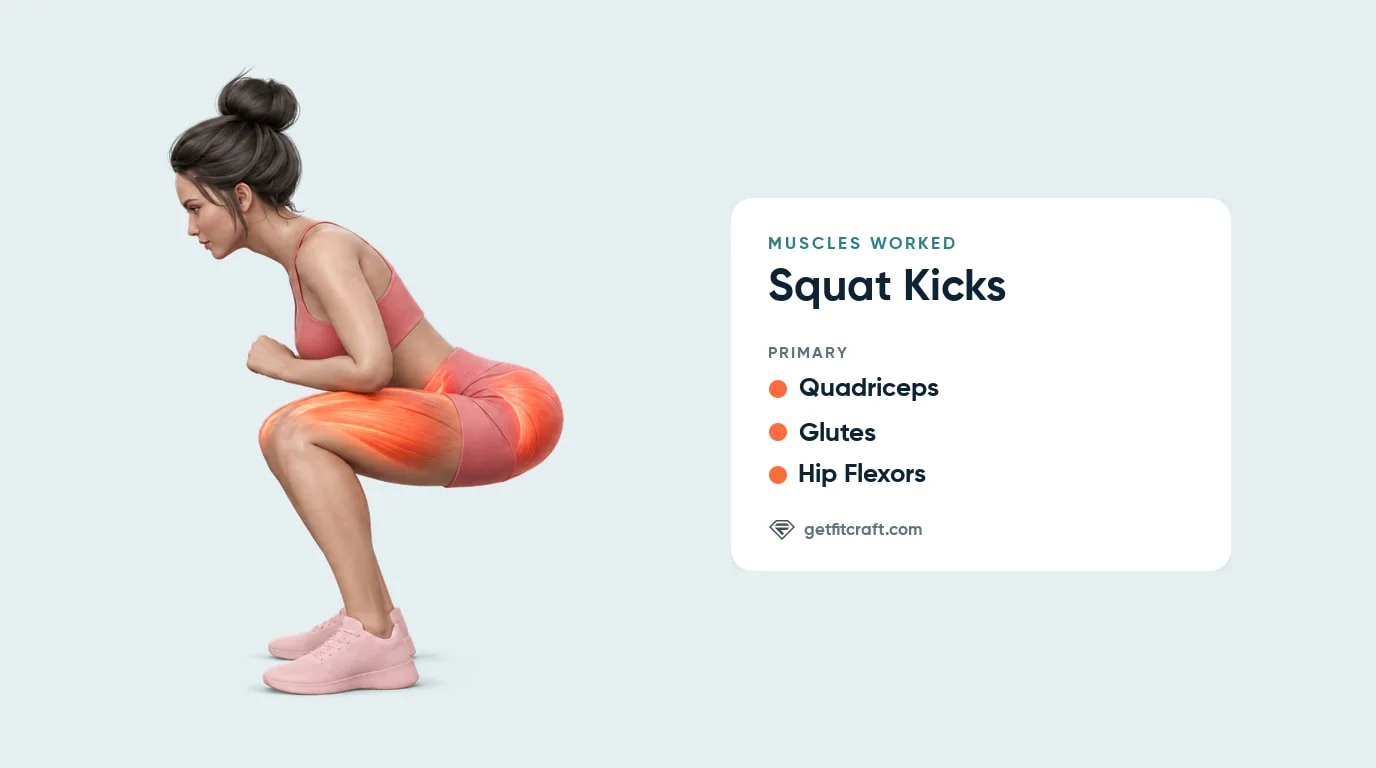
Muscles & Systems Worked
Primary muscles: the quadriceps, the glutes and the hip flexors. The quadriceps, on the front of your thighs, control the squat on the way down and straighten your knees to stand you up. The glutes, including the part on the outside of your hip, drive your hips up out of the squat and help lift the kicking leg out to the side. The hip flexors, at the front of your hip where the thigh meets the pelvis, help lift the kicking leg up.
Heart rate: each rep moves your whole body through a deep squat and a kick, so your heart rate climbs quickly over a set. No study measuring muscle activity in squat kicks was found, so this page describes each muscle by what it does in the move.
Step-by-Step: How to Do Squat Kicks
- Set your stance. Stand with your feet wider than shoulder-width, about one and a half shoulder-widths, toes pointing forward or turned out a little. Raise your hands in loose fists in front of your chest like a guard.
- Squat down. Push your hips back and bend your knees until your thighs are about level with the floor, or less deep if that is what you can control. Keep your heels flat, your knees pointing the same way as your toes, and your back flat with your chest up and a slight forward lean.
- Stand up and shift your weight. Push through your whole foot to stand up with control, then shift your weight onto one leg, keeping that knee soft.
- Kick out to the side with control. Kick the other leg straight out to the side (a little forward of that is fine too), only as high as you can control; hip height is plenty. Straighten the kicking knee smoothly, never snapping or locking it, and let your trunk lean a little away from the kick.
- Reset and alternate. Set the kicking foot down softly back in the wide stance, squat again, and kick with the other leg. Keep a steady rhythm of about five seconds per squat and kick, and never rush the squat to get to the kick.
Tip: Breathe in as you squat down and breathe out as you stand and kick. Never hold your breath.
Get this exercise in a personalized workout
FitCraft, our mobile fitness app, uses its AI coach Ty to program conditioning work like this into your plan at the right volume and intensity, based on your level, goals, and equipment. Ty was designed and trained by Domenic Angelino, MPH (Brown University) and NSCA-CSCS, with research published in the Journal of Strength and Conditioning Research and Medicine & Science in Sports & Exercise.
Take the Free Assessment Free • 2 minutes • No credit card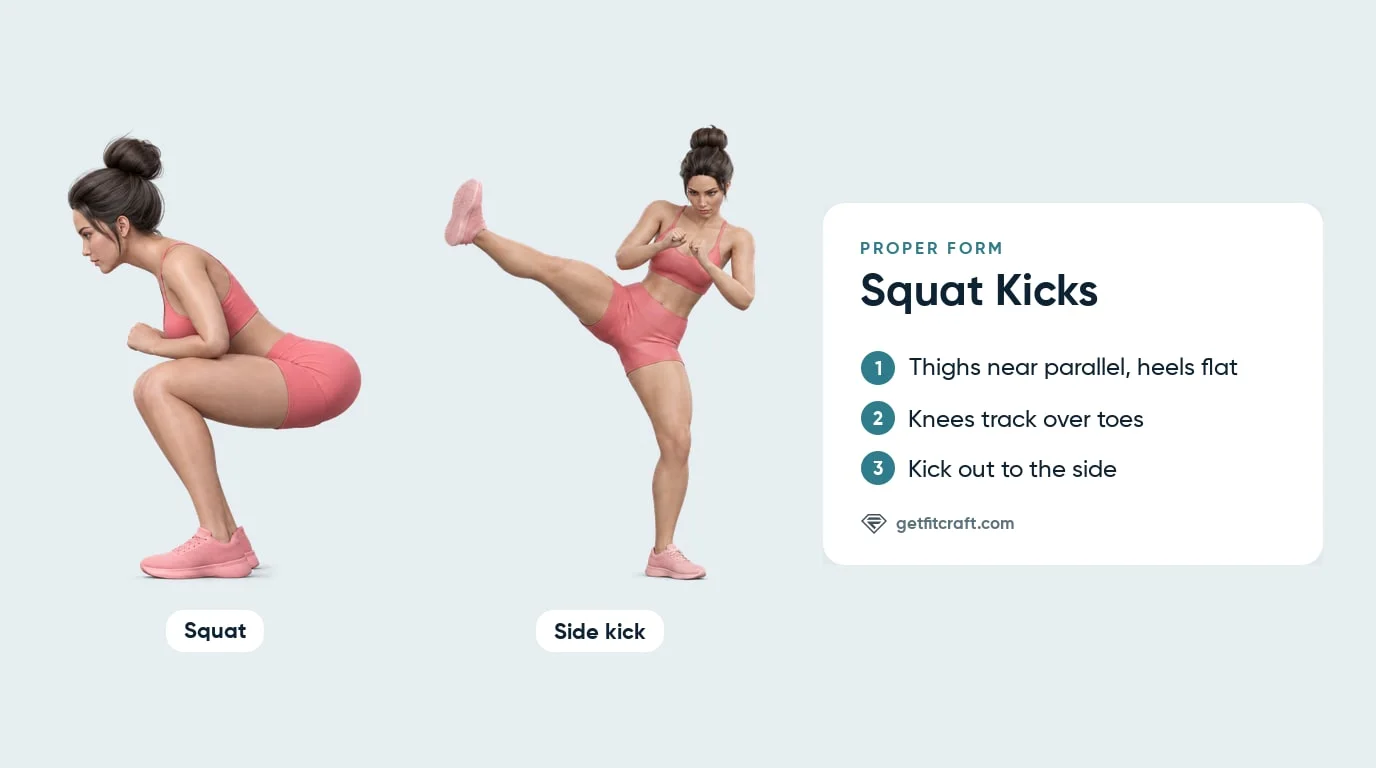
Common Mistakes (and How to Fix Them)
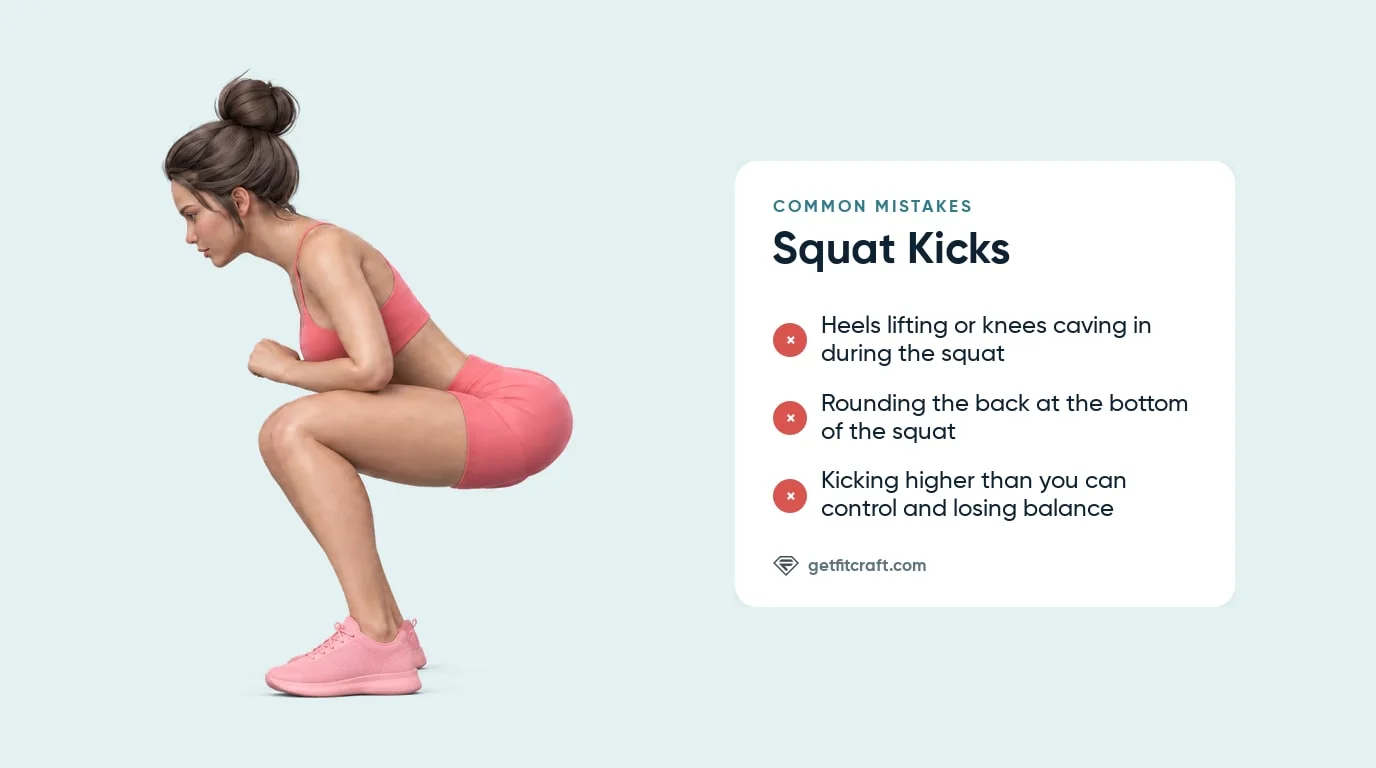
- Heels lifting or knees caving in. In the squat, your heels may lift or your knees may drift inward. Fix it by keeping your whole foot flat and your knees pointing the same way as your toes.
- Rounding your back at the bottom. A rounded back at the bottom of the squat means you went deeper than you can control. Fix it by keeping your back flat and your chest up, and squat only as low as you can with your heels down.
- Kicking higher than you can control. Forcing the kick up costs you your balance. Fix it by kicking only as high as you can control, about hip height, with your standing knee soft. A little lean away from the kick is normal. If the hip flexors tire and the kick drops, lower the target or end the set.
- Snapping the kick straight. Whipping the kicking knee straight, or locking it, is a common beginner mistake in kick-based cardio. Fix it by straightening the knee smoothly and stopping short of locking it.
- Dropping the kicking foot. Letting the foot slam down means you are rushing the reset. Fix it by setting the kicking foot down softly in the wide stance before you squat again.
- Rushing the rhythm. Rushing the squat to get to the kick makes some squats deep and others barely a bend, and the kicks get sloppy. Fix it by keeping a controlled pace, about five seconds per squat and kick, and choosing a depth you can repeat on every rep; a shallower squat is fine.
- Holding your breath. Fix it by breathing in as you squat down and breathing out as you stand and kick.
Squat Kick Variations: Regressions and Progressions
Scale squat kicks by changing squat depth, pace, or kick height. The FitCraft app teaches one version, the wide squat with a side kick described above, and rates it Expert. A squat with a front kick is a different version that the app does not use.
Easier: Paused Squat Kick
Do a squat, stand fully, pause for one beat, then kick out to the side. The pause lets you set your balance before the kick. Resting one hand on a chair or wall also helps with balance.
Easier: Partial Squat Kick
Squat only partway before each kick, and kick to about knee height. To practice the shallower squat on its own, use the partial squat in the squats guide, which the FitCraft app rates Beginner.
Expert: Alternating Squat Kick
Squat, stand, kick one leg out to the side, set it down, then repeat with the other leg, at about five seconds per rep. This is the version the FitCraft app teaches and rates Expert.
Harder: Deeper Squat Kick
Squat a little deeper than thighs level with the floor, as long as your heels stay flat and your back stays flat.
Harder: Quicker Squat Kicks
Pick up the pace while every squat and kick stays controlled and your standing foot stays flat.
When to Avoid or Modify Squat Kicks
Squat kicks are safe for many healthy adults, but the conditions below call for a doctor's or physical therapist's advice first. A stretch or burn in the working muscles is normal; any pain in a joint, your lower back or your neck means stop the exercise. Always consult your physician or physical therapist for personalized guidance.
- Known cardiovascular disease or uncontrolled hypertension. Squat kicks raise your heart rate quickly. Get your doctor's clearance first, and stay within any heart-rate limits they give you. Stop right away if you feel chest pain or pressure, dizziness, or unusual shortness of breath.
- Acute knee, ankle, hip, shin, or foot injury. Every squat and kick loads your legs. Do not do squat kicks while any of these hurts. See a doctor or physical therapist, and let them decide when you can do squat kicks again and which exercises suit you.
- Pregnancy or early postpartum recovery. Check with your doctor or midwife before you do squat kicks, and ask them which exercises fit each stage. Any pain, especially in your hips, lower back or pelvis, any pelvic-floor pressure or leaking, or feeling dizzy means stop.
- Stress incontinence or pelvic-floor symptoms. Squatting and kicking can trigger leakage or pressure. See your doctor or a pelvic health physical therapist first, and ask them when and how to add squat kicks. Any leaking or pelvic-floor pressure means stop.
- Vertigo, balance disorders, or vestibular symptoms. Kicking on one leg raises the risk of a fall. Check with your doctor or physical therapist first, and stop and sit down if you feel dizzy or light-headed.
- Asthma or exercise-induced bronchoconstriction. Check with your doctor about exercising with asthma, keep any rescue inhaler they prescribe close by, and stop if your breathing feels unusual for you or your chest feels tight.
Related Exercises
Use these exercises to build the pieces that squat kicks demand or to swap the conditioning pattern when you need a different stress level.
- Lower-impact conditioning: Step-N-Clap and Marching in Place keep your heart rate up with less balance demand.
- Squat foundation: Squats and Quarter Squats build the lower-body pattern that anchors every rep.
- Kick and hip-flexor prep: High Knees, Toe Touch Kick, and Side Kicks train faster leg lift with different balance demands.
- Core stability foundation: Deadbugs and Forearm Planks help you keep the trunk stacked while one leg moves.
- Lower-leg work: Calf Raises and Calf Hops train the calves, which squat kicks do not target.
- Higher-demand cardio options: Burpees, Jumping Jacks, and Mountain Climbers work well in the same circuit family.
How to Program Squat Kicks
Squat kicks are usually programmed by time, with work and rest intervals. The American College of Sports Medicine position stand defines progressive overload as a gradual increase in training stress, such as more repetitions, more load, or more total volume (Ratamess et al., 2009). It does not set intervals for squat kicks, so the ranges below are practical starting points, not figures from a study.
| Level | Work interval | Rest between sets | Frequency |
|---|---|---|---|
| Starting out (partial squat, lower kick, or a pause before each kick) | 20-30 sec work per round | 60-90 seconds | 2-3 sessions/week |
| Expert (the app's version) | 30-45 sec work per round | 45-60 seconds | 3-4 sessions/week |
| Harder (deeper squat or a quicker controlled pace) | 45-60 sec work per round | 30-45 seconds | 3-5 sessions/week |
Where in your workout: use squat kicks in a standalone HIIT session, after resistance training, or as a short finisher at the end of a workout. Avoid doing long squat kick intervals before heavy lower-body strength work, because tired legs make the squat and your balance harder to control.
Form floor over rep targets: stop the interval when squat depth, knee tracking, kick height, or control of the kicking foot breaks down. A shorter clean round beats a longer sloppy one.
How FitCraft Programs This Exercise
Squat kicks fit best when they support the rest of the training week instead of stealing quality from strength work.
During your personalized diagnostic assessment, the FitCraft app maps your fitness level, goals, and available equipment, then builds a training plan for your level. The app has one squat kick, rated Expert and filed under cardio: the wide squat and side kick on this page, at a controlled pace of about five seconds per rep.
Use the variations and the programming table above to choose your version and your intervals. The aim is enough challenge to build fitness, with a form floor that keeps the work useful.
Frequently Asked Questions
What muscles do squat kicks work?
Squat kicks work the quadriceps, the glutes and the hip flexors. The quadriceps, on the front of your thighs, control the squat on the way down and straighten your knees to stand you up. The glutes, including the part on the outside of your hip, drive your hips up out of the squat and help lift the kicking leg out to the side. The hip flexors, at the front of your hip, help lift the kicking leg up.
Are squat kicks cardio or strength?
Squat kicks are mainly cardio, and the FitCraft app files them under cardio. Your thighs, your glutes and the front of your hips do real work in every squat and kick, and repeating that big range of motion raises your heart rate and breathing.
How high should I kick during squat kicks?
Kick only as high as you can control. Hip height is plenty. Kick higher only if your hips feel loose and you stay balanced, with your standing knee soft and the kicking knee never snapped or locked. Never force it.
Can I do squat kicks if I have knee, ankle, or hip pain?
Not while they hurt. Any pain during squat kicks, especially in your knee, ankle or hip, means stop. See a doctor or physical therapist, and let them decide when you can do squat kicks again and which exercises suit you. A burn in your thighs and glutes is normal; joint pain is not.
How many squat kicks should I do?
Start with 20 to 30 seconds of alternating reps at a controlled pace of about five seconds per rep, then rest 60 to 90 seconds. As that gets easier, build toward 30 to 45 second intervals with 45 to 60 seconds of rest, then 45 to 60 second intervals, as long as your squat depth, balance and kick control stay clean.