The Russian twist is a rotational core exercise for people who can already brace well in a seated lean. It can build oblique endurance and trunk control, but it rewards patience. Fast twisting, rounded posture, and heavy loading turn a useful core drill into a lower-back irritant.
Think of the exercise as controlled rib-cage rotation with a light floor touch on each side. The best reps look slower than most gym-floor versions: chest lifted, abs tight, shoulders turning together, and breath steady.
Quick Facts: Russian Twists
- Equipment needed: None; optional light dumbbell, medicine ball, or weight plate
- Difficulty: Intermediate to Advanced
- Modality: Core strength and rotational control
- Body region: Core
- FitCraft quest category: Core
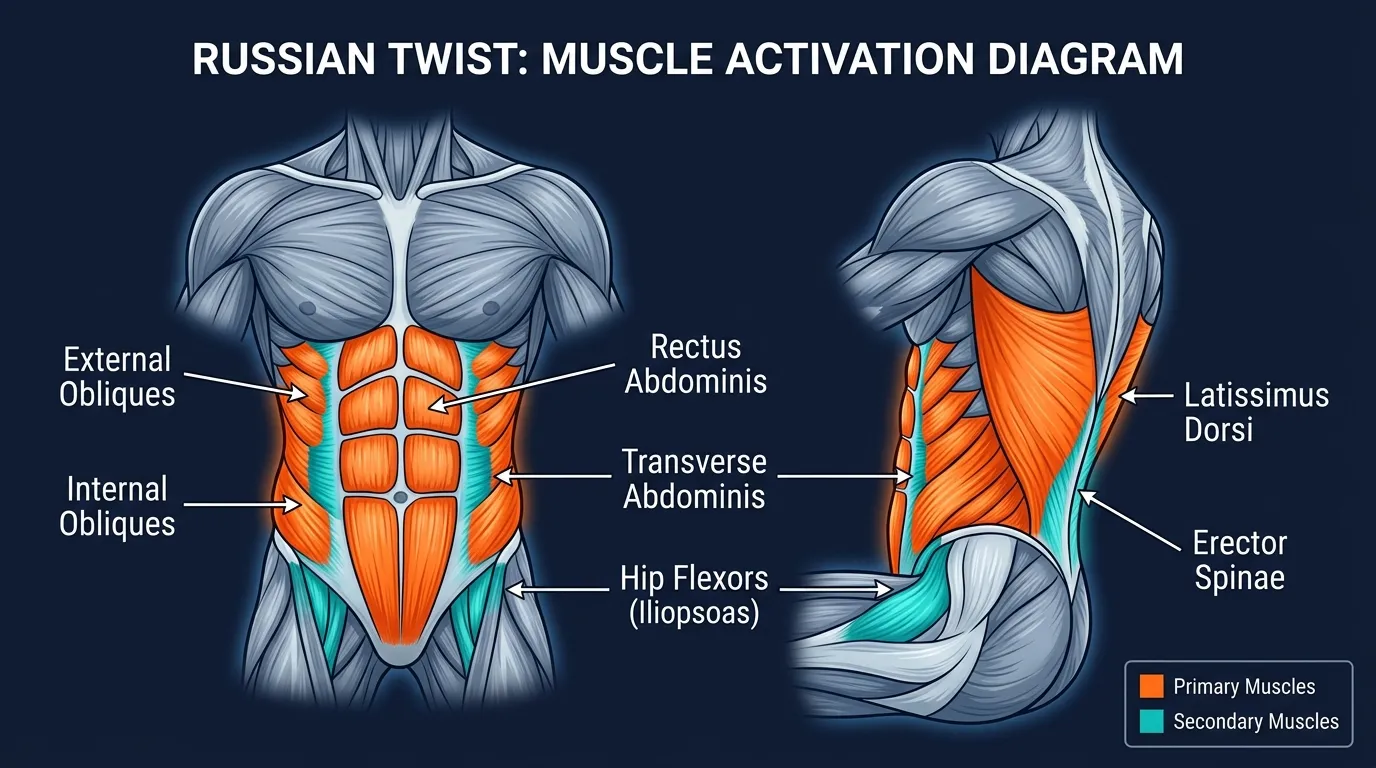
Muscles Worked
Primary movers: The internal and external obliques drive the side-to-side trunk rotation. They contract concentrically as you turn toward each side and eccentrically as you slow the return to center.
Secondary movers: The rectus abdominis helps keep the rib cage pulled down, while the transverse abdominis creates the deep brace that keeps the torso from wobbling. The hip flexors work hard to hold the seated lean, especially when the feet are lifted.
Stabilizers: The diaphragm and pelvic floor support the deep core canister, the spinal erectors keep the back long, and the glute medius plus deep hip rotators keep the pelvis from tipping side to side. Exhaling during the twist helps the transverse abdominis tighten without forcing a breath hold.
Mechanism: Russian twists challenge rotation and anti-flexion at the same time. The trunk has to turn through the upper back while the lower back resists rounding, which is why range of motion matters less than staying tall and controlled.
Step-by-Step Instructions
- Set your seated position. Sit on the floor with your knees bent and feet planted. Lean back until your abs turn on while your spine stays long.
Coach Ty's cue: "Find the angle where your abs work and your back still feels tall."
- Brace before you rotate. Clasp your hands in front of your chest or hold a light weight close to your sternum. Exhale gently, brace your abs, and keep your ribs stacked over your pelvis.
Coach Ty's cue: "Lock in the brace before the first twist."
- Rotate to one side. Turn your shoulders and rib cage to the right while your hips stay mostly square. Move slowly enough that the rotation comes from your trunk, not from swinging your arms.
Coach Ty's cue: "Turn your chest, then let your hands follow."
- Return through center. Bring your torso back to the middle under control. Keep your chest lifted and stop if your lower back starts rounding.
Coach Ty's cue: "Control the middle. That's where most sloppy reps hide."
- Rotate to the other side. Turn to the left with the same range and speed, then alternate sides for the target reps. Keep breathing as you move and end the set before speed replaces control.
Coach Ty's cue: "Match both sides. Same range, same tempo."
Get this exercise in a personalized workout
FitCraft, our mobile fitness app, uses its AI coach Ty to program core stability work like this into your plan at the right volume and intensity, based on your level, goals, and equipment. Ty was designed and trained by Domenic Angelino, MPH (Brown University) and NSCA-CSCS, with research published in the Journal of Strength and Conditioning Research and Medicine & Science in Sports & Exercise.
Take the Free Assessment Free · 2 minutes · No credit card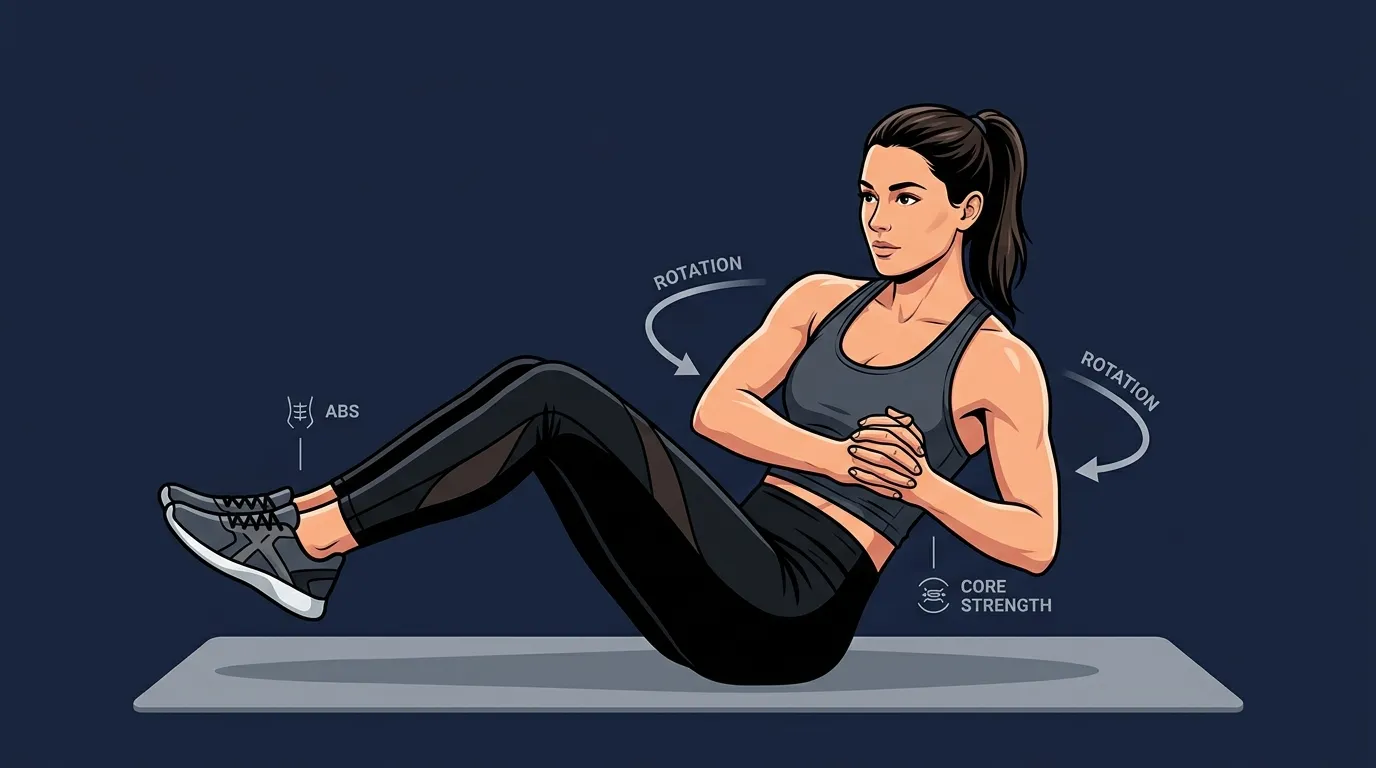
Common Mistakes
- Rounding the lower back. A slumped spine makes the rotation feel easier but moves stress into the lumbar area. Sit taller, reduce the lean, or put your feet down.
- Moving only the arms. If your hands swing while your chest stays still, your obliques are missing the job. Turn your shoulders and sternum together.
- Going too fast. Momentum hides weak control. Use a tempo slow enough that you could pause on either side without losing balance.
- Adding weight too early. A heavy plate usually shortens the range and encourages rounding. Earn load after bodyweight reps feel smooth.
- Holding your breath. Breath holding spikes pressure and can make the torso rigid in the wrong way. Exhale lightly into each twist and inhale through center.
- Twisting through pain. A working burn in the side abs is fine. Pinching, radiating pain, or sharp lower-back discomfort means stop and regress.
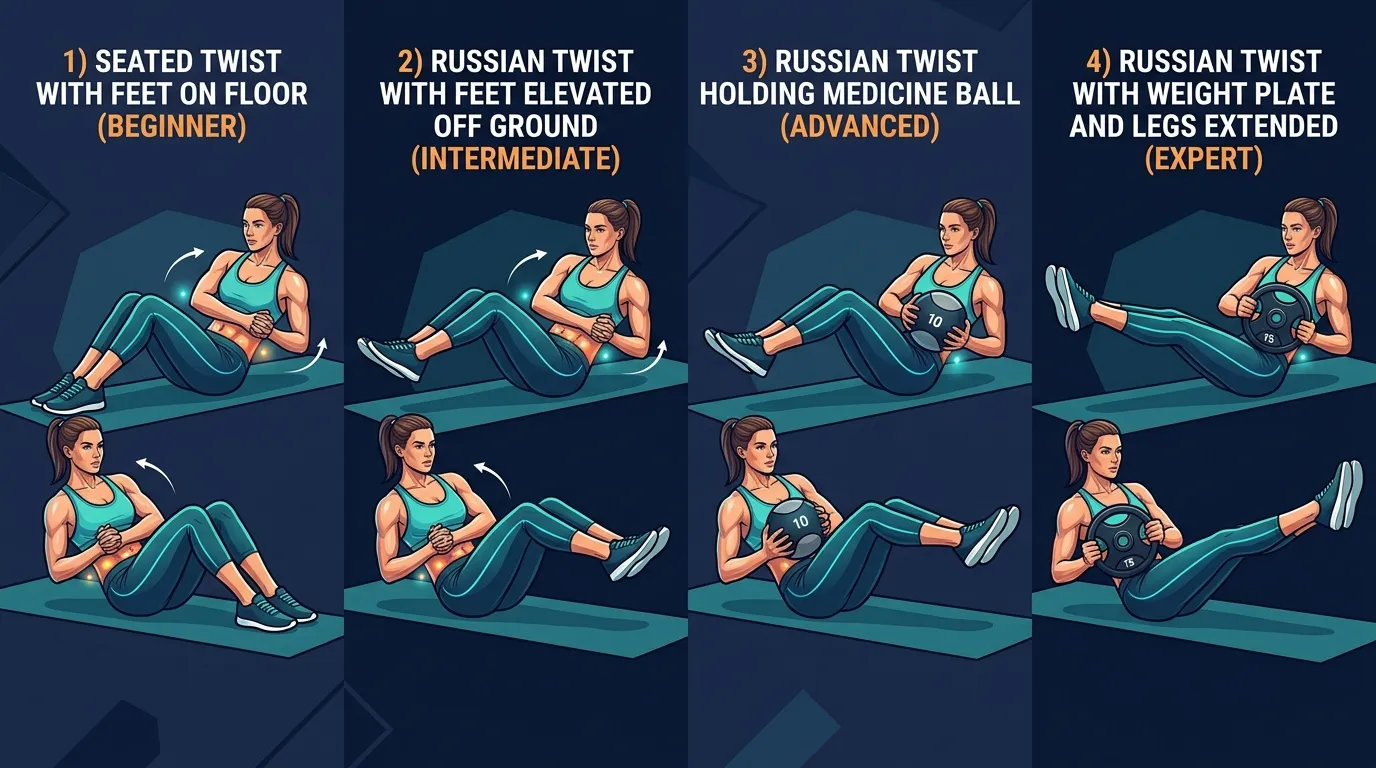
Russian Twist Variations: Regressions and Progressions
- Feet-down Russian twists: Keep both feet flat on the floor and rotate through a shorter range. This is the best starting point for learning the brace.
- Heel-tap Russian twists: Touch the floor lightly on each side without bouncing. The tap gives a range target while keeping the load bodyweight-only.
- Feet-elevated Russian twists: Lift your feet a few inches and balance on your sit bones. Use this only if the feet-down version stays smooth.
- Weighted Russian twists: Hold a light dumbbell, medicine ball, or plate close to the chest. Keep the weight close before trying longer arm positions.
- Slow-tempo Russian twists: Take 2 seconds to rotate, pause briefly, and take 2 seconds to return. This makes the exercise harder without adding load.
When to Avoid or Modify Russian Twists
Russian twists are useful for healthy adults who tolerate seated rotation well, but a few situations call for a regression or a different core drill. Always consult your physician or physical therapist if pain, medical history, or pregnancy status makes rotation questionable.
- Acute lower-back pain or known disc pathology: Skip loaded twisting and use deadbugs, bird-dogs, or forearm planks until symptoms are cleared.
- First 6-8 weeks postpartum or active diastasis recti: Rotational flexion can increase abdominal wall pressure. Start with breathing, pelvic-floor coordination, deadbugs, and bird-dogs.
- Recent abdominal surgery or hernia repair: Get surgeon clearance before loaded trunk rotation. Begin with gentle bracing drills before adding movement.
- Pregnancy, especially second and third trimesters: Avoid aggressive rotation and high-flexion abdominal work. Choose upright core drills or side-lying options approved by your clinician.
- Pelvic-floor dysfunction or pelvic-organ prolapse: Keep pressure low and avoid breath holding. Work with a pelvic-floor physical therapist on safer core progressions.
- Hip-flexor pinching in the lean-back position: Put your feet down, reduce the lean, or switch to seated side bends for a gentler trunk option.
Related Exercises
- Same rotation family: Standing twists train trunk rotation from an upright position with less hip-flexor demand.
- Dynamic core pairing: Bicycle crunches add flexion and rotation for a harder ab-focused progression.
- Spinal bracing foundation: Deadbugs and bird-dogs teach the brace that Russian twists need.
- Anti-extension base: Forearm planks build core stiffness without rotation.
- Anti-lateral-flexion base: Side planks strengthen the side-body endurance that supports controlled twisting.
- Compound core demand: Squats need the same trunk stiffness under a larger full-body load.
How to Program Russian Twists
Ratamess et al., 2009, the ACSM Position Stand on resistance training progression, supports matching volume, rest, and frequency to training level. For Russian twists, use the dynamic core template and progress only while the lower back stays neutral.
| Level | Sets x Reps | Rest between sets | Frequency |
|---|---|---|---|
| Beginner | 2-3 x 8-12 reps per side, feet down | 45-60 seconds | 2-4 sessions/week |
| Intermediate | 3 x 10-20 reps per side, bodyweight or very light load | 45-60 seconds | 3-5 sessions/week |
| Advanced | 3-4 x 15-30 reps per side with slow tempo or light load | 60 seconds | 4-6 sessions/week |
Place Russian twists near the end of a strength session or inside a dedicated core circuit. Avoid doing high-rep rotational work before heavy squats, deadlifts, loaded carries, or overhead lifts because trunk fatigue can reduce spinal stability under load.
Use a form floor over rep targets: stop the set when your lower back rounds, your hips start rocking, your breath locks up, or your hands are moving faster than your chest.
How FitCraft Programs This Exercise
FitCraft uses Russian twists as one possible core option after a user has enough bracing control for rotation. Ty adjusts the variation and volume to match your level, starting with feet-down bodyweight reps when needed and progressing toward slower or lightly loaded versions when control is ready.
The app keeps the exercise in context. Russian twists usually pair better with anti-extension and anti-rotation drills like deadbugs, bird-dogs, forearm planks, and side planks than with more fast twisting.
Frequently Asked Questions
What muscles do Russian twists work?
Russian twists mainly train the internal and external obliques, with the rectus abdominis and transverse abdominis helping keep the trunk stiff. The hip flexors, spinal erectors, diaphragm, pelvic floor, and deep hip stabilizers help hold the seated lean.
Can I do Russian twists with lower-back pain?
Avoid Russian twists during acute lower-back pain, radiating symptoms, or known disc pathology unless a clinician has cleared rotation. Use deadbugs, bird-dogs, or forearm planks first because they train core stiffness with less spinal rotation.
Should Russian twists be done with feet up or feet down?
Feet down is the better starting point because it gives the pelvis a stable base. Lift your feet only after you can rotate slowly without rounding your lower back or losing your brace.
How many Russian twists should I do?
Start with 2 to 3 sets of 8 to 12 reps per side. Build toward 3 sets of 10 to 20 reps per side before adding load or lifting your feet.
Are weighted Russian twists better?
Weighted Russian twists are useful after the bodyweight version is controlled. Add a light dumbbell, medicine ball, or plate only if your torso rotation stays smooth and your lower back stays neutral.